

Photochromic smart glasses is a search term that behaves like a category but covers two different lens mechanisms with almost opposite supply-chain consequences. Before anything else, establish which one you are actually sourcing. The word photochromic on a supplier listing is a label, not a specification, and the first job of a procurement team is to turn it into one.
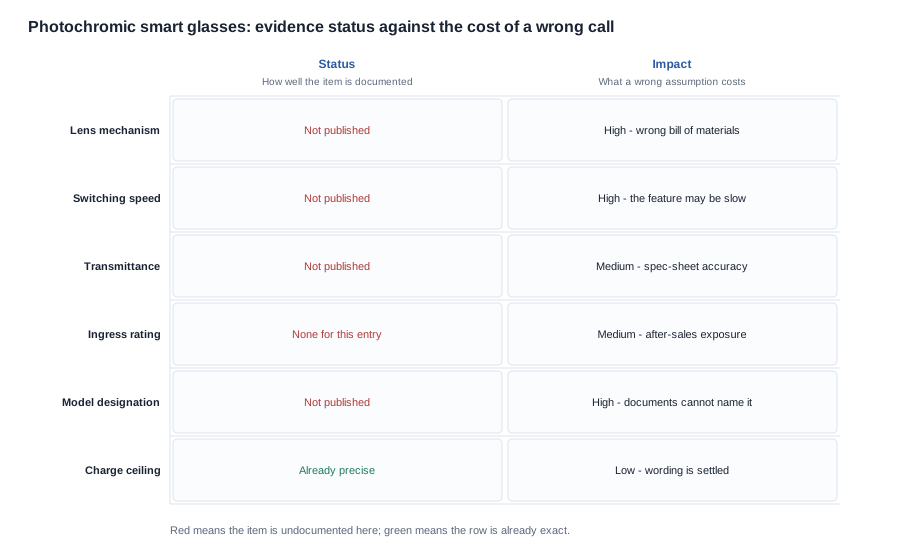
Our own catalogue publishes a single entry in this space, and that entry is the electrically driven one. Five fields are documented for it: a 100 mAh cell, a charge time of two hours or less, roughly seven hours of rated endurance, magnetic charging, and Bluetooth version 5.4. Not one lens figure is published — no switching speed, no illuminance level, no transmittance figure, no tint depth, no operating temperature range, no lens substrate, and no model number that any of it could be attached to.
That produces an unusual brief. You can plan the electrical envelope, the charging logistics and the radio generation with confidence. You cannot plan the feature your customers searched for. The correct response is not to substitute typical figures from elsewhere in the industry, and it is not to abandon the category. It is to convert every missing number into a written question, put those questions to the supplier, and treat an evasive answer as a procurement finding in its own right.
What follows is organised around that conversion: what one published row can settle, how to build a shortlist when a category publishes one row, what to ask for each missing item, the order sequence that reduces exposure, and where our own documentation stops.
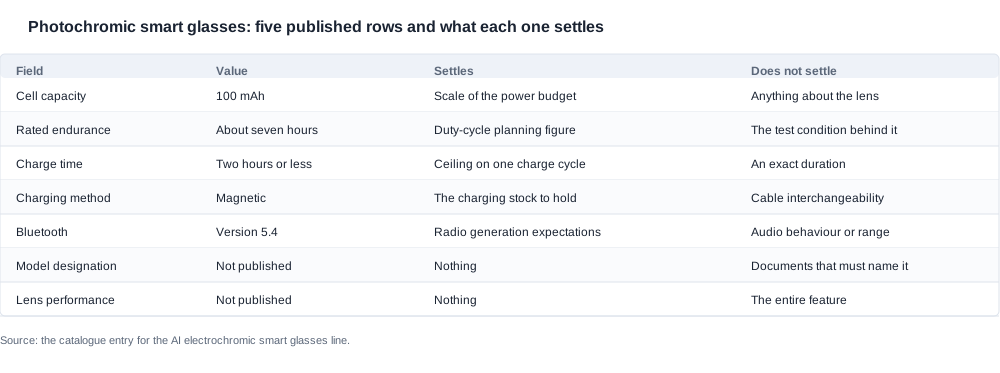
Photochromic smart glasses: what a single catalogue row can settle
Start with the row that exists, because a single row is still a useful document if you know what it is and is not a specification of.
The entry is named as an AI electrochromic smart glasses product. It carries no model designation of any kind, which is unusual for a catalogue of this size and has a direct consequence for everything downstream. A document that must name your product cannot be issued against an unnamed entry. A warranty claim cannot be tied to a specific configuration. A second quotation cannot be confirmed to be for the same object as the first. Any buyer who has negotiated a discount on the strength of a comparison is, in the absence of a model designation, negotiating on an object that is not yet defined.
What the five documented fields do settle is real, and it is worth stating plainly. The 100 mAh cell fixes the order of magnitude of the power budget. The roughly seven hours of endurance is a rated value, published without a stated test condition, so it is the number to plan a duty cycle against rather than a promise to quote downstream. The charge time of two hours or less is a ceiling, and ceiling wording matters commercially: a schedule built on "two hours or less" is honest, while the same schedule built on a strictly shorter two-hour promise is a claim the supplier has not made and you cannot defend. Magnetic charging tells you that the charging ecosystem is proprietary and that your logistics will carry a specific lead count. Bluetooth version 5.4 tells you the radio generation and removes one class of pairing question.
One more boundary is worth drawing early, because the catalogue contains a second, unrelated product that a careless search will surface. A camera product line in our catalogue carries a tinted-lens configuration, but it is a separate line with its own cell, its own endurance range and its own charging approach, and none of those may be carried across to this one. Nothing published for that line may be carried across to this one. The two are separated by a charging architecture, a cell size and a product class, and merging their figures is the most common way a buyer ends up with a specification sheet nobody at the factory recognises.
Across the whole catalogue of 28 entries, the charging method splits three ways: 17 entries use magnetic charging, 7 use a different connector, and 4 publish no charging-method row at all. Magnetic is therefore both documented for our entry and the majority convention in the range, which is a useful position to argue from when a supplier proposes changing it to a generic connector to simplify your carton.
| Field | Value in the catalogue | Settles | Does not settle |
|---|---|---|---|
| Cell capacity | 100 mAh | The scale of the power budget | Anything about the lens |
| Rated endurance | About seven hours | The duty-cycle planning figure | The test condition behind it |
| Charge time | Two hours or less | The ceiling on one charge cycle | An exact duration |
| Charging method | Magnetic | The charging stock you must hold | Cable interchangeability |
| Bluetooth | Version 5.4 | Radio generation expectations | Audio behaviour or range |
| Model designation | Not published | Nothing | Any document that must name the product |
| Lens performance | Not published | Nothing | The entire feature |
Building a shortlist when the category publishes one row
A shortlist normally compares models. Here there is one entry, so the shortlist has to be built from configuration decisions instead, and the honest version of it is a set of yes-or-no branches that a supplier has to answer before a comparison is even possible.
The first branch is the mechanism. A lens that darkens in response to ambient ultraviolet behaves passively: no power, no control path, no firmware, and a different certification surface, because the radio is then the only active element. A lens that darkens because the product asks it to is an active feature that consumes charge, depends on a control path, and changes what the product is. If your use case is a person moving between an interior and a bright exterior and not wanting to swap frames, both mechanisms can serve it, but they produce different products, different bills of materials, different development risk and different support arguments. A supplier who will not name the mechanism has not answered the first question and should not be sent a second one.
The second branch is the duty cycle. About seven hours of rated endurance is a single number with no published condition attached, so the planning exercise is not to interpret it but to decide whether your own cycle sits inside it. If a typical day involves continuous use plus a recharge in the middle, the recharge is a magnetic-lead event that will be interrupted, and the two-hour-or-less ceiling has to be planned into the interruption. Build the schedule from the ceiling and you will never be caught out by a slow charge; build it from an assumed ninety minutes and you will be, eventually, on a Tuesday.
The third branch is charging logistics, and this is where a category like this quietly becomes expensive. Magnetic charging means a proprietary lead, a defined quantity in your warehouse, a spare-puck policy, and a loss rate that has to be budgeted. It also means the counter staff at your retail partner, or the field technician at your installer, are holding a single cable that can walk away. That is an inventory line, a training line and a warranty line, and it belongs in the quotation rather than being discovered after the first season.
The fourth branch is documentation. The catalogue entry carries no per-model conformity row, so any conformity documentation you need has to be requested and issued against a model designation that does not yet exist. That single fact should shape your first email: the model designation is not a formality to be collected at the end, it is the key that unlocks the documents.
Finally, the shortlist must include the rejection criteria. A quotation that arrives with a total price, no mechanism, no model designation, no charge assumptions and no liability for the lens claim should be excluded on arrival. A second quotation should be compared line by line against the first on exactly those five points, because a lower number with a wider set of exclusions is a more expensive product, not a cheaper one.


Turning every unpublished item into a written question
The catalogue publishes no lens performance data for this entry. That is not a gap to be filled with an industry average, and it is not a reason to abandon the category either. It is a list of questions, and the value of a procurement team is in the quality of the list it sends.
A question is only useful if it forces a specific answer. "Tell me about the lens" does not. "State the switching time and the illuminance at which it was measured" does, because a supplier who has a measured figure can answer it in one line, and a supplier who has only a marketing description cannot answer it at all. The diagnostic is not the answer — it is the speed and the specificity of the answer.
The questions below are grouped so that they can be sent as separate numbered sections, each with a deadline. That structure matters: a single unstructured question list gets a single unstructured answer, and a supplier with nothing documented will produce a long paragraph instead of a short "not available", which is harder to act on.
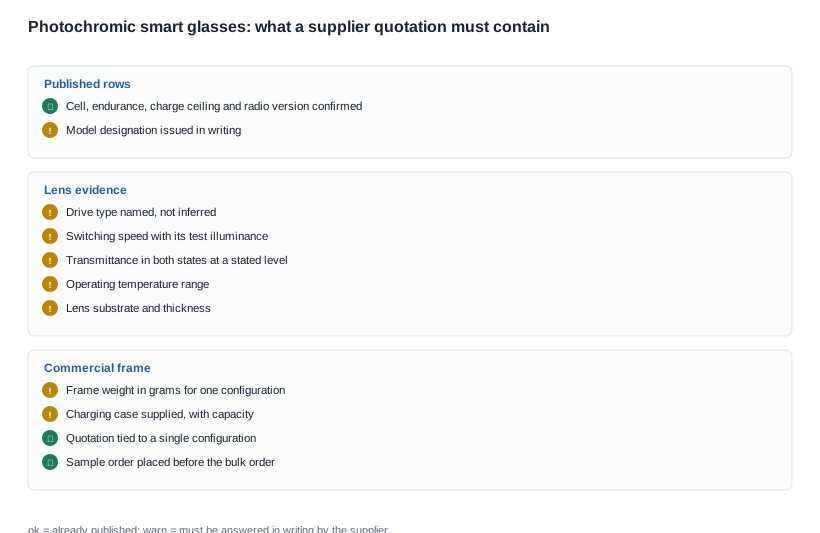
On the mechanism. Ask the supplier to state, in their own words, whether the lens is driven by the product or by ambient light, and to confirm the drive type in the product documentation rather than in a sales reply. The catalogue names this entry as electrochromic, so the supplier is expected to be able to point at a document. If the answer is a photograph of a lens that has darkened, treat the mechanism as unconfirmed.
On the speed and its condition. Ask for the time taken to move from the clear state to the tinted state, and the illuminance or environment in which that time was measured. Ask separately for the return time, because a lens that darkens quickly and clears slowly produces a different complaint pattern from the reverse. A figure without a condition is not a figure, and the response-time analysis sets out why the condition has to travel with the number.
On the optical state. Ask for the transmittance of the lens in both states, at a stated light level, and for the figures to be expressed in a form that can be checked. A qualitative description — dark, deep, comfortable — cannot be put on a specification sheet and cannot be re-ordered against. The tint-depth discussion explains what a re-orderable description has to contain, and the transitions comparison sets the two mechanisms against each other when a supplier uses the same word for both.
On the environment. Ask for the operating temperature range over which the published figures hold. This is not a technicality to be glossed over: the same lens behaves differently in a hot vehicle and a cold morning, and the temperature-effects analysis covers the mechanism. The procurement question is narrow and simple — is there a stated range, and does it cover the climates you ship into?
On the physical build. Ask for the lens substrate, its thickness, and the weight of the product in grams. None of these are published for this entry, and all three change the carton, the shipping weight and the margin. A supplier who quotes a frame weight without a configuration is quoting an average, and averages are not what ships.
On exposure. Ask what ingress protection applies to this entry. The catalogue publishes an ingress rating for two products only, the V06 and the S7, and nothing for this one, so no water, sweat or rain claim may be made or implied for it. A supplier who answers "IPX-rated" for this entry has answered for a different product.
On the accessory ecosystem. Ask whether a charging case is supplied, what its capacity is, and how many units ship in the retail carton. The catalogue publishes no charging-case row for this entry, which is an absence of information rather than a statement that no case exists, and the distinction has to be settled before you price the carton.
On paperwork. Ask for the battery transport test documentation, the conformity documentation that will name the model, and the labelling that will appear on the retail unit. These are the documents that turn an object into a product that can be imported, and the route through them is covered in the certification piece for this category.
On the commercial frame. Ask for the quotation to be issued against a single named configuration, with the minimum order quantity, the sample order quantity, the packaging specification, and the delivery schedule stated in the document. A quotation that is not tied to a configuration cannot be compared, and a schedule that is not in the document cannot be relied on when the factory is busy.
Two habits make this list work. First, record each answer in the same words the supplier used, in a document both sides have seen, so that a later change of contact does not lose the record. Second, write "Not published" in your own purchase specification wherever an answer is missing, so that both parties are signing the same gap rather than holding different beliefs about it.
A sample-first sequence before any bulk order
The most common failure in this category is not a bad lens. It is a good sample that cannot be matched by the production unit, and a matching problem that is caught after tooling, packaging and freight are committed.
- Obtain the model designation in writing before anything else. A quotation without one is not a quotation for a product; it is a quotation for a category. Until the designation exists, no conformity document, no warranty claim and no repeat order can be tied to what you receive.
- Order a sample against the same configuration as the eventual bulk order, including the lens state, the packaging and the labelling. A sample with a different lens or different firmware tells you about a different object.
- Run the sample through the environments you ship into rather than through a desk. An interior, a vehicle and a shaded exterior are the three places where a driven lens shows what a datasheet cannot: whether the transition is visible to the person using it, whether the state persists in a shaded space, and whether the return to clear is fast enough to be usable indoors.
- Fix the acceptance criteria in writing before the sample is opened. State the pass conditions — the documented figures, the environment behaviour, the state persistence, the charging cycle, the radio connection, the runtime observed — and state which of them are measurable by a person on your team and which require a document.
- Keep the sample. It becomes the golden sample against which the first production unit is compared, and it is the physical reference when a later order is questioned.
- Verify the paper against the object. Check that the model designation on the unit, on the packaging, on the conformity documentation and on your purchase order are the same string. Mismatches at this stage are cheap to fix and expensive to discover at customs.
- Place a re-order test. A second sample from a later production window, ordered at the same time as the bulk run, tells you whether consistency is being maintained or whether you have bought a one-off.
- Only then release the bulk order, and state in the purchase order that the production units must match the golden sample on the criteria you fixed in step four.
The commercial logic of this sequence is straightforward. A sample order costs a fraction of a bulk order and takes a fraction of the time. The specification work done before the sample arrives is reusable, because the same questions produce the same answers for the re-order. What is not reusable is a bulk order placed against a description of a lens that nobody has yet written down.
The boundary of what our own catalogue states
There is a limit to what we can put in front of you for this entry, and it is worth stating in the same tone as everything else above.
What the catalogue publishes for the AI electrochromic smart glasses entry is five fields: a 100 mAh cell, a charge time of two hours or less, roughly seven hours of rated endurance, magnetic charging, and Bluetooth version 5.4. What it does not publish is any lens specification, a model designation, a weight, an ingress rating, a charging-case capacity, a battery transport document, a per-model conformity row, a price, a minimum order quantity or a delivery schedule. Those are absences, and we would rather tell you they are absent than fill them with figures we cannot substantiate.
We are equally clear about what we will not do. We will not quote a typical switching time, a typical transmittance, a typical tint level or a typical service life from elsewhere in the industry and present it as though it described this product. A typical figure from another product is not evidence about this one, and in a category where the entire commercial proposition sits in the lens, passing off somebody else's number is worse than publishing nothing.
What we can do is answer the electrical rows precisely, name the drive type in the way the catalogue records it, and tell you in writing exactly which documents will have to come from the supplier, in which order, and what each one has to contain. The care routine for this category covers the handling instructions that should ship inside the carton, because the handling regime is part of the product you are buying and not an afterthought.
If you are evaluating this category, tell us the destination markets, the duty cycle you need to support and whether the driven lens is the core of the proposition or a line extension. We will tell you which of the five published rows already answers part of that, and which parts have to be answered by a supplier before a purchase order is worth raising. That is the honest extent of what a photochromic smart glasses buying guide can offer when the catalogue publishes a single row and the lens remains undocumented.


