

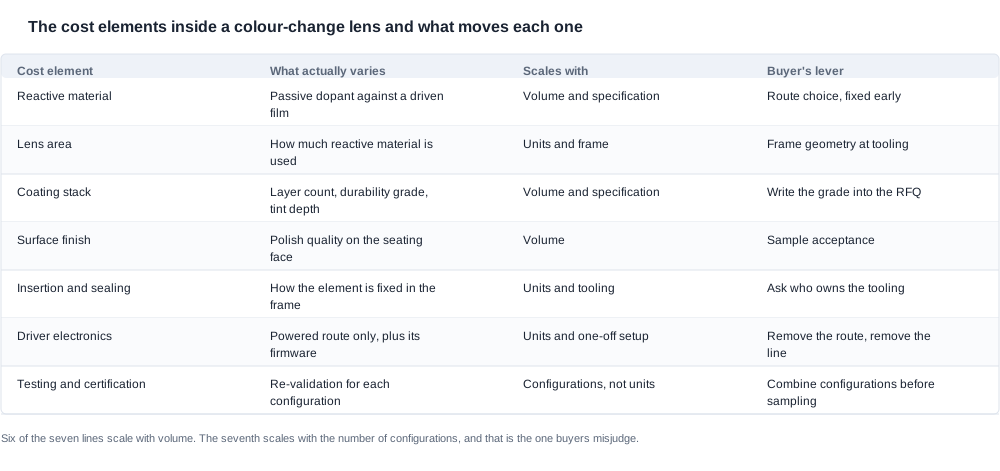
The cost of a colour-change lens is not one number and it is not the lens. It is a stack of seven elements, six of which scale with the number of units and one of which scales with the number of configurations — and that single configuration-scaling element is where most buyers lose money, because it is invisible in a unit price comparison. Two quotations for what appears to be the same product can differ by a small fraction per unit and by a multiple across the programme, and the difference is almost never in the lens. This article decomposes the cost structure, marks which parts you can model yourself today from published rows and which can only be priced by quotation, and shows how to compare two offers when neither supplier will hand you a breakdown.
Photochromic: where the money actually sits in a lens
Why two quotes for the same product differ by a multiple
The reason is structural rather than opportunistic. A colour-change lens is not a component you drop into an existing product; it changes what the product is. On the camera platform in our catalogue, the lens appears as a configuration alongside an 8 MP sensor, a 220 mAh cell, a rated runtime of 5–8 hours, Type-C charging, charging in two hours or less, flexible temples and three published colour options. The dedicated route is a different product with its own published rows: Bluetooth V5.4, a 100 mAh cell, charging in two hours or less, a rated runtime of about seven hours, magnetic charging, and a lens technology described as electrochromic.
Adding a lens to either of those changes the optical description of the product, which changes the technical file, the artwork, the labelling set, the sample and the certificate model list. None of that is visible on the unit price line, and all of it is priced. A supplier who quotes the lens as a variant line is quoting a variant cost for a product-scale piece of work, and the gap between the two quotations is where the negotiation actually is.
The lines you can model yourself today
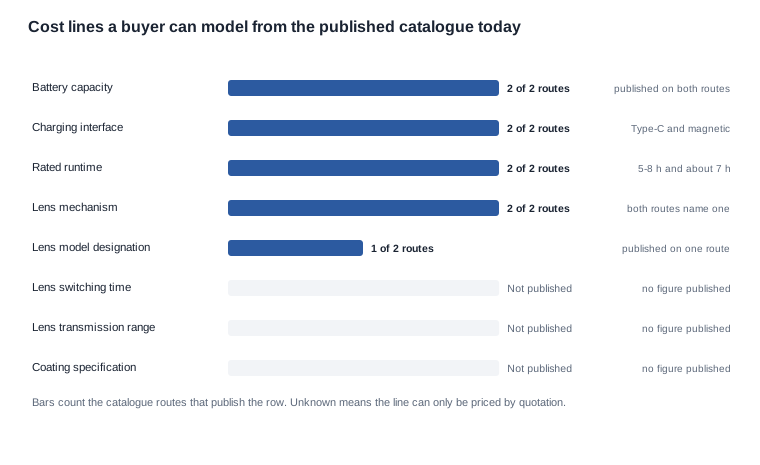
Before any supplier conversation, it is worth separating the cost lines that published rows can bound from the lines that cannot be touched. Our catalogue publishes the battery capacity, the charging interface, the rated runtime and the lens mechanism for both routes, and it publishes the sensor class, the charging time and the colour options for the camera route. It publishes nothing at all about the lens itself: no switching time, no transmission range in either state, no coating specification, no lens model designation. That is why the lens lines in your cost model have to be quotation-only, and why comparing two quotes on the lens means comparing the structure of the quote rather than the unit number.

The four cost elements inside the lens
The reactive material is the specification
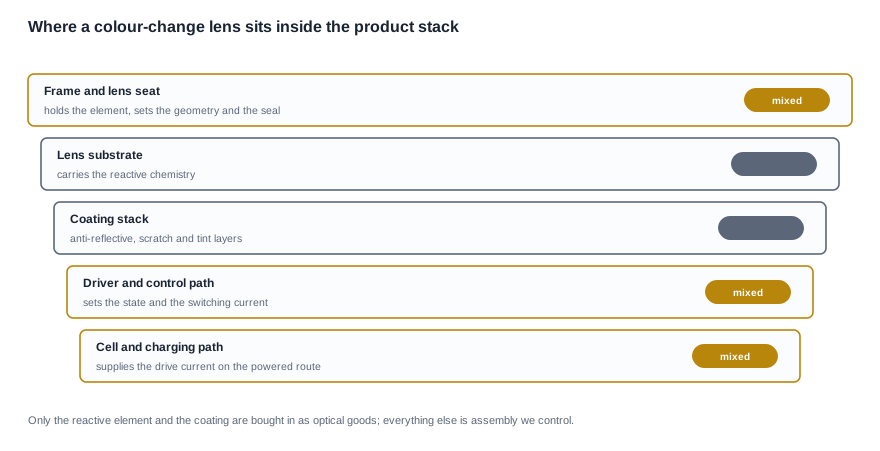
The single most consequential decision in the lens cost is the material itself, and it is decided early and badly if it is left open. A passive route reacts to ultraviolet in the incoming light and needs no power. A driven route holds a state under an applied voltage and brings a driver circuit, a control path, a firmware function, a charging interface and, on the dedicated route in our catalogue, a magnetic charging arrangement and a separate cell.
The cost consequence of that choice is not the material. It is everything the material drags into the bill of materials. When you evaluate a supplier's quote on the lens, the first question to ask is not what the element costs but whether the quote includes the power path. A quote for a passive element and a quote for a driven film are quotes for different products, and the gap between them is a product decision rather than a negotiation.
Coating is where the difference hides
The coating stack is the least visible and most expensive part of the lens, and it is where two quotes for the same platform diverge most without either supplier misrepresenting anything. A stack has layers, and each layer has a purpose: anti-reflective performance for clarity, a scratch layer for durability, a tint layer if the coating carries the colour response rather than the substrate. The variables that move the price are the layer count, the durability grade, the depth of the tint, and the process capability behind them.
Two practical consequences. First, a coating grade is a specification, and a specification is something you can write into the request for quotation and hold the supplier to at sample stage — the same coating grade at two price points is the clearest evidence that one of the quotes has been trimmed. Second, a coating grade cannot be changed late without re-qualifying the lens, which makes it a change-control item rather than a purchasing decision.
Surface finish and the seating face
The face of the element that sits against the frame has to be finished to a tolerance, and that finishing step is a cost line that is almost always buried inside a lens unit price. Its relevance to a buyer is that it determines what the element can be assembled onto. A finish that is adequate for a bench test can be inadequate for a frame that has to be sealed against it and then shipped and stored.
The threshold to hold is a stated dimensional tolerance and a stated finish on the seating face, per configuration, agreed before the first article. Asking for it costs one line in the request for quotation; discovering it at assembly costs a re-validation cycle.
Transmission depth is bought, not engineered
The range the lens covers between its clear state and its dark state is a purchased characteristic of the material and the coating, and it is the characteristic that most often justifies a price premium — and the one most often quoted without conditions. We publish no transmission range for any model in our range, so a supplier figure is the only figure available, and it arrives with a measurement method attached or it arrives unusable.
The threshold is a range with the units and the method stated, including the clear state. A quote that offers only the darkened end of the range is quoting the number that looks best in a demonstration.

Costs that scale with units and costs that scale with configurations
Setup, tooling and the amortisation question
Most of the lens cost scales with units and falls as volume rises, and a supplier knows that, which is why the unit price is the least interesting number in the quotation. The setup elements behave differently. Frame tooling is amortised over the first order, and the useful questions are over what volume it is amortised and what happens to it if the programme is discontinued — because tooling that cannot be redeployed is a sunk cost that turns into a liability the moment the forecast changes.
The lens element's own setup, where it exists, follows the same pattern, and so does any fixture needed to seat the element reliably. A buyer who negotiates only the unit price has left the largest single line in the programme untouched.
Documentation and testing scale with configurations
This is the line that separates a competent quotation from an optimistic one. A configuration change is a new product for documentation purposes. The technical file, the declaration of conformity, the certificate model list, the labelling set, the instructions, the artwork and the sample approval all have to reflect the configuration, and each of those is priced per configuration rather than per unit.
The arithmetic is unforgiving in a way buyers rarely anticipate. One platform with three published colour options and a colour-change lens configuration is three configurations. Add a prescription option and the count multiplies again. Add a second market with a different label set and the count multiplies once more. The unit price does not change at all across that arithmetic, and the programme cost does.
Where the volume threshold sits
Because the configuration-scaling cost is per configuration, there is a volume below which the lens programme is structurally uneconomic — not because the unit price is too high, but because the per-configuration cost is spread over too few units. The threshold to find is the one where the per-configuration cost divided by the units per configuration stops being acceptable against the price the channel will pay.
Two commercial levers move it without moving the lens. The first is the minimum order quantity per configuration: committing to a combination count rather than a unit count is a negotiation that a supplier can actually respond to, because it changes their exposure rather than their margin. The second is the number of configurations themselves, and that one is entirely in your control, at design time.
The per-configuration line that is usually missing
Ask any supplier for a colour-change lens quotation and the line most often absent is the one that says what a configuration costs to exist as a product. It is missing because it is awkward: it is not a clean number, it depends on which documents the market requires, and it is different for the first configuration and for every one after it.
It is also the line that determines whether adding a colourway, a market or a prescription option is a normal commercial decision or a project. The first configuration carries the setup: the artwork, the label set, the sample approval, the technical file update and the certificate model list. The ones after it carry a smaller but real version of the same thing, and a supplier who has only quoted the first has not quoted the second.
The threshold to hold is a written statement of what a new configuration costs, expressed separately from the unit price and separately from the one-off setup. If the answer is that additional configurations are free, that is not a concession — it is an indication that the documentation is family-level and will not survive your first market-specific label.

Two ways a lens gets cheaper, and what each one costs you later
Removing the driven route
The largest single reduction available in a colour-change lens programme is removing the drive from the lens, and it is worth checking whether the requirement genuinely needs it. A driven element brings a cell, a driver circuit, a control path, a firmware function and a charging arrangement into the product, and with them a battery transport file, a charging accessory, a service spare pool and an additional failure mode.
What it also brings is control: a specific tint on demand, a state that holds, and behaviour that does not depend on ambient ultraviolet at all. If your channel needs a tint that a customer can set, the driven route is not an option to be traded away — it is the requirement. If your channel needs a lens that responds to daylight, it is not. Decide which one you are in before the quotation is opened, because the answer changes the unit price, the programme cost and the number of months the programme takes.
Standardising the configurations
The second lever is the configuration count, and it is the one with the better ratio of effect to effort. Freezing colourways before artwork is commissioned, merging markets that can share a label set, and holding one lens specification across every colourway all reduce the per-configuration cost without touching a single unit price.
The negotiation content of this lever is specific and worth having in the request for quotation: the minimum order quantity expressed per configuration, the artwork round count, whether the documentation pack is priced per model or per family, and the price tier at which the supplier reopens it. The first two are direct cost lines; the third determines whether adding a market later is cheap or expensive; the fourth tells you how far the programme can grow before the structure changes.
What a price tier does and does not commit
A price tier is a supplier's statement about where your volume is expected to land, and it is more useful than it looks if you read it correctly. It commits the supplier to a unit price at a volume, which is a real commitment and is worth having in writing. It says nothing about the configuration count, the documentation scope, the packaging requirement or the shipment terms, and those are precisely the lines that decide whether the programme is viable.
The practical use is a comparison tool. Take the two quotations and read the tier structure rather than the headline number: a quote with a steep tier structure is telling you the programme economics depend on you reaching a volume, and a quote with a flat structure is telling you the supplier is not expecting your volume to matter. Both are legitimate, and they point at different risks. In the first case the risk is that you under-order; in the second it is that you are being offered a price that assumes a configuration count you have not agreed.
How the trade-off between spending on performance and spending on programme structure is actually decided is covered in photochromic smart glasses cost vs performance. The selection method behind both articles is in how to choose photochromic smart glasses, and the category background sits under photochromic lens technology.
Turning a cost structure into a quotation you can compare
Comparing two quotations line by line
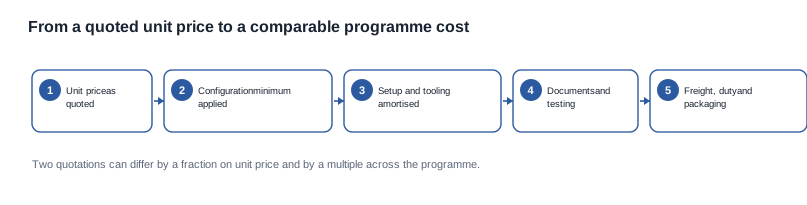
Two suppliers will not hand you the same breakdown, so the comparison has to be reconstructed on your side. Build the comparison in five columns and demand a number in each:
- Unit price, at the volume you intend to order, with the price tier named.
- Configuration minimum, per configuration, and the total number of configurations the price assumes.
- Setup and tooling, as a separate line, with the volume it is amortised over.
- Documentation and testing, priced per configuration, and which configurations it covers.
- Logistics, at the packaging level you require, with the incoterms stated.
A quotation that answers four of the five is not comparable with one that answers five, and the difference is not a technicality — it is usually the whole of the disagreement. When a supplier declines to separate the documentation line, ask instead for the total programme cost at your volume and your configuration count. Two numbers, both explicit, are comparable; a unit price alone is not.
One more line belongs in the same table, and it is the one your own finance function will ask for: the landed cost. Unit price plus freight, duty, packaging amortised across the units per configuration, and the per-configuration documentation charge divided across those same units. A colour-change lens distorts the landed cost calculation more than it distorts the unit price, because the packaging and documentation components do not scale down with volume in the way the unit price does.
The questions to ask a supplier about cost
The questions that produce a usable cost breakdown are short. Which parts of the quotation are per unit and which are per configuration. What is the minimum order quantity for a configuration carrying a lens. Is the documentation priced per model or per family. Which coating grade is in the quoted price, and what changes the price if the grade changes. What is the unit price at the second and third price tier, and what is the volume that moves you between them.
The last of those is the one most often skipped and the one with the largest effect on the total cost of the programme. Price tiers are a supplier's forecast of where you will land, and the tier structure is negotiable in the same way as the configuration minimum — committing to a volume shape rather than a single number is a real negotiation, and a supplier with capacity to spare will take that trade.
Before you send the request, write the answers you need into it rather than waiting to be asked. A request for quotation that names the configuration count, the coating grade, the documentation scope and the target volume will return a comparable number; a request that asks for "your best price on the photochromic model" will return a unit price that cannot be compared with anything. The comparison criteria that matter are these, and they are worth writing on one page before you approach any supplier:
- The configuration count the price assumes, including colourways and markets.
- The coating grade and the lens specification the price covers.
- The price tier structure, with the volume at each boundary.
- Whether documentation is priced per model or per family.
- The payment terms, the incoterms and the packaging requirement.
- The warranty basis, stated as a failure condition rather than a period.
A quotation that answers all six can be compared with any other quotation that answers all six. A quotation that answers two cannot be compared with anything, and the difference between the two is where the negotiation is.
The working rule we apply: we publish the rows we hold and mark the rest as open. We do not publish unit prices, cost breakdowns, coating specifications, transmission ranges, switching times, lens model designations or tooling figures for any model in this range, and we would rather tell you that than quote a typical figure you cannot verify. The supplier-verification side of the same question is in how to choose photochromic smart glasses.
If you are building a cost model for a colour-change programme, send us the platform, the configuration count, the target markets and the volume. We will tell you which cost lines are fixed by the mechanism, which scale with your configuration count, and which are worth negotiating.


