

A budget does not buy performance in this category; it buys a position on a small number of decisions, and each decision has a cost that a supplier will price differently depending on how it is asked. The question "what can I get for this price" is the wrong question, because the answer is always a compromise of somebody else's choosing. The right question is "which of these four behaviours do I need, what has to be measured to prove it, and what does the remaining budget have to cover". This guide sets out the three tiers the category resolves into, the performance rows that separate them, the trade-offs a supplier will ask you to make, the criteria that hold at every tier regardless of price, and a worked budget conversation that shows the sequence a procurement team can copy.
Photochromic: what the budget buys at each tier
Three tiers, three different products
The category collapses into three tiers, and the useful insight is that they are not versions of one product. They are different products with different bills of materials and different documentation, which is why a tier is decided by a requirement rather than by a price.
The standard tier is the product without a colour-change lens. It is a camera platform or an audio platform, and it carries the cost structure of a platform: unit price, setup amortised over volume, documentation at the platform level, and one configuration per colourway. On the camera platform in our catalogue that means an 8 MP sensor, a 220 mAh cell, a rated runtime of 5–8 hours, Type-C charging, charging in two hours or less, flexible temples and three published colour options, with no lens involved.
The passive tier adds a lens that reacts to ultraviolet in the incoming light. It adds no cell, no driver, no firmware function and no charging arrangement, and it therefore avoids the battery transport file that a powered route brings with it. It also introduces a set of requirements that the standard tier does not have: switching behaviour, a transmission range, a uniformity tolerance, a temperature range and a cycle life.
The driven tier adds a lens that holds a state under an applied voltage. The dedicated route in our catalogue publishes Bluetooth V5.4, a 100 mAh cell, charging in two hours or less, a rated runtime of about seven hours, magnetic charging and a lens technology described as electrochromic. It brings a power path, a control path, a firmware function, a charging accessory and a battery transport file, and it brings the requirement that the state at a flat battery be specified rather than discovered.
The tier a lens product belongs to
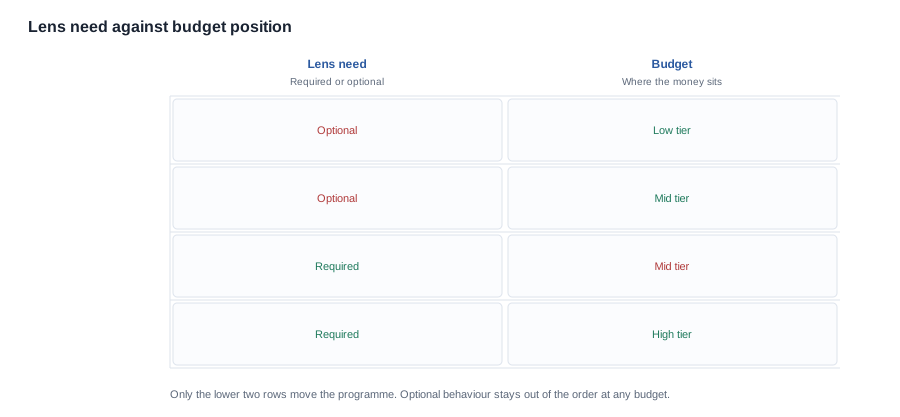
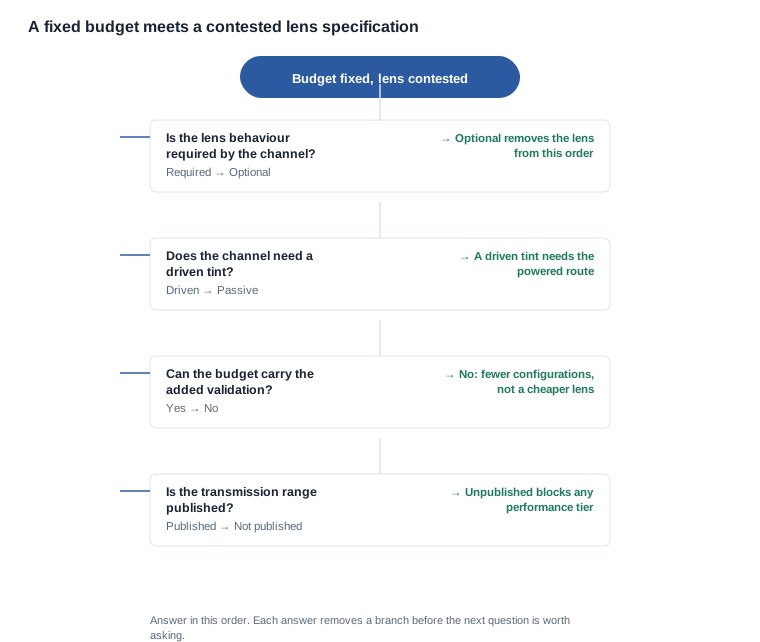
The tier is decided by one question and one question only: does the channel need a particular tint at a particular moment, or does it need a lens that responds to daylight? The first requires the driven tier, and there is no negotiation that turns a passive element into a controllable one. The second is satisfied by the passive tier, and the standard tier is simply a product with a feature you did not need.
Nothing else moves a product between tiers. Not the budget, not the volume, not the channel's appetite for a premium listing. The decision is about the behaviour, and it is made before the request for quotation is written.

The performance rows that decide a tier
A tier is only as good as the rows that distinguish it from the one below, and in this category three rows do almost all of the work.
Switching behaviour is the first discriminator
The passive tier and the driven tier are separated by whether the tint is a consequence of the environment or a result of a command. The consequence route is free of electronics and slow to respond in cold conditions. The command route responds on demand and holds a state, and it introduces a failure mode that the passive tier does not have: the state at a flat battery.
We publish no switching figure for any model in our range, so the threshold has to be written as a requirement rather than compared against a published number. Two figures, one per direction, each with a light level and a temperature attached, and a written statement of whether each figure is typical or a best case. A supplier who offers one figure has measured one direction, and a supplier who offers a figure with no condition has offered a number you cannot compare with anybody else's.
Transmission range is the second
The range the lens covers between its clear state and its dark state decides whether the product can be described as adapting to light at all, and it is the number that most often appears in a listing without the condition that makes it meaningful. Two lenses that both move from a high clear state to a low dark state are different products if one ends at twice the other's darkness.
The threshold to hold is a range with the units and the method stated, and it has to include the clear state. We publish no transmission range for either route. Ask for the clear state first, because it is the state your indoor customer will see and the state that determines whether the product is usable at all in a low-light environment.
Uniformity and cycle life are the third
Uniformity is the tolerance between zones of the lens, and it decides whether a good unit is rejected at first article. Cycle life is the number of transitions the element survives before it is considered failed, and it decides whether a warranty has a measurable end. Both require a criterion written by the buyer, because both are quantities without one.
The cycle criterion is the one worth being deliberate about. A transmission level at which the lens is deemed failed, written by you and applied by both parties, converts a warranty from a period of time into a state of the product. That is the difference between a warranty claim that can be settled in an afternoon and one that becomes a negotiation about what "worn out" means.
The rows that do not discriminate, and should not be paid for
Between any two quotations in this category sit a number of rows that sound decisive and settle nothing. They are worth naming, because a buyer who treats them as differentiators ends up paying a premium for a word.
A premium lens designation is a marketing label with no measurable content. Two suppliers offering it at different prices are offering the same thing at a different price, and the question that separates them is the coating grade, not the adjective.
A military-grade or automotive-grade claim is a claim about a standard, and the standards in question are written for glazing and for vehicle glazing rather than for a wearable with a camera behind it. Unless the supplier names the standard and the test method, the claim is a positioning statement and should be treated as one in a shortlist.
A cycle count without a transmission floor attached is a quantity, not a durability claim. Two suppliers quoting ten thousand and fifty thousand cycles are quoting the same absence of information unless both state the end point.
A light transmission percentage quoted without the state it belongs to is one number from a range, and the range is the product. This is the most common of the four, because the dark state is the number that looks best in a demonstration and the clear state is the one that decides whether the product can be sold into the market the buyer actually has.
The filter for all four is the same: a row is worth paying for only if it can be written as a criterion with a condition and an end point. Rows that fail that test belong in a notes column, not in a comparison table.

The trade the supplier asks you to make
Where the money usually goes
Every supplier conversation in this category converges on the same trade, and it is not the trade buyers expect. The trade is not between a better lens and a cheaper lens. It is between spending on the lens and spending on the programme that surrounds it.
Money spent on lens performance is visible, testable and priced per unit. Money spent on programme structure — the configuration count, the documentation scope, the artwork rounds, the number of markets, the re-validation of each change — is invisible, priced per configuration, and usually the larger number. A buyer who optimises the lens and ignores the configuration count pays for the lens in every unit and for the programme in every configuration.
The practical version of the trade: at a fixed budget, you can have a better specified lens with fewer configurations, or a cheaper lens with more of them. Both are legitimate. The question is which one your channel can carry, and the answer is usually decided by how many markets and colourways you intend to launch with rather than by anything about the lens.
The trade-off nobody prices: programme structure
There is a second trade-off hiding under the first, and it is the one that decides whether the programme can grow. The first order and the tenth order are different programmes. If the price is structured so that adding a colourway or a market requires a new round of setup and documentation, the programme will not grow — not because the lens cannot grow, but because each increment is priced as a project.
Ask the question that exposes it: what happens to the unit price when we add a second market that shares the same lens specification? If the answer involves new artwork and a new documentation set, the per-configuration cost is what you should have been comparing from the start. If the answer is that nothing changes, that is worth far more than a unit price reduction, and it is worth having in the quotation rather than in a conversation.
The comparison method behind this is in photochromic smart glasses cost factors, and the requirement side of the same question is in photochromic smart glasses for different use cases. The camera platform that carries the lens configuration as one of its options is at AI camera glasses.
What a supplier will not price separately
Some of the trade-off is invisible because the supplier bundles it. In a quotation for a colour-change configuration, the documentation and testing work is usually folded into a single setup line, which makes it impossible to see whether the second market or the third colourway costs anything.
The question to ask is blunt: if we double the configuration count and keep the unit volume, what changes in the price? A supplier with a per-configuration cost will answer with a number. A supplier with a family-level documentation approach will answer that nothing changes — and that answer, if it is true and can be evidenced, is worth more to a growing programme than a unit price reduction.
The second bundled item is measurement. The cost of proving the acceptance criteria — the sample units, the measurement rounds, the third-party laboratory where one is required — is often absorbed into the unit price of the first order. Ask what the sample and measurement work costs as a separate line, and ask what happens to it if the criteria change after the first round. A criteria change after the measurement has begun is one of the most expensive events in a programme of this size, and it is nearly always the result of criteria that were written without conditions in the first place.

Thresholds that hold at every tier
Criteria that apply to every tier
Whatever tier you land on, five criteria hold, and they are cheap to write and expensive to omit. They are the criteria that make the purchase defensible later rather than at the moment of the order.
- The mechanism is named. Passive ultraviolet-driven, or voltage-driven, with the power path described. A supplier who cannot name the mechanism has not specified the product, and every downstream document will inherit the ambiguity.
- Every performance figure carries its condition. Direction of travel, light level and temperature. A figure without conditions is not usable in a specification and should be removed from the comparison rather than carried into it.
- The model designation is fixed. The dedicated colour-change route in our catalogue publishes no model designation, which makes it impossible to list on a certificate as it stands. Fixing one is a condition of the order, not an administrative detail.
- The acceptance criteria are inside the purchase order. A criterion that exists only in an email is not binding. A criterion inside the order is the standard against which a lot can be refused.
- The warranty is written against a failure condition rather than a period. Time-based warranties on a reactive element always end in an argument; state-based ones do not.
What to drop when the budget moves
When the budget tightens, the order in which to give things up is not obvious and is worth fixing in advance. Give up the number of configurations first, because each one carries a per-configuration cost and the unit price is unaffected. Give up the tier second, and only if the requirement genuinely allows it — a driven lens given up in the wrong order leaves a passive product with a controlled-tint expectation attached to it, which is the worst of both.
Do not give up the measurement conditions. A budget saved by dropping the light level, the temperature and the direction from a specification is not a budget saved, it is a budget moved into the returns column, where it costs several times more. The measurement conditions cost nothing on a unit price line; they cost only attention at the sample stage.
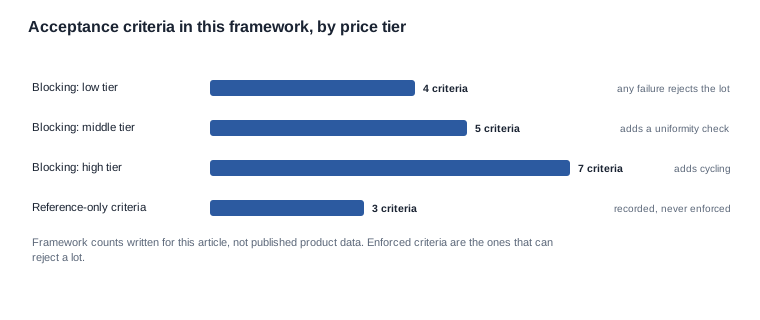
The framework above counts four blocking criteria at the standard tier, five at the passive tier, seven at the driven tier and three that are recorded but never enforced. The counts are a framework written for this article rather than published product data, but the shape is the point: each tier adds criteria, and none of them can be removed without changing what the product is. The three that are recorded rather than enforced are the useful ones to keep visible, because they are the criteria a supplier will cite in a negotiation and the ones a buyer should therefore be able to see and decide about rather than discover later.
A budget conversation, worked through
The following is a hypothetical scenario rather than a client project, written to show the decision sequence rather than to report a result.
Assume a brand-side product manager with a fixed unit budget, an existing camera platform that already ships in three markets, and a channel that spends most of its time outdoors in direct sun. The constraint that matters is not the budget: it is that the brand has never published a lens performance figure and does not want to be the first to do so on a product page.
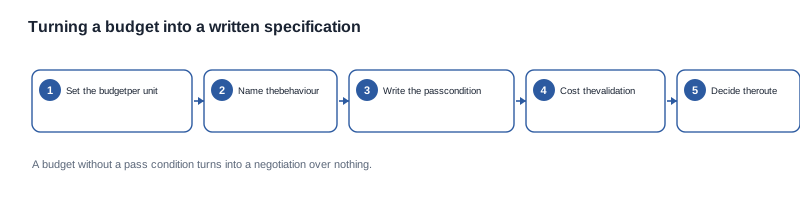
Step one: the budget. The manager fixes the unit budget and writes down the number of configurations the programme will carry — the existing colourways across the three existing markets, with one lens specification across all of them. That second decision, the configuration count, is worth more than any negotiation with a supplier, because it is the line that scales per configuration rather than per unit.
Step two: the behaviour. The channel needs the lens to respond to daylight; nobody in the channel asks for a specific tint at a specific moment, and the driven route's added cell, driver and firmware bring a battery transport file and a charging accessory that the channel does not need. The manager selects the passive tier and writes that the requirement is daylight response, not a controlled tint. That sentence is what keeps the programme inside the budget.
Step three: the pass condition. Because no figure is published, the manager writes the acceptance criteria rather than comparing against a number: two switching figures, one per direction, each with a light level and a temperature; a transmission range including the clear state; a uniformity tolerance on a stated grid; a cycle count with a transmission floor as the failure condition. The criteria are attached to the order, and the supplier is asked to quote against them.
Step four: the route. The manager asks the supplier what changes when the lens configuration is added: which documents are reopened, whether the documentation is priced per model or per family, and what the unit price is at the second price tier. The answer determines whether a fourth market is a decision or a project, which is the question that decides the programme two years later.
The outcome of this sequence is not a particular price; it is a programme where the decision about the lens was made from the requirement, the cost was compared at programme level rather than unit level, and every published figure in the listing is one the brand can defend.
The working rule we apply: we publish the rows we hold and mark the rest as open. For the camera platform with the colour-change lens configuration we publish the sensor class, the rated runtime, the charging interface, the cell capacity, the charging time, the temple design and the published colour options. For the dedicated colour-change entry we publish the Bluetooth version, the cell capacity, the charging time, the rated runtime, the charging interface and the lens technology. We do not publish switching times, transmission ranges, uniformity tolerances, temperature ranges, cycle life figures, coating specifications or lens model designations, and we do not publish unit prices, because those are commercial terms rather than specifications and each of them changes with volume, configuration count and market.
The background on the category sits under photochromic lens technology. If you want to pressure-test a budget before you send it out, send us the platform, the configuration count and the target volume, and we will tell you which lines in the budget are fixed by the mechanism and which are the ones a supplier can actually move.


