

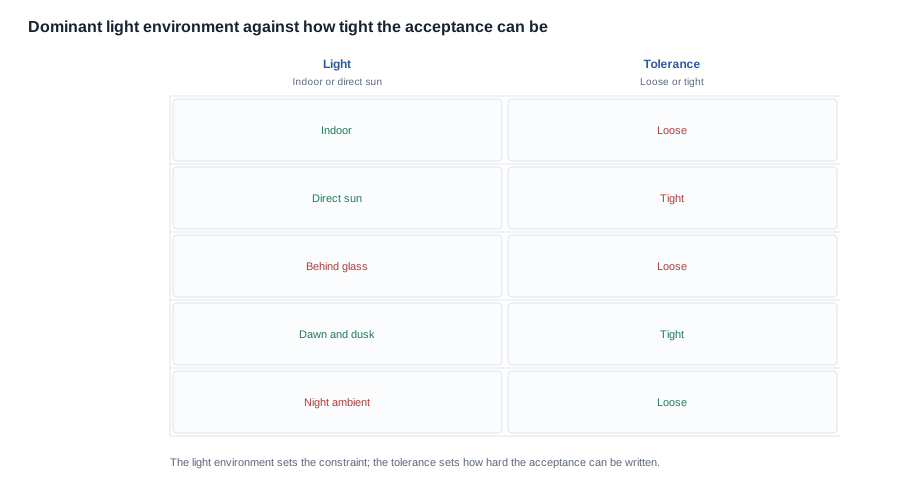
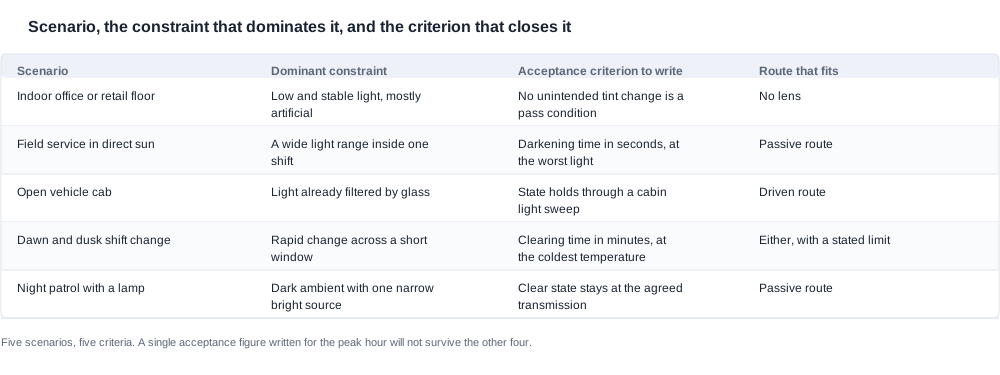
The scenario is not a marketing segment, it is the operating environment, and the operating environment is what determines the specification. A colour-change lens is a decision made against a light profile, and five light profiles account for almost every deployment in this category: an indoor environment with stable artificial light, direct sun across a working day, a vehicle cab where the light has already been filtered, a shift that crosses dawn and dusk, and night work where the ambient is dark and the source is narrow. Each of those produces a different dominant constraint, and each produces a different acceptance criterion, and in two of the five the correct decision is that no colour-change lens belongs in the product at all. This map sets out the five environments, the constraint that dominates each one, the criterion that closes it, and the route that satisfies it.
Photochromic: five light environments, five specifications
Why the scenario decides the specification
A light-responsive lens changes the light transmission of the product in response to its environment. What makes that useful, or useless, or actively wrong is the environment itself: how much light there is, how fast it changes, where the light came from and whether the light reaching the lens has been filtered on the way. Those four variables are properties of the working context, not of the customer, and they are knowable before a product is selected.
That is what makes a scenario map possible. It also makes it worth having, because a specification written for one environment is routinely shipped into another — usually by a distributor who assumes the environments are similar, or by a channel that consolidates several customer types behind one listing. The failure shows up as a product that performs correctly in the demonstration and incorrectly in the field.
The structure of the map is straightforward. Each environment produces one dominant constraint. Each constraint produces one acceptance criterion. Each criterion produces one decision about the route: no lens, a passive lens, or a driven lens. Where the constraint can be satisfied by the standard build, the standard build is the correct answer, and the price of the lens is not recovered.
The day as a sequence, not a single condition
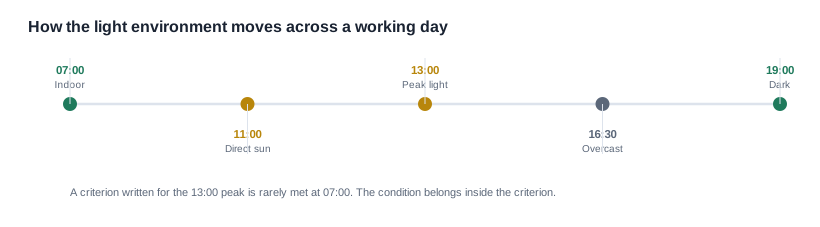
The second structural point is that a working environment is a sequence of light conditions rather than a single one, and a criterion written against one moment of that sequence will fail at another moment of it.
Consider a shift that starts indoors, moves into direct sun around the middle of the day, passes through a period of overcast light, and ends after dark. A criterion written for the midday peak will not be met at the start of the shift. A criterion written for the morning will not be met at the peak. The only criterion that survives the sequence is one that names the condition it applies to, and the buyer has to decide which condition is the binding one.
Indoors, where a colour-change lens earns nothing
The acceptance criterion for an indoor channel
The indoor environment covers retail floors, offices, warehouses, showrooms, indoor inspection lines and most service work. Its defining characteristic is that the light level is low, stable and artificial, and that it does not change in a way that a reactive lens would respond to.
The dominant constraint is therefore not optical at all — it is commercial. The constraint is that a colour-change lens adds cost to the unit, adds a configuration to the programme, adds documentation scope and adds a claim obligation, while producing nothing a customer can see in the environment the product is actually used in.
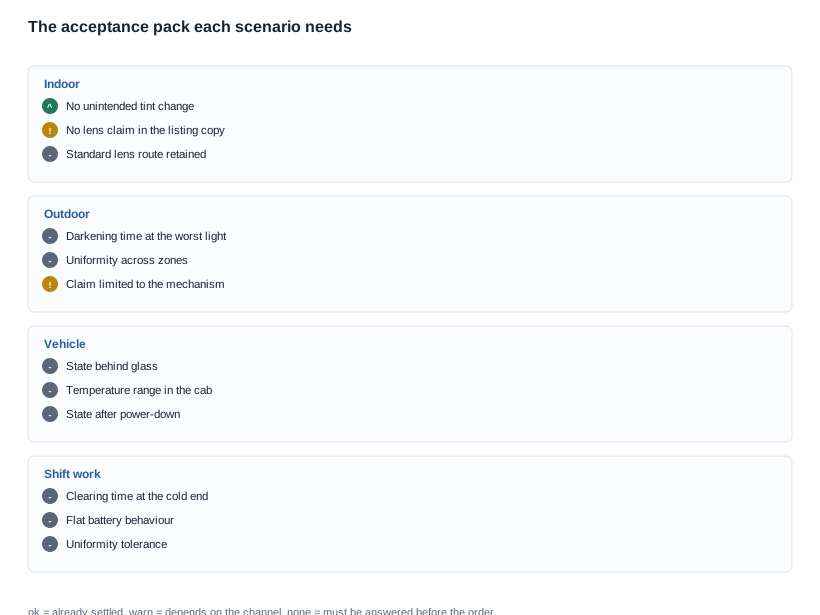
The acceptance criterion for this environment is unusually simple and worth stating precisely, because it is the criterion most often skipped: no unintended tint change is the pass condition. In an indoor environment with stable artificial light, the product must not change its transmission. A lens that drifts under indoor lighting, that retains a dark state after being brought in from outside, or that shows a visible edge-to-edge variation under a display light, fails that criterion.
That criterion is not a formality. It is the criterion that catches the most common indoor failure, which is the lens that arrives dark. A unit that has been stored in direct sun, or that has been left in a parked vehicle, arrives in a tinted state, and indoors that tinted state is the visible defect. The criterion is met by specifying a storage and transport condition — a maximum storage temperature with a defined exposure time, and a dispatch rule — rather than by specifying the lens.
What the standard build costs instead
The decision that follows from that criterion is the one most programmes in this category get wrong by default. If the acceptance criterion is no unintended tint change, then the product that satisfies it best is the product with no colour-change lens at all, and the only reason to include one is a channel requirement about outdoor use outside the indoor environment.
The comparison to run is not lens against no lens on unit price. It is the full programme position: the unit price difference, the per-configuration documentation difference, the artwork and labelling difference, the measurement and acceptance work, and the aftersales script that has to explain the behaviour. On an indoor channel, the second and fifth of those are the larger numbers, and both of them exist only because the lens exists.
Where a channel mixes indoor and outdoor work, the honest structure is usually two configurations rather than one, and the deciding question is whether the outdoor configuration is worth its own minimum order quantity, its own artwork and its own documentation. That is a judgement about configuration count rather than about optics, and it should be made before the request for quotation rather than after.
Direct sun and the outdoor working day
The outdoor constraint and the passive route
The outdoor environment covers field service, construction, agriculture, logistics yards and any channel where the working day is spent under open sky. Here the light level is high, it varies across the day, and the light reaching the lens is direct and unfiltered.
The dominant constraint is speed of response relative to the change in light, and its direction matters more than its magnitude. A lens that darkens slowly leaves the operator in full sun while it catches up; a lens that clears slowly leaves them in a dark tint as they move into shadow or into a building. Both are visible, both are reported, and both are expensive because they happen in front of customers rather than in a laboratory.
This is the environment in which the passive route is mechanically sufficient. A passive lens reacts to the ultraviolet in direct sunlight, needs no power, no driver and no firmware function, and adds no cell to the product. The acceptance criterion is a darkening time measured at the worst light the working day actually reaches, with the light level and the ambient temperature stated, and a second figure for the clearing direction measured at the coldest condition the channel experiences.
Both figures matter, and the second one is the one that is usually missing. A cold morning is the condition in which a passive lens is slowest to clear, and a customer who walks from bright sun into a cold vehicle or a cold warehouse meets exactly that condition at the worst possible moment.
Where a driven tint becomes justified
A driven lens earns its cost in this environment only when the requirement goes beyond reaction. Two conditions justify it. The first is a specific tint on demand — a channel that needs a stated level of attenuation for a task, not a reaction to whatever the light is doing. The second is consistency: a driven lens holds a state, so the product behaves the same way in a shaded bay as it does in open sun, and that predictability is worth paying for in operations where the light cannot be controlled.
The acceptance criterion for a driven route is different in kind, and this is where a specification written for a passive lens causes trouble. Instead of a reaction time, the criteria are a set of reachable states, a tolerance on each state, a time to reach a commanded state, and a stated behaviour at a flat battery. The driven route in our catalogue publishes Bluetooth V5.4, a 100 mAh cell, charging in two hours or less, a rated runtime of about seven hours and magnetic charging, which is the platform that would carry such a specification — and it publishes no state tolerance, no reach time and no flat-battery behaviour, so those rows would have to be written by the buyer.
There is also an interaction with the camera that only exists where a camera exists. The camera platform in this category publishes an 8 MP sensor, and a camera behind a lens whose transmission changes has to cope with that change. Whether the exposure re-adjusts as the tint moves, and how quickly, is a measurable behaviour, and it belongs in the acceptance criteria of any outdoor scenario where the product also carries a camera.
Behind glass, where the environment decides the mechanism
The vehicle cab and the glass filter
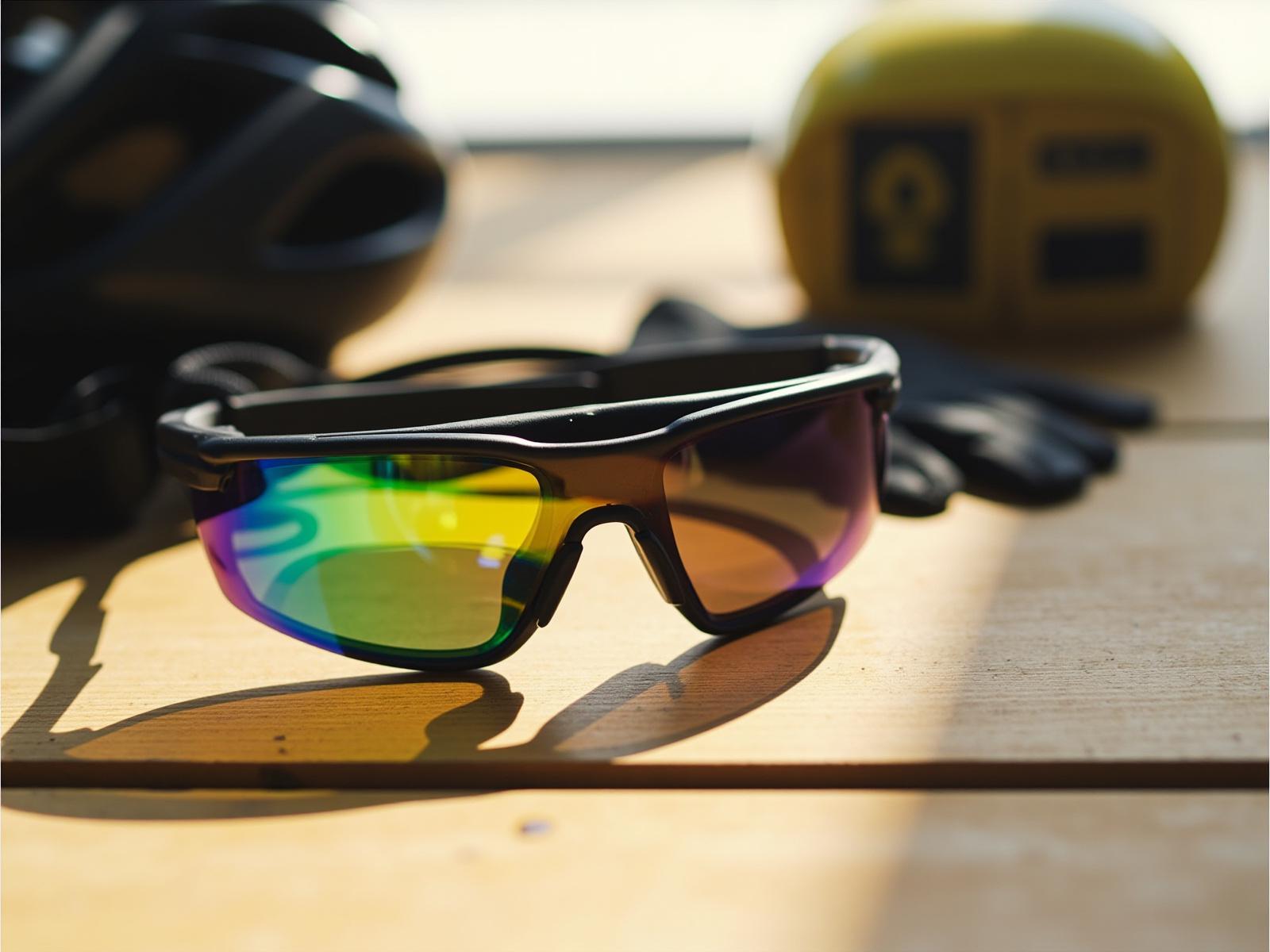
A third environment is the vehicle cab, and it is the one that most often invalidates a passive route by assumption rather than by measurement. Glass removes a large part of the ultraviolet that a passive reaction depends on, so a passive lens in a cab may darken weakly, inconsistently, or not at all. A buyer who has not asked the question will find out from a customer, and the report will read as a fault.
The acceptance criterion for the vehicle environment is a state behaviour, not a reaction behaviour: the state shall hold through a defined cabin light sweep, measured by exposing the unit to the light range encountered in a cab and recording what the lens does at each point. The comparison is between the cab condition and the open-air condition, and the requirement has to state whether the two are expected to differ.
If they are expected to differ and the difference matters to the channel, then the driven route is not an upgrade but the requirement, because it makes the behaviour independent of the ultraviolet reaching the lens. If the difference does not matter, the criterion is simply a documented tolerance and the passive route remains adequate.
Night work and the narrow bright source
The fifth environment is night work: patrol, security, night maintenance, warehouse operation after dark, and any channel where a lamp or a vehicle's own lights are the only bright source. Here the ambient is dark and the bright source is narrow and close, which produces a constraint that has nothing to do with the sun.
The dominant constraint is the clear state. A product that has been in a dark environment and is then brought into a bright one must return to a defined clear transmission, and it must do so without overshooting into an almost opaque state that the operator cannot work through. A lens with a slow clearing response is a serious problem here rather than a cosmetic one, because the clearing happens precisely when the bright source appears.
The acceptance criterion is therefore written on the clear state and on the clearing direction at the temperatures the channel actually experiences: the clear-state transmission at the agreed figure, and the time taken to reach it from a stated starting state, at a stated temperature. The flat-battery behaviour belongs in the same criterion for the driven route, because in night work a unit that has been idle in a vehicle all evening may be flat when it is needed.
Which scenarios share a criterion
Two of the five environments can share a criterion set, and the other three cannot, which is itself a useful planning fact. The indoor environment and the night environment both require a defined clear state, so a channel serving both can use one acceptance pack with two lighting conditions inside it. The outdoor environment and the vehicle environment both require a defined dark behaviour, but under different light, so they need two separate dark criteria.
The dawn-and-dusk environment is the one that cannot share with anything, because it is the only one where the transition itself is the acceptance event. Its criterion is a clearing time measured at the coldest temperature of the shift, with the starting state stated and the light level stated, and it needs a second figure for the reverse transition. A shift that crosses both ends of the day is the environment where a marginal lens becomes visible, and it is the environment that a specification written at midday will not survive.
Writing an acceptance pack per scenario
The four questions each scenario pack must answer
Every scenario needs a pack of four answers, and a pack is incomplete if any one of them is missing. The pack is short enough to write in half a page per scenario, which makes it cheap to produce and cheap to compare across suppliers.
- The binding light level. The worst or most frequent light condition in that environment, stated as a level rather than as a description, because the reaction or the commanded state has to be evaluated against it.
- The temperature at that moment. Not a range for the season, but the temperature at the binding condition, because the response of a reactive lens and the capacity of a cell both depend on it.
- The required behaviour. What the product must be doing at that light level and temperature, stated as an observable outcome rather than as a mechanism.
- The evidence. The measurement, the sample size and the method that will close the criterion, and who performs it — the supplier's laboratory, your own protocol, or a third party.
The fourth question is where most scenario specifications fail. Without it, a criterion is a wish; with it, a criterion is something a lot can be judged against and something a warranty can be settled with.
What each scenario costs to specify and to carry
Scenarios are not free, and the cost of adding one is where a procurement team should look before a programme is divided into environments. A scenario that needs its own criterion set needs its own acceptance record, and an acceptance record belongs to a configuration. Two scenarios therefore usually means two configurations, and a configuration carries a minimum order quantity, an artwork round, a labelling set, a documentation line and a sample approval.
The commercial content of this is negotiable, and it is worth negotiating in a specific order. The first item is the minimum order quantity per configuration, which moves most readily when a committed configuration count is offered in exchange. The second is the artwork and labelling round count, where each additional round is a week of schedule and each is cheaper to fix before the artwork is commissioned than after it is approved. The third is the documentation scope, and the question that moves it is whether the documentation is priced per model or per family — a family-level file makes a second scenario cheap to add and is worth more to a growing programme than a unit price reduction.
Two further items belong in the agreement rather than in the negotiation. The first is a clause requiring notice before any change to the lens, the coating, the tint range or the frame material, because each of those invalidates a scenario criterion that has already been written and paid for. The second is the warranty basis, which has to be written against a failure condition for each scenario rather than against a period, since a scenario criterion is a state and a period is not.
The supply chain question that follows is about capacity rather than about price: whether the supplier's capacity and lead time cover the configuration count that the scenario map implies, or whether the map has quietly assumed a volume the factory has not been briefed on. That question belongs in the first request for quotation, because the answer changes the shape of the programme and not only its size.
How to shortlist a supplier against the map
The scenario map is also the right instrument for supplier evaluation, because it converts a vague question about quality into a set of things that have to be answered. The evaluation criteria fall into four groups, and a shortlist should be built by scoring each group rather than by comparing the totals of two quotations.
Capability. Which mechanism the supplier actually builds, in which substrate, and whether the factory holds the coating and assembly steps or buys them in. A supplier evaluation that does not ask this cannot see the difference between a manufacturer and a trader, and the difference is the whole risk profile of the programme.
Evidence. Which of the rows in the map are backed by a measurement the supplier has made, which are backed by a laboratory report, and which are simply not available. The due diligence question here is not whether the supplier is competent; it is whether the rows you need exist at all.
Programme. The price tier structure, the minimum order quantity per configuration, the lead time against your launch date, the sample order cost, the quality control arrangements at the point of assembly, and the defect handling route.
Risk. The compliance and certification position for the markets you intend to enter, the warranty basis, the agreement on change control, and the landed cost once freight, duty and packaging are added.
The red flags worth naming: a supplier who quotes the unit price but not the configuration minimum, who declines to say whether the documentation is per model or per family, who offers a switching time with no condition attached, or who treats a configuration change as an administrative matter. Each of those is a place where the final programme cost will be larger than the quotation, and each is visible before you order if the shortlist is built on the map rather than on the price.
Where the specification for the product ends
There is a limit to how far the scenario map can go, and stating it is more useful than extending the map past what the evidence supports. Our catalogue publishes the rows we hold and marks the rest as open. For the camera platform with the colour-change lens configuration that means an 8 MP sensor, a 220 mAh cell, a rated runtime of 5–8 hours, Type-C charging, charging in two hours or less, flexible temples, three published colour options and the lens as a configuration. For the dedicated colour-change entry it means the lens technology described as electrochromic, Bluetooth V5.4, a 100 mAh cell, charging in two hours or less, a rated runtime of about seven hours, magnetic charging, and no model designation.
We do not publish switching times, transmission ranges, uniformity tolerances, temperature ranges, cycle life figures or coating specifications, and we do not publish a bare frame weight for any model — the catalogue's single weight figure is MT6's glasses body at 158 g, which includes its 265 mAh cell and camera and excludes the folding charging case, and the case is listed separately at 1200 mAh with no weight given. Every acceptance criterion in this article is therefore a criterion the buyer writes and the supplier confirms, not a figure the catalogue supplies.
The mechanism behind both routes is set out in how photochromic smart glasses work, and the protocol that closes the open rows is in how to measure photochromic smart glasses. The product entry for this route is at photochromic smart glasses and the category background sits under photochromic lens technology.
If you are mapping a channel onto this framework, send us the environments, the light conditions you can actually observe and the number of configurations you intend to carry, and we will tell you which of the five scenarios your programme is really buying and which acceptance rows have to be written by you.


