

The honest list of limitations for a light-responsive lens product in smart glasses is short but consequential, and almost none of it can be fixed by choosing a different supplier — because the limitation is the technology's, and the category's thin published data is a symptom of it rather than an oversight by any one manufacturer. Photochromic smart glasses limitations and drawbacks is a list of what a buyer is committing to, stated plainly.
Our published position in this range is the whole of what we can say about the product: Bluetooth 5.4, a 100 mAh cell, charging in two hours or less, roughly seven hours of runtime, magnetic charging, and electrochromic lenses. There is no second light-responsive platform with published lens data to compare it against, since the V03 Pro carries a photochromic lens configuration and no lens figure of its own, and there is no model designation, no switching time, no transmission range, no temperature behaviour, no uniformity figure, no cycle durability and no coating detail.
That is a thin record, and buyers routinely read thin records as bad news. The more accurate reading is that this category is young and the record reflects the category rather than the product. A constraint you can name is a constraint you can write into a specification, and a constraint you discover from a customer is a constraint you pay for twice.
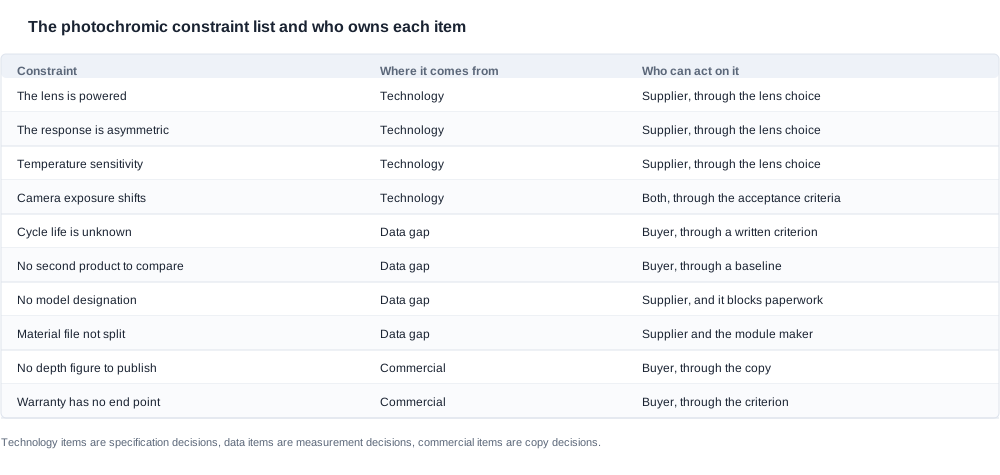
The photochromic smart glasses limitations and drawbacks fall into three groups
Why the split matters before anything is ordered
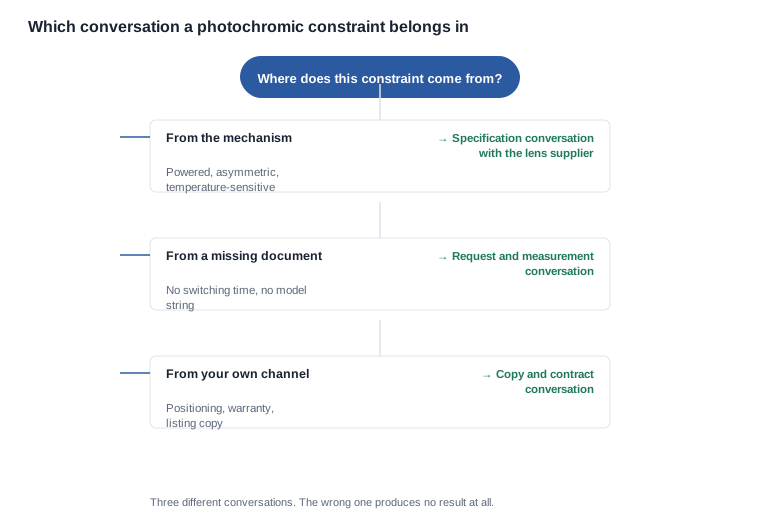
Every item on a limitations list comes from one of three places, and the place it comes from decides which lever you pull.
Technology-derived items are properties of the mechanism. No supplier can remove them, and no commercial term changes them. The right conversation is a specification conversation: what are the values, and which of them can be chosen.
Data-gap items are properties of what has not been published. They are not necessarily properties of the product. A missing switching time may mean nobody measured it, or it may mean it exists and will be supplied on request. The right conversation is a request-and-measurement conversation, and the buyer closes it with a protocol rather than with a price.
Commercial items are properties of where the product sits in the market. A claim that cannot be substantiated is not a defect; it is a claim the buyer has chosen to make, and the buyer owns it. The right conversation is a copy and contract conversation, and it is the cheapest of the three to fix.
Three different conversations, and a buyer who treats them as one has no idea which lever to pull. The cost of getting this wrong is asymmetric: a technology item accepted by mistake cannot be un-accepted at all, while a data item that turns out to be answerable costs one email.
The split also tells you what a supplier's answer is worth, which is a useful diagnostic in its own right. When a supplier answers a technology question with a document, the document is about a different constraint and the answer has been misrouted. When a supplier answers a data question with "it depends on the batch", the answer is narrower than a specification but wider than a marketing claim, and it usually means the number exists. When a supplier answers a commercial question with a feature description, the question has been answered by a different department and nothing has been decided yet. Buyers who learn to read these three response patterns can tell within two exchanges whether the programme is going to have a specification or only a brochure.
It also changes the order of work. Technology items have to be settled before the specification is drafted, because they set the values the specification refers to. Data items have to be requested before the sample is measured, because a measurement without a stated condition is a data gap with a decimal point. And commercial items have to be decided before the copy is written, because a claim written first and evidenced later is a claim that has to be withdrawn.
The five items that are not a data gap
Five of the items on the list are structural and would remain even if every measurement in this article were published tomorrow. They are worth naming separately so that a buyer does not go looking for a document that will resolve them.
- The lens is powered. A powered lens needs a cell, a driver, a control path and a defined state, which makes it a different product from a passive one.
- The response is asymmetric. Darkening and clearing are separate behaviours with separate timings.
- The behaviour is temperature-sensitive. Nothing about this can be negotiated away.
- A state change moves the camera exposure. Any camera product with a tinted lens has this interaction, and it is a design consequence rather than a defect.
- The published data in the category is thin. This is a property of the market, not of one supplier, and no amount of persistence in a single supplier fixes it.
The remaining items on the list — the flat-battery state, the switching times, the transmission range, the uniformity tolerance, the temperature range, the cycle life, the coating, the model designation, the material file, the control strategy — are all data items, and all of them are closable by a buyer who knows what to ask for.

The constraints the technology puts on the product
The full constraint list is below. The second column decides which conversation it belongs in, and the third column decides who can act on it, which is the difference between a limitation the buyer can close and one the buyer can only accept.
| Constraint | Where it comes from | Who can act on it |
|---|---|---|
| The lens is powered, and has a state at zero power | Technology | Supplier, through the lens choice; buyer, through the specification |
| The response is asymmetric | Technology | Supplier, through the lens choice |
| Temperature moves the behaviour | Technology | Supplier, through the lens choice and the market |
| A state change moves the camera exposure | Technology | Both, through the acceptance criteria |
| Published data in the category is thin | Category | Nobody; it is a property of the market |
| Cycle life is unknown | Data gap | Buyer, through a written end point |
| No second light-responsive platform with published lens data | Data gap | Buyer, through a baseline |
| No model designation | Data gap | Supplier, and it blocks four other tasks |
| The material file is not split at module level | Data gap | Supplier and the module maker |
| No depth figure to publish | Commercial | Buyer, through the width of the claim |
| The warranty has no end point | Commercial | Buyer, through the failure criterion |
A powered lens has a defined state at zero power
This is the limitation a customer meets first, because the first thing a customer does is not charge the product. A powered lens on a flat cell has a state, and the state has to be specified rather than discovered: it may hold its last commanded tint, it may return to clear, or it may sit in an intermediate state that is neither. Each of those three is a support script, a return reason and a product review comment, and the difference between them is a specification line.
The practical instruction is to ask for the behaviour in writing and to put it in three places: the instructions, the product page and the support team's response template. A product where the lens holds a dark tint on an empty cell is a pair of sunglasses a customer cannot switch off, and if that is the behaviour, it needs to be stated rather than managed.
The response is asymmetric, and the slow direction is the one users notice
A lens that darkens quickly and clears slowly is a good morning product and a bad evening one. The asymmetry is not a defect, it is a property of the chemistry and the drive, and it is one of the reasons the two switching times have to be published separately rather than as a single "switching time" figure.
The commercial consequence is that the slow direction decides which channel the product fits. A lens that clears slowly is well suited to a morning-commute outdoor channel and poorly suited to an evening indoor channel, and a buyer who has only one of the two figures will pick the wrong channel. This is one of the clearest cases in the category where the missing data is not a documentation gap but a product-market question.
Temperature moves the behaviour of a powered lens
A powered lens that behaves correctly at room temperature may behave differently in a parked car in summer or outdoors in winter, and the published data in our range says nothing about temperature behaviour. The useful figure is not the range but the slow end of it, because a lens that reacts slowly in cold conditions produces a complaint — a lens that appears not to work — rather than a specification failure.
If a channel sells into markets with cold winters, the criterion has to hold at the temperature the customer will actually experience, and that means the acceptance test has to include a cold run. A brand that discovers the behaviour from returns has already paid for the discovery twice.
A state change moves the camera exposure
Where the product also carries a camera, a lens that changes state changes the amount of light reaching the sensor, and an automatic exposure will respond to it. The symptom is outdoor footage that is over- or under-exposed for a few seconds around a state change, and the cause is that the interaction was never in the specification.
This one is entirely preventable and entirely a buyer's decision. The interaction belongs in the acceptance criteria, and the test belongs in the acceptance procedure: record while the lens changes state, in the conditions the channel sells into. A supplier who calls this a software fault after the fact is describing a specification that did not exist.
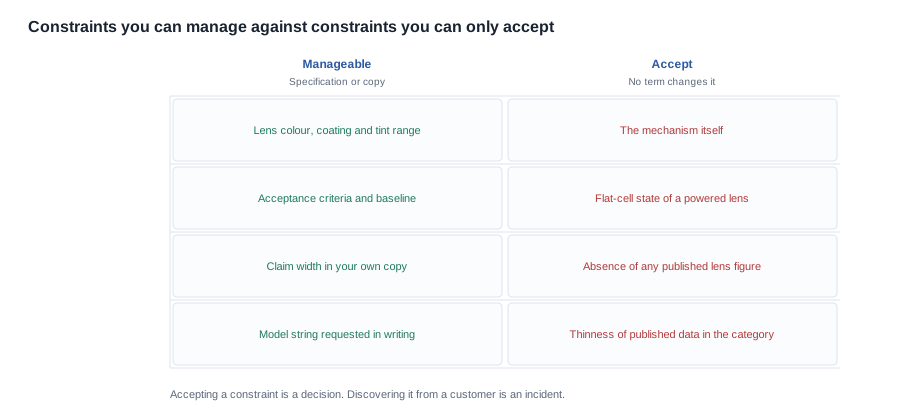
The constraints the thin published data puts on your programme
Why no second light-responsive platform carries lens data
A buyer with two quotations in this category cannot compare them, because the category has one published product and no peer. The practical consequences compound. A buyer cannot benchmark, cannot verify a supplier's claim against an independent reference, cannot tell whether a quoted switching time is good or bad, and cannot build a price argument on performance, because there is no performance data on either side of the negotiation.
The only route out is a buyer-run baseline: a measurement made on units the buyer controls, on a protocol written before the first reading, with the conditions recorded alongside the figure. That baseline is the only thing that will be comparable with the next supplier's baseline, and it is the reason a protocol agreed in the first programme is worth far more than it appears.
The model designation gap and the four things it blocks
The absence of a published model designation on the electrochromic entry is the most operational of the data gaps, because it blocks four things at once: the artwork, the technical file, the customs description and the warranty reference. It is harder to place in a conformity file, harder to reference in a contract and harder to trace in the field.
This is not a formatting quibble, and we are not going to invent one to make the paperwork look tidier. A platform without a string cannot be documented to a standard, and the buyer who schedules a programme around it is scheduling around a task that has not been sized. The remedy is a supplier commitment with a date attached, and the rest of the documentation work follows from it.
The lens module is three materials behaving as one component
An electrochromic lens is an active layer, an electrolyte and a conductive coating, and each of them is a separate material with a separate declaration. The framework that covers the housing covers the lens in principle and covers it in name only in practice, and a material declaration filed against a generic lens specification is not evidence about the lens that is actually fitted.
The diligence question is therefore not "do you have a RoHS declaration" but "which materials are in the lens module, and who holds the declarations for them". A supplier who cannot name the module maker is telling you that nobody in the chain has characterised the lens, and the buyer who signs for a programme in that state is accepting an open item that will surface at a conformity review rather than at a factory gate.

The constraints the commercial position puts on your copy
The claim has to be narrower than the buyer would like
Without a published transmission range, the product cannot be positioned as a sunglasses replacement, and the defensible positioning is that the lens adapts to light conditions. That is a smaller claim than a brand would like, and it is a claim that survives review, because it is narrower than the evidence rather than wider.
The cost of a wider claim is not the claim. It is that a claim the customer can falsify becomes a return, and a return in this category arrives with a comparison to the mineral lenses the customer owned before, which reframes a specification question as a quality complaint. The second claim boundary is the buyer's own copy: whatever the mechanism is called on the product page has to match the mechanism stated in the manual and in the support script, because three different descriptions of the same feature is what generates the reviews that say the product does not do what the page says.
The warranty needs a criterion rather than a cycle count
A cycle count without a failure criterion is not a test, and a warranty built on one has no end point. The first claim under such a warranty is unanswerable, because nobody can say what a failed lens looks like, and a warranty that cannot settle its first claim is a warranty that will be settled badly.
The fix is short and it belongs at the sample stage: write the transmission level at which the lens is considered failed, agree it with the supplier, and set the warranty against it. The trade-off is that a written criterion narrows what you can claim — the supplier may resist a threshold it cannot meet — but an unwritten criterion hands the decision to whoever argues longest.
The schedule carries the documentation cost
A product with no model designation cannot have its paperwork written in parallel with production, so the documentation effort lands inside the programme rather than beside it. That is the fourth commercial constraint and it is the one most often left out of a launch plan, because it is a cost of time rather than a cost of money and it therefore does not appear in a quotation.
The number of artwork rounds, the number of configurations, the number of markets and the number of component changes each add a round of review. Buyers who fix those four early are converting an open-ended documentation cost into a scheduled one.
Turning a photochromic constraint list into a specification
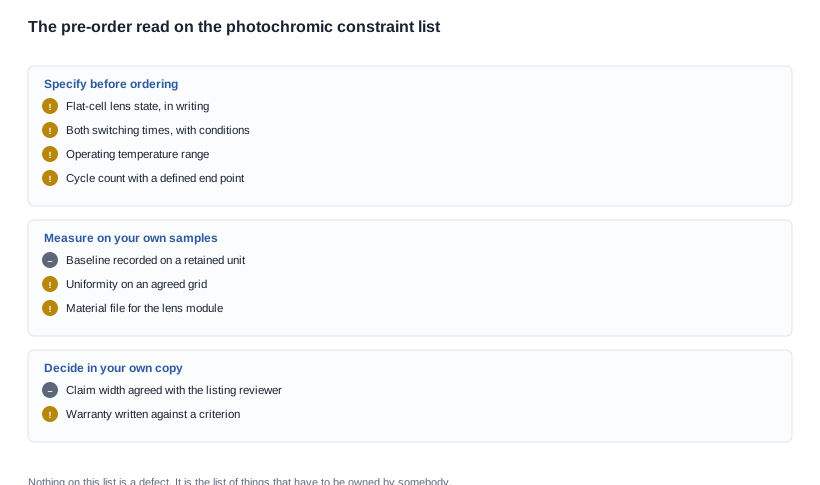
The pre-order read on the whole list
Read the list as a pre-order checklist rather than a warning, and it becomes a work plan with three columns. The items you specify are the technology items plus the flat-battery state, the two switching times, the temperature range and the cycle end point. The items you measure are the uniformity, the material file and the baseline. The items you decide in your own copy are the claim width and the warranty.
Each item has an owner and a completion test, and that is what turns a limitations list into a programme. A switching time with no owner and no test is a sentence; a switching time with an owner and a protocol is a specification row.
Which limitations to accept, and how to say so in writing
Some constraints cannot be closed and have to be accepted in advance, and the honest thing is to write them down rather than to hope nobody notices. The mechanism is one. The flat-battery behaviour of a powered lens is another. The absence of a published figure for the product is a third, and it is a permanent one for as long as the category stays thin.
Writing an accepted limitation into the purchase order has a specific commercial effect. It removes the argument later: a supplier cannot be held to a figure that both sides agreed was never published, and a customer complaint can be answered with the wording that was agreed in advance rather than with an improvised explanation. The clauses that do this are short — the lens specification and the model designation attached to the order, the acceptance criteria referencing the measurement rows and their conditions, a notice obligation before any change of lens, coating, tint range, cell or case, a re-issue obligation for the documentation pack after a configuration change, and a statement of who bears the cost when the sample does not meet the criteria.
On the commercial side, the specification and the criteria are negotiable documents, and a supplier who will sign the buyer's protocol is agreeing to be measured against the buyer's own threshold. Minimum order quantity, the number of configurations, the packaging and insert design, the market labels, the artwork round count and the payment node structure are all ordinary negotiation points. What is not negotiable is the cost and the elapsed time of a conformity route, the amortisation of tooling, or the mechanism of the lens itself.
The short answer: we publish the rows we hold and mark the rest as open, and the honest limitation list is more useful to a buyer than a set of reassuring adjectives. We publish Bluetooth 5.4, a 100 mAh cell, charging in two hours or less, roughly seven hours of runtime, magnetic charging and electrochromic lenses, and we publish no model designation, no switching time, no transmission range, no temperature behaviour, no uniformity figure, no cycle durability and no coating detail.
We will also be direct that most of this list is a symptom of a thin category rather than a defect in one product, and that a buyer who reads it as a reason not to enter the category has taken it the wrong way round. The list is a specification to write, not a verdict to accept.
What we can do is work through the list with you, separate the items you can specify from the ones you can only accept, and tell you which of them our documentation answers today and which have to come from a supplier or a measurement. The background is under photochromic lens technology, the related errors are in photochromic common mistakes, the wider considerations are in photochromic advanced considerations, and the range is photochromic smart glasses.
Where the limitation list comes from
Send us your channel and we will tell you which of these limitations you can specify around and which you have to accept.


