

The expensive mistakes in this category happen after the order, not during it. A buyer who compares three quotations correctly and then accepts a delivery without a baseline record has already lost the argument with the supplier, because there is no baseline to compare against and every later claim becomes an opinion. The catalogue publishes no photochromic performance figure at all — no switching time, no transmission range, no uniformity tolerance, no temperature range — so every judgement made in the field has to be defended by a record the buyer created before the first unit was installed. This is a list of nine operating-phase mistakes, the symptoms that produce them, the thresholds that settle each one, and the contractual language that keeps the supplier answerable once a unit leaves your warehouse.
Photochromic: the first hour after a shipment lands
Two errors occur before a single unit reaches a customer, and both of them are cheap to prevent and impossible to repair afterwards. The first is failing to record what a working unit looks like. The second is accepting the delivery without establishing which unit is which.
A baseline nobody recorded
Our catalogue publishes the rows we hold — for the camera platform with a colour-change lens configuration: an 8 MP sensor, a 220 mAh cell, a rated runtime of 5–8 hours, Type-C charging, charging in two hours or less, flexible temples, three published colour options, and the lens listed as a configuration. For the dedicated colour-change entry: Bluetooth V5.4, a 100 mAh cell, charging in two hours or less, a rated runtime of about seven hours, magnetic charging, and the lens technology described as electrochromic. It publishes nothing about how either lens reacts. The practical consequence for a buyer who has just taken delivery is that there is no supplier figure to point at, so the first unit that arrives becomes the reference by default — whether or not anyone wrote down what it did.
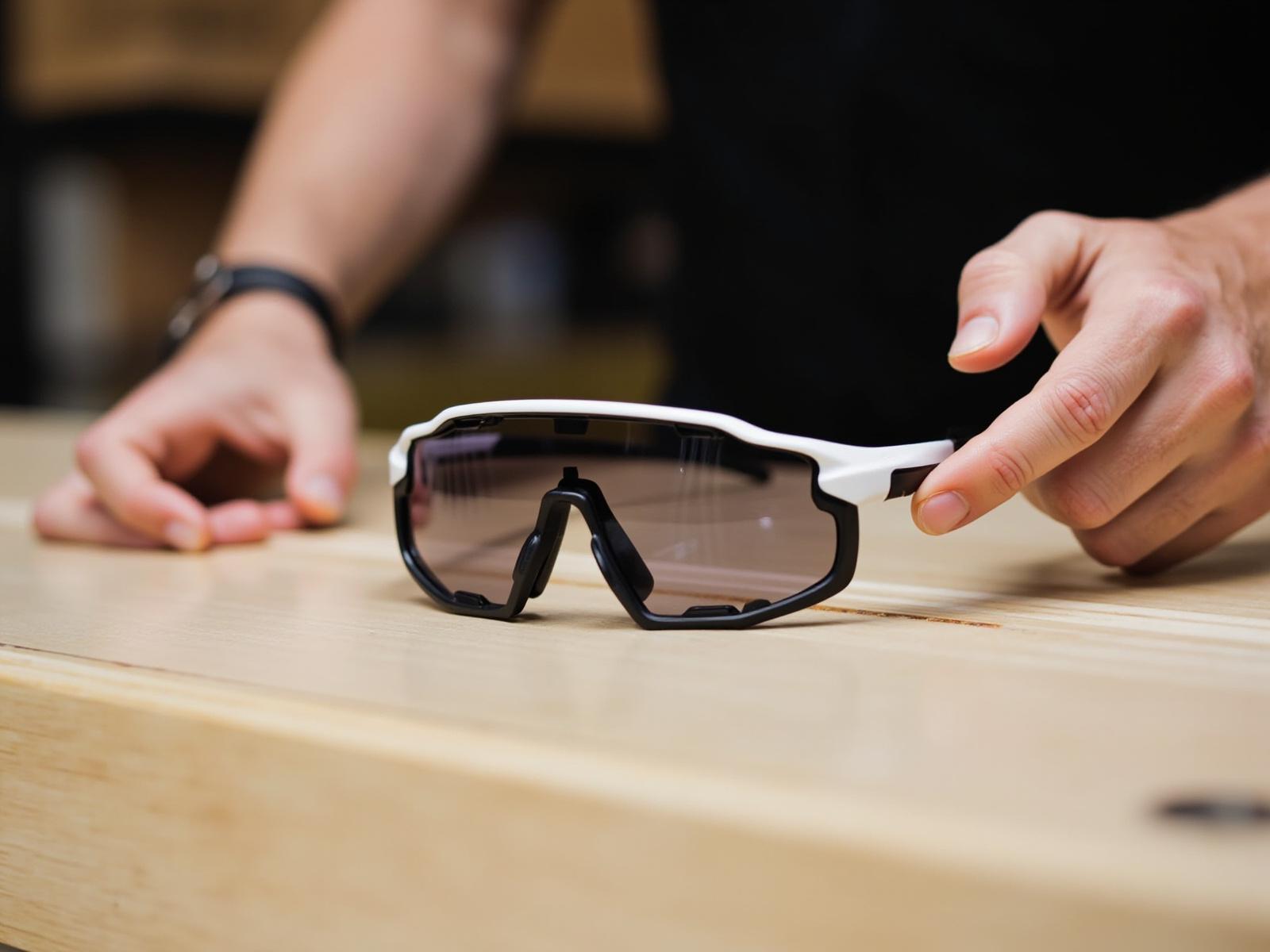
Record the baseline while the units are still in your own space and the comparison is free. The protocol is short enough to write on one page and long enough to settle a claim:
- Photograph one unit, in one light, at one moment, with an object of known optical behaviour in the same frame.
- Time the change in one direction with a stopwatch, starting from a stated light level, and write the level down rather than describing it as "bright".
- Repeat the timing at the coldest condition you can realistically provide, and record the temperature with the measurement.
- Read the transmission at a stated set of points across the lens, on a grid agreed in advance, so that the grid is the same on every unit you examine.
- Date the page, countersign it, and file it against the model designation and the delivery date before any unit leaves your own space.
That page is worth more than any assertion in a supplier email, because it is the only document in the chain that nobody else wrote, and because it was produced before anyone had a reason to dispute it.
Accepting the delivery without an identity check
The second error is administrative and it is more common than it should be. A colour-change lens is not a colour, it is a configuration, and configurations multiply: one platform, three published colour options and a lens configuration is three configurations on one platform, not one product with a swatch. Each configuration can carry different artwork, a different labelling set, a different sample approval and a different position on the certificate model list.
Check the model designation on the units against the designation on the purchase order before anything else. The dedicated colour-change entry in our catalogue has no model designation published at all, which is a fact about the entry rather than about your shipment — and it is exactly the situation in which a receiving team fills the gap with a convenient internal name. Internal names are not traceability. If your own article references a model string, that string has to survive into the technical file, the declaration, the packaging and the certificate model list, and the only way to guarantee that is to compare it on receipt.

Symptoms that arrive with the first delivery
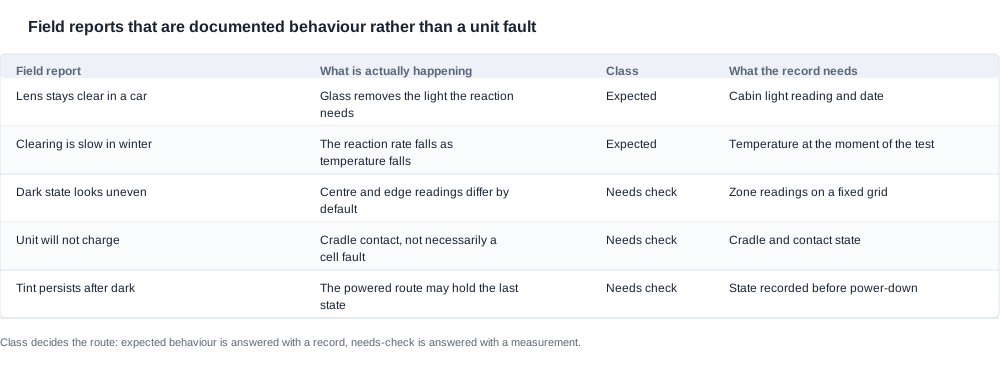
Most field reports about a colour-change lens are not defects. They are documented behaviour that nobody wrote down at the point of delivery, meeting a customer who expected a different technology. The four symptoms below account for the large majority of what a channel operator sees in the first weeks, and each of them has a threshold that can settle the question.
Slow clearing in cold weather
A photochromic lens reacts to light. The rate at which it reacts changes with temperature, and the change is not subtle at the cold end. A unit that clears in a few seconds on a warm afternoon can take considerably longer on a winter morning, and the customer reports it as a fault because the product page did not mention temperature. The threshold to hold is not a number you can publish today — we publish no switching figure for either route — so the threshold has to be a protocol: measure the clearing time at a stated temperature, record the temperature with the measurement, and compare only measurements taken at comparable temperatures. A claim built on a warm-afternoon reading and a cold-morning reading is a claim that will be rejected, because the two numbers are not the same measurement.
The practical rule for procurement is to write the temperature into the acceptance criteria for the sample, not just into the internal test note. If the supplier cannot state a working range with the rate at each end, that is an answer you need before the first shipment, because the first cold morning in your market will generate the report.
The tint that never appears in a car
Glass removes much of the light that drives the reaction. A passive lens sitting behind a windscreen may never darken at all, and the customer concludes the product is broken. This is the single most frequent expectation gap in the category, and it is a specification failure rather than a product failure: nobody wrote down which light environment the claim assumes.
If your channel includes driving, the threshold has to be a written statement from the supplier about the behaviour behind glass, or a measurement of it. There is no version of this where the buyer's own expectation is a safe default. Either the requirement changes to a driven lens with a controllable state, or the copy states the light assumption, or both.
There is a third option that is usually underestimated, and it is the cheapest: keep the lens out of that configuration entirely and sell a different variant to that channel. The operational cost of doing so is a second configuration, a second set of artwork and a second line on the packing list, all of which are countable before launch. The operational cost of not doing so is a stream of reports from a channel that cannot be defended, and that stream does not stop.
A dark state that looks uneven at the edges
A centre reading is easy and nearly useless, because a customer notices edge-to-centre variation long before they notice an average. A lens that darkens evenly in the middle and less at the edge is the normal shape of a coated, curved element, and it will read as a defect if the first shipment is judged on photographs.
The threshold to hold is a maximum difference between zones, measured on a stated grid, agreed before the first article and not discovered at it. Without an agreed grid, any two people can produce two different measurements of the same unit and argue about them indefinitely. A uniformity tolerance written after the first complaint is a tolerance that has already been missed.

Storage, transit and the temperature the lens actually lives in
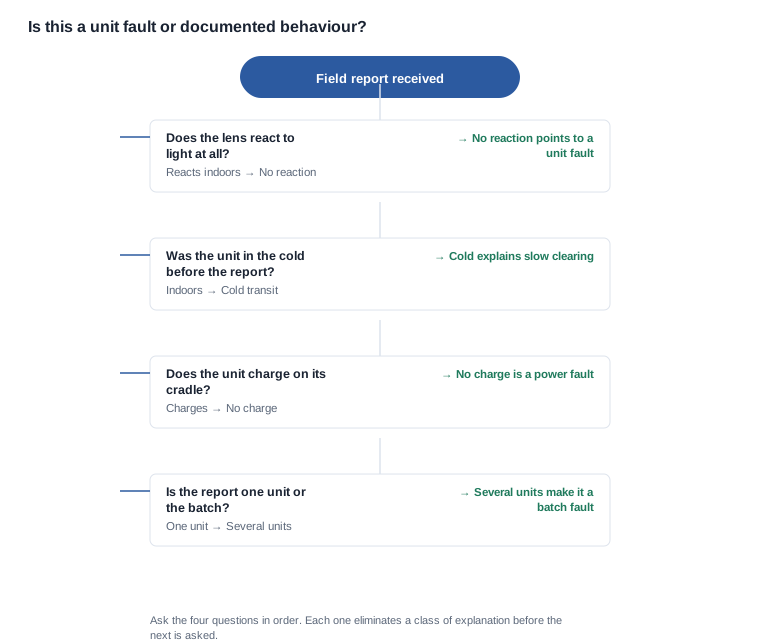
Most channel operators store product between seasons in whatever space is available. In a category where the behaviour of the lens is temperature-dependent, storage is not a logistics detail — it is a specification input, and it is the one that most often produces a false fault report.
A parked vehicle in summer
A vehicle interior in summer reaches temperatures that exceed anything in a warehouse, and the light inside a parked car is enough to hold a reactive lens in a dark state for hours. A unit that comes out of a parked vehicle and is shipped across a country in that state will reach the customer already tinted, and the customer will read it as a defect rather than as storage.
Two thresholds settle this. The first is a maximum storage temperature written into the distribution agreement, with a defined exposure time. The second is a shipping condition: a dark, insulated outer carton and a dispatch rule that the product spends no extended period in a vehicle. Neither of these costs anything during assembly, and both of them are almost impossible to impose after the programme has launched, because the channel has already built its own logistics around the old assumption.
Wiping agents and the coating stack
The lens is a stack, and the top of the stack is a coating. The reactive element underneath it, the substrate under that, and the anti-reflective and scratch layers on top are all specified separately, and a solvent that is harmless on a frame can attack a coating.
This is where operational discipline matters most, because the decision is made by whoever is holding the unit at that moment — warehouse staff, a repair partner, a field technician. The threshold is a one-line instruction that names the permitted agent and the prohibited ones: a lint-free wipe, dry or lightly damp with a stated solution, and no household aerosol, no solvent, and nothing abrasive. Make that instruction part of the documentation pack, part of the channel agreement and part of the training for anyone handling product, because the damage is not visible at the time and it is reported months later as a haze, a scatter, or a camera output that no longer matches expectation.
The commercial version of this instruction is a warranty clause. Where the coating has been damaged by an unapproved agent, the claim should fail. Where the coating has degraded under the stated operating conditions, the claim should pass. Without that separation, you are paying for damage you caused.
Charging cradles and the powered route
The dedicated colour-change entry charges magnetically, and it publishes a 100 mAh cell, charging in two hours or less, and a rated runtime of about seven hours. The camera platform with the colour-change lens configuration charges over Type-C with a 220 mAh cell and publishes a rated runtime of 5–8 hours. Two products, two interfaces, two accessories.
Mixing cradles across the two is a predictable field failure, and it is a failure of the operation rather than of the product: a unit presented to the wrong cradle either does not charge at all or charges unreliably, and the report that arrives says the unit is faulty. The threshold is trivial to state and expensive to ignore: the charging accessory is identified by model designation in the packing list, the channel agreement and the service documentation, and the cradle itself is a stocked item with its own minimum order quantity, its own lead time and its own spare pool. A powered route that ships without spare cradles will generate a fault rate that is entirely a logistics artefact.

Separating a unit fault from a batch fault
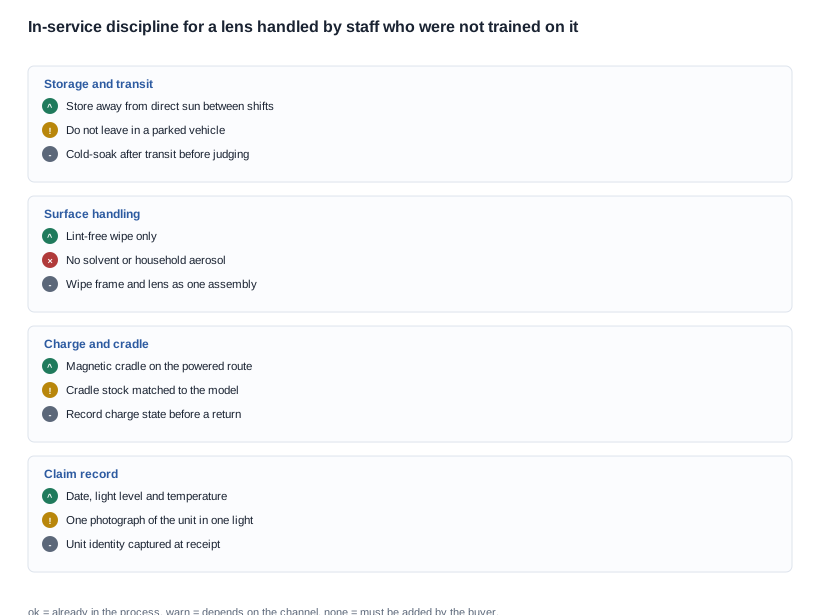
The distinction that decides cost more than any other in the operating phase: a unit fault is a warranty event, a batch fault is a supply-chain event with a different root cause, a different remedy and a different price. Confusing the two is what turns a contained problem into a recall.
One unit against the batch
The test is simple and it has to be run within a defined window. If one unit in an order of several hundred behaves differently and the rest are consistent, that is a unit fault and it goes through the warranty route. If a cluster from the same delivery window, the same carton or the same date code behaves the same way, that is a batch fault and it goes through the quality route, and the investigation asks about the supplier's own production window rather than about the customer's handling.
The threshold for declaring a batch fault should be written before the programme launches, and it should be a number with a scope — for example, more than a stated share of units from one delivery failing the same written criterion. A threshold invented during an investigation is a threshold shaped by the conclusion, and the supplier will refuse it, correctly.
Evidence that survives the return
A returned unit is the evidence, and it degrades. A lens that reacts slowly on the day of the complaint will react normally a week later, once it has been stored at room temperature, so a unit returned without a protocol is a unit that can no longer be examined.
The evidence that survives a return is unglamorous: the unit itself, the date, the ambient light condition, the temperature, the elapsed time from exposure to the observed state, a photograph taken in one light, and the charge state before the unit was powered down. On the powered route, the state of the lens before power-down decides whether the observation is reproducible at all, and it cannot be recovered later.
Two commercial consequences follow. First, the return authorisation should specify what travels with the unit, and the warranty clause should say that a claim missing those elements cannot be settled without further data — which means a cost the customer bears, and which therefore gets taken seriously. Second, the settlement cost should be agreed in advance, because a warranty with no cost basis is a warranty with no decision procedure.
The buyer-side due diligence is therefore a matter of three documents: the acceptance criteria agreed at sample stage, the warranty criteria written against a stated failure condition, and the returns procedure that says what evidence travels with a unit. A fourth document is worth adding if the channel is large: a short register of every unit returned, keyed to the delivery it came from, because the pattern only becomes visible once the register exists and the pattern is the entire basis of a batch claim. The rules for how to ask a supplier for these are in how to measure photochromic smart glasses, and the mechanism behaviour that sits behind them is set out in how photochromic smart glasses work.
What a serviceable claim needs, and where our answers stop
The claim wording that gets rejected
Most claims on colour-change lenses are rejected because of the sentence, not because of the unit. "The lens stopped working" tells the supplier nothing that can be tested. "The lens cleared from its dark state over approximately four minutes at an ambient temperature of six degrees" is a claim that can be reproduced.
The three elements that make a claim settleable are the same three that make a measurement valid: the direction of travel, the light level, and the temperature. A claim that carries all three is usually settled quickly, because both parties can agree on what happened. A claim that carries none of them is usually rejected, and the rejection is legitimate.
The buyer-side mistake is to write the claim template in marketing language rather than in measurement language. Fix the template once, at the launch of the programme, and make it the only template the channel is allowed to use. A red flag to watch for in a supplier's own proposal is a template that asks for "the problem description" without asking for direction, light level and temperature — because a supplier who cannot collect those three cannot settle a claim either, and the warranty will be unworkable from the first month.
What we can and cannot answer
Here, we publish the rows we hold and mark the rest as open. For the camera platform with the colour-change lens configuration we publish the sensor class, the charging interface, the cell capacity, the rated runtime, the charging time, the temple design, the published colour options and the fact that the lens is a configuration. For the dedicated colour-change entry we publish the Bluetooth version, the cell capacity, the charging time, the rated runtime, the charging interface and the lens technology. We do not publish any switching time, any transmission range, any uniformity tolerance, any temperature range, any cycle life figure, any lens model designation or any coating specification, because we have not confirmed them and a plausible figure on a product page becomes a claim your customer will test on a windowsill.
We also do not publish a bare frame weight for any model in the range. The catalogue publishes one weight figure in total: MT6's glasses body at 158 g, and that figure is the whole unit including its 265 mAh cell and the camera, and it explicitly excludes the folding charging case. The case itself is listed separately at 1200 mAh, and no weight is given for it. No bare frame weight is published anywhere in the range, and every other model's weight has to be requested from the supplier rather than inferred.
The wider background on the category sits under photochromic lens technology. The claims that are most often overstated in listings are covered in photochromic smart glasses myths, and the purchase-stage errors that precede everything in this article are in photochromic smart glasses red flags.
If you are already operating a colour-change programme, the fastest useful next step is to send us your acceptance criteria and your claim template. We will tell you which lines of each are settleable as written and which are still missing the condition that makes a number comparable.


