
Most problems with a light-responsive lens are not lens problems. They are protocol problems, and they arrive in a predictable order: the lens behaves unexpectedly, the buyer cannot tell whether it is defective, the sample is rejected or accepted wrongly, and the programme spends a month on a dispute that a written protocol would have prevented. Photochromic smart glasses problems and fixes therefore has to be written as a diagnostic procedure rather than as a troubleshooting table, because a table needs a known-good state to compare against and there is no known-good state published.
Our catalogue entry for the electrochromic product in this range publishes Bluetooth 5.4, a 100 mAh battery, charging in two hours or less, roughly seven hours of runtime, magnetic charging, and the fact that the lenses are electrochromic. There is no model designation, no switching time, no transmission range, no temperature behaviour, no uniformity figure and no cycle durability. That absence is not a minor detail for this article. It is the reason the diagnosis has to be built from first principles, and the reason the single most useful habit in the category is to record a baseline on a unit before anything else happens to it.
The practical result is that a buyer who arrives with a protocol and a retained reference unit resolves a lens problem in an afternoon. A buyer who arrives with an observation and a supplier's published figure — which does not exist — resolves it in a month, and usually does not resolve it at all.
The photochromic smart glasses problems and fixes are a diagnosis, not a troubleshooting table
Why a troubleshooting table needs a known-good state
A conventional troubleshooting table works because every row says "if you see A, do B", and the rows are anchored to a known-good behaviour. That anchor is missing here. There is no published switching time to compare against, no published transmission range, no published uniformity tolerance and no second light-responsive platform with published lens data to compare a reading with.
Without the anchor, the same symptom has several possible causes and the buyer cannot tell which one applies. A lens that will not darken might be a fault, might be the wrong test for the mechanism, might be a flat battery, or might be a control strategy that simply does not respond to sunlight. A lens that darkens unevenly might be a tolerance problem, a measurement geometry problem, or a grid the two parties have not agreed on. A troubleshooting table in that situation produces confident wrong answers, which is worse than no table at all.
The alternative is a procedure that eliminates causes in a fixed order rather than matching symptoms to remedies. Each step either narrows the field or it does not, and the order is chosen so that the cheapest eliminations come first.
The four steps and what each one eliminates
- Establish the mechanism and the starting state. Is the lens electrochromic and powered? What was the state before the observation, and what does the unit do at power-up? This eliminates the entire class of "wrong test" problems, and it is the step most often skipped because it feels too elementary to be worth stating.
- Isolate the power path from the optics. Charge the unit fully, confirm the charge path works, and observe the lens across a full charge and discharge cycle. This eliminates the class of problems where a flat cell is presented as a failed lens, and it separates a power or control fault from an optical one.
- Measure against your own recorded baseline. Not against a published figure, because there is none. This eliminates the class of problems where an observation is compared with a number that came from a different unit, a different build or a different condition.
- Reproduce under a stated protocol before escalating. Same unit, same conditions, same protocol, different time. This separates a fault from an observation, and it is the step that decides whether the supplier can act on the report.
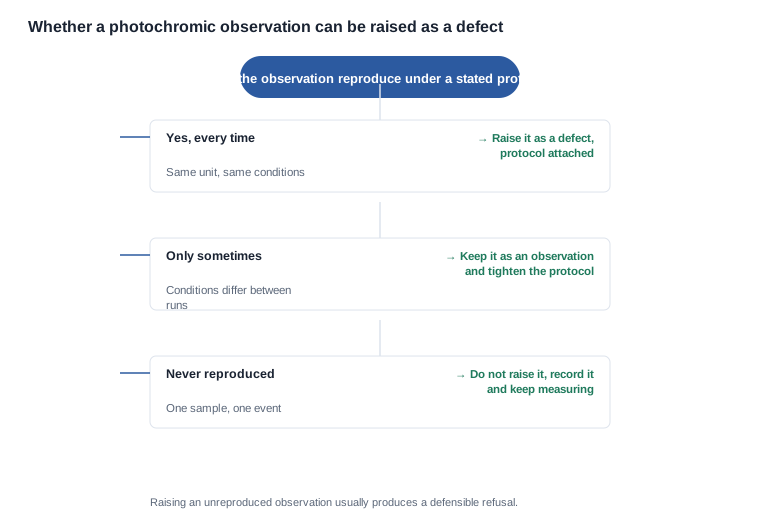
A fault that reproduces under a stated protocol is a fault you can raise. A fault that reproduces once is an observation, and raising it as a defect usually produces a defensible refusal — which is worse than useless, because it teaches the buyer that the supplier will not act on reports.
The questions to ask a supplier before a diagnostic programme starts
A diagnostic programme is easier to set up than to retrofit, and the questions to ask are the same on every platform. Ask them before you order, not when the first return arrives.
- What is the mechanism, and what is the behaviour at power-up and on a flat cell? One answer settles the whole class of "wrong test" problems.
- What is the power path, and what does a full charge and discharge cycle look like? A supplier that describes the cycle has characterised the product.
- Does the lens state persist across a power cycle, and is that intentional? The answer is a product decision and belongs in the instructions.
- Which unit should be used as the reference, and how should it be stored and conditioned? A baseline is only worth having if the reference unit is handled consistently.
- What is the escalation route, and what does the engineering contact need in order to act? An answer that is only an account manager is a finding.
- Are there known failure modes on this build that we should expect to see? A supplier that answers this question has a fault history worth paying for, and a supplier that does not is telling you the product has not been running in the field for long.
The first three questions decide whether the diagnostic procedure can be written at all. The last three decide whether it will be worth anything when it is used.

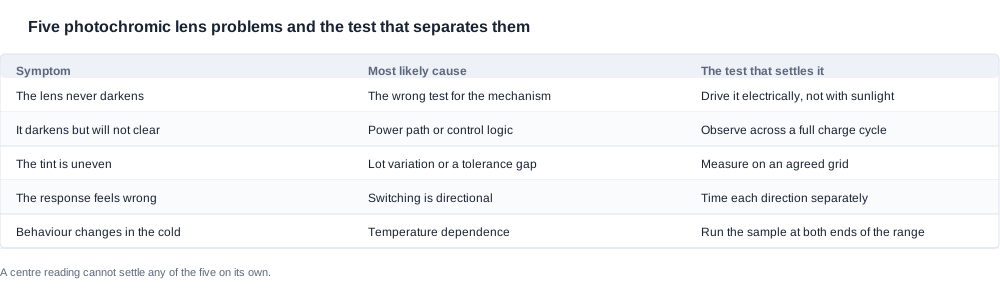
The five lens symptoms and what actually separates them
Each of the five symptoms has more than one plausible cause, and the third column is the test that separates them without a published figure to compare against.
| Symptom | Most likely cause | The test that settles it |
|---|---|---|
| The lens never darkens | The wrong test for the mechanism | Drive it electrically rather than with sunlight |
| It darkens but will not clear | The power path or the control logic | Observe across a full charge and discharge cycle |
| The tint is uneven | Lot variation, or a tolerance that was never set | Measure on an agreed grid, not at the centre |
| The response feels wrong | Switching is directional, and the slow direction is one of them | Time each direction separately |
| The behaviour changes in the cold | Temperature dependence | Run the sample at both ends of the range the channel sells into |
The lens that never darkens
Before treating this as a fault, establish whether the lens is electrochromic and powered. An electrochromic lens responds to an applied voltage, not to ultraviolet light. A powered lens that has been sitting in a dark room and then been carried into bright sun is being given the wrong test entirely, and a unit that passes that test may still be a powered lens that simply is not driving.
This is the most common false defect report in the category, and it is common precisely because the test is intuitive. The rule that separates it is short: the observation has to record how the lens was being driven, and if the answer is "it was in the sun", the observation is not yet a fault report.
The lens that darkens but will not clear
This is the most common genuine fault in a powered lens, and it is nearly always a power or a control problem rather than a lens problem. The check runs in a fixed order, and the order is what makes it efficient.
Start with the battery state, because a unit that has not been charged to a sufficient level will show a partial response and then hold it. Then confirm the unit actually reached a charged state, rather than appearing to have charged because the indicator changed. Then check the charge path itself, including the interface. Our published configuration for this platform is magnetic charging, and a magnetic interface that is not seated gives a partial state that looks like a successful charge. Then check the firmware's state handling, because a powered lens can fail to return to its clear state on a logic error rather than a hardware one.
A lens that will not clear back to a transparent state leaves the product unusable in low light, which is why this fault is worth establishing early rather than deferring to the first return.
The uneven tint and the grid it needs
An uneven tint is a manufacturing-quality question, and it is the one in this list that is easiest to get wrong procedurally. A centre reading is easy and nearly useless, because users notice edge-to-centre variation before they notice an average. A pair of units can both be within an acceptable average and both be visibly banded, and the centre reading will not show it.
The measurement has to be on a grid, and the grid has to be one both parties use. That means agreeing the zone boundaries, the viewing geometry, the instrument and the tolerance before the first article rather than after it. A tolerance set afterwards is a tolerance that has already been missed, and the discussion that follows it is about the tolerance rather than about the product.
The response that feels wrong, and the cold morning that proves it
Where the response time is the complaint, the direction of travel is the first question, because darkening and clearing are separate behaviours with separate timings. A lens that darkens quickly and clears slowly feels entirely different from one that does the opposite, and the difference is most noticeable in the second half of a day. Timing each direction separately is the test that settles it.
The second question is temperature, and it is the one that turns a subjective complaint into a measurable one. Electrochromic behaviour is temperature-dependent, and a lens that works at room temperature may behave differently in a parked car in summer or outdoors in winter. The published data says nothing about temperature behaviour, so this problem is diagnosed by measurement or not at all. The protocol that works is to run the sample at both ends of the range the channel sells into and time each direction at each temperature.
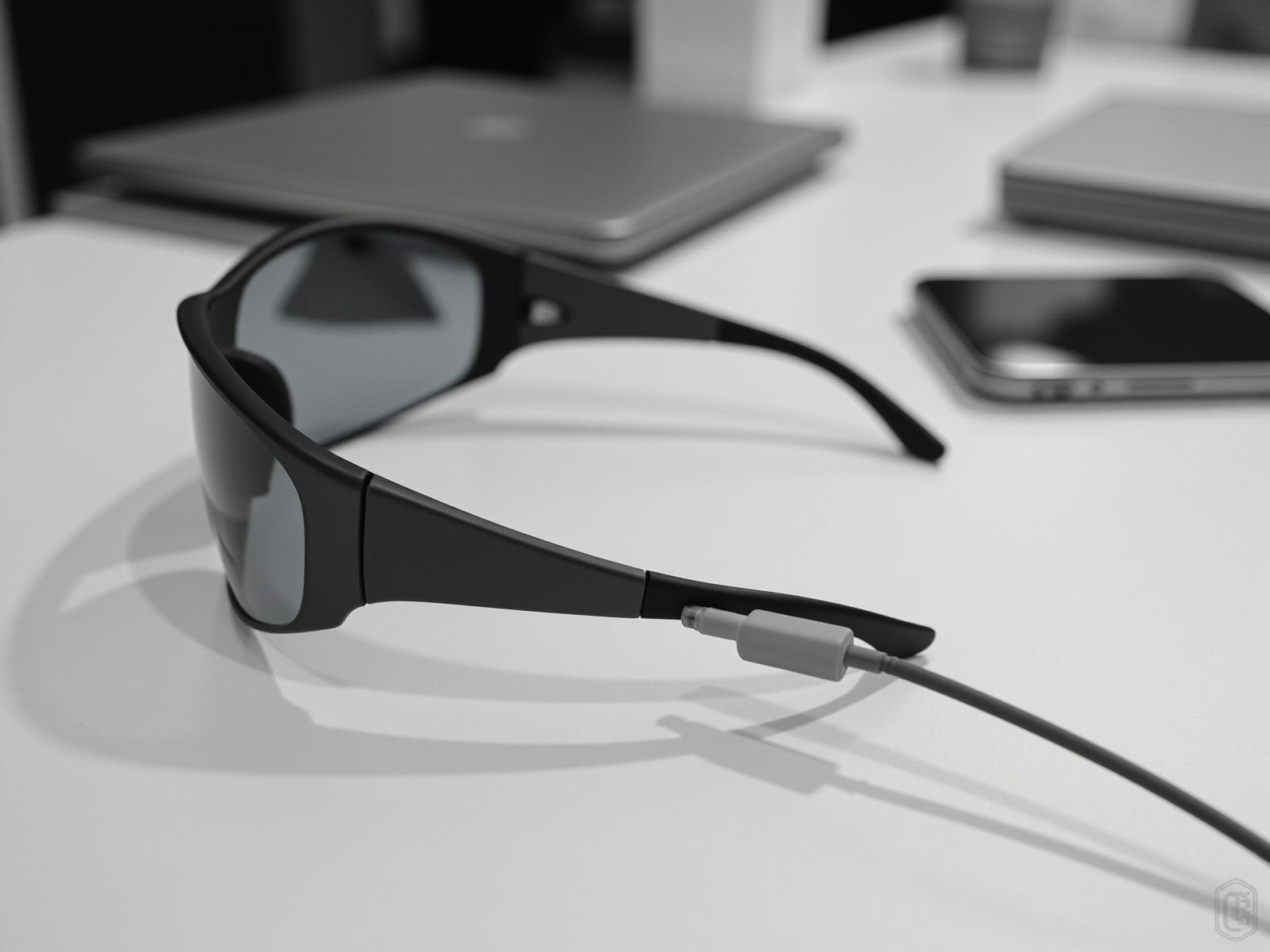
Isolating the power path from the optics
What to check on the power path, in order
The power path check is short enough to be written on a card, and the order matters because each step either confirms the previous one or replaces it.
- Charge state. A known charge level, not an indication. If the indication is the only evidence, the observation is not usable.
- The charge path. Interface seated, source accepted, and the charging behaviour consistent with the published configuration — for this platform, magnetic charging and a charge time of up to two hours.
- A full charge and discharge cycle. Watch the lens across the whole cycle rather than at one point in it. A lens that behaves consistently while powered and inconsistently when not is telling you the fault is in the power or control path, and the lens is not the suspect.
- The charge interface itself. A magnetic interface is a deliberate opening in the enclosure. A contact issue, a worn pad or a contaminated surface produces an intermittent charge, and an intermittent charge produces exactly the symptom that gets misfiled as a lens fault.
- State handling across a power cycle. Whether the lens state persists, resets or degrades when the unit is powered off and on again separates a state-machine problem from a drive problem.
The output of this check is a simple statement: the fault is in the power path, or it is not. Every branch that survives step five is an optical or drive fault, and that is a much shorter conversation with a lens supplier.
The state that persists across a power cycle
One result of the power path check deserves its own attention, because it changes what the product is. If the lens state persists across a full power cycle — the unit is switched off, the cell is allowed to settle, the unit is powered on, and the lens is still dark — then the lens is holding a state through a loss of power, and that is a behaviour the buyer has to decide about deliberately.
It may be entirely reasonable. It may be a deliberate energy-saving behaviour in the firmware. It may also be a sign that the cell is not actually reaching a low state, which is itself a finding. What it must not be is an unspecified behaviour that the customer discovers, because the discovery will arrive as a complaint about a product that will not clear.
The right action is to ask for the behaviour in writing and to put it in the instructions, in the manual and in the support script. That is the same sentence in three places, and it costs one email to obtain.
Turning an observation into something a supplier can act on
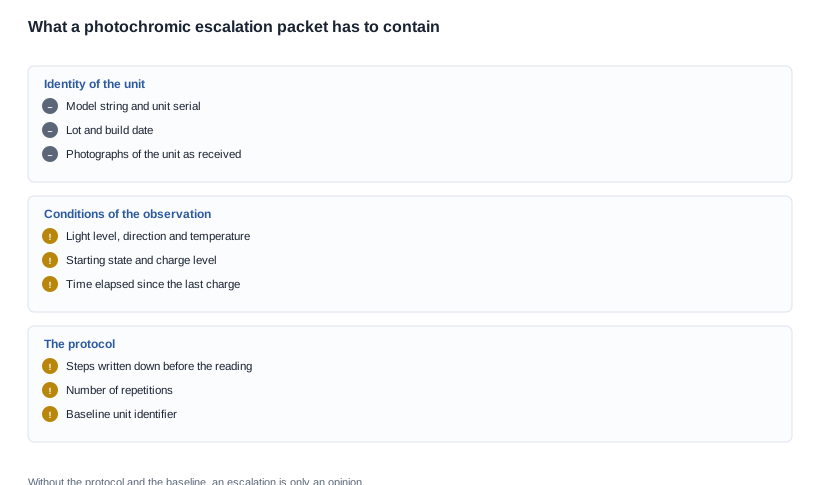
The four parts of an escalation packet
A supplier's engineering team needs four things in order to act, and an escalation that is missing any one of them comes back as a question rather than as an investigation.
- The identity of the unit. The model string, the unit serial, the lot and the build date, plus photographs of the unit as received. In a category where several platforms share electrical rows, a unit that cannot be identified cannot be located in a build record.
- The conditions of the observation. The light level, the direction of the change, the temperature, the starting state, the charge level and the time elapsed since the last charge. This is the part that turns a report into a reproduction.
- The protocol. The steps, written down before the reading was taken, and the number of repetitions. A protocol designed afterwards is a description of what happened, and a supplier can decline to act on a description.
- The baseline. Which unit was used as the reference, what it read, and when it was measured. Without this, the supplier has no way to judge whether the reading is anomalous or normal.
Reproduce before you raise it
The rule that saves the most time is simple: same unit, same conditions, same protocol, different time. A fault that reproduces every time is a defect report. A fault that reproduces intermittently is a data problem and the protocol needs tightening. A fault that happened once is an observation, and it belongs in the returns log rather than in an escalation.
The commercial reason for the rule is that the supplier's response to an unreproduced observation is a refusal, and a refusal is worse than silence. It costs the buyer a week, it establishes an adversarial tone, and in a category where the buyer-run baseline is the only reference in existence, an early refusal can end the supplier's willingness to help with the measurement programme at all.
The clauses that make the protocol binding
Three clauses turn the diagnostic procedure from a good habit into a contractual one. The first attaches the diagnostic protocol and the baseline record to the purchase order, so that "the unit behaved as designed" is not an available answer to a report that followed the protocol. The second sets the acceptance criteria for the sample, referencing the grid measurement, the power-isolation test and the temperature test explicitly, so that a sample which passes the protocol is a sample that was actually tested. The third names the engineering escalation contact and the information required, so that an escalation goes to a person rather than to a queue.
There is a fourth clause that is worth more in this category than in most: a notice obligation before any change of lens, coating, tint range, cell or firmware. A lens that changes behaviour after a firmware update is a very difficult fault to diagnose retrospectively, because the reference baseline no longer describes the product.
What we will not call a defect before the mechanism is known
The published rows we will stand behind
The short answer: we will not publish a switching time, a transmission range, a uniformity tolerance or a durability cycle count for the electrochromic entry, because none is published to us and a plausible-looking number here becomes a claim on a product page. We publish Bluetooth 5.4, a 100 mAh battery, charging in two hours or less, roughly seven hours of runtime, magnetic charging and the fact that the lenses are electrochromic, and we publish no model designation and no lens performance figure of any kind.
We will also not tell you a lens is faulty without knowing the mechanism, the state and the power path, because a large share of what arrives as a fault is a measurement made under the wrong conditions. That is not a way of avoiding responsibility. It is the observation that the four-step diagnosis eliminates most reported faults before they become reported faults, and the buyer who runs it saves the cost of a replacement unit and the cost of a month of correspondence.
What we need from you to narrow the fault down
If you tell us what the lens did and what the conditions were, we will say which of the five problems it most likely is. The measurement method is in how to measure photochromic smart glasses, the related errors are in photochromic common mistakes, the background is under photochromic lens technology, and the range is photochromic smart glasses.
What we can do is help you design the protocol before the sample arrives, tell you which of the five problems you can narrow down from your own data, and run the baseline with you so that the first unit you receive is measured before it is anything else. The commercial terms that go with this are straightforward: the protocol and the baseline record are negotiable documents, and a supplier willing to sign yours is agreeing to be measured against your own reference. Minimum order quantity, the number of configurations, the packaging and insert design, the artwork round count and the payment node structure are ordinary negotiation points. What is not negotiable is the cost and the elapsed time of a conformity route, the amortisation of tooling, or the escalation route itself — a supplier whose only contact is an account manager is telling you the engineering team is not available to you, and in this category that is a finding rather than a service level.
Where the diagnostic procedure comes from
Tell us what the lens did and under what conditions, and we will say which of the five problems it most likely is.


