

Our product record names the indicators that would decide a lens of this type, and the third of them is the one the trade means when it says a lens is dark: the speed of the colour change, how evenly that change sits across the lens, and the transmission of the lens. That third indicator is the subject here, and the first thing to settle is the word itself, because the record names transmission while the trade says depth, and those are not the same measurement.
The mechanics of that difference decide whether two numbers can be compared at all. A depth figure in this category can be expressed as the proportion of light the lens blocks at its darkest state, or as the corresponding visible-light transmittance, and supplier documents also carry a third form in which a clear reading and a dark reading are collapsed into a single ratio. All three describe the same property and none of them can be compared with another without the quantity being named, because the blocked-light form and the transmittance form move in opposite directions: the first rises as the lens darkens and the second falls.
There is also no published number to work backwards from. The word for transmission does not appear anywhere in the catalogue, and the one appearance of the word for depth is in the company profile page, where it appears in a phrase about depth of technical accumulation. What follows is therefore about the parts of a number that have to be fixed before it can be compared with anything: which word, which state, which quantity, which conditions and which tolerance.
Why the word itself has to be settled first
Take two suppliers. One quotes the proportion of light blocked at the deepest state; the other quotes the visible-light transmittance at the same state. Both numbers are correct, both describe the same lens, and a buyer comparing them sees them as contradictions, because a darker lens blocks more light and transmits less of it. Nothing is wrong with either measurement. The problem is that the two documents are using the same ordinary word for two different quantities, and the buyer has no way of knowing which convention each side applied.
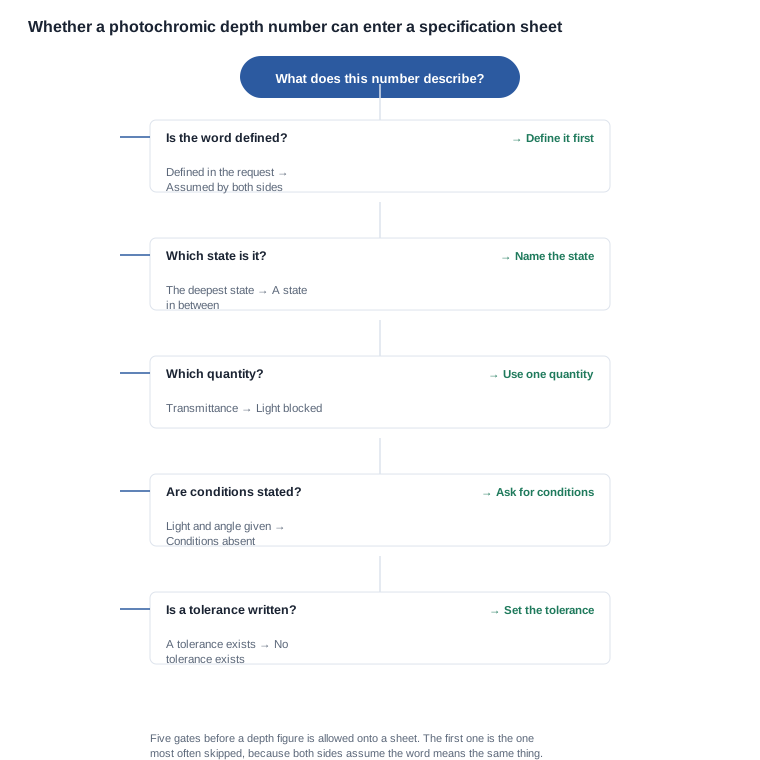
That is why the request has to carry the quantity rather than the property. The record's own choice is useful here: it says transmission, which fixes the direction of the number and therefore makes the comparison possible once both sides are on it. A sheet that carries the trade's shorthand instead will collect figures from both conventions and average them into a specification that describes no lens in particular. The criteria for settling the word are short: it has to name a quantity, it has to name a state, and it has to be the same word on every document that carries the number, including the purchase order, the inspection sheet and the carton.
The third form, the ratio between a clear reading and a dark reading, deserves separate mention because it looks precise and is not. A ratio is attractive on a specification sheet because it is a single figure with the units already cancelled out, and it is genuinely useful for comparing two units of the same type. What it cannot do is describe the clear state on its own, and the clear state is one of the three things the record names. A buyer who takes a ratio and a separate clear-state figure has two documents to reconcile; a buyer who takes a ratio and nothing else does not know what the lens does before it is activated. The ratio is a comparison instrument, not a specification.
There is a trade-off in all of this, and it is worth naming rather than avoiding. Naming the quantity precisely makes the request longer, the reply slower and the specification sheet harder to read. A shorthand request produces a shorthand answer, which is faster and which will be quoted in a listing by somebody who never saw the conditions. The questions to ask and the order to ask them in follow from that: the word first, because the number is worthless until the word is fixed.
Provenance is the other half of the word problem, and it is where the request has to be specific about who says what. A figure quoted on a product sheet, a figure quoted in a test report and a figure quoted in an email are three different kinds of statement, and they carry different weight: the first is a description, the second is a result for a named unit under named conditions, and the third is an assertion. When a buyer collects figures from three places without recording which is which, the specification sheet ends up resting on the weakest of them. One line in the request — which document each figure is taken from — is enough to prevent that.

Four states, four separate figures
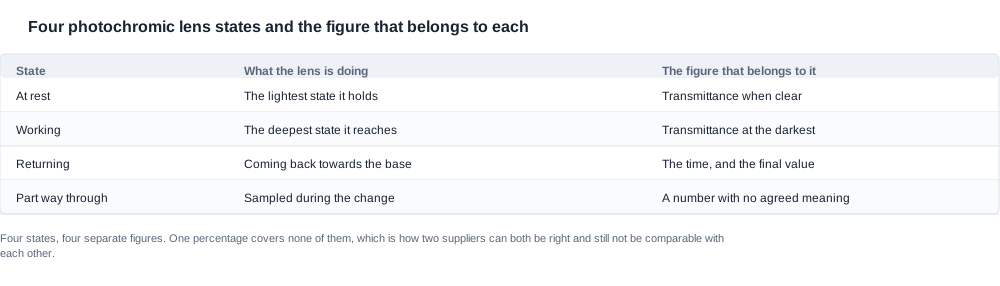
A lens in this category is not in one state, it is in four, and a single percentage cannot describe them. At rest, the lens holds the lightest state it can reach, and the figure that belongs to that state is the transmittance when clear. In the working state, it reaches the deepest state it can reach, and that state's figure is the transmittance at the darkest point. Returning, it comes back towards the base, and what matters there is the time it takes and the value it settles at, because a lens that darkens fully and returns to a different resting point behaves differently from one that returns to where it started. Part way through, the lens is sampled while the change is still running, and that is the state with no agreed meaning at all, because nothing in the documentation says where in the change a reading should be taken.
The consequence for procurement is that a depth figure without a named state is not a specification, and the request has to ask for the states separately rather than for the number. It also has to decide, explicitly, what happens to the intermediate state: either a rule is written that says readings are taken at the settled states only, or the intermediate readings are excluded from the acceptance sheet entirely. Leaving it undecided is how a number gets measured at whatever moment was convenient and then quoted as if it described the lens.
Two of the record's three named indicators sit on top of this structure and are worth keeping apart from the third. Speed is the time dimension of the change, and it is what the state sequence above is measured against. Uniformity is a property of the lens across its surface rather than a depth, and it has to be asked for separately: a lens can be perfectly even at a shallow depth and uneven at a deep one, so a buyer who asks for depth and receives a uniformity figure has been handed the wrong property. Three indicators, three requests, and none of them substitutes for another.
The clear state deserves a line of its own on the sheet, for a practical reason that has nothing to do with the lens itself. It is the state the product sits in for most of its working life, and it is the state a customer will ask about while holding the product, having just come in from outside. A figure quoted for the clear state that arrives as a verbal reassurance is worth less than a figure quoted for the deepest state, because the deepest state is usually described by a supplier with a figure in hand, while the clear state is often described as an assurance. Written on the sheet, the clear-state figure becomes something an inspection can check.
A tolerance belongs to the same structure. A figure without a tolerance is a single reading, and a single reading cannot be applied to the next unit: the question at incoming inspection is whether this unit sits inside the range the supplier agreed to hold, and that question needs a number on both sides of it. The tolerance also has to be attached to the right figure, because a tolerance on the deepest-state transmittance is not a tolerance on the uniformity of the change, and the two are usually different numbers. A lens can drift in depth and stay even, or stay in depth and drift in evenness. Which one a supplier means when they say the units are consistent is worth asking, because the answer is often one number offered for both.
What the photochromic record publishes, and the three rows around it
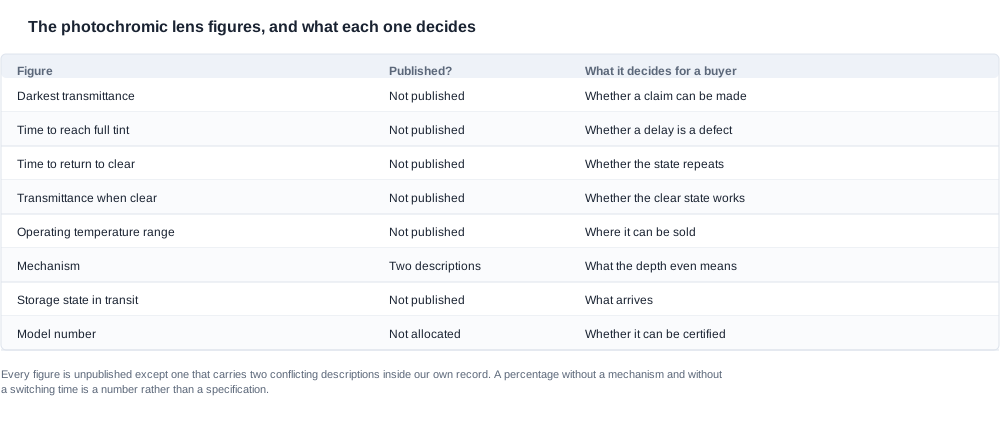
Five rows appear on the catalogue page for this entry, and every one of them is electrical: 100 mAh of cell capacity, a charge limit of two hours or less, roughly seven hours of endurance, magnetic charging and a V5.4 radio version. No lens row of any kind appears, and no figure for any of the three named indicators is published, which the record says explicitly when it states that no performance parameter for a lens of this type appears anywhere in the catalogue, and that no claim to differentiation can be drawn from the row.
Three rows around that gap decide what a buyer can do with the answers. The first is the certification row, and its position needs stating precisely because it is easy to misread in either direction. The record does contain a certification position for this entry: it states a company-level claim of the usual three marks, and what it does not contain is the per-model certificate numbers. In the camera and audio entries the record adds a note that those numbers await confirmation; here it does not, and the reason is structural rather than an omission — this entry has no model code for a number to be attached to. So the position is a claim at company level, with nothing model-specific behind it, which is a different thing from having no certification information at all.
The second is the model code. The entry is recorded without one, with a formal code marked as outstanding, and that single row is what blocks certification, warranty, listing and the purchase order. It also blocks the depth figure, because a depth value that cannot be attached to a unit cannot be certified against, filed, or checked against incoming goods later. Every other question in this article hangs off that one, which is why it is asked first and not last.
The third is the file position. No real photographs, no video and no detection report are on file for any model in the range, and this entry has no product page of its own, which is the position for twenty-five of the twenty-eight entries in the record. The supplier's own file is therefore the only place a depth figure can come from, and the buyer should expect to be asking for the document rather than opening a folder.
There is one further point specific to this category, and it is a question about the mechanism rather than about a number. The record's key technology column names an electrochromic lens, while the use case column in the same row describes the category as moving between indoor and outdoor light. Two characterisations of one behaviour sit in one row, and no published figure reconciles them. That matters for depth specifically, because the deepest state of a lens whose colour change is driven and the deepest state of a lens whose colour change is triggered by light are not the same physical state, and the phrase "at the darkest point" does not identify which one a figure describes. While the mechanism is unconfirmed, the definition of the deepest state has to be written into the request rather than assumed — and the supplier is the only party who can supply it.

The questions to send, and how to read the answers
Six questions, in an order that matters, because the first three decide whether the remaining three can be read at all.
- Which quantity does the figure express — the proportion of light blocked, or the visible-light transmittance — and at which state?
- What are the two settled figures, separately: the transmittance at the clear state, and the transmittance at the deepest state?
- Under what conditions were they taken: light level, angle of incidence, temperature, and whether the reading was taken during a change or after one had settled?
- What are the times to reach the deepest state and to return to the base state, and were both measured on this model rather than on a reference unit?
- What tolerance does the supplier hold units to, and how is that tolerance measured on incoming goods?
- Which document names this model code, and what mechanism does the lens use?
Four answers are worth refusing, and each of them sounds like an answer in a supplier's reply. A single percentage with no state attached. A typical value taken from elsewhere in the industry, which describes a category rather than a product. A figure for a neighbouring model, which is a common reply to a request for a model that has no code yet. And a figure that mixes the two conventions, usually because one value came from a test report and another from a product sheet.
How to read the reply is simple. A reply that names the quantity, the state, the conditions and the model code is a specification, and it can go onto a sheet. A reply that carries a number and none of those four is a number, and it cannot go onto a sheet and it cannot go onto a carton either. The test to apply is whether a second supplier, given the same reply, would produce the same figure; if not, the conditions are missing and the reply has to be sent back.
A partial reply is not a failed request, and it is worth handling as data rather than as an obstacle. A reply that names the quantity and the state but omits the conditions has still fixed two thirds of the problem, and the two remaining questions can go back with a single line attached to the first. A reply that gives conditions for the deepest state only has told you that the clear state is still open, which is a narrower gap than the one you started with. Writing the replies into a single table with a column for what is still missing turns a correspondence into a status, and a status is something a programme can be run against.
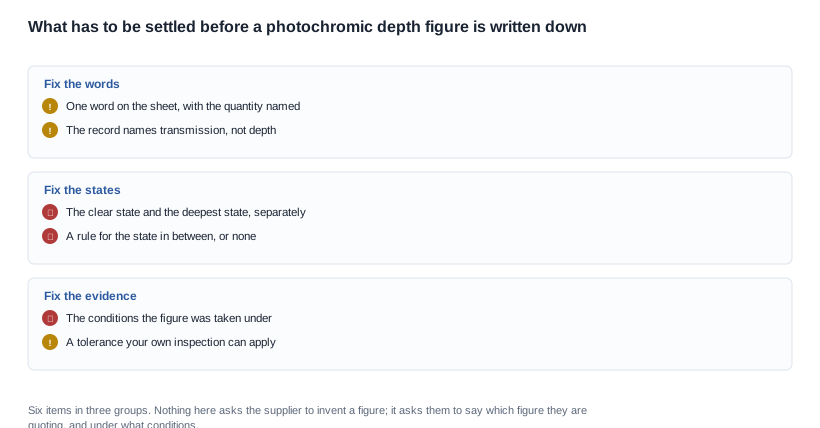
There is a trade-off to state plainly, because this category pushes hardest on one number. The depth figure is the figure a listing leans on, which is exactly why it tends to get quoted first and defined last, and a request that fixes the quantity, the state and the conditions before asking for the number will come back slower than a request that simply asks for the darkness. What it avoids is the more expensive sequence, where a figure arrives, a listing is written around it, and the conditions surface when a customer asks what the percentage was measured under. For a category where the supplier's own file is the only source, that sequence is not a risk worth taking.
What the photochromic record supports on depth
The position we take is narrow and we will state it directly. We will not quote a depth figure, a transmittance figure, a switching time or a uniformity figure for a lens we hold no data for, and we will not import a typical value from the wider industry to fill a gap the record itself has flagged. We will not use the trade's shorthand on a specification sheet, because the shorthand is where the two conventions meet. We will not present a value measured on a sample as though it described a unit that has not been identified. And we will not resolve the mechanism question on the buyer's behalf when our own record raises it in two columns at once.
There is a second thing this article is not going to do, which is to imply that the depth figure will settle the category on its own. It will not, because the same gap applies to the other two named indicators, and because a depth figure on a lens that has no model code, no detection report and no page of its own is a number without a product behind it.
There is a further consequence in the way this catalogue is organised, and it applies to the depth figure more than to any other row in it. The rows that most models in a range share — the pixel counts, the cell capacities, the charge limits — can be checked against each other, because two models publishing the same row can be compared directly, and a buyer can see for themselves whether a claim about one of them holds. This entry publishes no lens row at all, which means the depth figure has nothing inside the documentation to be checked against: there is no second model in this category, no published value for the same quantity on a neighbouring model, and no table to place it in. Every comparison a buyer might want to make has to be brought in from outside, which is exactly why the request has to specify the quantity and the conditions rather than asking for a figure and planning to compare it later. The figures have to arrive as a set, attached to an identified unit, and the set has to be checked by whoever holds the inspection rather than by whoever wrote the listing.
What the record does support is a request that can be written today. It names three indicators for this category and states in the same place that no values exist for them and that this leaves no room for a differentiation claim. It publishes five rows about the electronics and none about the lens. It states a company-level certification claim with no per-model numbers behind it and no model to attach them to. It flags a formal code as outstanding, and it flags that no detection report exists for any model in the range. Those are the conditions of the category, stated plainly, and they are enough to write a precise request rather than a vague one.
The practical conclusion is that three words have to be fixed before any number can go onto a sheet: which quantity, which state, and which conditions. Fix them in the request, attach the model code question to the same message, and the depth figure becomes a figure you can defend to a customer, a channel partner and an inspector — which is the only kind of figure this category is ever going to produce. The photochromic smart glasses range is where the entry sits, the photochromic lens technology notes cover the mechanism terms the request has to settle, the photochromic smart glasses certification piece covers the claim-by-claim reading this category's certification position requires, and the market compliance reference covers the destination-market routes a category of this kind has to clear before a listing can be published in it.
Tell us the wording you intend to use, the depth you are trying to describe and whether the lens proposition is central or supporting, and we will tell you which of the six questions has to be answered before the wording is printed, and which one can wait for the sample.


