

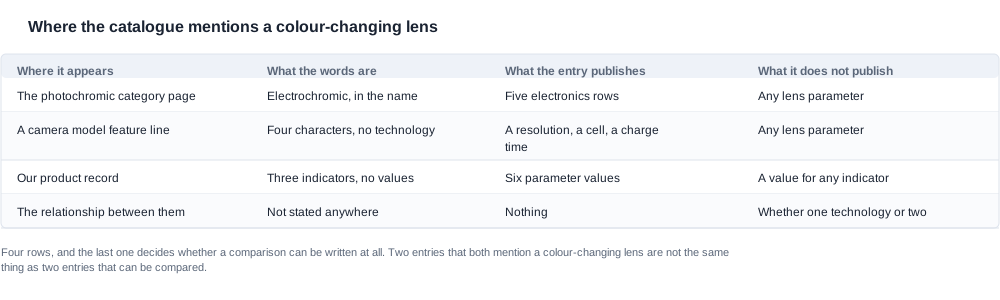
A comparison needs two sides that can be compared, and the two places in this catalogue that mention a colour-changing lens cannot be put side by side. One of them is a category page whose name carries a technology word. The other is four characters on the feature line of a camera model. They are not two variants of one product family, they are not two models of one technology, and the catalogue nowhere states how they relate to each other.
The detail matters, because the difference is not a missing number. The photochromic entry occupies a page of its own, and every row printed on it belongs to the electronics rather than the lens: the charge mode is magnetic, the cell capacity is 100 mAh, the endurance figure is about seven hours, the charge limit is two hours or less and the radio version reads V5.4. The name on that page uses the electrochromic term, and it names no lens parameter at all. The camera model carries four characters meaning a colour-changing lens among three other feature words, alongside a published resolution of eight megapixels, a two hundred and twenty milliamp hour cell, a five to eight hour usage duration, a Type-C charge port and three colour options.
Those two entries differ in three separate ways at once. The words differ, because one of them names a technology and the other does not. The product classes differ, because one is an audio-class entry with a radio and a magnetic charge mode and the other is a camera model with a resolution and a Type-C port. And the published rows do not overlap: there is not a single specification line that appears on both pages with the same meaning. A comparison needs at least a shared basis, and this one has none.
What the catalogue actually says about a colour-changing lens
It is worth setting the two mentions down in the exact words the documentation uses, because the temptation in a comparison article is to round both of them up to the same technology. On the category page the entry is named for an electrochromic lens and everything else on the page is electronics. On the camera model's feature line, alongside a flexible temple, a Type-C charge port and a set of colour options, the words are a colour-changing lens and nothing more.
The distinction is not pedantry. A four-character descriptor on a feature line is not a technology declaration, and no parameter sits behind it: there is no material, no coating, no figure of any kind, and no indication of who defined the term or what it was taken to mean. A buyer who reads that line as "the same kind of lens as the photochromic category" has imported a product relationship that the catalogue never prints, and that relationship is exactly the thing a range plan is built on.
A second thing a buyer can establish from the documentation is how little the two entries share at the level of a purchase order. An order for the camera model would name a resolution, a cell, a charge interface, a usage duration and a colour. An order for the category entry would name a radio version, a cell, a charge limit, an endurance figure and a charge mode. Neither line can be written from the other, and a supplier who quotes one set against a request built on the other has quoted a different product. For a buyer assembling a range, that is the practical form of the problem: the documentation does not support one specification template across the two entries, so the specification sheet has to be built per entry, and the parts of it that could have been shared — the compliance file, the packaging artwork, the shipping paperwork and the warranty terms — have to be requested separately for each one as well.
The identity question sits underneath all of this, and the difference between the two entries' identities is worth being explicit about. The camera model has a stable code, a catalogue page and a set of published rows that a buyer can write onto a purchase order today. The category entry has a catalogue page, five rows and no code, with a formal code recorded as outstanding. A buyer building a range therefore has one entry that can be ordered and one that cannot, and the comparison the documentation appears to invite is between a thing that exists and a thing that has not yet been given an identity.
The record side of the two entries is no tidier. The photochromic entry has no code of its own — the record marks a formal one as outstanding — and no page beyond the catalogue, whereas the camera model has a code, a page and its own published rows. That difference in kind is worth noting on its own: one side of the proposed comparison is a documented product and the other is an entry waiting to become one.
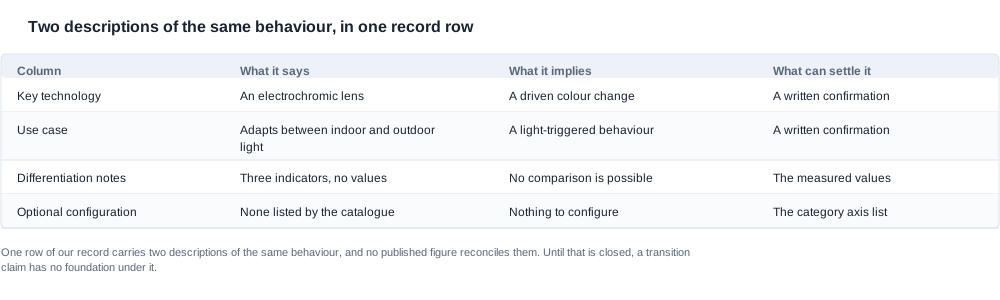
Two further points come from the same record row, and both bear directly on any transition comparison. The first is that the row names three indicators for this category — the speed of the colour change, the evenness of that change across the lens and the transmission of the lens — and states in the same place that the catalogue carries no performance figure for this category, and that no differentiation claim follows from the row. The second is that the row carries two descriptions of the same behaviour: a key technology line naming an electrochromic lens, and a use case line describing the category as shifting between indoor and outdoor light. Two descriptions, one row, and no published figure that reconciles them.

Why the two entries cannot be compared from the documentation
There are three reasons, and each of them closes a different route that a comparison could take.
The first is the word. For a comparison to mean anything, both sides have to be talking about the same mechanism, and only one of them says what its mechanism is. A driven colour change and a light-triggered colour change are different things to ask questions about, and the documentation describes one of them with a technology name and the other with a phrase. A comparison table with one named side and one unnamed side does not compare mechanisms; it compares a mechanism with an absence.
The second is the product class. Even setting the mechanism aside, the two entries have no specification line in common. The category entry publishes a radio version, a cell, a charge limit, an endurance figure and a charge mode; the camera model publishes a resolution, a cell, a usage duration, a charge interface and a colour set. The cell capacities are not even close, and the rest of the rows describe different subsystems. Two entries with no common row cannot be compared on their specifications either, which is usually where a buyer expects a comparison to start.
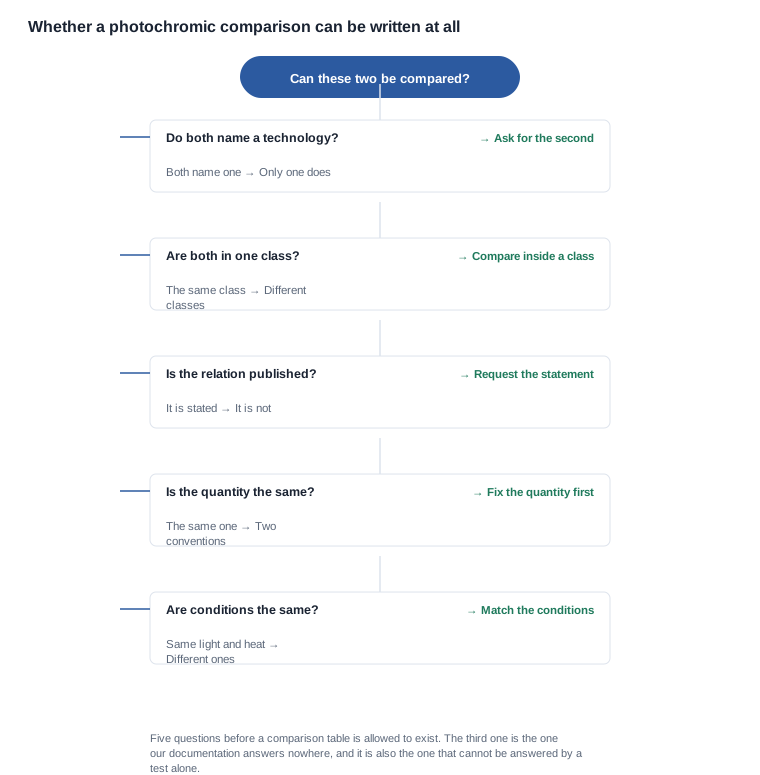
The third reason is the one that cannot be closed by a measurement at all. Whether the two entries use the same technology, whether they come from the same supplier, and whether a unit of one can stand in for a unit of the other are three questions about a relationship, and the documentation answers none of them. They can only be answered in writing by the supplier, as a statement. A test report settles what a unit does; it cannot settle what one unit is in relation to another.
None of the three reasons can be worked around inside a single conversation with a supplier, and each one carries a cost that a buyer should price before starting. The word costs a definition and a written confirmation. The class costs a second specification sheet and a second set of artwork. The relation costs a statement that somebody in the supplier's organisation has to be willing to sign. A buyer who assumes the relationship can be inferred from the fact that both entries mention a colour-changing lens will discover the cost of the third reason at the point where the goods arrive and the packaging does not match the assumption.
There is one comparison a buyer can legitimately make today, and it is the one that needs no documentation to resolve: whether the two entries can both sit in the same range at all. That is a question about the portfolio rather than about lenses, and a buyer can answer it alone. But it depends on the other two reasons, because a range that contains two entries which cannot be compared also contains two sets of packaging, two compliance files and two sets of customer expectations. The buyer who has not asked about the relation is the buyer who finds that out at the sample stage.

The three files that would make a comparison possible
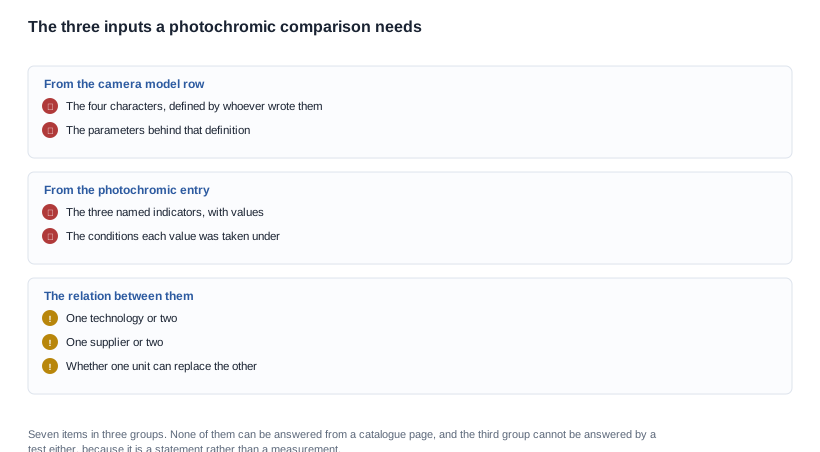
If the comparison cannot be built from the catalogue, then what can be built is the request that would make it possible. Three inputs, and the third is the one that matters most.
The first input concerns the camera model: what the four characters on that feature line were taken to mean, who defined them, and what parameters sit behind the definition. This is a request for a definition and a set of values, and it should go to whoever wrote the feature line rather than to whoever wrote the product page.
The second input concerns the photochromic entry: the three indicators the record names, with values and with the conditions each value was taken under. The record has already done the naming, so the request only has to ask for the numbers and the conditions attached to them. One of those numbers carries a condition that is not obvious: the endurance figure on that page was measured in some state of the lens, and the state is not published, so a figure transferred from one entry to the other would carry an unstated condition with it.
The third input is the relationship itself, and it is three questions in writing. Are the two the same technology or two technologies? Are they made by the same supplier or by two? Can a unit of one replace a unit of the other, and on what basis? These are the questions that decide whether a comparison table is legitimate, and no amount of testing on a sample answers them.
The questions to ask turn those three inputs into something a supplier can answer, and they are worth sending in this order.
- Which technology do the four characters on the camera model's feature line refer to, and who decided that wording?
- What parameters sit behind that wording for that model, and are they published anywhere else in the range?
- What are the three indicators the record names, with values, for the photochromic entry?
- Under what conditions was each of those values taken, and what was the state of the lens during the endurance measurement?
- Are the camera model's lens and the photochromic entry the same technology, and if they are not, what are the differences that matter to a buyer?
- Can a unit of one stand in for a unit of the other in a quotation, in a warranty file or in a shipment?
The first two come from the camera model, the third and fourth from the photochromic entry, and the fifth and sixth are the relation itself. A reply that answers the first four and leaves the last two open is still worth having, because it fixes what each side is; the relation remains a statement to be obtained rather than a value to be measured, and it stays on the register until somebody signs it.
Reading the replies is easier once the question order is fixed, because the order itself shows where a gap sits. A reply that defines the camera model's four characters but leaves the photochromic indicators open has fixed the identity of one side and left the other as a category. A reply that gives values for the indicators but no conditions has handed over numbers that cannot be compared with anything, including the numbers in the same reply. Neither reply is a reason to stop. Both are narrower than the gap the request started with, and the next set of questions follows directly from which half of each pair came back.

How to write the comparison once it is possible
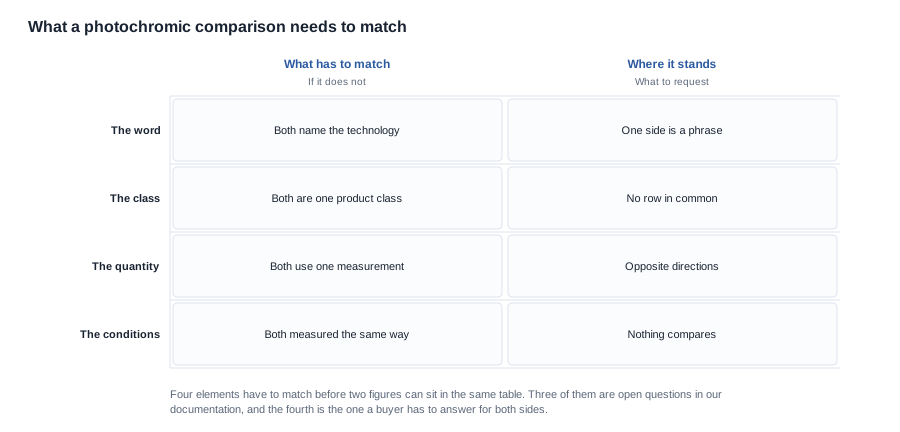
Assuming the three inputs arrive, there is a right way to build the table and a wrong one, and the difference is not presentational. Four elements have to match before two figures can share a row: the technology named on both sides, the product class, the quantity being measured and the conditions under which it was measured. The technology and the class come out of the first and third inputs, the quantity out of the definition of what each side means by its lens, and the conditions out of the values themselves. Where any of the four does not match, the honest output is two separate tables rather than one.
The method that follows is two steps rather than one, and it is slower than a buyer would like. Step one is to write each side on its own sheet: its own states, its own quantity, its own conditions, its own tolerance. Step two is to put the two sheets beside each other and to state plainly which rows can be paired and which cannot, because a comparison that lists what cannot be compared is more useful to a buyer than a table that implies every row lines up.
The trade-off is real and it is worth naming. A single table takes one afternoon and produces a document a channel partner can quote from; two sheets take longer and produce a pair of documents that a salesperson cannot reduce to a line. What the two sheets buy is that neither side inherits the other's assumptions, and that a claim built on the comparison survives the first question asked about it.
There is also a wording discipline that follows from all of this, and it is the part that reaches the customer. Until the three inputs are in hand, a listing for either entry should not use comparison language at all — not "the same lens as", not "interchangeable", not "the same colour-changing technology", and not any phrasing that places the two in one family. The documentation does not support a relationship, and a relationship asserted on a carton is a relationship the supplier will be asked about at the first complaint.
The trade-off here is the same one that runs through the rest of this category, and it is worth naming because the two-step method looks slower than it is. A single comparison table costs an afternoon and produces something a channel partner can quote from immediately; two sheets cost a week and produce a pair of documents that nobody can compress into a line. What the two sheets buy is the absence of a comparison that cannot be defended, which is also the absence of the total cost of a listing that has to be withdrawn. The criteria for deciding how to choose between the two routes are about what the programme has to publish: if the listing needs a comparison, the two-step method is not optional; if the listing needs one entry described accurately, the first sheet is enough and the relation can stay open for a year. The red flags for the single-table route are a supplier who volunteers a comparison, a documentation pack that contains a table with no conditions attached, and an answer that uses the word interchangeable without a statement behind it.
What the photochromic record supports on transitions
We will not publish a transition speed, a reversibility claim, an activation figure or a comparison between these two entries, and we will not adopt a typical figure from the wider industry to cover the gap. We will not promote a four-character descriptor into a technology name, because that is the whole of the error this category invites. We will not resolve the mechanism question on a buyer's behalf while our own record carries two descriptions of it in one row.
What the record does support is a file a procurement team can keep working from today. It records that there are two mentions of a colour-changing lens in the documentation; it records the exact words used in each; it records that the category entry has no model code while the camera model has one; it records that three indicators are named without values and that no detection report exists for any model in the range; and it records that the two descriptions of the behaviour sit in the same row of the same table. That is a short list, and every item on it is something a buyer can ask about, escalate or record as open. A compliance checklist that lists those open items with owners and dates is a better position than a specification sheet that implies a comparison the documents do not support, and the second is far more expensive to unwind once it has been printed, listed and shipped. And we will not present a figure measured on one unit as though it were a property of the category it belongs to.
What the record does support is a short description of where the evidence stands, and it is more useful than a comparison would be. There is one category entry, named for an electrochromic lens, publishing five electronics rows and no lens parameter, carrying three named indicators with no values, no model code and no detection report. There is one camera model whose feature line contains a colour-changing lens in four characters, with its own published rows and no parameters behind the phrase. Between them, no published relation of any kind. The photochromic lens technology notes settle the mechanism terms a request has to settle, the photochromic smart glasses response time piece covers why identity comes first, and the photochromic smart glasses tint depth piece covers the quantity that has to be fixed before any figure can be compared with another.
The practical conclusion for a range plan is that these two entries should be treated as two separate propositions rather than one family with two variants, and that the three inputs above can be requested this week. The photochromic smart glasses range is where the category sits, and the smart glasses battery life notes cover why a published endurance figure cannot be transferred between entries until the state behind it is known.
Tell us whether the two entries are meant to sit in one range or two, the claims your listings need to make and the markets you are shipping into, and we will tell you which of the three inputs has to be closed first, and which comparisons cannot be written at all until it is.


