

Response time is the first number a buyer asks for in this category, and it is the number our record supports least. The catalogue page for the photochromic entry publishes five rows — a radio version, a cell capacity, a charge limit, an endurance figure and a charge mode — and not one lens parameter. Our product record names the three indicators that would decide a lens of this type, and in the same line states that no photochromic performance parameter is published and that the category has no room for a differentiation claim. Between the two documents, the names exist and the numbers do not. There is a second gap behind that one, and it is the reason this piece leads with a question rather than a specification: the photochromic entry carries no model code of its own, so a response figure that arrives without one describes a category rather than a product that can be ordered, certified or returned.
What follows is the sequence that moves a named indicator into something a procurement team can check. Three moves, in order: establish the identity of the unit the figures belong to, obtain the value together with the conditions it was measured under, and obtain evidence that names the unit. Each move is cheap on its own and expensive to skip, because a figure collected out of order cannot be attached to anything at the end. Nothing in this article publishes a response time, and the reason is not that the number is commercially sensitive — it is that no measured value exists for us to publish.
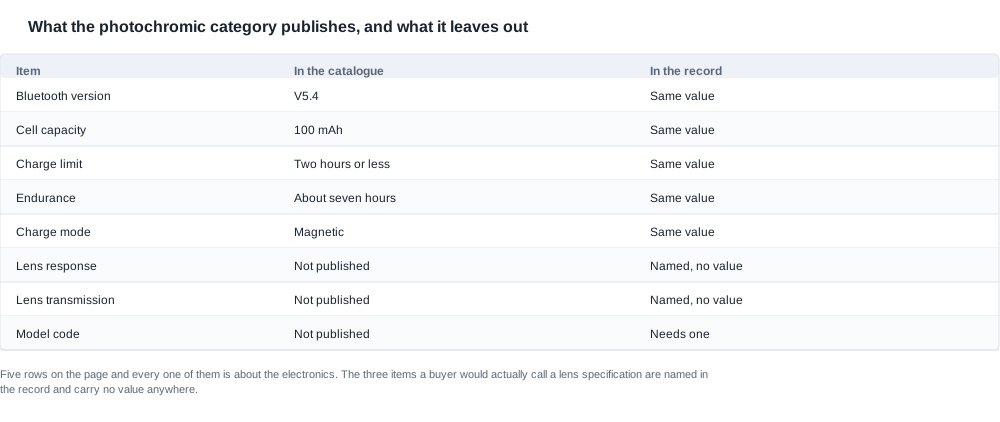
What the photochromic entry publishes, and what it leaves out
The photochromic entry in the catalogue occupies a single page, and the page is short. The electronics side of that page runs to five rows: a radio version of V5.4, a cell capacity of one hundred milliamp hours, an endurance figure of about seven hours, a charge limit of two hours or less and a magnetic charge mode. Those five rows are the entire published specification for the entry, and every one of them concerns the electronics and the power budget rather than the lens. The page does not carry a camera resolution either, so nothing on it belongs to the camera range, and it does not carry a model code.
Searching the catalogue for lens data is worth doing once, because the results are instructive. The words for response, speed, transmission, colour temperature and light sensitivity do not appear on any of the thirty-three pages. The word for depth appears exactly once, on the company profile page, in a phrase about depth of technical accumulation, which has nothing to do with a lens. The word for lens appears on the two children's pages, in the captions of a functional diagram that belongs to an electronic atomiser feature — lens clear and lens fogged — so a buyer searching the catalogue for lens data lands in a different category entirely.
The word for colour change appears in four places, and the fourth is the only one that matters here. It is the category list on the cover, the index, the photochromic page itself, and one feature line on a camera model, which prints colour-changing lens as a four-character descriptor alongside two other feature words. That camera model publishes a resolution, a cell and a charge arrangement of its own, sits in a different product class, and the descriptor it carries is not a lens parameter. In neither place does the catalogue print a photochromic performance value, and a buyer comparing the two entries against each other is not comparing a category with a model. They are comparing a category with a word.
One more navigational detail is worth knowing before anyone spends an afternoon in this catalogue. The printed index on the third page lists the photochromic category with a page reference that does not match the page the entry actually occupies, and the same disagreement shows up across the index for the camera and audio categories as well. The product record cites the physical page, which is the correct reference, so the record and the catalogue disagree with the catalogue's own index rather than with each other. A buyer who follows the index literally lands on the wrong page and may conclude that the category has no specification at all, when in fact it has five rows and an entry. If you are auditing a supplier's documentation rather than reading a website, that discrepancy is worth raising in the first email, because a document set that cannot find its own pages is a document set that will also misfile a certificate later.
| Item | In the catalogue | In the product record |
|---|---|---|
| Radio version | V5.4 | Same value |
| Cell capacity | 100 mAh | Same value |
| Charge limit | Two hours or less | Same value |
| Endurance | About seven hours | Same value |
| Charge mode | Magnetic | Same value |
| Lens response | Not published | Named, no value |
| Lens transmission | Not published | Named, no value |
| Model code | Not published | Needs one |

The three indicators the record names, and the values behind them
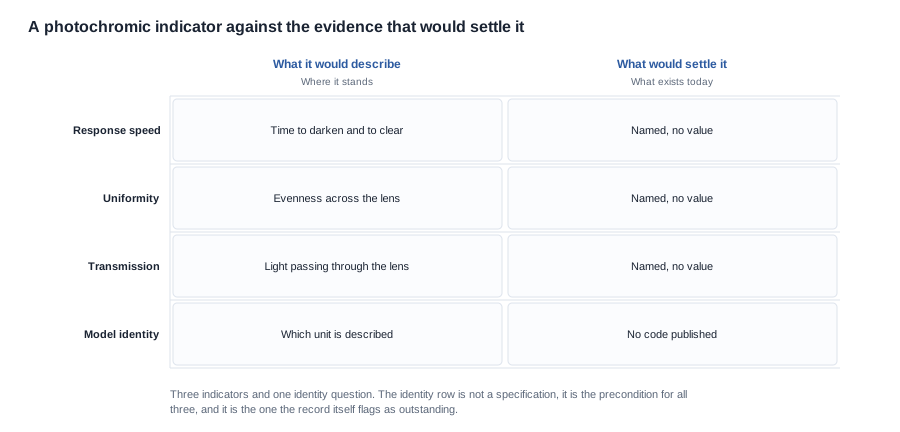
The product record does something more useful than publishing nothing, and it does it in a single cell. It names three indicators as the ones that decide this category — the speed of the colour change, how evenly that change covers the lens, and the light transmission of the lens — and it then states that the catalogue publishes no photochromic performance parameter of any kind, and that this leaves no room for a differentiation claim. Read as a whole, that is a precise statement about the state of the evidence: the record identifies what a buyer would need in order to compare products, and declines to make any claim about the values, because there are none.
That is a different thing from a catalogue that omits the topic. An omission can be filled with a typical figure, and a typical figure is exactly what a buyer ends up with when a specification gap is treated as a formatting gap. Here the absence is stated, which means it can be planned around. A buyer who knows that the three indicators are unmeasured can schedule a measurement as part of the programme, put the method in writing before the first sample arrives, and hold the supplier to the method they agreed. A buyer who does not know will receive a number in a reply to a question, and will not know what it describes.
The record also carries a category-level configuration field for this entry, and it names a lens colour-change range and speed alongside colour and packaging. That is an axis name, and no more than that: it says which property could be developed, not what any unit does. In the factory partnership piece we set out the difference between a statement the record grades and a statement it only annotates, and this field belongs to the second kind. It sits at category level, it carries no value, and it has no test report behind it. Read as a development option it is useful, because it tells you the property is workable; read as a specification it is a category-level sentence that has been placed in a row carrying a model name, and that is the trap worth naming.
Two further columns in the same row point in different directions, and a buyer should see both. The key technology line names an electrochromic lens with Bluetooth audio and low power. The use case line describes the category as adapting between indoor and outdoor light without changing glasses, as anti-glare outdoors, and as an everyday commute product. Those two lines describe two different behaviours, and no published figure exists that would let a buyer check which one a unit does. That is not an argument about either description being wrong; it is an argument that a description is not yet evidence, and that a measurement, not an adjective, is what would settle the distinction between them.
The configuration columns in that row make the same point in a different way, and the shape of the record is more instructive than any single value in it. The optional-configuration field for this entry is explicitly empty — it records that the catalogue lists none — while the customisation field in the same row names three axes. Two fields, both about what can be configured for this product, one empty and one full, for the same product. That is the signature of a record assembled from a catalogue rather than from a production file, and it tells a procurement team where the real work sits: in the gap between a field that is empty and a field that is filled, rather than in either field.

Why the first question is the model, not the response time
The entry's product code in our record reads as not labelled, and the pending column for that row says a formal code needs to be added by the company. The evidence grade on the same row is a plain grade for the parameters and an explicit unknown for the model. That is the structure of the whole gap in one line: the electronics are recorded, the product is not yet identified.
The consequences run further than the specification sheet. This entry is one of only three in the range with no model code at all, and those three are also the three without a catalogue page of their own, so there is no specification document to open. The same column makes a second point across the whole range: only three of the twenty-eight entries have an independent product page of their own, which means the catalogue is where nearly every model is described. A certification claim cannot be attached to a product that has no code to attach it to, and the certification field for this entry shows the consequence precisely: it states a company-level claim and, unlike the camera and audio entries, it does not even carry the note that the per-model numbers await confirmation, because there is no model against which a number could be confirmed. A warranty file, a purchase order and a test report all have the same dependency.
That is why the first question a buyer should ask about a response time in this category is not about the response time. It is about which unit the figure belongs to. A lens figure without a code is a figure about a category, and a category cannot be ordered, shipped, certified or returned. The buyer who asks for the code first also learns something about the supplier: a supplier who cannot name the unit cannot give a figure that transfers to your order, because the figure would be describing something they also cannot point at.
The trade-off is worth naming, because it looks like bureaucracy from the outside. Asking for an identity before a performance figure adds a step, and in a category where the supplier may simply say the code will be issued with the order, it can feel like the conversation is going sideways. It is the cheapest question in the sequence and the one that determines whether everything after it is transferable to your paperwork. A buyer who skips it will collect a response time that cannot be attached to an invoice, and will find out at the point where the certificate, the warranty claim or the return is processed.
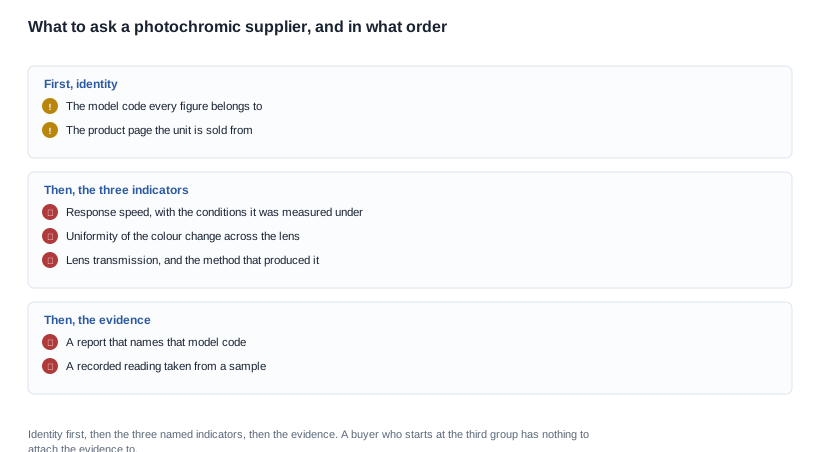

What to ask a supplier, and what to ask it with
The second move is the value, and a value on its own is not usable. A response figure describes what happened under a set of conditions, and if the conditions are missing, two accurate figures can describe two completely different products. Four conditions have to travel with the number, and none of them can be inferred from the number itself.
- The light level the change starts from and the light level it ends at. A change measured from a dim interior into bright daylight is a different transition from one measured between overcast and direct sun, and a figure that does not name its starting condition can be quoted for either.
- The temperature at which it was measured. A figure that carries no temperature describes a laboratory bench rather than a market with a seasonal range, and the market you are shipping into is not always the laboratory.
- Darkening and clearing stated separately. They are two different measurements, and a single figure that merges them describes neither well enough to write onto a specification sheet.
- The range the lens is specified to work across. An operating range is a specification in its own right, and it is the one a buyer is most likely to discover late.
Put together, the questions to send are short enough to be answered in one reply, and they are worth sending in this order rather than as a single paragraph.
- Which model code do the lens figures belong to, and is that code the one that will appear on the purchase order?
- What are the values for response speed, uniformity of the change and lens transmission for that code, and for which of them does a measured figure exist today?
- Under what light levels, at what temperature, and with which starting and ending conditions was each figure taken?
- Are darkening and clearing measured separately, and can both be given?
- What is the operating range the lens is specified across?
- Is there a detection report that names that model code, and can it be issued against our sample rather than against yours?
- What method would we use to read these three properties from a sample ourselves, and can the method be agreed in writing before the sample arrives?
The last question is the one that saves the programme. A buyer who agrees the reading method in advance converts an open technical question into a routine check that any second unit can be measured against, which is the difference between a one-off number and a quality control procedure. The photochromic smart glasses temperature effects piece covers why a laboratory figure and a field result diverge, the photochromic smart glasses tint depth piece covers what a depth figure has to state before it can be compared with another one, while the photochromic smart glasses transitions comparison piece sets out how two different lens behaviours should be handled in a range plan rather than in a headline.
There are answers a buyer should decline. A single number with no conditions describes a test bench rather than a customer. A typical figure imported from the wider industry is not evidence about this product at all. A figure printed on a sheet that names no model code cannot be matched to the goods when they arrive, and a marketing adjective with no measured value behind it — the kind of wording that turns up in listing copy — cannot be defended when a customer asks what it is based on. Those four are the red flags, and they all share one shape: a figure with its conditions, its model and its evidence removed.
The commercial reason to insist is not a compliance argument, it is a dispute argument. A listing that says the lens adapts quickly is a claim that a customer will hold you to, in a returns conversation and in a channel review, and the cost of answering that question later is far higher than the cost of asking it now. The same figure that cannot be produced at the sample stage will not appear at the point of dispute either, because nothing in the supply chain will have generated it in between. One question in the list is worth isolating for that reason: ask which of the three indicators is measured today and which are not. A partial answer is more useful than a refusal, because it tells you which measurement to schedule, which one to leave out of the copy for now, and where your own incoming inspection has to take over.

The sequence that turns a named indicator into a checkable one
It is worth setting the whole thing out as a sequence, because the order is what makes the work efficient and because the order is where most programmes lose time. Identity comes first, then the value, then the conditions, then the evidence, and then the same four steps are repeated on a sample rather than on a description of one.
| Step | What it settles | What it produces |
|---|---|---|
| Identity | Which unit the figures describe | A model code on every sheet |
| Value | What the three indicators measure | Three numbers, or a stated gap |
| Conditions | What the numbers were taken under | A comparable measurement |
| Evidence | Whether a third party can confirm it | A report naming the code |
| Repeat | Whether the sample matches the sheet | A record for incoming goods |
The last step is the one that converts a document into a control. A buyer who has agreed a reading method can record the readings from the first sample as a table, and every later unit can be measured against that table instead of against an opinion. It is the same logic that runs through incoming inspection for any other property: a number nobody wrote down at the point of receipt is a number that has to be negotiated after a complaint.
Two details decide whether that table survives contact with a real purchase order. The first is who measures: the supplier's own line, a third-party laboratory, or your incoming goods check, are three different records with three different evidential weight, and a method sheet that does not say which one applies is a method sheet that will be interpreted differently by each party. The second is the order of the goods. In a category where the entry has no model code, a sample order cannot be raised as a bare request for a unit; it has to name the configuration and the code that will be issued with it, which means the identity question has to be closed before the sample request goes out rather than in the same email. That is a scheduling consequence, and it is the reason the sequence starts where it does.
There is a real trade-off here and a buyer should price it. Agreeing a method takes time to write, delays the first order, and produces numbers for the units actually tested rather than for the range. For a category with no published performance data, that is the only route to any data at all, and a programme that needs a figure for marketing will find that a measured number from three units is worth more than a typical figure that no one can defend. What is not worth doing is the opposite trade: skipping the method, accepting a number without conditions, and discovering the absence at the point where a customer returns a unit or a channel partner asks for the evidence.
Where the photochromic record stands today
The position is narrow, and it is where we start from. We will not publish a response time, a clearing time, a transmission figure or an operating range that has not been measured for a named unit, and we will not reach for an industry-typical number to paper over a gap the record itself has flagged. We will not print a photochromic performance claim next to a model name while the entry has no model code and no independent product page. And we will not describe the category's behaviour with an adjective that no measurement supports, which is why the record states what it states: three named indicators, no published values, and no room for a differentiation claim until they exist.
What the record does support is a programme that can be run properly. Five published rows for the electronics, with a radio version, a cell capacity, a charge limit, an endurance figure and a charge mode, and a page in the catalogue that carries them. Three indicators named precisely enough to be requested from a supplier, with the gap stated in the same cell that names them. An explicit note that a model code has to be issued before anything in this category can be certified, warranted or ordered. And a marketing-file position of one catalogue image, no functional diagram, no video and no detection report, which tells a buyer at the outset that the measurement work sits on their own desk rather than in a folder they can open.
The practical conclusion is that a buyer in this category is not looking for a figure that is missing from a document. They are looking at a product that has not yet been identified well enough to carry a figure, and the work that follows from that is specific: get a code, ask for the three values with their conditions, ask what evidence exists, and agree the method before the sample lands. The photochromic smart glasses category page is where the entry sits in the range, and the photochromic lens technology notes cover the part of the subject that is technical background rather than a specification.
Tell us the market you are shipping into, the claims your listing needs to make and the sample you can test, and we will tell you which of the four steps above each of your questions belongs to, and what the record can already settle for you.


