

Photochromic smart glasses upgrade considerations start with one distinction that decides most of the rest: a photochromic lens is not an electronic feature. It is a lens that reacts to ultraviolet light, and it does so without consuming a milliamp, without a control circuit, and without any measurable switching delay you would notice while walking. That is its main strength and its main limitation at the same time, and the second one is that it does not work behind a car windscreen, where the glass has already filtered out the ultraviolet that drives the reaction.
The strategic point is this. If your customer's complaint is "I am constantly taking glasses off and on because the light changes", a photochromic lens solves it, and it is a lens swap rather than an electronics project. If the complaint is "I want to control the tint myself", photochromic is the wrong technology, and the correct route is an electrochromic lens — a different class of product with a different power budget and a different set of compliance questions.
What makes this an upgrade question rather than a selection question is that the platform already exists. That single fact changes everything downstream: you are not choosing a product, you are adding a variant to one you have already qualified, priced, packaged and documented. The considerations below are the ones that follow from that.
Photochromic: what a light-responsive upgrade changes
Three questions that decide an upgrade, and none of them is about the lens
An upgrade to a light-responsive lens is decided by which of the two routes your requirement needs, and then by three questions that are not about the lens at all: does it change the number of combinations you have to order, does it change the packaging and photography story, and does it change the claims and certification position. Those three are where the commercial consequence of a lens upgrade lands, and they are the ones a buyer forgets because the conversation starts with the lens.
Our catalogue actually offers two routes
The first is a lens option on an existing platform: the V03 Pro lists a photochromic lens configuration alongside its 8 MP camera, its 220 mAh cell, its Type-C charging, its flexible temples and its three published colour options. That is the cheapest possible upgrade, because the platform is already there and the lens is a variant. It is also a change to the optical description of the product, which has consequences for the technical file.
The second is a dedicated entry in the photochromic category, published as Bluetooth V5.4 with a 100 mAh cell, a charge time of two hours or less, roughly seven hours of rated runtime and magnetic charging, with an electrochromic lens listed as its key technology. Two things about that entry are worth flagging for an upgrade project. It has no model number in our catalogue, so it cannot yet be quoted as a specific SKU. And it carries no photochromic performance figure of any kind.
The gap between those two routes is the gap between a variant and a new product. For an upgrade, that gap decides whether your project is a configuration change with a re-approval, or a second product launch with a second documentation pack, a second artwork set and a second set of minimums.
The four performance rows that nobody publishes
A buyer deciding on a lens wants four numbers, and our catalogue contains none of them for any model: how long the lens takes to darken, how dark it gets, how much light it transmits when clear, and the range of temperatures over which the reaction still works. These are not unusual specifications to omit. They are the specifications that define the product, and a lens sold without them cannot be compared against another lens sold without them.
The practical consequence is that the decision has to be made on a sample. Put the sample in a window and watch it darken. Put it in a car and watch it not darken at all. Put it in a freezer or a hot car and see whether the response is still there. All three observations take an afternoon and answer questions that no published figure in this category will.
There is also a difference between the two lens technologies that matters commercially. Photochromic is passive: it needs ultraviolet light, it needs a temperature range in which the chemistry works, and it responds to ambient conditions rather than to a user. Electrochromic is active: it needs a drive circuit and power, it responds quickly, and it can be programmed. If your product promise is a lens that adapts automatically, photochromic is the correct answer at a materially lower engineering and power cost. If your product promise is a lens the wearer controls, only the active route can deliver it.
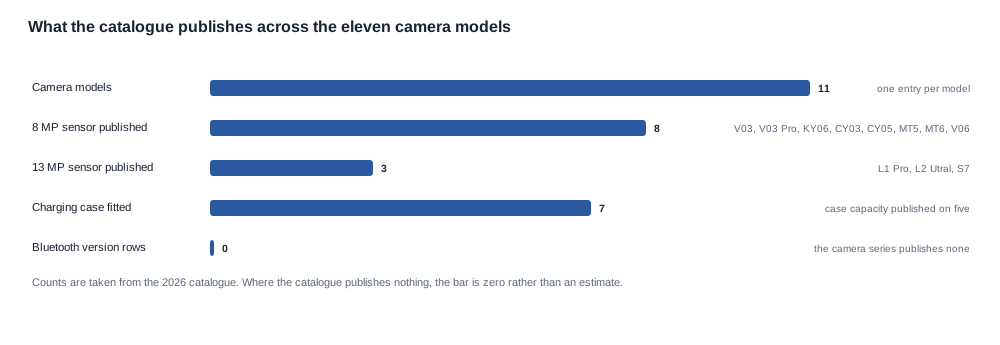
The bar chart above is worth pausing on, because it sets the scale of what is knowable. Across the eleven camera models in our catalogue, eight publish an 8 MP sensor and three publish a 13 MP sensor; seven are fitted with a charging case, of which five publish a case capacity; and not one of the eleven publishes a Bluetooth version. That last figure is the general shape of this catalogue's publication: the mechanical rows are there, and the rows that depend on a module outside the factory's control are not. A lens is one of those modules, which is why the lens performance rows are empty across the whole range.
The route decision: passive material or driven state
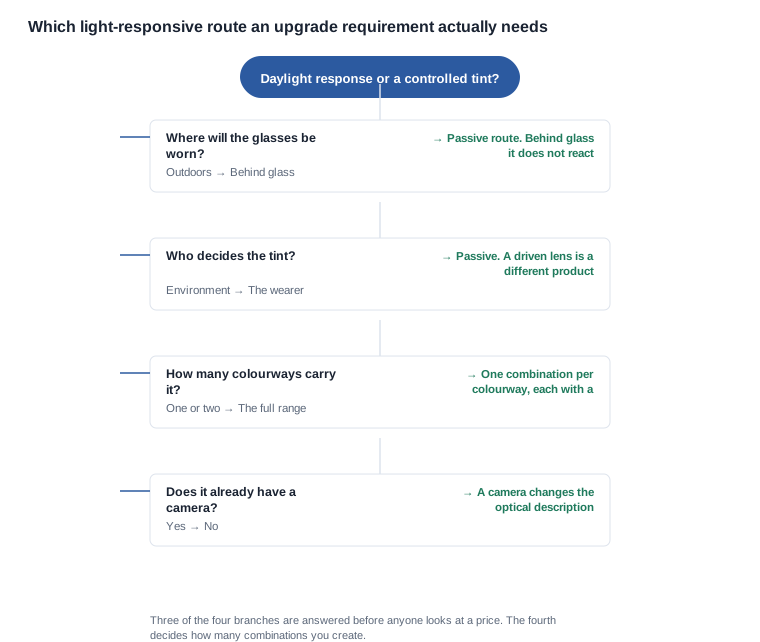
The decision has four branches, and three of them are answered before price
The route is not a preference. It is determined by what your channel does and what your customer expects, and once those are established the route is fixed — you cannot negotiate a passive lens into a controllable one, and no supplier will.
Where the glasses are worn decides the passive route's viability on its own. Outdoors in daylight, a passive lens works exactly as the customer expects. Behind a car windscreen it does nothing, because the glass has already removed most of the ultraviolet. If your channel includes driving — and for a photochromic proposition, it very often does, because the customer who buys one for outdoor use often drives to the outdoor place — then the passive route has a documented blind spot that has to appear in the listing and the instructions.
Who decides the tint separates the two technologies completely. If the environment decides, a passive material is sufficient and cheaper. If the wearer or the app decides, only the driven route can deliver, and the driven route brings a cell, a driver circuit, a control path, a charging accessory and a firmware function with it.
How many colourways carry the lens decides the shape of the commercial problem, not the shape of the product. A lens applied across a range is one variant per colourway, and each variant carries its own minimum.
Whether the platform already carries a camera decides how much of the documentation has to be revisited. A lens changes the optical description of the product, and where the product also has a camera, it changes the imaging description. For a camera platform, that means the technical file is reopened rather than extended.
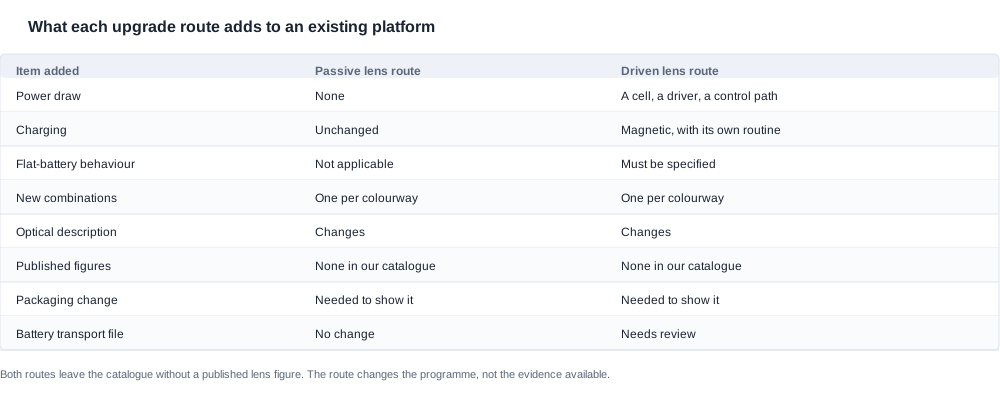
The two routes are different products, not two configurations of one product
This is the sentence that saves the most money in this category, because the two routes are routinely quoted as if they were variants of a common platform.
The passive route adds no cell, no driver, no firmware function and no charging arrangement to the platform. It does introduce a set of requirements the platform did not have: switching behaviour, a transmission range, a uniformity tolerance, a temperature range and a cycle life.
The driven route adds a power path, a control path, a firmware function, a charging accessory and a battery transport file — and it adds the requirement that the state at a flat battery be specified rather than discovered by a customer.
The compliance and engineering cost follows from that one choice, and it is not a line you can negotiate away.
The three upgrade consequences buyers forget
One: the combination count multiplies, and the minimums multiply with it
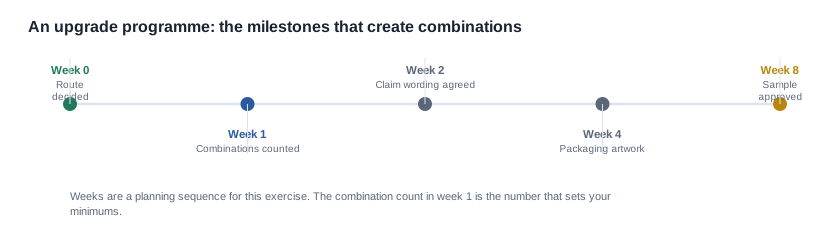
A lens option on a four-colour range is four new combinations, not one. Each combination carries its own production minimum, its own artwork approval, its own packaging variant and its own documentation scope. This is where an upgrade quietly becomes twice the size of the programme it started as, and it happens before anyone has ordered anything.
The mitigation is procedural rather than commercial: count the combinations before the artwork is approved, and ask for the per-configuration minimums in the same conversation. A supplier who prices the combination rather than the lens is negotiating with you on the right number. A supplier who quotes a lens unit price and leaves the combination count implicit is not.
If the upgrade is a single-colour pilot instead of the full range, that is a legitimate way to buy a smaller commitment — but it has to be a deliberate decision with a date attached, not an accident that happens when the range is too large for the first order.
Two: the packaging and photography change is real work, and it usually has no owner
If the lens darkens, the retail box and the product photography need to show that. The "same glasses, different light" claim is far stronger when the customer can see it happening, which means the photography has to include a light-to-dark sequence rather than a single frame.
That is a change to the packaging design, the artwork round count and the shoot schedule, and in most programmes it is the item with no named owner. It is also the item that is discovered at the launch date rather than at the artwork date, which is the worst possible moment, because there is no time to re-shoot and reshoot the box.
The practical fix is to put the packaging and photography change into the upgrade scope with a name and a date against it, alongside the lens work itself. If it is not on the schedule, it will be done in the week of the launch, and it will be done badly.
Three: the claims and certification position has to be revisited before the copy is written
A lens that changes the light transmission of the product is a feature a customer can see, and a visible feature is a feature a customer will describe back to you. That makes the claims position more than a marketing formality: it is the document that decides whether your listing wording can be defended when a customer says the product did not do what the page said it would.
Two practical consequences. First, a claim written from the retail word rather than from the mechanism — "photochromic" where the product is electrochromic, or "adapts to the light" where the product never reaches a depth worth describing — is a return waiting for a photograph. Second, a product promoted as a sunglass replacement without transmission figures behind it is a claim you cannot substantiate at all.
The claims check has to happen before the copy is written, not after the listing reviewer rejects it. That single sequencing point is the difference between a revision and a delay.

Scoping an upgrade request that a supplier can quote
The ten questions, and what each one is for
A lens upgrade that is scoped by a photograph and a budget gets quoted as a product swap. A lens upgrade that is scoped by the rows below gets quoted as a programme. The difference is usually the first two questions.
- Is the lens passive or active, and if active what is the power path? This decides the product.
- What are the four performance figures, with their conditions? Two transmission values, two switching times with the light level and temperature stated.
- What is the temperature range, and where does the figure come from? This decides whether the feature can be sold into your market's season.
- What is the flat-battery behaviour of the lens? A written product behaviour, not a support improvisation.
- How many colourways and configurations carry the lens, and what is the minimum on each? This is the number that sizes the programme.
- What is the model designation for the new configuration? A stable SKU, not a family name.
- Which certificate numbers cover the new configuration? Numbers naming the exact configuration, with the issuing body and validity dates.
- What changes in the packaging and the photography, and who owns each? A plan with a date.
- What changes in the claims position, and what wording is supported? A statement, and the copy that matches it.
- What changes in the case, the accessories or the charging arrangement? The interface and the case coverage.
The commercial structure of an upgrade
The lines worth negotiating on an upgrade are the per-configuration and per-colour minimums, because a lens option multiplies them and a supplier who understands that will price the combination rather than the lens. The number of distinct lens configurations is negotiable before the platform is chosen. Minimum order quantity is negotiable, and a single-colour pilot is a good way to buy a smaller commitment. The artwork round count is negotiable, and each round is about a week of schedule. Packaging and insert design, including the market labels and the language of the documentation pack, is a low-cost negotiation. Delivery splitting against a sample-approval milestone is often granted more easily than a price concession.
The lines that are not a lever are the certification cost and the certification elapsed time — the fee is per product family and the queue belongs to the test laboratory, so pressing on either produces a longer schedule rather than a shorter one. A tooling cost is normally a one-off item amortised across the first order, so the useful questions are over what volume it is amortised and what happens to it if the programme is discontinued. And the mechanism itself is not a variable: if the requirement needs a wearer-controlled tint, a passive lens is not a cheaper answer, it is the wrong product.
Before the deposit, the documents to request are the mechanism and the power path, the four performance rows with their conditions, the SKU and colour combination list with the minimums, the packaging and photography plan, the model designation and the certificate numbers for the new configuration, and the interface and case coverage.
In the purchase order, the clauses that matter are the lens specification and the new model designation attached to the order; the SKU and colour combination list attached to the order, so the minimums are contractual rather than a surprise; the acceptance criteria for the sample referencing the four performance rows and the three observations; a notice obligation before any change of lens, coating, tint range or frame material; a re-issue obligation for the documentation pack after a configuration change; and a statement of who bears the cost when a sample fails the criteria.

A worked upgrade on an existing four-colour range
The scenario below is invented for the sake of the reasoning: it is not a client project, and it shows the order of steps rather than an outcome.
Assume a brand-side product manager with an existing camera platform in four colourways, currently shipping into three markets, considering a light-responsive lens option for a spring line. The binding constraint is not the lens. It is that the brand's own listing reviewer rejected a claim in the previous cycle because the supplier's datasheet had no measurement behind it, and the brand does not want to repeat that.
Step one: the route. The brand's channel is cyclists and trail runners who spend hours outdoors and whose complaints are about swapping glasses. The exposure is direct sun, so a passive ultraviolet-driven lens is mechanically sufficient, and it removes a cell, a driver, a firmware function and a charging routine from the design. The engineering lead notes that the passive route also removes the flat-battery question entirely, which removes one of the acceptance criteria they would otherwise have to write. The car case is flagged in the listing draft rather than discovered later, because the passive route cannot cover it.
Step two: the demonstration. Rather than accepting the supplier's figure, the brand buys one unit, places it next to a lens the team already owns, and photographs both in the same light at the same moment. The result shows the tint is visible in a photograph, which is the test that matters, because the brand's product photography will show the lens. The brand records the protocol and the observation in a single page, and that page becomes the source of the copy.
Step three: the paperwork. The brand asks for the certificate numbers per configuration and finds that the family-level document names the platform rather than the lens configuration. That is a real gap, and it converts the model designation from an administrative detail into a precondition. The brand makes the designation a condition of the first order and puts a re-issue obligation into the contract.
Step fourth: the commercial structure. Four colours with a lens option is four new combinations, and the brand negotiates the per-configuration minimum on the basis of a committed combination count rather than a unit count. It also moves the artwork approval earlier than it normally would, because the lens configuration has to appear on the box, and it adds one artwork round for the feature demonstration to the schedule.
Step five: the claim. The brand's copy is confined to a lens that adapts to light conditions, and it stays silent on sunglass depth, because no transmission range was available. The listing reviewer accepts it, because the claim has been drawn inside the evidence rather than stretched across it.
The result is a cheaper programme, a narrower claim, and a schedule with one identified precondition rather than four unowned risks. The decisive decisions were all made before the sample order, and the lens specification was never the thing that decided the outcome.
What we publish, and what we decline to invent
It is worth being precise: we publish the two routes as our catalogue states them, and we publish the fact that no switching time, depth, transmittance or temperature range is published for any model we offer. We will not quote a photochromic performance figure from a typical value, and we will not describe a passive lens as though it were an actively controlled one.
We will also be direct that the dedicated entry cannot yet be quoted as a specific SKU, because it has no model number in our catalogue. That is a real operational limitation for a private-label programme, and it is better established at the start of one than discovered at the artwork stage.
We publish one weight across the whole catalogue — 158 g for the MT6 camera platform, excluding its foldable charging case — and no model publishes a weight with a lens fitted. For a product whose listing leads on comfort and on all-day wear, that row has to exist before the listing goes live.
Nothing we sell carries a vision, health or eye-protection efficacy claim. A device that detects a position or a distance and reminds is not a clinical intervention, and a listing that implies otherwise is a regulatory exposure rather than a marketing decision. If your channel is built on an eyesight concern, this is the wrong category.
What we can do is tell you which of the two routes your requirement actually needs, and — once a model number is confirmed for the dedicated entry — arrange the sample observations that close the four performance rows. The technology is described under photochromic lens technology, the platform range is on the AI camera glasses page, the behaviour of the two mechanisms is in how the photochromic lens actually works, and the decision guide is in how to choose photochromic smart glasses.
Related reading
- How the two lens types behave differently — how the lens actually works
- Choosing between the two routes — how to choose photochromic smart glasses
- AI camera glasses range
Tell us the customer complaint in their own words, and we will tell you which of the two routes it needs.


