

Every sample arrives with a short window in which it is still evidence. Everything that happens inside that window — the photograph taken before the carton is opened, the serial read before the unit is powered on, the parcel weighed against the packing list — is a fact you can still use two years later when something has gone wrong. Everything after it is an assertion, and an assertion made by whoever opens the box is very hard to convert back into a fact.
That asymmetry is why arrival checking feels bureaucratic and is not. The checking itself takes about twenty minutes with a phone and a scale. The value is not in those twenty minutes; it is in the fact that the alternative is a photograph of a damaged carton that cannot be taken any more.
There is a second reason this matters more in this category than in most. The published specification here is thin enough, and uneven enough, that a buyer who does not check specific things on day one genuinely will not know what arrived. The Bluetooth version is not published for eleven camera models, for two children's models or for the bone conduction entry. The charging method is not published for four camera models. Only one model in the whole catalogue publishes a frame weight. Only two publish an ingress marking. A sample checked against a catalogue page tells you almost nothing; a sample checked against a written request tells you almost everything.
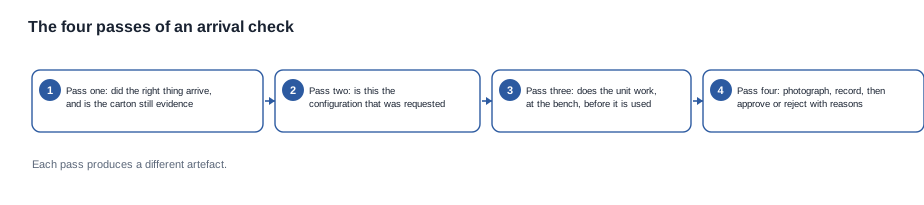
Requesting smart glasses samples: the arrival check in four passes
The check is easier to run when it is split into passes, because each pass answers a different question and produces a different artefact. Rushed into one, it collapses into "it looks fine" — which is the single least useful output available.
Pass one, before anything is opened: did the right thing arrive? This pass produces the transit record. Outer carton condition, corner damage, moisture, seal integrity, the weight against the packing list, the model designation on the shipping paperwork, the accessory count on the packing list. None of it requires the box to be opened, and all of it is destroyed by opening the box. The shipping damage claims process sets out the full sequence, and the order matters: photograph first, open second, always.
Pass two, as the box is opened: is this the configuration requested? This pass produces the identity record. The model designation on the unit, on the box and on the documentation, compared with each other and with the request. The colour and finish against the approved reference. The cell configuration, the charging interface and the case option against the written request. The presence or absence of a charging case, and if there is one, whether it fits the glasses and whether it seats correctly. The accessory count again, now that the contents are visible.
Pass three, at the bench, before the unit is used: does it work? This pass produces the functional record. Pairing with the actual phones you intend to support, and the Bluetooth name the device reports. A charge from a flat state, timed, with the ambient temperature noted. The camera, the audio, the microphone, the controls, whatever the configuration contains — exercised once each and logged. The identifiers, matched against the traceability record supplied with the shipment.
Pass four, after everything: what have you got, and what are you going to do with it? The photographs are taken from every angle, with the accessories and the documents laid out. The record is written, the findings are classified, and the sample is either approved, approved with observations, or rejected with reasons. The last of those three is the one that gets skipped, and it is the one that makes a sample worth the fee.

Before the carton is opened
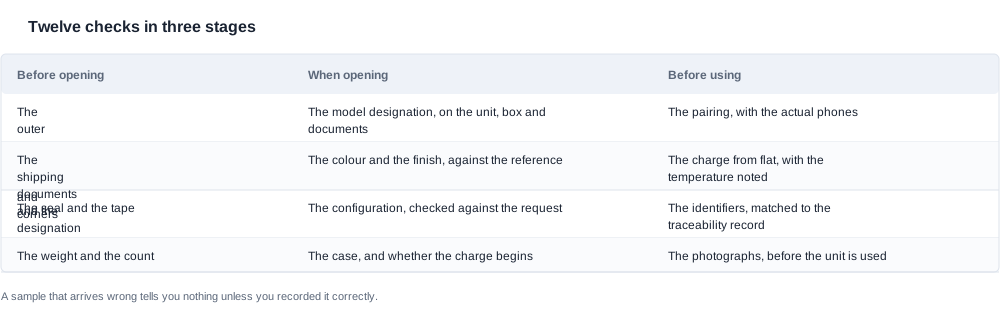
Six checks, and the reason for putting them first is that they are the only ones that cannot be repeated.
- Photograph the outer carton on all four sides and all four corners. Corners are where transit damage happens, because the corner is the only part of a box that is in contact with nothing. Photographing a crushed corner in good light takes ten seconds and is worth more than an entire argument later about whether the damage was in transit. If there is moisture, photograph it before it dries.
- Read the shipping paperwork before anything else. The commercial invoice, the packing list, and the model designation printed on the shipping documents. That designation is the first and cheapest check on whether the right thing was sent, and it costs nothing. If the paperwork names a different model from the one you requested, stop there and photograph the paperwork — that single discrepancy is usually the whole story.
- Look at the seal and the tape. A broken seal on a carton the recipient did not open is a finding, and it is the one finding that is impossible to reconstruct afterwards, because once the carton is open the evidence is gone.
- Weigh the parcel against the packing list. A shipping scale and the packing list. A light parcel is a missing-unit finding, and it is worth weighing before the carton is disturbed rather than after three units are already out of the box and the count looks wrong.
- Count the cartons and the units in the outer box against the packing list, without opening the inner boxes. A consolidated shipment can contain a unit from a different configuration if the packing was done at the wrong level, and this is the moment that error is visible.
- Note the date and who received it, at the moment of receipt rather than later. A date recorded a week afterwards, in a returns claim, is a date that can be argued with.
These six produce the transit record, and each one of them costs seconds. The reason they are worth doing at all is that they are the only six checks in the whole arrival process that cannot be repeated once the carton is open.
Requesting samples and the commercial terms to settle at the same time
A sample request and a purchase order are usually treated as separate conversations, and the separation costs more than it saves. The sample establishes what the configuration is; the purchase order establishes what you have committed to. If they are negotiated by different people against different documents, the programme arrives with two versions of the truth, and the second one is always the more expensive.
The practical rule is to settle the commercial terms in the same exchange as the sample request, even if the order itself comes later. Nine items belong in that exchange, and asking for them together is not aggressive — it is what a prepared supplier expects.
- The quotation, per configuration. Not per family and not a range. A quotation for a named configuration tells you the supplier has read the specification; a quotation for a range tells you it has not. Where the model is published in two variants — the L2 Utral publishes case capacities of 900 mAh and 1400 mAh — quote both, because a quotation for "the L2 Utral with a case" has not quoted anything.
- The minimum order quantity, stated against that configuration. MOQ is where the first-article economics live, and a configuration with a per-colour or per-option minimum is a different commercial proposition from one without. Our own figures are confirmed per enquiry rather than published, because the MOQ moves with the current schedule, the documentation scope, the quantity and the configuration.
- The lead time, broken into the stages that actually drive it: tooling, first article, sample approval, production, and inspection. A single number is a summary of a plan you have not seen, and it is the number that will be wrong.
- The sample fee and what it is credited against. Whether the sample cost comes off the first order is a commercial term worth settling explicitly, because a sample fee that is not credited is a fee.
- The warranty position — duration, what it covers, what it excludes, and how a claim is raised. Liquid ingress, physical damage and unauthorised modifications are the exclusions that matter most in this category, and they are worth reading before the first return rather than after it.
- The certification scope, per destination market and per model. In our own published position the catalogue carries no certification row broken down model by model. What the export-certification page holds is ten patent certificates in one image, eight of them design patents and two of them utility models. So the question to settle is which markets you are selling into and what each one requires, not what we have on file.
- Tooling and non-recurring engineering charges, their ownership, and their amortisation against your first-order volume. A tool paid for once and used for five years is a different line from a setup charge per order.
- The inspection terms — the AQL or acceptance standard, the sample count, who appoints the inspector, and whether the inspection result is tied to the payment milestone. Nothing about an inspection without a golden sample to compare against.
- The delivery terms, including the incoterm. DDP and FOB place very different obligations on the buyer, and the difference in cost and risk between them is large enough that it should never be left to the quotation default.
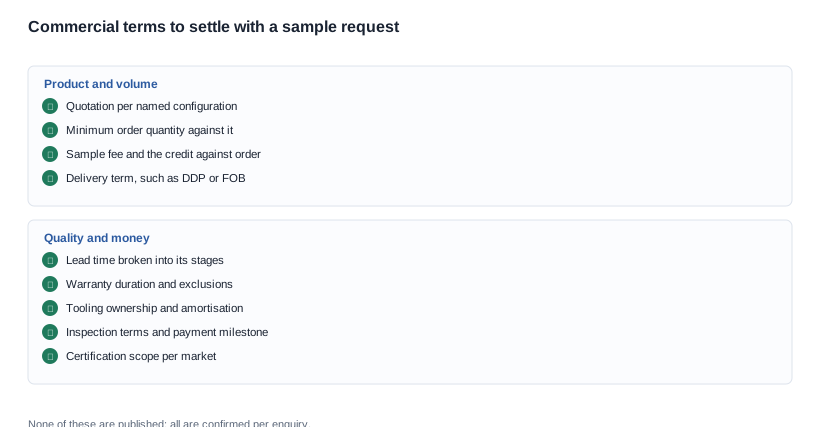
None of these nine are published on our website, and all of them are confirmed per enquiry, because each of them turns on the configuration, the order quantity, the documentation scope and today's schedule. The reason they belong in the sample exchange is that the sample is what makes the terms comparable: a quotation for a configuration you have physically seen is a quotation you can check against the unit, and a quotation for one you have not is a quotation against a description.
Two trade-offs are worth naming. The first is the sample fee against the information it buys — a fee that is credited against the first order is cheap, and a fee that is not is the cost of avoiding a mistake. The second is the time cost of a broad request against the attention it gets: nine items in one email to a prepared supplier is efficient, while nine items asked separately over three weeks is a research project. The due diligence value of a sample request is highest when the request doubles as a shortlist qualification, and the criteria it should be qualifying against are the same criteria you will use for the order.

What to record when the sample arrives
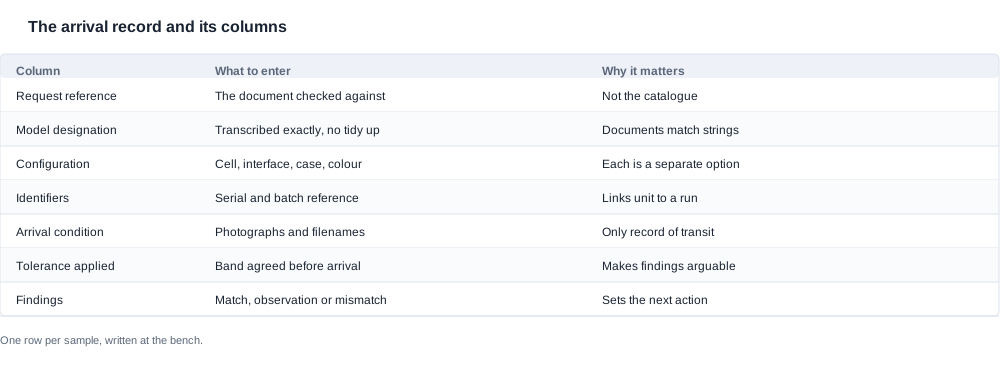
The record is the deliverable of the arrival check, and it is much easier to make it at the bench than to reconstruct it from memory in a claims conversation eighteen months later. One row per sample, with these columns:
- The request reference — the document the sample is being checked against, not the catalogue.
- The model designation as it appears on the unit, on the box and on the paperwork, transcribed exactly. Do not normalise it. One entry in our range is published as "L2 Utral" and carries an additional variant designation whose meaning is nowhere published, so a designation you tidy up is a designation you can no longer match against a document.
- The configuration — cell configuration, charging interface, case option, colour, all compared against the request.
- The firmware version, read from the device where it is visible, because it is the version that produced the behaviour you observed.
- The identifiers — the serial or batch reference, transcribed, and the traceability record it should match.
- The arrival condition — the photographs, their filenames, and where they are stored.
- The date, the time and the person who received it.
- The findings, each classified as a match, an observation or a mismatch, with the photograph reference attached.
- The tolerance applied — the acceptable variation for this check, agreed in advance where it can be. A colour tolerance, a runtime tolerance, a charge-time tolerance, agreed before the sample arrives, is what turns "this looks wrong" into "this is outside the agreed band".
- The decision — approved, approved with observations, or rejected with reasons, and the date it was taken.
Two habits make this record worth having. The first is to write the identifiers down by hand or by voice as you read them, because a serial number transcribed three times is more reliable than one copied twice. The second is to attach the photographs to the record on the same day, while the filenames still mean something to you.
There is also a finding classification that matters, and it is not about whether the unit is good or bad. It is about whether the finding is a manufacturing issue, a specification issue or a request issue. A unit that matches the request but fails your test is a specification issue and belongs in the specification. A unit that does not match the request is a supplier issue. A unit that matches a request that was itself wrong is a request issue, and it is the most common of the three and the most expensive, because it means the sample answered a question nobody was asking.

Findings that a requesting buyer should expect
Some findings are common enough in this category that a buyer who has not seen them before will read them as evidence of a bad supplier rather than as evidence of a thin specification. It is worth knowing them in advance, and it is worth knowing which of them are cheap to fix and which are not.
A designation that does not match the paperwork. Almost always a naming rather than a build problem, and cheap to fix — one written confirmation from the supplier settles it. But it must still be recorded and confirmed in writing, because the designation is what a model-specific document names, and a designation you resolve informally is a designation your compliance file will not have.
A colour that matches the swatch and not the approved reference. This is the most common first-article rejection and it has nothing to do with build quality. A colour match approved from a screen will not survive daylight, because a screen cannot show the difference between two finishes that differ only in gloss. The published colour data is narrow enough to make this manageable — the V03 Pro publishes three colour options and the V06 publishes four, while the rest of the range records no colour options at all — so in most cases there are few finishes to compare against. The fix is procedural rather than technical: approve against a physical reference in daylight, never against a screen.
A charging case that is missing, present when it should not be, or the wrong capacity. The case is a separate configuration, not an accessory, and the published rows are specific: capacity is published for five models, with L1 Pro and CY05, and the CY03 — each at 1400 mAh, the L2 Utral at 900 mAh or 1400 mAh, plus the MT6 at 1200 mAh in a foldable case. The KY06 and the MT5 are fitted with a case whose capacity is left unstated. The V06 and the V03, and the S7 appear with no case row at all, and the V03 Pro is entered with no case. A sample that arrives with a case for one of the last four is a configuration finding, and a sample that arrives without the L2 Utral case you specified is a capacity finding, because "the L2 Utral with a case" names two different products and two different tooling commitments.
A charging interface that differs from the request. Seventeen of the twenty-eight entries publish magnetic charging and seven publish Type-C, and four camera models do not publish a method at all. If your request said "magnetic" and the sample arrives with Type-C, that is not a cosmetic substitution — it is a different unit, and it will change the packaging artwork, the accessory list and the customer expectation.
Documentation that does not include the model. Our own published position is that the catalogue publishes no certification row at model level, and that the export-certification page is a picture page carrying ten patents in total, eight of them design patents and two of them utility models. A sample arriving with a general document is therefore the expected outcome rather than a disappointment, and it is a fact you need on your record, because it is the fact your compliance file will later contain. The follow-up is a written scope question: which destination markets does this configuration cover, and on what basis.
A feature the specification does not contain. A capacitive touch panel, a translation function — the catalogue holds no capacitive-touch row and no translation row at all. If a sample appears to have either, you have a mismatch between the sample and the published range, and it needs to be resolved in writing before it becomes a product page claim.
A runtime shorter than the published range. Every one of the eleven camera models publishes a runtime, and the published range covers five to eight hours, measured on cells of 220 mAh to 290 mAh — with no test condition stated. If your sample runs four hours, either the condition is the difference or the unit is not the unit you requested. That question is worth asking before it becomes a returns problem, and it is another reason to state your tolerance before the sample arrives rather than after.
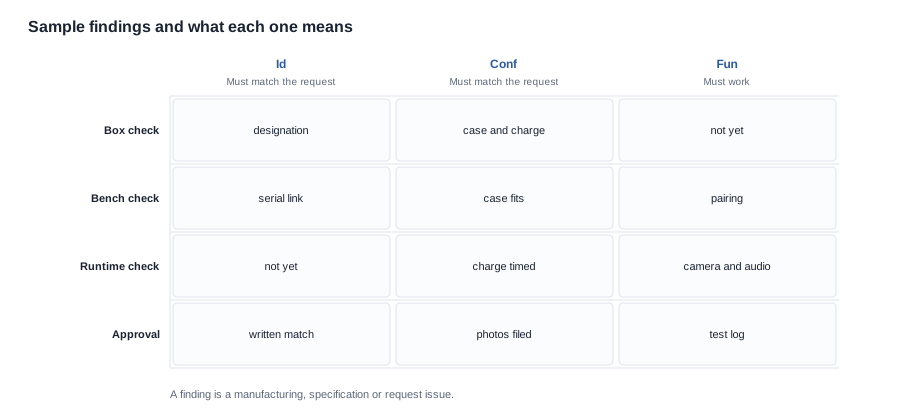
What a requesting sample settles and what it does not
A sample is a physical fact about one unit. That is what it is good for, and the discipline of using it well is knowing the boundary.
What it settles. Whether the configuration you ordered can be built and delivered. Whether the finish matches an approved reference. Whether the case fits and charges. Whether the unit pairs with the phones you support and what name it reports. Whether the runtime is tolerable under your own conditions rather than a ceiling. Whether the documentation that arrives with the goods mentions your model. Whether the accessories are complete. Whether the supplier's answers to your written questions match the object in front of you — and that last one is worth more than the others, because it is the one point in the whole programme where the conversation and the goods can be compared directly.
What it does not settle. Anything about production consistency, which is what the golden sample and the inspection instruction are for. Anything about certification, which is settled by checking a document reference against a registry rather than by inspecting a unit. Anything about the unpublished rows: a single unit cannot establish a Bluetooth version for a model that does not publish one, cannot produce an ingress basis for a model that does not carry a marking, and cannot give you the frame weight for anything other than the MT6 at 158 g for the glasses alone. And nothing at all about the terms — unit price, minimum order quantity, lead time, sample fee and warranty are confirmed per enquiry, not demonstrated by a sample.
Which is why the sample is most valuable when it is requested against a written brief rather than asked for in general terms. The sample request content sets out the five variables a request has to fix, and how to request samples covers the mechanics of putting the request in front of a supplier. A request that names the model, the configuration, the market and the specific test you intend to run produces an answerable sample. A request that says "general evaluation" produces a generic unit, and the arrival check then has nothing to check against.
We will supply a sample against a stated configuration, and we will say plainly in writing what the sample is and is not. That includes the published gaps — one published frame weight, no published charging method for four camera models, no published Bluetooth version for the camera and children's entries, no per-model certification row, and no capacitive-touch or translation rows anywhere — because a buyer who knows the gaps in advance checks the right things on arrival instead of discovering them on the product page.
Send the model, the configuration, the market and the quantity through the quote request route, and we will tell you what we will provide and what the sample will and will not settle.
Related reading
- Requesting samples
- What to include when requesting samples
- How to request samples
- Shipping damage claims process
Send the model, configuration, market and quantity and we will tell you what we will provide.


