

The form factor difference between the S7 smart glasses and the YKC02 is not a styling question, and treating it as one is the most common way this comparison goes wrong. It is a consequence of what each frame is published to carry. One of them has an imaging module, an ingress marking and a detachable inner frame; the other has a surround sound descriptor, a two-cell battery arrangement and a published radio version. Because neither page prints a weight, a dimension or a temple length, the physical comparison cannot be made from the catalogue at all — and the catalogue publishes exactly one unit weight anywhere, belonging to a third model. What the pages do support is a comparison of the load each frame carries and the evidence each one obliges its owner to produce. This page is written for the buyer choosing which brief the product belongs in, and for the channel partner who needs to explain the two shapes without borrowing a measurement from somewhere else.
Two different products that both wear like sports glasses
The visual impression of these two products is the first thing a channel partner will be asked about, and it is the least informative thing available on them. Both are published under names that place them in a sport context, both are frames rather than pendants, and a buyer who saw only the silhouettes would have no basis for separating them. The published material separates them cleanly once the pages are read side by side, and the separation starts with a naming point that catches people out.
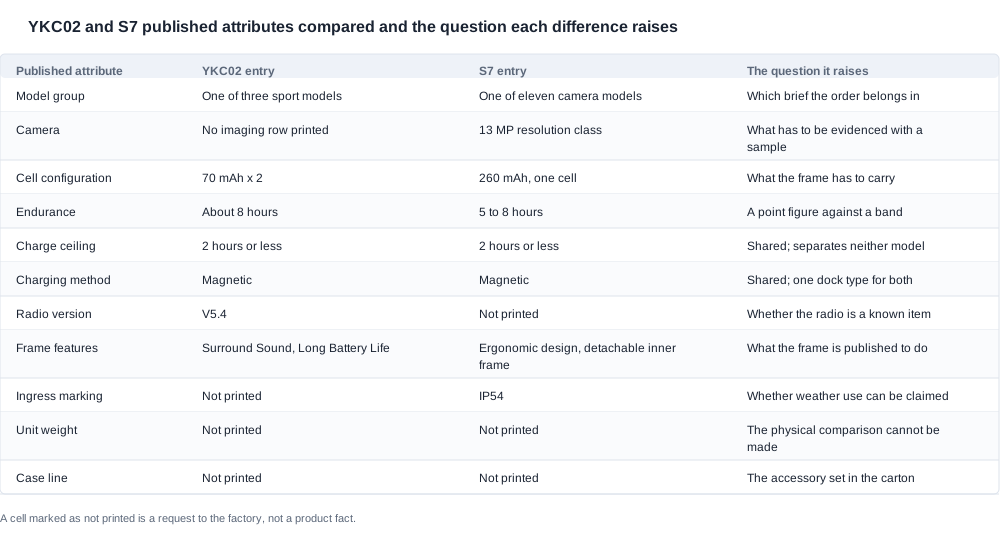
The YKC02 is one of the three sport models in this catalogue, alongside the D17 and the ZH12, and its own product name in the table of contents carries no camera wording at all. The S7 is one of the eleven camera models, and while its name does carry sport wording, that word describes the shape of the product, not the group it sits in. This is not a pedantic distinction. The group determines what a page can print: a camera page prints a resolution class, and a sport page does not, and the S7's page does. Any range slide that files the S7 alongside the three sport models on the strength of its name will produce a comparison that collapses on contact with the pages, because the two products will be compared on attributes that only one of them publishes.
What each frame has to carry
Once the groups are set straight, the form factor question becomes tractable, because a frame's shape follows what it has to hold. The S7's page tells us what its frame is carrying: a camera at a thirteen megapixel class, a single 260 mAh cell, a magnetic charging contact arrangement, an ergonomic design descriptor, a detachable inner frame, and an ingress marking. The YKC02's page tells us what its frame is carrying: two 70 mAh cells, a magnetic charging contact arrangement, a surround sound descriptor, a long battery life descriptor, and a V5.4 radio.
Two things follow immediately. The first is that both frames are magnetic-charged and both carry the same two-hour charge ceiling, so the charging dock and the cable in the accessory programme are common to the two products rather than specific to either. The second is that everything else about the two frames is different in kind, not in degree. One frame has to accommodate a camera and a cell of more than double the size of either of the YKC02's two; the other has to accommodate a speaker arrangement and two smaller cells. A buyer who has seen one of these products and is deciding whether the other one will look bulkier is reasoning about exactly the rows the catalogue does not print.
That is worth being blunt about, because the instinct to answer the physical question anyway is strong. The catalogue publishes one unit weight for the whole library — 158 g for the MT6 eyewear body, and that figure counts the eyewear without the folding case listed beside it. Nothing is printed for the S7 or the YKC02. No frame dimensions, no temple length, no lens height, no bridge width, and no indication of where the two cells sit in the YKC02's frame or where the camera sits in the S7's. A form factor comparison built on any of those would be a guess wearing the clothes of a specification, and it would be discovered the first time a buyer puts the two products side by side on a desk.
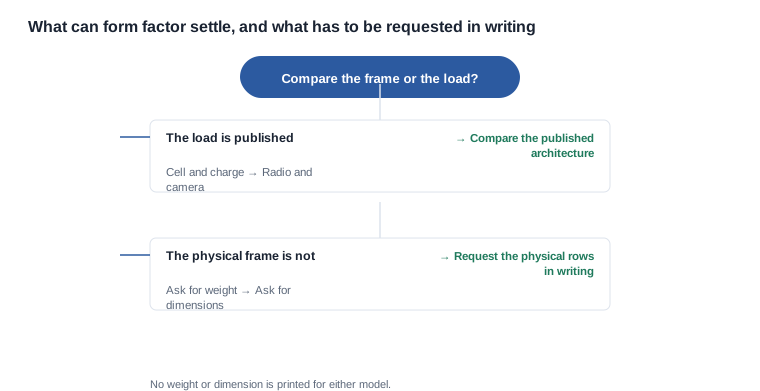
What can be compared is the published architecture, and the architecture comparison has real commercial content. The S7's frame brings an imaging obligation with it: a resolution class is published, and behind it the imaging chain is undescribed — not the sensor model, not the lens, not the field of view, not the frame rate, not the video format, not the stabilisation, and nothing on low-light performance. The YKC02's frame brings an acoustic obligation: a surround sound descriptor is published, and behind it there is no driver size, no frequency response, no output power and no measurement of any kind. Neither obligation is a defect. They are simply the two different forms that evidence takes, and a buyer who has to write an acceptance criterion has to write a different one for each.

What the S7 publishes that the YKC02 does not
Three rows exist on the S7's page and have no counterpart on the YKC02's page, and they are the rows that make the two products different products rather than variants of one.
The first is the camera class. The S7 prints thirteen megapixel; the YKC02 prints no imaging row of any kind, which is normal for a model in the three-model sport group. A camera class is a component figure and it is the starting point of an evidence obligation rather than the end of one, so what the S7 actually gives a buyer is a defined place to begin asking: which sensor, which lens, which field of view, what frame rate, what file format, how much storage, and how the unit behaves in low light. All of that is available from a factory as a written answer, and none of it is on the page. The YKC02's equivalent evidence question is acoustic rather than optical, and the request reads the same way with different nouns.
The second is the ingress marking. The IP54 marking appears on two pages in the entire catalogue, and they are the S7's page and the V06's. That makes it a distinguishing feature of the S7 rather than a shared one, and it also means the S7's owner inherits an evidence obligation the YKC02's owner does not: a marking is a claim about a level of protection, and the level has to be supported by a report that names the standard, the laboratory and the sample batch it covers, including whether the removable inner frame was in place when the unit went through the test. A page that prints a marking with no report reference is not wrong, but it is incomplete in a way that a buyer has to close. The YKC02's page prints no such marking, so nothing of that kind is owed.
The third is the detachable inner frame. The S7 and the V06 are the only two pages in the catalogue that carry it, and it changes what a buyer has to plan. A removable inner frame implies a size programme, a spare-parts route, a minimum order quantity for spares, its own packaging artwork, and a question about interchangeability between models. The S7's page prints none of those. The YKC02's page prints nothing of the kind, which means the YKC02's owner is not carrying that programme, and a brief written for one of these two products is structurally different from a brief written for the other.
One more published difference is worth noting because it is easy to overlook on a page with fewer rows. The YKC02 prints a radio version of V5.4, and the S7 prints none. That is the general pattern of the library rather than an omission peculiar to either model: every one of the eight audio models prints a radio version while not one of the eleven camera pages does. The practical consequence is that a buyer who needs to know the radio fitted to the S7 is making a request that covers the whole camera group, which is a better question to send than a model-specific one, and the answer that comes back will cover the eleven camera pages rather than this one.

The YKC02's two-cell build against the S7's single cell
The most visible published difference in the power architecture is the cell configuration, and it is worth reading carefully because a two-cell figure and a single-cell figure are easy to convert into a comparison that the catalogue never made.
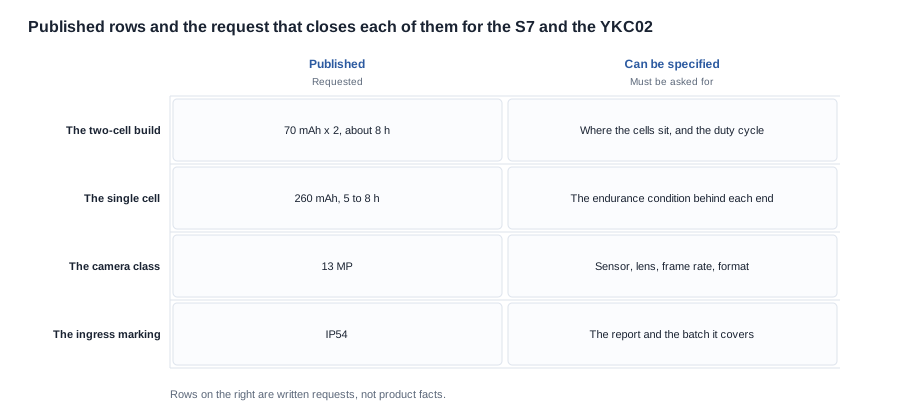
The YKC02's page prints the battery capacity as 70 mAh multiplied by two, which is a figure for two cells of that size. The S7's page prints a 260 mAh figure for a single cell. A reader will immediately do the arithmetic and conclude that one product carries more than twice the battery of the other, and the arithmetic itself is not wrong — the two figures together do describe a larger total in the S7 — but the total is a derived number rather than a published one, and the brief makes a point of separating the two. The published form on the YKC02 page is a cell figure and a cell count, and that is what belongs in a table. The conclusion that follows from it — that the S7 carries a single larger cell and the YKC02 carries two smaller ones — is a statement about architecture that the pages do support, because a single figure and a multiplied figure are exactly that.
What the pages do not tell you is where those cells sit. The YKC02's frame is a two-cell frame and the catalogue does not say whether the cells are distributed one to each side, stacked in one temple, or positioned behind the bridge. That question has direct consequences for a buyer: a distributed two-cell frame balances differently from a single-cell frame, and a buyer who has a requirement about what happens when one side of the frame is knocked does not have any published material to answer it with. It is a legitimate request line, and it is also the kind of line that a factory answers without difficulty.
The runtime figures are different in kind as well, and this is the second place where the two pages are easy to read as comparable when they are not. The YKC02 prints about eight hours, which is a single approximate figure for one condition. The S7 prints a band running from five to eight hours, which is a range across conditions that the catalogue does not describe. A point figure and a band cannot be set against each other, because a point figure implies a single tested condition and a band implies a range of them, and a buyer who reads the two numbers as "about the same" is doing so across two different kinds of statement. The request that closes the gap is the same on both products: the test condition, the duty cycle, and what the device was doing during the hours being counted.
The charging method is shared, and the shared method is genuinely useful information for an accessory programme. Both frames charge magnetically and both print the same two-hour ceiling, so a buyer stocking both products buys one kind of charging contact arrangement and one class of cable. A buyer carrying a mixed range across camera, audio and sport models has to plan three charging arrangements rather than one — magnetic across most of the library, Type-C on seven models including both the D17 and the ZH12, and no published charging method at all on four camera pages — and that plan is a real procurement artefact.
Form factor, evidence and the questions to ask
A form factor comparison between these two products can be closed out in three steps, and the three steps are more useful to a buyer than any physical comparison could be, because each of them produces something that can go into a purchase order.
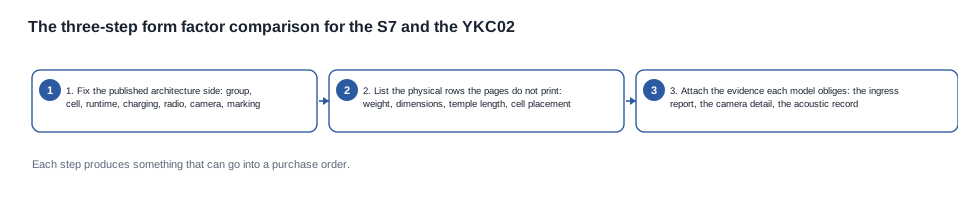
The three steps are a checklist rather than an opinion, and the order matters more than it looks. The first step fixes what is published, so that nothing in the brief is argued about. The second step names what is missing, so that the missing items go to the supplier as questions rather than to the customer as assumptions. The third step attaches the evidence, so that a returned order is judged against a criterion rather than against an impression. A buyer who wants to know when to ask a supplier about a physical property rather than settling it on the pages can use a simple test: if the answer would change the physical product, the page cannot settle it, and if the answer would only change the paperwork, the page probably can.
For a procurement team the three steps also produce a shortlist criterion, which is where the trade-off sits. On the published architecture the two products are not close: one carries a camera class and an ingress marking, the other carries a two-cell build and a surround sound descriptor. On the physical frame they cannot be separated at all from published material, which means a shortlist built on published rows will separate them cleanly while a shortlist built on appearance will not. That is the reverse of the usual expectation, and it is the reason the criteria should be written down before the samples arrive rather than after. We will not let appearance settle a question that a published row has to answer.
Two red flags are worth naming before the samples arrive. The first is a carton contents list that changes between the quotation and the shipment, which is a configuration failure rather than a shipping error and is stopped by a written packing list attached to the order. The second is an ingress answer given for the model range as a whole rather than for the batch that will ship, which cannot be attached to a purchase order. Both are easy to detect while the request is still open and awkward to detect afterwards, which is the argument for asking early.
The first step is to fix the published architecture side. That is the table above: the model group, the cell configuration, the runtime statement, the charging arrangement, the radio version, the camera class, the ingress marking, the frame descriptors and the accessory line. Everything on that list is printed, and everything on that list can be quoted without a further question. A brief that starts here is a brief that costs a buyer no time.
The second step is to write down what the published pages cannot settle about the shape itself, and to keep that list separate from the first. The physical rows — weight as shipped, frame dimensions, temple length, and where the two cells sit in the YKC02's frame — are not printed for either model. A request for those four items is a normal supplier question, and the answer is a document rather than a promise.
The third step is to attach the evidence obligations that come with each model, because they are different and they are not optional. For the S7 that means the ingress report with its laboratory, standard and sample batch, the camera detail behind the class, the size range of the removable inner frame together with the rules for swapping one for another, and the spares route. For the YKC02 it means the acoustic evidence behind the surround sound descriptor, the trigger and output specification for the remote shutter if the brief needs one, and the cell arrangement. Each of these belongs in the acceptance criteria rather than in a product description.
The question list, in the order it is worth sending, runs like this:
- The unit weight of each model as it will be packed, and the master carton dimensions for each.
- The frame dimensions and temple length for each, and the size range the inner frame programme covers on the S7.
- Where the two cells sit in the YKC02, and the charge and discharge behaviour if one side of the frame is dropped.
- The test condition and duty cycle behind the runtime figure on each page.
- The ingress test report for the S7, naming the standard, the test house and the batch of samples covered.
- The camera detail behind the thirteen megapixel class, and the evidence behind the surround sound descriptor on the YKC02.
- The carton contents list for each, and the charging case position stated in words.
- The price per unit at the stated quantity, the order minimum, the production lead time, the payment nodes and the warranty response.
That list is deliberately written so that it can be sent to one supplier in one message and answered in one reply. The two products can be quoted against it separately, and the answers can then be compared on the same basis — same accessory treatment, same packaging specification, same order quantity, same definition of a valid unit price — which is the only comparison between two products that carries commercial meaning.
The S7 and the YKC02 are not comparable on a measurement neither page prints, and no shared charging method or charge ceiling makes the two interchangeable. The S7 and the YKC02 are close in silhouette and distant in function, and the published rows are what make that visible: on one page a camera class, an ingress marking alongside a removable inner frame, on the other a two-cell build, a surround sound descriptor and a published radio version. If you want the published rows for the S7 in one place before writing either brief, the S7 specification breakdown holds the published rows, and the annex that turns them into a request is written out in the S7 buyer review checklist. The remaining question is not which of the two frames is the right shape, but which of the two published sets matches the requirement in front of you.


