
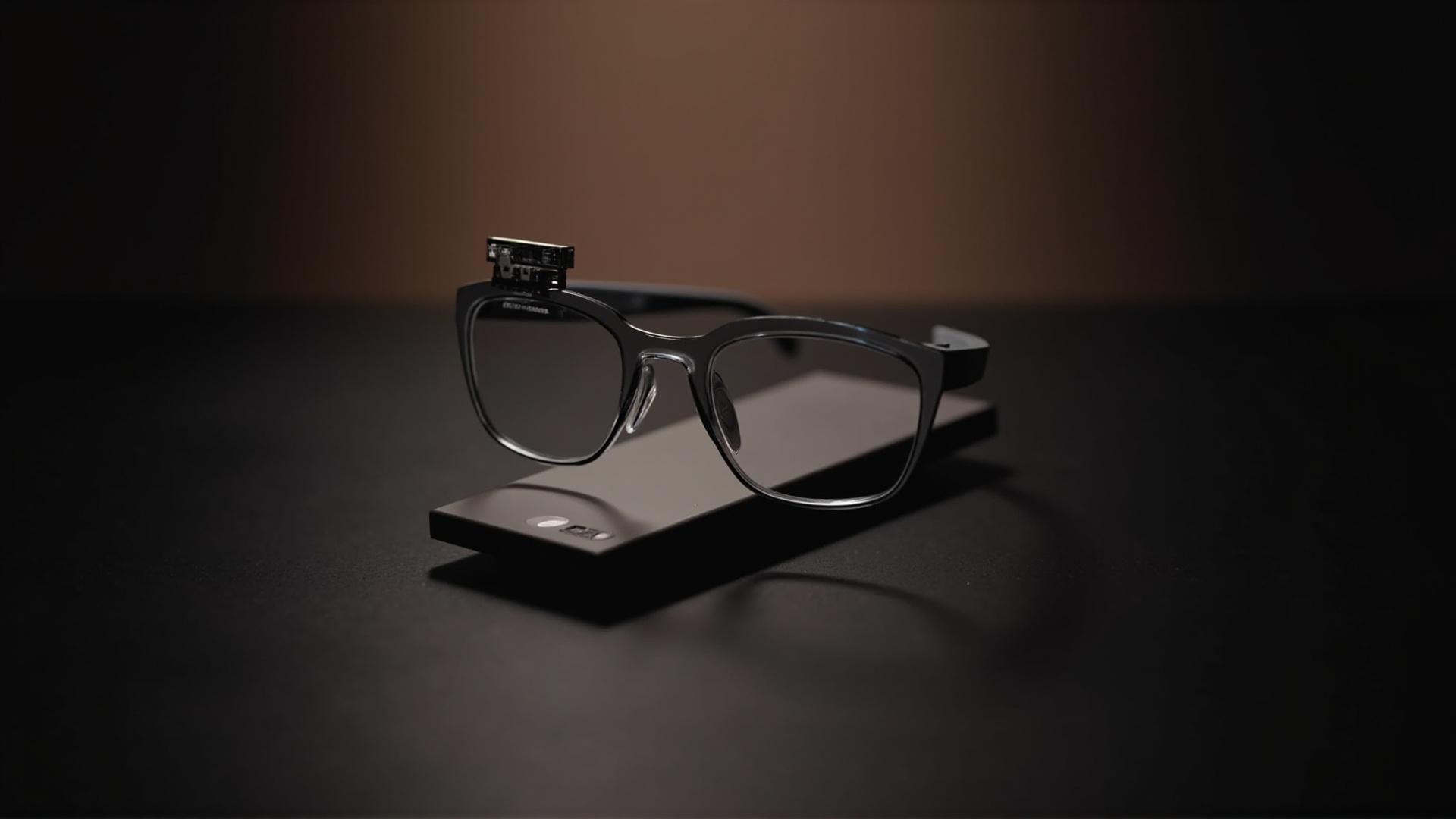
Reading a catalogue specification is a procurement task, not a reading task. The printed row is the start of a claim, not the end of one, and the gap between what a page states and what it leaves unstated is where most sourcing disputes begin. Before any figure from this camera model travels into a purchase order, a buyer needs a way to separate what has been committed to, what is implied by a neighbouring row, and what must be answered in writing before the order is placed. The rows below follow the catalogue as printed for the S7, and the gaps are marked as gaps.
S7 specifications and features: the rows the catalogue prints
The S7 catalogue page is unusually disciplined compared with most consumer-facing spec sheets. It prints a fixed set of rows, in a fixed order, and it stops there. Nine rows appear, carrying eight distinct facts: camera resolution, battery capacity, usage time, charging time, charging method, frame design, inner frame, and ingress rating. The resolution is printed twice on the page, once inside the specification block and once among the feature rows. There is no marketing paragraph on the page, no scenario description, and no comparison table pointing at a "better" model. Everything a buyer can verify about this unit at a glance comes from those eight distinct facts.
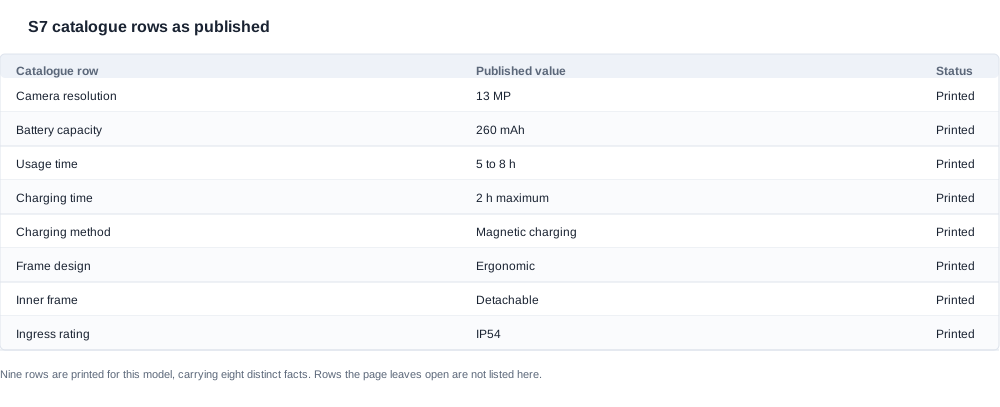
That restraint is useful, because it lets a sourcing team build a comparable picture. The eight rows that carry a value are the ones that can be held against a competing quotation without any interpretation. The table above reproduces them in the order the catalogue sets them out, so a buyer can mark each line as closed or open and carry the same mark-up into a supplier conversation.
| S7 catalogue row | Value as printed | Status for a buyer |
|---|---|---|
| Camera resolution | 13 MP | Published |
| Battery capacity | 260 mAh | Published |
| Usage time | 5 to 8 h | Published |
| Charging time | 2 h maximum | Published |
| Charging method | Magnetic charging | Published |
| Frame design | Ergonomic | Published |
| Inner frame | Detachable | Published |
| Ingress rating | IP54 | Published |
| Bluetooth version | No value printed | Not published |
| Unit mass | No value printed | Not published |
| Sensor model | No value printed | Not published |
| Field of view | No value printed | Not published |
| Charging case | No case row for this model | Not published |
| Certificate identifiers | No value printed | Not published |
The right-hand column is the part that does the work. A row marked published can be written into a specification sheet and treated as committed. A row marked not published cannot, no matter how similar the model looks on the shelf, and the correct response is to raise it as a written question rather than to infer it. The six entries above the divider are the entire published surface for this model.
That distinction is also why this model appears in a different way in our comparison material. In how the S7 compares in day-to-day use we look at what the published rows mean for an end user, and in S7 battery life and charging explained we work through the duration rows in detail. Here the scope is narrower: the catalogue rows themselves, what they assert, and what a buyer still has to close before the order is placed.
A workable review method is to work down the table in a fixed order, and to keep three columns: the row as printed, the evidence that would close it, and the person who asked. The order matters more than most teams expect, because the rows are not independent. Frame and inner frame decisions change how the unit is worn, and therefore how the duration rows should be read, and the ingress row determines whether the unit can be exposed to the environments the duration figure assumes.
- Mark every published row as closed on the strength of the catalogue page alone.
- List every row the page leaves open, and write the question you will send with the request for a sample.
- Order the open rows by operational risk, so the answers that change the specification come first.
- Record the answer and its source, not just the answer, in the specification file.
That last step is where due diligence usually breaks down. A verbal answer that "the Bluetooth version is the latest" is not usable six months later when a customer opens a unit and finds a different chipset, and a photograph of a screen that "shows IP54" is not a test report. Buyers who close a row with an unsourced answer end up reopening the same question with every new order, which is where the real cost hides.
One more habit makes the whole review defensible later. Keep the comparison sheet at row level rather than at model level, so that every cell carries its own source. A sheet that says one model is better than another collapses the eight rows that carry a value and the six the page leaves open into a single opinion, and an opinion cannot be re-checked when a supplier revises a page or when a colleague asks where a number came from. A sheet that says which row on which page supports which cell can be audited, corrected, and re-used for the next model you add to the shortlist, which is where the time saving actually appears in the end.

The thirteen megapixel row and what it does not carry
The camera row reads 13 MP. Within the catalogue that figure is unusual: three of the models carry a thirteen megapixel sensor, the rest sit at eight megapixel, and eight models in the library print 8 MP explicitly. This model is therefore near the top of what the catalogue publishes on resolution, and it is one of the few rows on the page where a buyer can read a number and immediately know how the model compares with its neighbours in the same catalogue.
What the row asserts is narrow and precise: the camera captures at thirteen megapixel. Beyond that figure nothing is printed: no sensor model, no lens specification, no field of view, no frame rate, no video format and no stabilisation system. None of those appear as printed values for this model, and the catalogue as a whole does not print them for any of its twenty-eight models either. The honest reading of the row is that it is a resolution figure and nothing more.
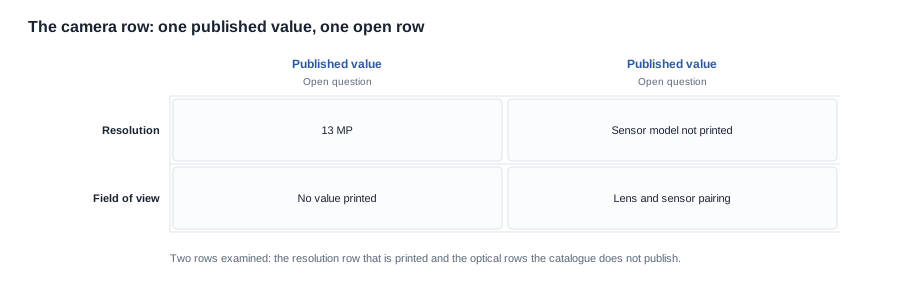
The practical trap is that buyers tend to read a megapixel number as a proxy for image quality, and then carry that assumption into a comparison against a competitor specification that means something different by the same number. Resolution tells you how many pixels the sensor collects. It tells you nothing about the pixel size, the lens, the aperture, the processing pipeline, or the way the unit handles low light. Two devices can print the same resolution and produce visibly different results.
Two things further complicate the comparison. First, the catalogue prints no capacitive control row anywhere. Across all twenty-eight models, a search for touch, gesture, or capacitive control returns nothing, so no interaction method should be assumed from a camera specification. Second, there is no translation row in the catalogue either, and no published feature set that can be read as a translation capability. If either is on your requirement list, it belongs in the written question list rather than in the assumption set.
So the way to evaluate this row is narrow and practical:
- Treat 13 MP as the only camera claim that exists in writing, and write it into the specification exactly as printed.
- Ask which sensor and lens combinations ship with it, and whether the pairing is fixed for a given order.
- Ask whether any video format, frame rate, or stabilisation claim applies, and how it is documented.
- Do not carry the resolution figure into a quality comparison until the sensor and lens answers are on file.
If the answers come back in writing, the row closes. If they come back as impressions, the specification stays open, and an open camera row is a good reason to ask for a sample rather than to settle the question from a datasheet. Our camera imaging technical notes cover the imaging parameters that buyers usually need to see alongside a resolution figure, and the S7 value assessment looks at how this model is usually judged against its cost.
What this row is good for, then, is segmentation rather than measurement. Buyers who separate product lines by how the output is consumed, by whether the frame is worn continuously or only for short capture sessions, or by how the unit is expected to be stored between uses, can treat a thirteen megapixel figure as a screen on suitability rather than a promise on quality. That is a legitimate use of the number. Using it as a ranking across manufacturers is not, because the configuration behind it is unknown on every side of the comparison. When you build a shortlist from a resolution figure, treat it as a filter with a low bar, and move the real decision onto the sensor and lens answers.

The ingress row, and why it sits on only two models
The ingress row reads IP54. In a catalogue of twenty-eight models, only two print any ingress rating at all, and this is one of them. The other is the V06, which is otherwise a close relative of this unit: the same battery capacity of 260 mAh, the same usage time of 5 to 8 h, the same charging limit of 2 h, the same magnetic charging method, the same ergonomic design row, the same detachable inner frame row, and the same IP54 marking. The difference between the two printed pages is the camera resolution, 13 MP against 8 MP, and the colour row that the V06 carries and this page does not.
That is why the ingress row is worth reading closely rather than treating it as a routine entry. It is the one row that most often separates a model that can be sold into a specific use case from one that cannot, and it is also the row most often over-read. IP54 is a first digit for solid particle protection and a second digit for water ingress, and the second digit is what buyers usually remember. It describes splash and spray conditions. It does not describe immersion, and it does not describe a jet of water aimed at the unit from any direction.
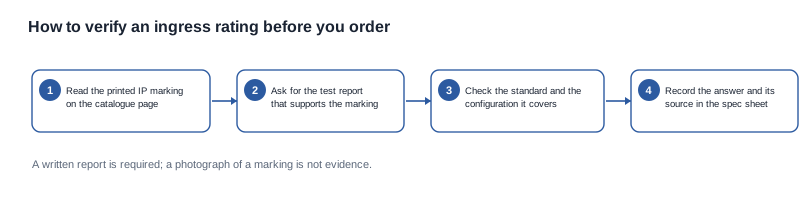
The verification path above is deliberately short, because an ingress claim is cheap to check and expensive to assume. Read the printed marking first, so the question is anchored to what the catalogue actually says. Then ask for the test report that supports the marking, and check which standard and which configuration it covers, because a report written for a housing can differ from a report written for a finished unit with the frame and inner frame fitted. Finally, record the result in the specification file in the same words the supplier used.
Three practical points usually close this row faster than buyers expect:
- Ask whether the marking covers the assembled unit with the detachable inner frame in place, since the two pieces are separable and the joint is a natural place for water to find its way in.
- Ask whether the marking covers the magnetic charging contacts, which stay uncovered whenever the unit is away from its accessory.
- Ask how the marking changes if the unit is reworked for a particular market, because any housing change can invalidate a report written for the original configuration.
This model prints no certificate identifier anywhere in its rows, and the certification section of the catalogue is a set of images rather than a text list, so the IP54 marking is attached to no numbered document. That is exactly why the question above has to be answered with a document rather than a reference. A buyer who wants the technical background on the rating scheme itself can use the rating scheme explained as a checklist for reading whatever comes back, and the compliance document set covers what to ask for when a model prints certification language of any kind.
The scarcity of the rating deserves a sentence of its own, because it shapes how you write the question. When a catalogue prints an ingress rating on two models out of twenty-eight, the printed value on those two pages has been decided by someone, and on the other twenty-six pages nothing has been decided at all. The absence says nothing about quality. It also means a buyer cannot lean on comparison inside the catalogue to resolve a doubt, because there is nothing to compare the rating against. The only route is the document. That is why the flow above puts the report request ahead of the scope question, and why a supplier that answers the scope question well but has no report is telling you something you need to know before you order rather than after delivery.

The detachable inner frame row and what it commits you to
Two configuration rows appear together on this page. One is ergonomic design, which is a comfort and fit statement, and the other is detachable inner frame, which is a structural statement about how the product is built. Together they describe a frame whose inner component can be removed and replaced, and that single phrase carries a chain of consequences that reach well beyond fit.
The first consequence is assembly and inventory. A detachable inner frame means the unit can arrive with more than one inner frame option, which is useful for channel programmes and for operators running different wearers across the same frame. The second consequence is spares and after-sales: because the inner frame is separable, a worn or damaged inner frame is a consumable that can be replaced without replacing the whole product, and that has to be priced into the after-sales model as a real line rather than an afterthought. The third is packaging and handling, because a separable part has to be protected, counted, and matched to the correct unit at the point of assembly.
The fourth consequence is the one that catches most teams: an IP54 marking and a separable joint are two statements about the same physical assembly, and a buyer who accepts one without asking about the other is accepting an assumption. That is a due diligence question, not a quality-control question, and it belongs in the written request that accompanies a sample.
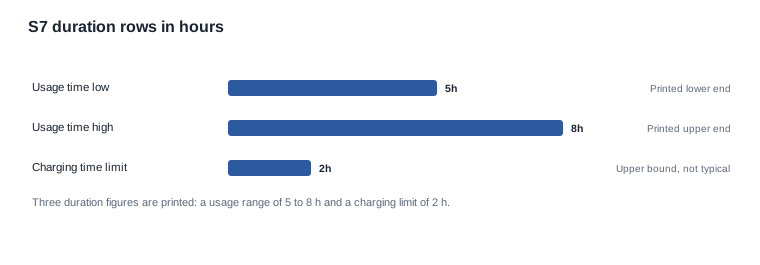
The duration rows sit next to this one for a reason. The usage time of 5 to 8 h is a range printed on the page, and the charging limit is 2 h as an upper bound rather than a typical figure. A detachable inner frame changes the operating rhythm: a unit that can be re-fitted quickly is easier to rotate between wearers across a shift, and a unit that charges magnetically to a full state in under the printed limit is easier to return to service between users. The bars above show the three duration figures as they appear in print, and they are the numbers to compare against the way the product will actually be used.
Two criteria decide whether that promise holds for a given programme. The first is availability: spares have to be obtainable in the volume the programme needs, not just in a single sample quantity. The second is documentation: the part number, the fitment rule, and the ingress position of the replaced frame all have to be written down, because a replacement that is not the same part changes what the IP54 marking means. Here are the criteria to apply when you evaluate this row in a sourcing context:
- Establish which inner frame options are available for the order, and whether that list can grow during the programme.
- Ask how spares are supplied, and whether they can be obtained in the quantities a rolling channel programme needs.
- Confirm whether the ingress marking is documented for the assembled unit in each configuration you intend to ship.
- Model the after-sales cost of a replaced inner frame against the cost of a replaced unit, because the two have very different service implications.
The fourth item is where the total cost of ownership argument actually lives. A detachable inner frame is a promise that a worn component can be renewed cheaply, and the promise only holds if spares exist, are obtainable, and are documented. That is a question with a written answer, not an assumption, and it is a question worth asking before the order rather than after the first field failure.
For the surrounding operating detail, battery life and charging explained sets out how the duration rows are usually read, and S7 battery life and charging in practice covers how the printed range behaves under real use.
The ergonomic design row, printed alongside it, is the softer half of the same statement, and it deserves the same discipline. An ergonomic frame is a fit claim, and fit claims resolve themselves in front of the user rather than on a datasheet, which is another reason a sample carries more information here than any further question about the print. Two practical checks close the fit side without delay: confirm that the inner frame options fit the same outer frame shell, so that spares are interchangeable across the range you plan to sell, and confirm whether fit adjustment is a matter of choosing a different inner frame or a different outer shell, because the two lead to very different spare-parts structures downstream.
Where CYNRIN stands on the S7 published rows
The camera row reads 13 MP and stops there: no sensor model and no field of view sit beside it, and the page publishes nothing that narrows the figure down. Only the rows we can stand behind are printed, and an empty cell is left empty rather than filled with a convenient figure. That means nine rows are printed for this model, with the resolution appearing twice, and everything else on this page is either an open question or a documented absence. Where the catalogue is silent, we would rather tell a buyer that the answer is not published than publish a number we cannot stand behind, and we will answer those open questions in writing whenever we can.
For a buyer, the practical version of that position is a checklist, and it is short enough to run against any model in the catalogue:
- Compare only published rows against published rows, on a like-for-like basis, and keep a copy of the page each figure came from.
- Ask every unpublished row as a written question, in the same message as the request for a sample, so the answers arrive with the unit in hand.
- Treat a photograph or a verbal assurance as an open row, not a closed one, and record the source of every answer.
- Watch for red flags in the answers: an ingress marking with no test report, a resolution figure with no sensor pairing, a duration range with no operating condition, and a detachable frame with no spares route.
- Keep the specification file, the answers, and the sample notes in one place, so the next order starts from a file rather than from memory.
Two situations deserve a different order of attack. When the programme is a single large order, the total cost question dominates, because the working life of the unit and the cost of replacing components decide the real figure per hour of use. When the programme is a rolling channel order, the trade-off shifts towards the availability of spare parts, and the question that matters most is which components you can hold and which ones you have to chase. Knowing which of those two situations you are in before you send the question list is what makes the answers comparable against the next model you look at.
The ordering matters. In most of the conversations we are part of, the questions that change the specification come last and get answered first, and the questions that only tidy the file get left open. The five-step order above puts the questions that affect the product before the questions that affect the paperwork, which is the cheapest way to avoid the expensive kind of revision.
If you want a second opinion on how this model compares with the closest alternatives, the S7 and V06 side by side and the S7 and V06 power rows cover the two models whose printed rows overlap most heavily. For a first-hand sample and a specification discussion on your own use case, the sample request route is the fastest way to close the open rows.
Related reading: how the S7 compares in day-to-day use, the duration rows explained, the value case for the S7, plus background notes on ingress protection ratings and on camera imaging.


