
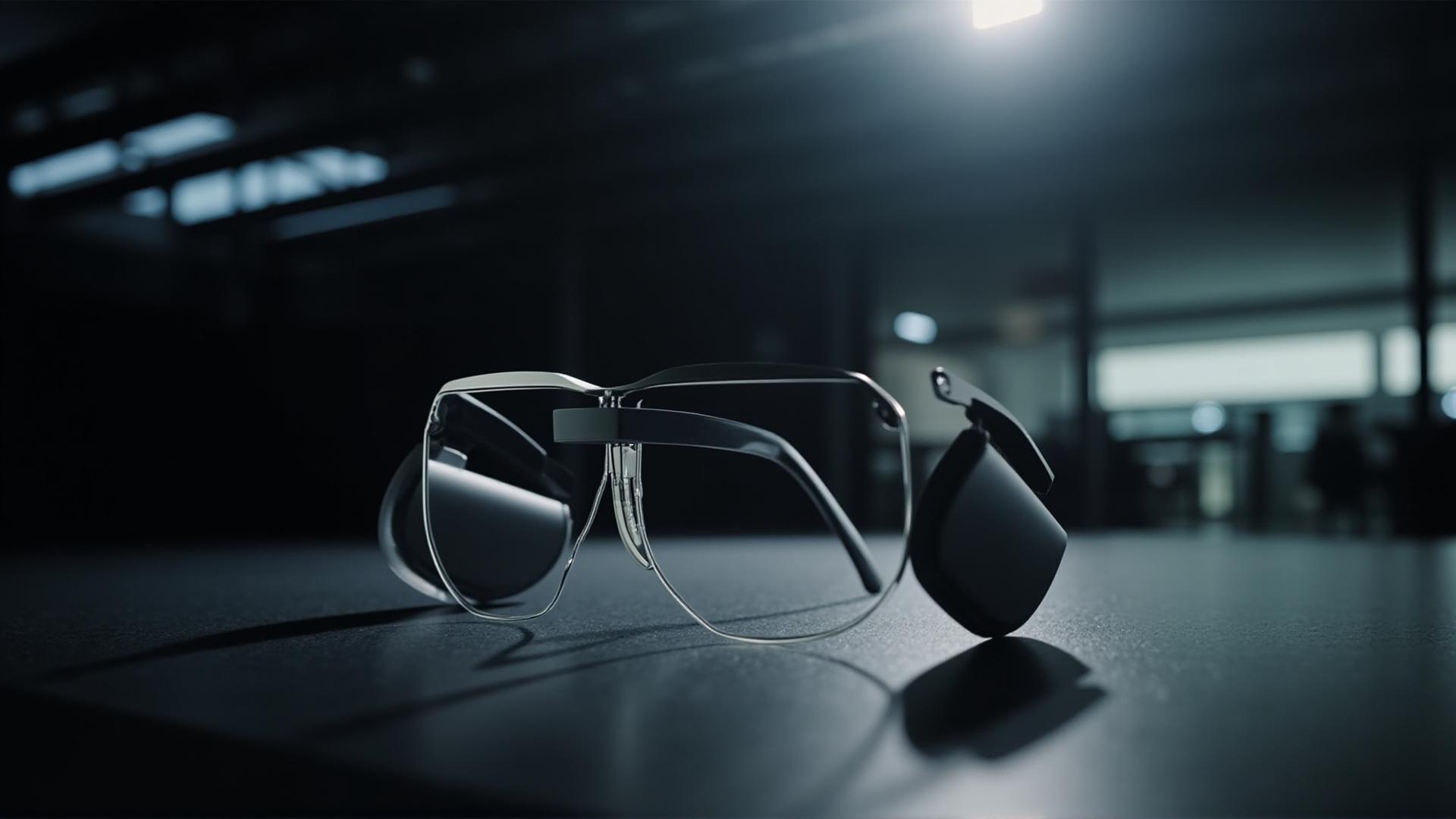
The S7 carries more specific claims on its page than any other model in the sport family: a camera resolution, an ingress marking, a removable inner frame, an endurance range, a magnetic charge arrangement and an ergonomic frame line. That density is exactly why it needs a review sheet rather than a description, and it is also where the review sheet gets its work. The catalogue publishes eight rows for this model, and in the product record every one of those eight is met with a condition or an absence rather than a value. Nothing here is complete enough to be accepted as it stands.
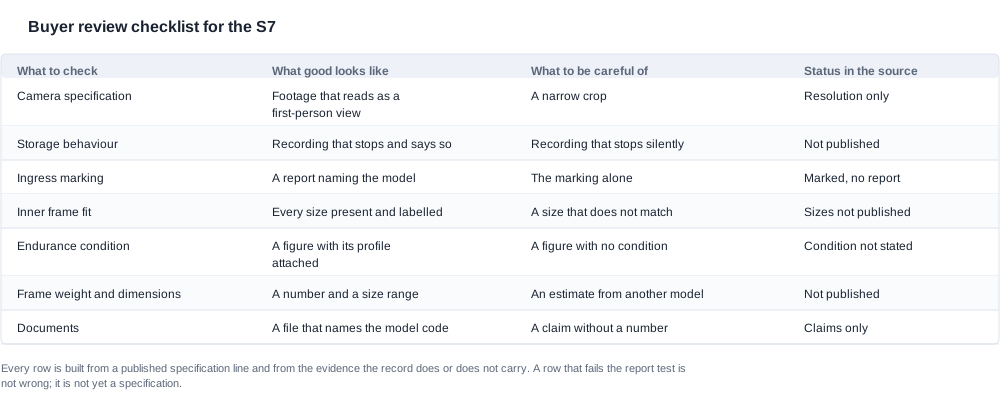
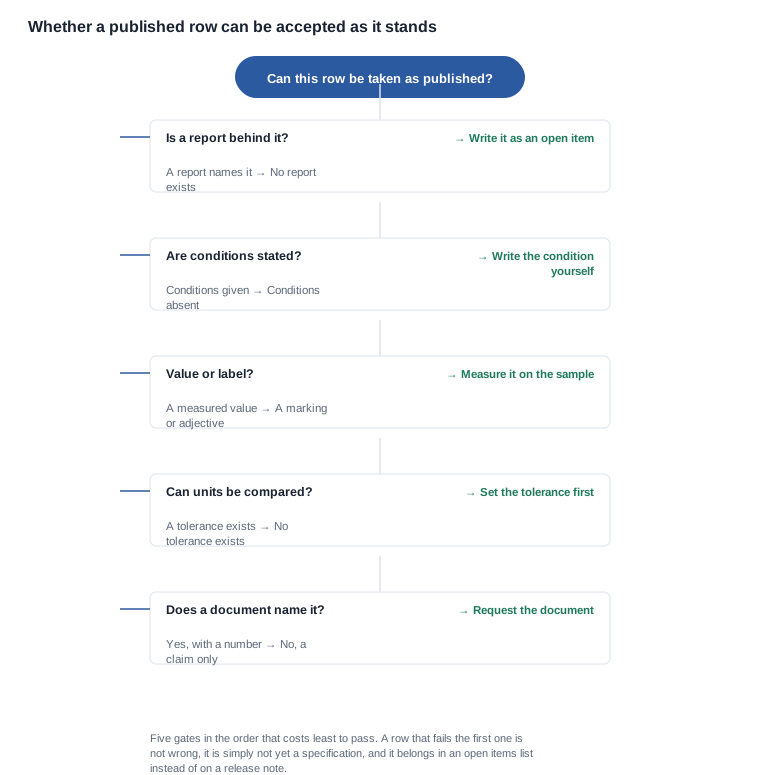
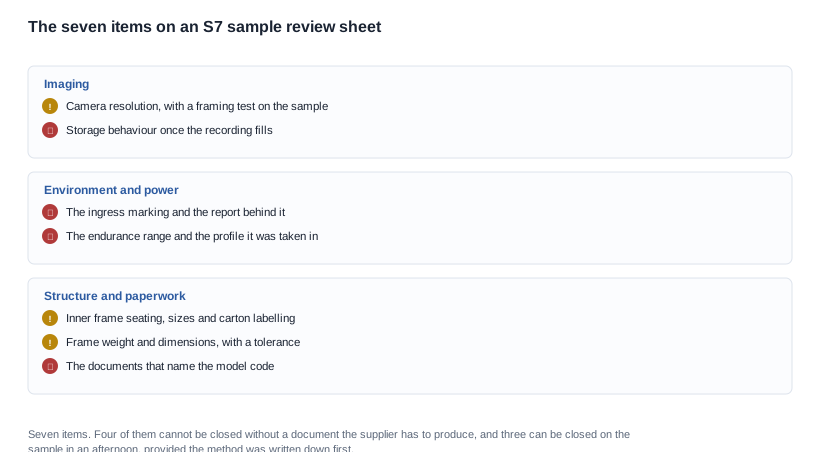
So this checklist is not a list of parameters. A parameter is what the catalogue prints. A review item is what a procurement team has to do to turn a printed row into a decision it can defend — who measures, how, against which criterion, with which tolerance written down before the first order. There are seven of them for this model, and each exists because the documentation behind that row is thin rather than because the product is difficult.
Nothing in this piece is a price argument, and none of the seven items depends on one. The record publishes no price, no order quantity and no lead time for any model in the range, so where the packaging makes the strongest claim — the ingress marking, the endurance range, the removable frame — the review has to produce the most, and that is a documentation rule rather than a commercial one. The S7 smart glasses specifications and features piece is the published baseline this checklist works against.
What the S7 publishes, and what the record adds
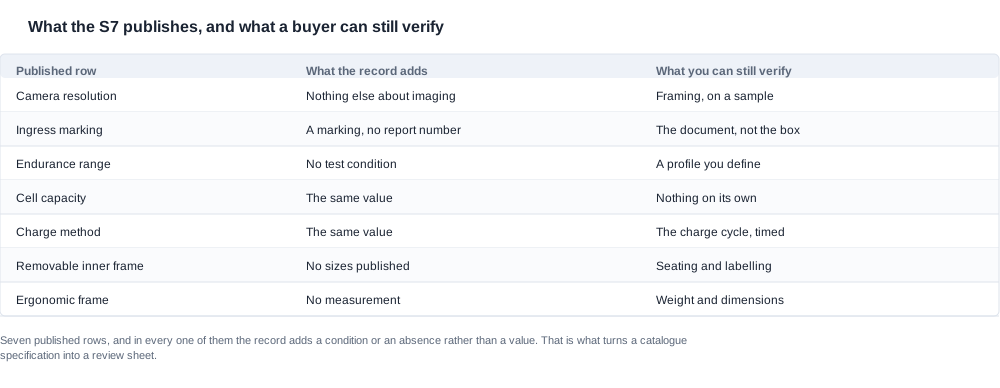
The catalogue page for this model is short and every row on it is specific. The header names a thirteen megapixel camera model in the sport family. The feature line carries four entries: an ergonomic frame design, a thirteen megapixel camera, a removable inner frame and an ingress protection marking. The specification rows underneath give the pixel count, a cell capacity of two hundred and sixty milliamp hours, a usage duration of five to eight hours, a magnetic charge mode and a charge time of two hours or less. The resolution appears twice, once in the feature line and once as a row, which brings the distinct published facts to eight, and those eight are the complete published specification for this model.
Now take the record, and read the same eight facts against it. The entry is graded as a plain fact for its parameters, which puts it with the twenty-four rows of the record that are graded that way rather than with the four that carry a qualification. The optional-configuration column for the model is explicitly empty: it records that the catalogue lists none. The marketing-files column gives one product image from the catalogue page and no wearing video. The product-page column records that this entry has no independent page of its own, and that is the position shared by twenty-five of the twenty-eight entries in the range, since only three models have a page of their own. A buyer therefore reaches almost every model in this range through the catalogue page, and a model page is a description rather than a technical file. The pending column carries the item that will shape most of this checklist: no real photographs, no video and no detection report have been provided for any model in the range, including this one. And the same pending column flags that the page reference in the catalogue is irregular for this entry, with the page footer and the catalogue index disagreeing about where the sport family sits.
Two further inconsistencies sit inside the record itself and a buyer will meet both. The first is the configuration pair of columns: one of them is explicitly empty for this model while the other names five configuration axes for the sport family as a category. The second is worse for a specification sheet. The key technology column for this row carries a remote shutter, surround sound and a one-hour fast charge, and the differentiation column in the same row attributes those three features to two different models rather than to this one. A specification sheet that copies the key technology column verbatim will put three capabilities into a purchase order that the record itself assigns elsewhere. That is the kind of error that survives until the goods arrive.
| Published row | What the record adds | What a buyer still has to do |
|---|---|---|
| Camera resolution, 13 MP | Nothing on sensor, field of view, format or frame rate | Run a framing test and record the result |
| Ingress marking | A catalogue annotation, with no report number behind it | Ask for the report that names this model |
| Endurance range | No test condition of any kind | Write the profile, then measure it |
| Cell capacity | The same value | Nothing on its own |
| Charge method | The same value | Time the charge cycle on the sample |
| Removable inner frame | No sizes published | Build the size matrix and check the labels |
| Ergonomic frame line | No weight and no dimensions | Weigh and measure, with a tolerance |
| Certification | A company claim | Request the documents that name the model |
The three published rows most often mistaken for verified
Three of the eight rows are the ones a review sheet tends to wave through, because each of them looks like a settled fact when it is read alone. Each one is also the row where a buyer is most likely to write something into a listing, a carton or a contract that the documentation cannot support.
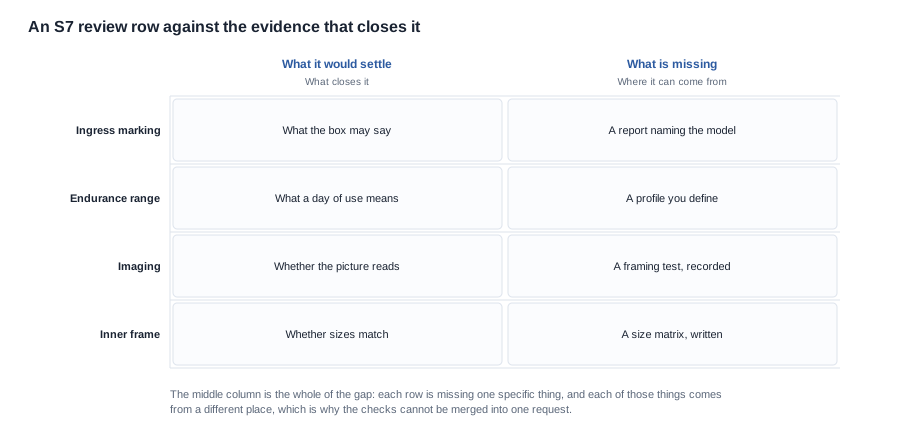
The camera resolution is the first of them. Thirteen megapixels is published, and nothing else about the imaging is: no sensor model, no field of view, no video format, no frame rate, no low-light behaviour and no storage capacity. A resolution is a count, not a picture, and the two come apart in a way a customer will find immediately. The acceptance action here is a framing test, and it is worth doing with a walk-through or a ride rather than a static subject: record it, play it back, and decide whether it reads as a first-person view. A narrow field of view produces a crop that no amount of resolution repairs, and the customer's conclusion will be about the product rather than about the specification. Write the judgement down, because the judgement is what a return will be argued about. The camera imaging notes cover why the field of view and the sensor are the two numbers that decide it, and they are the two numbers a supplier will have to supply if the framing test fails.
The ingress marking is the second. The catalogue prints the marking in the feature line, and the record states in the same cell that it is a catalogue annotation with no third-party report number behind it, and that an ingress level needs a detection report before it may be stated externally. Read the digits before you rely on them either: under the standard's own definition the first position rates protection against solid foreign objects and the second rates protection against water, so a four in the second position is protection against water splashing in any direction, and it is not immersion, not a shower and not a hose, while the five in the first position permits limited dust ingress rather than a dust-tight seal. A carton that says water resistant will be read by a customer as a stronger claim than the digits permit. The acceptance action is therefore a document and not an inspection: the standard, the laboratory and the sample batch, asked for in writing. The IP rating testing notes set out that question, the water resistance notes for the sport range set out what the marking permits where it applies, and the IP ratings guide is the reference for what each digit means.
The endurance range is the third, and it is the row most likely to be turned into a promise. The published figure is five to eight hours from a two hundred and sixty milliamp hour cell, and no test condition accompanies it — not the light level, not the temperature, not what the camera was doing, not whether the radio link was active. Nothing in the whole catalogue publishes a test condition for any endurance figure, and no model in the range can be compared to another on that basis. One point of labelling is worth getting right here, because it is the sort of thing that goes wrong in a spreadsheet: on this page the endurance row is labelled as a usage duration and it sits next to a separate row for charge time, so the two quantities cannot be confused on this page. That is not true of every page in the range, where the same word is used for both quantities on some models, so the label still has to be read on the page rather than assumed from the range.
The rows that need an acceptance method you write yourself
The remaining rows do not have a misleading published value so much as an absence of one, and the work is the same in each case: the buyer has to write down the method before the sample arrives, because a method invented afterwards is an argument rather than a decision.
The removable inner frame is the structure of this model and the feature most likely to appear on the packaging, and the sizes behind it are not published. The acceptance actions are mechanical and quick: every size in the range has to be present, each has to seat without forcing, and the labelling on the inner frame has to match the labelling in the carton and the size guide in the listing. A size mismatch at the point of sale is a return that no document prevents, and it is also a customer who concludes the size guide on the listing is wrong. Building the matrix is the work; the sport fit and sizing analysis covers how to structure it so that a mismatch is caught before the order rather than after it.
The ergonomic frame line is an adjective with no measurable content attached to it anywhere in the record: no weight, no dimensions, no temple lengths and no adjustment range. The acceptance action is to weigh the sample, measure the frame and the inner frame separately, and record a tolerance against each. There is a trap here that is easy to fall into and expensive to get wrong, because a single figure for weight does exist in the whole catalogue and it does not belong to this model. The one published weight anywhere in the range is a hundred and fifty-eight grams, and it belongs to a different model whose cell is two hundred and sixty-five milliamp hours — a larger cell than the one in this model — and which also has a folding case. It is a different product on a different power budget, so it cannot be used as a stand-in in either direction, and quoting it for this model would be a fabricated specification rather than an approximation. The sport weight comparison explains why a proxy is not a substitute, and the sport durability testing piece covers the mechanical side of the same product.
The charge arrangement and the recording behaviour are the last two. The magnetic charge mode is published and can be timed on a sample, which is a cheap item with a real payoff because it sets the cycle your own operation depends on. Storage is a different matter: capacity, file format and overwrite behaviour are not published for any model in the range, and on a camera product that gap is a returns driver, because a camera that stops recording when its storage fills presents in the field exactly like a camera with a fault. The acceptance action is to fill the recording on a sample, capture again, and record what happens. The AI camera glasses troubleshooting order treats it as the first check for that reason.
The certification items are the seventh, and they are a document request rather than a measurement. The certification status for this model sets out the seven documents and who resolves each one; the short version for a review sheet is that every one of them has to name this model code, and a certificate that names a family rather than a model closes nothing.
The seven questions to send with the sample request
The checklist works only if the questions go out before the sample, because each of them is a request for a method, a document or a number that the supplier has to produce rather than something the buyer can find. Sent as one list, they are seven lines long, and they are written to be answered in one reply.
- Which sensor, field of view, video format and frame rate apply to this model, and can you supply the sensor model rather than the resolution alone?
- How much recording does the camera hold, in what format, and what happens when it fills?
- What report stands behind the ingress marking on this model, which laboratory issued it, and which sample batch does it cover?
- What does the endurance figure measure — what was the camera doing, was the radio link active, and at what temperature?
- Which sizes of the removable inner frame exist, how are they labelled, and how do those labels map onto the carton and the size guide?
- What is the frame weight and what are the frame dimensions, measured on which unit and with what tolerance?
- Which of the certification documents name this model code, and which of them are still outstanding?
Each of those seven is written so that a partial answer is still usable. A supplier who can answer the fourth question with a profile but has no figure has told you where to schedule the measurement, and a supplier who answers the third with a laboratory name and no number has told you which document to chase. What is not usable is a single figure with no condition attached, a typical figure from elsewhere in the industry, or a document for a neighbouring model. Those three are the red flags in this exchange, and they share a shape: something has been detached from the unit it was supposed to describe.
Turning the checks into a review sheet that survives incoming inspection
A checklist that stays in a folder is a checklist that stops working at the first disagreement. The sheet has to survive contact with incoming goods, and that means six things for every row, written down before the first order rather than at the point of the first complaint: the method, who performs it, the record that is kept, the pass criterion, the tolerance, and what happens when the row fails.
The tolerance is the item most often left out, and it is the one that decides whether a measurement produces a decision or an argument. Without a tolerance, two units that differ by a fraction are both defensible and neither can be rejected, and the inspection ends in a discussion rather than in a release or a hold. The pass criterion is the second: what a good result looks like has to be written in terms somebody else can apply, which is why the framing test on this model is described as a judgement about whether the footage reads as a first-person view rather than as a number nobody has. And the third is the record, because a reading that is not written down at the point of receipt is a reading that has to be renegotiated later, when the supplier and the buyer no longer remember the conditions.
Who performs the check is a decision with evidential weight behind it, and the three options are not interchangeable. A reading taken on the supplier's line is a supplier's own result and is worth what its documentation is worth. A reading taken at a third-party laboratory is stronger and slower and costs money. A reading taken by your own incoming inspection is the weakest in evidential terms and the strongest in control terms, because it is the only one that happens on your own units, on your own site, against your own criterion. For most of the seven rows, the third option is the realistic one, and the method sheet is what makes it defensible.
The trade-off is worth naming rather than hiding. A seven-row sheet with written methods slows the first order, ties up inspection time on every unit that arrives, and occasionally fails a unit that would have passed a looser method. What it buys is fewer returns on the specific claims that generate returns, a channel conversation that does not depend on anyone remembering a verbal agreement, and a supplier who knows exactly which items are checked and how. For a product whose packaging makes specific claims, that is not a compliance cost so much as the price of being able to keep them.
What the S7 record supports today
We stand on a simple rule here: a published row is not the same thing as an accepted one, and the difference has to be closed by method and by document rather than by confidence. We will not present the resolution as an image quality claim without a sensor model and a framing test behind it. We will not print the ingress marking as a tested rating while the record describes it as a catalogue annotation with no report number, and we will not describe it in words that its digits do not permit. We will not present the endurance range as a working day, because no condition is published for it. We will not quote a certificate number, a case capacity, a size range or a weight that our documentation does not carry, and we will not borrow the one published weight in the range from a different model on a different power budget. And where the record attributes a capability to other models in its own columns, we will not carry it into this model's specification sheet.
What the record does support is a shortlist and a review sheet that can be written today. This model has a stable code, a catalogue page and a plain fact grade on its parameters, which is more than three entries in this range can claim. It publishes eight rows, and every one of them can be converted into a review item with a method, an owner and a tolerance. It carries an ingress marking whose documentation gap is precisely stated, an endurance figure whose missing condition is precisely stated, and a removable frame whose sizing gap is precisely stated. And its file position is a single catalogue image with no detection report behind it, which tells a buyer that arranging the measurements is their own task rather than something they can open a folder and find. The S7 battery life analysis covers the endurance row in more depth, the sport battery during activity piece covers what changes between a bench and a body, and the S7 value analysis sets out the commercial side of the same model. The sport smart glasses range is where the model sits.
Send us the market, the channel and the claims your packaging will make, and we will tell you which of the seven checks decide whether those claims survive the first week.


