
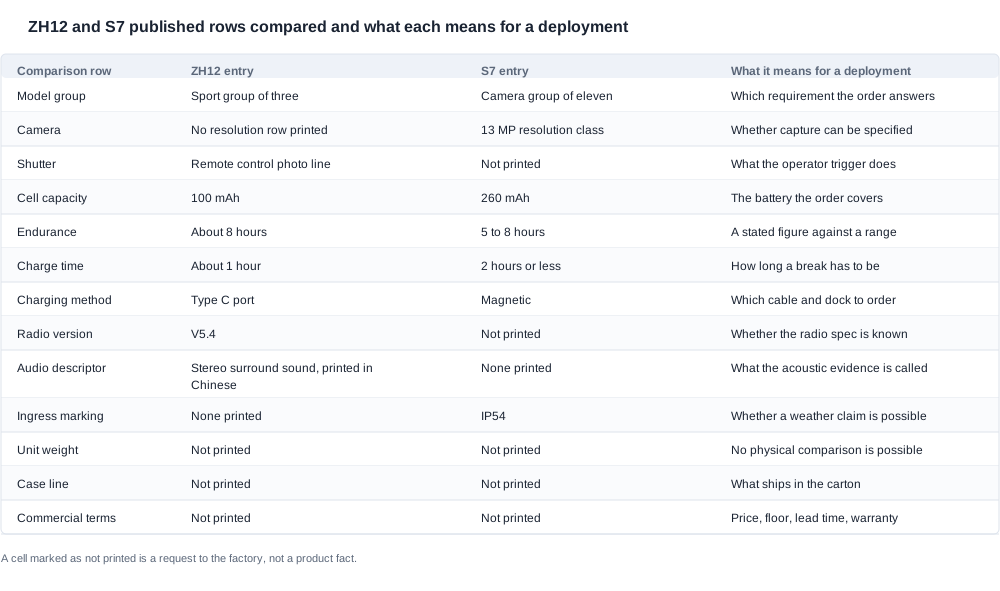
Deploying the S7 smart glasses and the ZH12 against one brief is a mistake that costs money, and the reason is that the two products are published in a way that makes them appear closer than they are. The ZH12's page names two features — remote control photography and a stereo surround sound descriptor — and prints a cell of 100 mAh, an endurance figure of about eight hours, a charge time of about one hour, Type-C charging and a V5.4 radio. The S7's page names a camera class of thirteen megapixel, and it prints a 260 mAh cell beside a five to eight hour endurance band. The charge ceiling of two hours or less sits alongside magnetic charging, and the feature lines add an ingress marking, an ergonomic frame, a detachable inner frame and a second mention of the pixel count. Nothing on either page says the two do the same job, and the fact that both are sold into sport contexts is a packaging fact rather than a functional one. This page is written for the buyer who has to match a product to a deployment and then defend the match.
Two sport platforms, two different jobs
Both products appear in sport contexts, and that shared context is where most of the confusion in this comparison comes from. The catalogue sorts them differently, and the sorting matters more than the naming. The ZH12 is one of the three entries in the sport group, alongside the D17 and the YKC02. The S7 is one of the eleven pages in the camera group, and while its catalogue name carries sport wording, that word describes the shape of the item and says nothing about the group it belongs to. A buyer who treats the two as members of one group will end up comparing attributes that only one of them publishes, and the comparison will be decided by whichever page happens to print more of the row being examined.
The published evidence for the two jobs is quite distinct. The ZH12's page is organised around audio and control: there is a cell, an endurance figure, a charge time, a charging method, a radio version, and two feature lines that in the original are printed in Chinese and read as remote control photography and stereo surround sound. That is a product whose value rests on what an operator hears and what they can trigger at a distance. The S7's page is organised around capture and environment: a camera class, a 260 mAh cell, an endurance band, a charge ceiling and a magnetic charging method, plus three feature lines covering the frame design, the pixel count and the removable inner frame, with an ingress marking added to the specification block.
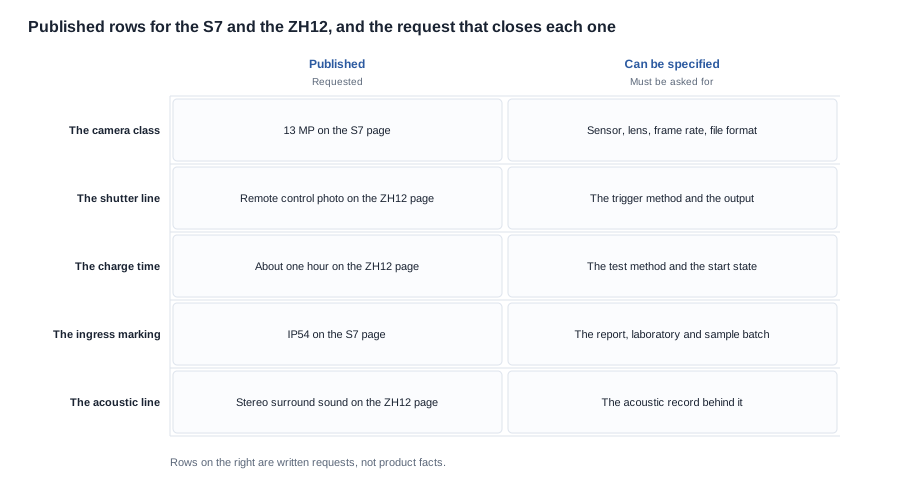
The clearest point of separation is the camera. The S7 prints a resolution class; the ZH12 prints no resolution class of any kind, even though its page carries a remote control photography line. That combination is the single most useful fact in the comparison, because it tells a buyer that the shutter on the ZH12 has no published output specification. A remote shutter with no published image specification is a control convenience, not a capture system, and a deployment that depends on the images coming off the device cannot be based on it.
There is a second separation that is easy to miss because it is about the charging cycle rather than the features. The ZH12 prints a charge time of about one hour, and the S7 prints a ceiling of two hours or less. Across the whole catalogue, twenty-six models print the two-hour ceiling and only two print the shorter figure, and the ZH12 is one of those two. That is a genuine operational difference rather than a catalogue formality, and it is the reason a deployment built around short turnaround between operators points at the ZH12's row. What it is not is a quality difference, because the shorter figure comes with the same missing context as the longer one — no starting state, no completion criterion, no test method.
The third separation is the one that has to be handled carefully, because it is a documentation difference rather than a product one. The ZH12's page prints its two feature lines in Chinese while the rest of the library uses English, and a search across the catalogue for the English words will not find them. A buyer building a data extract from the catalogue, or a channel partner writing copy from the published material, needs to know that the Chinese rows are the published rows and not a separate untranslated edition of a different page.
The S7 for capturing
The S7's page supports a capture-led deployment, and it does so with three published elements that have to be read together rather than separately.
The first is the camera class of thirteen megapixel, and its value in a deployment brief is that it is a class rather than a marketing word. Three camera pages in the catalogue print this class and eight print the lower one, so a brief can say which group a product belongs to and can attach the storage, transfer and file-handling arrangements that a camera product brings with it. The class is a component figure, and the evidence obligation sits behind it: the camera row stops at the pixel count, and the sensor, the optics, the field of view, the frame rate, the file format, the stabilisation and the low-light behaviour are all absent. A deployment that needs images from a moving operator therefore needs an image criterion the buyer writes, since the catalogue does not supply one, and the criterion has to be tested on a sample under the conditions the operator will actually work in.
The second is the ingress marking. The IP54 marking is printed on two pages in the entire catalogue and the S7's page is one of them, which makes it a distinguishing feature rather than a shared one. In a deployment brief it carries a specific obligation: the report behind the marking has to name the standard used, the laboratory involved and the batch of samples covered, and it has to record whether a removable inner frame was fitted when the test was run. A marking with no report reference is not a false claim, but it is an incomplete one, and it is incomplete in the part a customer's return will be tested against.
The third is the detachable inner frame, which is what turns this model into an equipment programme rather than a single unit. The S7 and the V06 are the only two pages in the library that print it, and the programme it implies is substantial: a size range that the page does not state, spares that have their own order quantity and their own packaging artwork, and an interchangeability question between models. A deployment that issues one frame per operator and replaces them on a cycle is buying a small parts business alongside the device, and the S7's published row is the reason that business exists.
The endurance band on this page is worth reading as a band. Five to eight hours is a range, and a range implies conditions that the page does not describe, and the charge ceiling of two hours or less is a bound rather than a typical cycle. Both are honest ways to publish runtime and charge time, and both need one request: the test condition, the duty cycle, the state the cycle starts from and the point at which a charge is considered finished.
The ZH12 for remote control and fast charging
The ZH12's page supports a different kind of deployment, one built around an operator who needs to trigger something at a distance and who needs the device back in service quickly.
The remote shutter is the first element, and it is the reason the model appears alongside the D17. Only those two pages in the catalogue carry a remote control photography line. What that line does not do is describe the output: the page publishes no resolution class, no sensor detail, no file format and no field of view, so the result of pressing the shutter is not a published specification of the ZH12. In a deployment brief the shutter therefore has to be written as an operator action with a written answer about what it produces, and the honest framing is a control function whose image output is to be confirmed rather than a camera capability.
The second element is the charge time, and this is where the ZH12 is genuinely distinctive in the library. About one hour is short enough to plan a turnaround around: a unit that is recharged during a break can be issued to the next operator without extending the shift. The qualification is the same one that applies to every published figure in this catalogue, and it matters more here rather than less, because a short figure invites more confident planning than a long one does. The catalogue does not say whether the hour starts from an empty cell, does not say at what point the charger decides the unit is finished, and does not publish the test method. A buyer should ask for all three before the turnaround is written into a roster.
The third element is the endurance figure of about eight hours, and here the cell is the point rather than the duration. The page prints a 100 mAh cell, which is the smallest figure among the models with a published radio version in the sport group, and the duration is a single stated figure rather than a band. A deployment brief should carry the cell figure and the duration together, because the pair is what tells an operator how long the device can be away from a charger, and the duration alone cannot be planned around if the cell is small.
There is a trap in this page for anyone working from a cell figure, and it is worth naming because it is easy to fall into when several pages are being read at once. A 100 mAh cell appears on four different pages in the catalogue, and each is a different product: the AR glasses page pairs it with magnetic charging and an eight hour figure, the electrochromic glasses page pairs it with magnetic charging and a seven hour figure, the D11 and the D12 pair it with Type-C charging and a seven hour figure, and the ZH12 pairs it with Type-C charging and an eight hour figure. A cell figure on its own identifies nothing. It is the combination of cell, charging method and duration that identifies a page, and a range sheet that keys on cell capacity alone will eventually put the wrong product in the wrong row.

The published limits on both
The limits here are shared, which is convenient in one sense and frustrating in another, because the same requests apply to both models and a buyer can send them together.
Neither page prints a unit weight, a frame dimension or a temple length. The catalogue publishes one weight for the whole library, and the single figure it carries sits on a third model's page: the MT6 eyewear body, listed at 158 g, measured on the eyewear and not on the folding case beside it. Nothing is published for either the S7 or the ZH12, so the physical comparison between these two frames cannot be made from the catalogue at all, and a deployment plan that turns on weight, on packaging volume or on how the device sits with a helmet or a visor has no published material to work from. It has a request, and the request is short.
Neither page prints a charging-case line either, and the S7's page is one of the camera pages where the case question is simply unanswered: a printed capacity on five camera pages, a named case without a figure on two, and no line at all on the rest. That is a statement about the catalogue rather than about the product, and the correct reading is that whether a case ships in the carton is an open question for the supplier to answer in writing, not a fact to be assumed in either direction. A deployment that hands out a device with a spare battery expects to know what the case contains, and a procurement file that assumes a case without asking has assumed the one thing the page does not say.
The radio version is asymmetric. The ZH12 prints V5.4 and the S7 prints nothing, and that is the general pattern of the library: the eight audio models all print a radio version and the eleven camera models all do not. A buyer who needs the radio fitted to the S7 is therefore making a request that covers a whole group of products, which is a better question to send than a question about one model.
The certification position is the limit that carries the most weight in a procurement file, and it should be stated plainly rather than assumed. No product in the catalogue carries a certification row, the familiar marks do not appear in the catalogue text at all, and the export certification page is made of patent images — two of them utility-model patents and eight of them appearance-design patents — which speaks for the company and not for this model. The conformity documentation a finished unit needs under the Radio Equipment Directive (EU) 2014/53/EU, with the EMC Directive 2014/32/EU met alongside it, is therefore a request, and it has to come back with the certificate numbers and the model schedule those certificates apply to.
Matching the model to the deployment
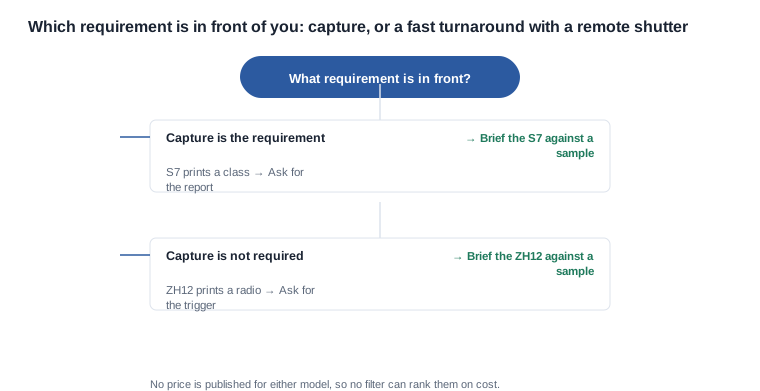
Matching a product to a deployment is a filtering process, and the filters for these two models are short because the published rows are short. The first filter is whether the deployment needs captured images at all, because one of the two prints a camera class while the other prints none. The second filter is whether the deployment needs a turnaround short enough to sit inside a break, because the ZH12 is one of only two models in the library that print a charge time below the two-hour ceiling. The third filter is whether the deployment happens in an environment where an ingress marking matters, because the S7 prints one and the ZH12 does not. The fourth filter is whether the deployment issues one device per operator and replaces them, because the removable inner frame on the S7 is a parts programme the ZH12 does not have.
None of these filters is a price filter, and it is worth saying why. No unit price, price tier, order floor, production timetable or warranty term is published for either model, so a filter that tried to rank the two on cost would be working from a number that does not exist. What the filters do instead is route a requirement to the product whose published rows answer it, and that is a different and more reliable kind of decision.
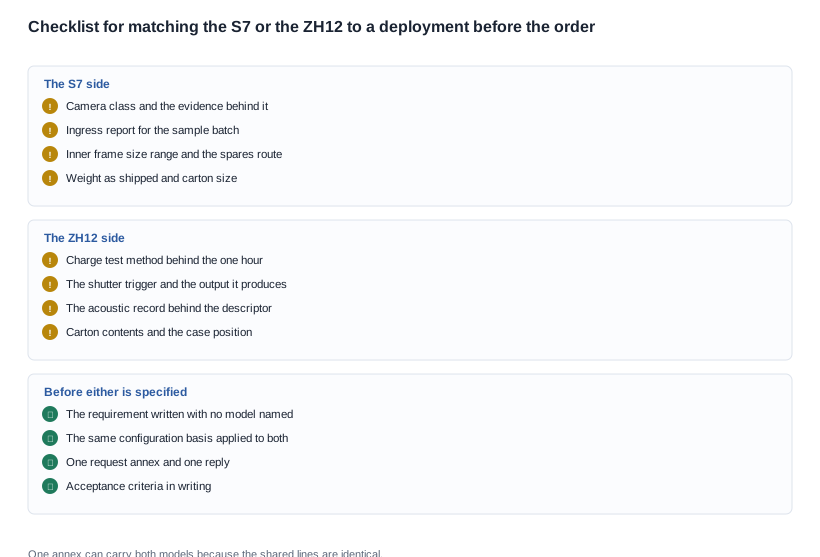
The request that follows is a single annex, and it can carry both models because the shared lines are identical:
- A carton contents list for each model, with the case position described in words.
- The weight of the unit as packed, and the master carton size given on its own.
- The test condition, the duty cycle and the start state behind each endurance figure.
- The test method behind each charge figure, and the point at which a charge is treated as complete.
- The camera detail behind the resolution class, and the output of the remote shutter.
- The acoustic record behind the surround sound descriptor.
- The ingress test report, naming the standard used, the laboratory involved and the sample batch covered.
- The size range, the interchange rules and the spares route for the detachable inner frame.
- The price per unit for the quantity being ordered, the order floor, the production lead time and the warranty period.
- The conformity documentation, with the certificate numbers and the model schedule those certificates apply to.
The order of the list reflects what can still change the outcome. Lines one to four can move a product out of the running, because a weight that breaks the packaging plan or a duty cycle that breaks the roster is a different product from the one on the page. Lines five to eight convert published descriptors into criteria that a returned order can be judged against. Lines nine and ten are the commercial and documentary set that a purchase order has to carry.
There are a few red flags worth naming, because they tend to appear in the answers rather than in the questions. A turnaround built on the one hour figure without the test method is a roster built on an assumption. A remote shutter answered with a marketing phrase rather than a trigger method and an output description is an undefined operator action. An ingress answer given for the whole model range rather than for the batch that ships cannot be attached to a purchase order. And a carton list that differs between the quotation and the delivery is a configuration change that has to be escalated, not absorbed.
Matching the S7 against the ZH12 has to be settled against a written requirement and the published rows, and we will not recommend either of them for a named deployment on the strength of a claim neither page supports. The S7 publishes a camera class, an ingress marking and a removable inner frame; the ZH12 publishes a charge time of about one hour, a V5.4 radio, a remote control photography line and a stereo surround sound descriptor. Those are the facts a deployment match should be built on, and they are enough to route a requirement without a single invented number. If you want the published rows for the S7 gathered in one place, the S7 specification breakdown holds the rows, and the annex a buyer actually sends is the S7 buyer review checklist. The question worth asking a factory is not which model suits a scenario, but what each of them will confirm in writing for the one you have chosen.


