

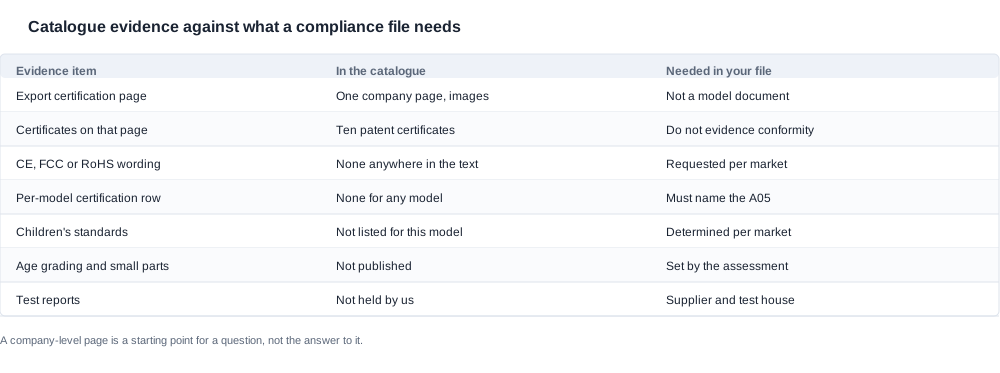
The certification status of the A05 smart glasses is the same as it is for every other model we sell, and it is worth stating precisely because the category invites imprecision: there is no per-model certification row anywhere in our catalogue, and the catalogue text contains no reference to CE, FCC or RoHS at all. What the catalogue does carry is a single company-level export certification page whose content is images rather than text.
That is a different situation from a supplier who publishes a certificate number you can look up, and it is a different situation again from a supplier who publishes nothing at all. This article sets out what the position actually is, what you have to request to close it, and what you should not write in a listing until it is closed.
A05 smart glasses certification status: what the catalogue does and does not say
One company page, and no model row anywhere
Our catalogue's export certification page carries ten patent certificates, eight of them appearance-design patents and two of them utility-model patents. Those are the only compliance-adjacent artefacts in the document, and they are patents rather than conformity documents: a patent certificate records that a design or a mechanism was granted protection, and it says nothing about whether a product conforms to a requirement in a market.
That distinction matters more than it might appear, because a buyer who sees a page of certificates on a supplier's cover assumes the supplier holds conformity evidence. We are not saying the A05 lacks conformity evidence — we are saying none has been provided to us, and we will not state a certification status we cannot evidence.
The second half of the position is simpler and is the part most often got wrong in either direction. The catalogue contains no per-model certification row for the A05, the A06, the A07 or any other model. There is no table anywhere that maps a model string to a certificate number, an issuing body, a validity date or a covered-model schedule. And the words CE, FCC and RoHS do not appear in the catalogue text.
Why a catalogue page cannot certify your order
Three reasons, and each of them bites differently depending on the channel you are selling into.
It does not name your model. A conformity document that names a model string covers that model. A page of patent certificates on a company cover names nobody. If your customer's specification says "evidence of conformity for the model ordered", a company page does not satisfy it, and the gap has to be closed with documents that carry the model string.
It does not name your market. Conformity is assessed against the requirements of a destination market and, in this category, against the age band and the intended use as those are declared. A company-level page is market-neutral in a way that no conformity assessment is.
It does not survive a tender. An institutional buyer scoring a supplier is asked to produce documents, not to describe a supplier's capabilities. The child product compliance guidance sets out the framework, and the certification checklist sets out the document set a file should hold before a claim is made.

The children's product rules that attach before the hardware questions
How the applicable requirements are decided
Children's eyewear in Europe and the United States commonly attracts requirements beyond general consumer electronics. In the European Union the reference point is EN 71, and in the United States the reference points are the Consumer Product Safety Commission requirements and ASTM F963. These are named here as text, without reference to any document we do not hold.
Whether any of them attaches to a given product is not decided by the product alone. It is decided by how the product is categorised, how it is marketed, what age band it is intended for, and what the buyer declares about intended use. That is why the correct answer from a supplier is never "it is certified" and never "it does not need certification". The correct answer is a set of documents and a written statement of the categorisation that produced them.
The practical consequence for a buyer is that the categorisation decision has to be made before the test programme can be specified, and the test programme is what sets the cost and the schedule. A buyer who requests "the certificates" without stating the market, the age band and the intended use will get a slower and less useful answer than one who requests a written categorisation and the evidence that follows from it.
Who has to make the determination
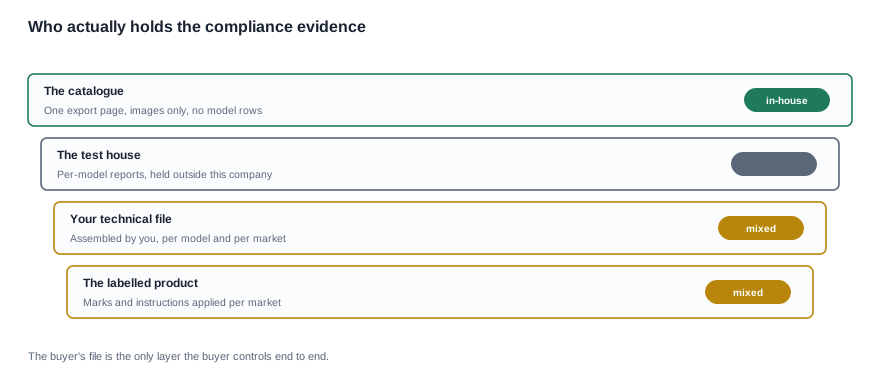
This is the part worth being blunt about. We are the supplier, and we hold the product specification and the manufacturing information. We are not the party that determines whether your product, sold into your market with your labelling and your intended use, conforms to your market's rules. That determination belongs to your compliance function or your appointed test house, and it belongs to you because it depends on decisions you make that we do not make: the market, the claims, the age band and the channel.
What we can do, and what we will do, is supply the material a determination needs: the published specification rows, the cell and charging details, the material information you request, the labelling content you ask us to print, and a written answer to every question about the product itself. The GPSR obligations route is the one that runs per destination market for a general consumer product, and it is where the technical documentation obligation sits.
The document list a tender file has to hold
The request, in one message
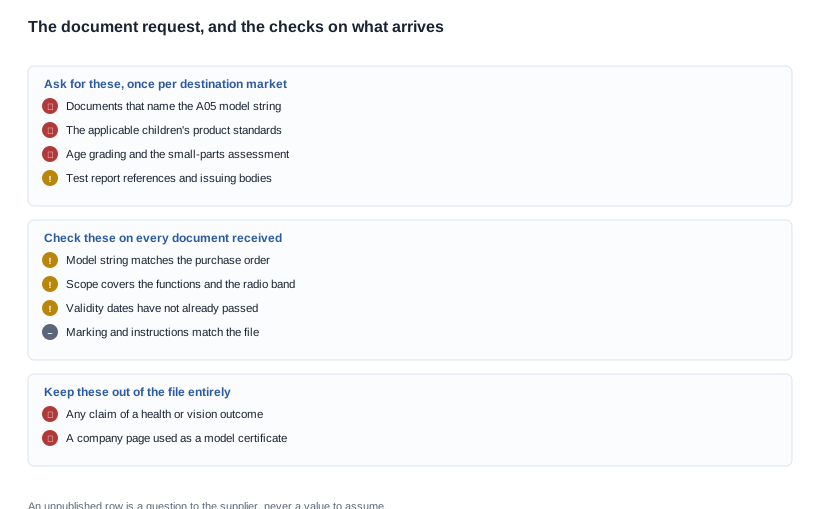
Ask for these together, in writing, and attach the model string, the destination market and the intended age band to the request itself:
- Every conformity document that names the A05, with the issuing body, the document number and the validity date for each.
- The applicable requirements list for the destination market, with the written categorisation that produced it.
- The age grading and the small-parts assessment for this model and this configuration.
- The test report references behind each of the above, so that a report can be requested and its scope read.
- The materials declaration for the parts that touch skin, and the battery transport summary for the fitted cell.
- The instructions and labelling content as it will be printed for this market, in the language that market requires.
A supplier who answers all six has a documentation habit. A supplier who answers two is telling you something useful before you place the deposit.
The scope question every certificate leaves open
Even a complete set of documents leaves one question open, and it is the question that bites hardest in this category: a document that names one model does not name the other. The A05 and the A06 publish identical rows and carry the same catalogue product name of a children's smart protection model, and our own documentation records the difference between them as an open item.
If you are buying one of them, the model string on the document is the thing to check, character by character, against the model string on your purchase order. If you are buying both, you need to know whether the documents name both, and if they do not, you need the second set. That is a second programme, a second cost and a second schedule, and it is entirely a consequence of the two models not being distinguishable in the documentation.
The A05 versus A06 specification comparison covers what the possible answers mean, and the A05 best-for analysis covers when carrying both is a range decision you should make deliberately rather than by default.
Running the determination on a schedule
Compliance work in a children's category is slow for structural reasons rather than because anyone is being difficult. The categorisation has to be decided before the test programme can be specified, the test programme has to be specified before the laboratory can be booked, and the marking and instructions have to be final before the goods are produced. Each of those steps waits on the one before it, which is why a buyer who starts the conversation at the certificate stage has already lost a cycle.
The order that keeps the programme moving is worth stating as a sequence rather than a list, because the sequence is the part that is usually wrong.
Determine the categorisation first. Market, age band, intended use, claims. Until these four are written down, the test house is quoting against a guess, and a quote against a guess is a quote that changes.
Then specify the test programme against the written categorisation, and ask for the report references rather than the reports. A reference is checkable later; a report attached to an email is a claim.
Then finalise the labelling and instructions, because the label is usually a test input in this category rather than a decoration. A change to the label after the assessment is a change that triggers re-evaluation, and a re-evaluation is another calendar cycle.
Then produce, with the label and the model string matched to the assessed configuration, and with the assessed configuration recorded on the purchase order so that a later batch can be checked against it.
The one thing that does not appear in that sequence is the moment at which the unit price is agreed, and it does not appear there because a price agreed before the categorisation is fixed is a price agreed against a guess. The unit price is settled last, and by then both sides know what they are settling.
A buyer running two markets should run the determinations in parallel rather than in series. The A05's specification does not change between markets, so the documentation effort overlaps, and the divergence between the two programmes is in the labelling and the applicable requirements rather than in the product.


The specification rows that are not compliance documents but still block compliance
A buyer can hold every document and still be unable to write a defensible listing, because some of the specifications that a tender asks about are not in the catalogue at all. These are the ones that come up repeatedly.
The runtime condition, the lens material and ingress protection
Roughly twenty hours is published without a condition. A tender that asks for the endurance figure with its test condition will not get one from us, and the answer has to come from the supplier's own test record. The figure is the highest published endurance in our range and the smallest published cell, so the condition is doing a lot of work.
Lens material is not published for this model. If your labelling or your listing will make any skin-contact or hypoallergenic statement, that has to be answered before the artwork is approved, because a claim about a material that has not been declared is a claim you cannot evidence.
Ingress protection is not published for this model. Two models in our range carry an IP54 rating and this is not one of them. That means there is no basis for a water, sweat or rain claim, which matters for a product intended for a playground, a gym or a school corridor.
The radio version and the specification that names one
The A05 publishes no Bluetooth version row, and that absence has a consequence beyond the specification sheet. If your customer's requirement document names a radio version — and many do, because they are written to be technology-neutral on the surface and specific underneath — you cannot confirm this model meets it, and no document will confirm it, because the row does not exist in our catalogue.
The resolution is a written statement from the supplier of the version fitted to this configuration, which is a straightforward thing to ask for and an easy thing for a supplier to be unable to answer. Ask it early rather than at first article.

The claim boundary this category sits on
Why a behaviour reminder is not a health claim
The A05 publishes a lens-type electronic fogging element, posture and distance sensing, a 40 mAh cell, a charge time of two hours or less, roughly twenty hours of rated use and magnetic charging. Nothing in that list is a clinical function, and nothing in it may be presented as one.
A device that senses a distance or a position and reminds is a physical sensing product. Presenting it as producing a vision, health or prevention outcome is a claim we do not make, cannot support, and will not help a buyer make. We hold no clinical data, no test protocol and no regulatory assessment for this category, and the boundary is set out in our medical boundary guidance and in the sensing notes for the kids range.
For a buyer, the practical effect is on copy rather than on paperwork. The claim wording is the part of the listing that creates the exposure, and it should be fixed before the product page is written rather than reviewed after it is published.
The twin model as a certificate-scope problem
The A05 and the A06 question is a commercial question and a documentation question at the same time, and the second half is the one that gets missed. Three consequences follow if it stays open.
First, a range of two models a customer cannot tell apart fragments the channel and the inventory for no commercial gain. Second, a document naming one model does not cover the other, so a brand carrying both may be carrying two document sets where it assumed one. Third, and most awkward, an age grading that was determined for one model is not automatically the grading for the other if the two differ physically at all — and that is exactly the attribute you are trying to establish.
The resolution is one written answer from the supplier, and it is worth asking before the range plan is built rather than after. The A05 buyer review checklist sets out where that answer sits in the sample-stage sequence.
Pricing an open compliance position
Which costs are fixed and which are negotiable
An open certification position is not a reason to stop buying, but it is a reason to price the programme correctly, because the cost is real and it sits outside the unit price.
Fixed, because they follow the process: the test and assessment cost for a model in a market, the lead time that the test laboratory imposes, and the cost of a second model being documented separately. Pressing on any of these produces a longer schedule rather than a shorter one.
Negotiable, because they are the supplier's own decisions: the number of units per model in a single production run, the delivery split that lets one tranche be the one which proves the documentation, the packaging and labelling work if your market requires specific content, the warranty period with a stated response, and the payment nodes that place inspection against the first shipment rather than the last.
Worth asking about explicitly: whether tooling is quoted separately from certification, because the two are frequently bundled into a single line that hides which is which. Tooling is normally amortised across the first order, while certification is a per-model and per-market cost, and the amortization question is a real one when a programme may be discontinued.
What the programme looks like on a calendar
A buyer who has never run a children's product programme tends to plan it as a single event with a duration, and the category does not work that way. The work is a chain, and each link has its own owner, and the links sit in different organisations.
The determination sits with the buyer's compliance function or appointed test house. The technical material sits with the supplier, and the requests are ours to answer. The labelling content sits with the buyer's marketing function, and it is the link most often left to the end. The production slot sits with the supplier and is scheduled against the assessment, not against the order.
Three practical consequences follow, and they are worth having in a contract rather than in a plan.
Write the assessment into the order, not into the schedule. A purchase order that names the assessed configuration and the label version makes the goods that arrive checkable against the documents. A purchase order that does not leaves you comparing a shipment against an email.
Hold the payment against the documentation, not only against the shipment. For a first order in a category with an open compliance position, the inspection node is more useful placed at the document review than at the goods-in check, because the document review is the step that can still stop the programme.
Ask for the re-issue obligation in writing. If the configuration, the labelling or the model string changes after the assessment, the obligation to re-issue the documentation should be a contractual one. Without it, the buyer absorbs a re-evaluation that the supplier caused, and in this category that re-evaluation is measured in months.
None of this is an argument against the model. It is an argument for entering the category with a programme plan rather than a purchase order, and the plan is what the certification checklist is for.
What we can and cannot tell you about the A05
This model should not enter a school or an institutional channel until a compliance determination has been made, and no certification status should be stated in a listing until a document supports it. We will tell you what the product is, and we will tell you item by item what we do not hold, and we will not fill the gap with a typical value.
Concretely: we publish the cell capacity, the charge ceiling of two hours or less, the rated runtime, the charging method, the fogging element and the sensing function. We do not publish a weight, a lens material, an ingress rating, a radio version, a charging case capacity or any conformity document for this model. The company-level export certification page in our catalogue is real, and it is a page of patent certificates rather than a set of conformity documents, and no per-model certification row exists anywhere in the catalogue.
What we will do is tell you which questions your compliance contact needs to answer, in the order that closes the file fastest, and which of them are ours to answer. Send us the destination markets, the intended age band and the channel, and we will tell you which questions we can answer from documentation today and which need a document request and a determination on your side.
Related reading
- Where an absent claim becomes a compliance question — child product compliance
- The route a buyer runs per destination market — GPSR obligations
- The document set a file should hold before a claim is made — certification checklist
- The sensing features this model does publish — sensing notes for the kids range
Give us the target market, the quantity and the required configuration, and we will reply with what is available and what is not.


