

The question behind this page is simple and the answer is uncomfortable: the catalogue does not say. There is no lifecycle status anywhere in the material, no end-of-life notice, no last-order date, no successor mapping and no list of withdrawn models. A page that is still printed is a page that still exists, and a page that exists tells you nothing about whether the product on it can still be ordered. That gap is the reason this subject is worth a page of its own rather than a footnote, because a buyer who assumes a printed model is a current model discovers the difference in the middle of a production run, and a buyer who assumes a missing model was withdrawn spends months chasing a product that never had a designation in the first place.
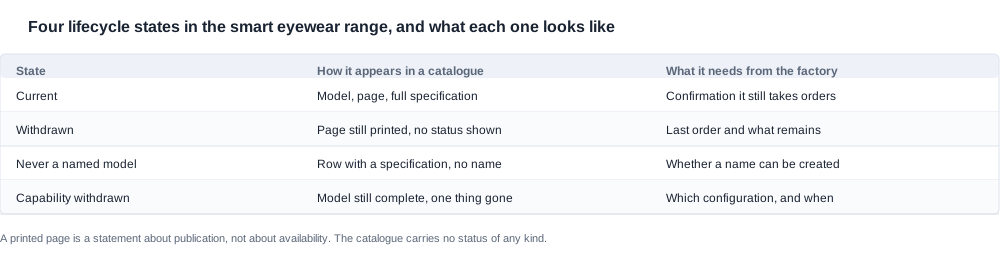
There are four states a buyer can encounter in a range like this, and they look similar in a catalogue index while being completely different commercially. Telling them apart is the work of this page, along with what to ask, what to keep and what to tell a customer.
Smart eyewear range discontinued categories: four states that are not the same thing
State one: published and current. The model has a designation, a page, a specification and an order history. Nothing in the catalogue distinguishes it from the others, because the catalogue is not a status document, and everything about it has to come from the supplier.
State two: published and withdrawn. The model had a designation and a page, and it can no longer be ordered. The page may still be printed, still be quoted by a distributor who holds old stock, and still appear in a list a buyer found three years ago. This is the state that causes the expensive confusion, because the evidence of existence and the evidence of availability look identical in an index.
State three: never a named model. The range contains rows that carry a product description and a specification but no model designation — an AR entry with an indicator light and a button control, a photochromic entry, and a bone-conduction entry with a published amplification gain. These are not withdrawn products. They are rows that have never carried a designation, and that distinction matters commercially: a withdrawn model can be reactivated if the factory still holds the build, while a row without a designation cannot be ordered, quoted or put on a purchase order line until the factory agrees to create one.
State four: a capability or a configuration that has gone. Sometimes the model stays and something else does not — a feature row that is no longer printed, a colour line that has been dropped, a case configuration that is no longer offered, a cell configuration that has been replaced. This state is the hardest to see from a catalogue, because the model page still looks complete, and the buyer only finds out when a customer asks for the configuration that used to be there.
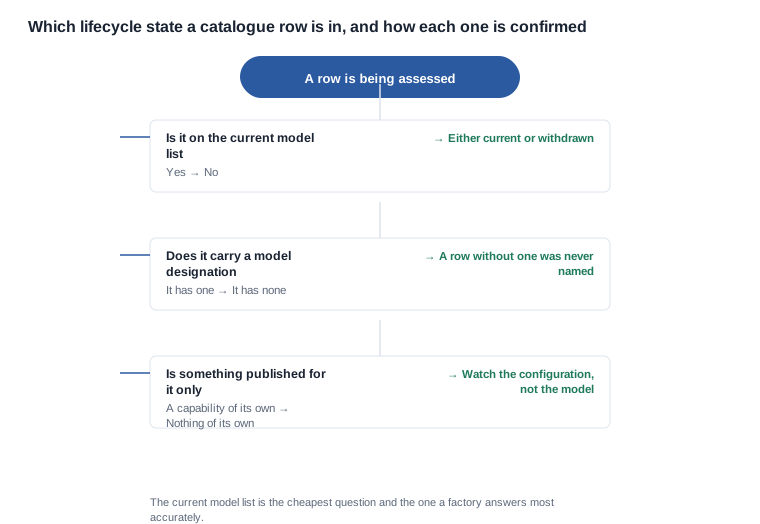
The four states are worth separating for one practical reason: each one needs a different question, and asking the wrong question produces an answer that sounds right and is useless. Asking a supplier whether a model has been discontinued produces a yes or a no and settles nothing about whether the packaging still exists or whether a repeat order can be reproduced. Asking whether a row without a designation can be given one produces a different answer entirely, and it is the question that matters when a buyer is looking at a special configuration.

What the catalogue does and does not tell you about withdrawal
The catalogue's position on lifecycle is neutral, and there is a reason for that which is worth understanding rather than resenting. A printed specification document is a statement of what exists at the time of publication. It is not a commitment to keep producing, it is not a statement that a model is in stock, and it is not a list of what is available for order. Any buyer who reads a catalogue page as a stock statement is reading a document that was never written to be one.
What the catalogue does give, indirectly, are two kinds of evidence. The first is the shape of the material itself: the set of models printed together, the set of fields printed per model, and the set of rows that have no model at all. Changes in that shape between two versions of the document are the earliest available signal that something has moved, and a buyer who keeps the previous version can read a change without asking anyone a question. The second is the internal logic of the model list, which is visible on the page: a model whose rows describe an old interface while its family has moved to a new one is a candidate for attention, and so is a row whose feature line no longer appears anywhere else.
What the catalogue does not give, and cannot give, is the thing a buyer most wants: which models can be ordered today. That is a single question, and it has to be asked, because no amount of reading produces it.
There is one more piece of evidence the catalogue gives that is often overlooked, and it is about the unnamed rows rather than the named ones. A row without a designation, sitting between groups of models that do have designations, is the visible edge of the range. It tells the reader that the manufacturer makes something here that they have chosen not to name. That is a fact about the catalogue's conventions, and it is worth understanding for what it is: those rows are not the remnants of a discontinued range, they are a deliberate way of presenting a product that does not have a model identity, which is a different situation and needs a different conversation with the factory.

The evidence that separates a withdrawn model from a thin page
The question a buyer actually needs answered is: is this model still orderable, and if it is not, when did it stop, and what remains? Three pieces of evidence answer it, and all three have to be asked for in writing, because a verbal answer about a withdrawn model is the one answer most likely to be out of date.
- The current model list — not the catalogue, and not a memory of the last catalogue, but the list of models the factory is currently taking orders against. The two lists differ, and the difference is the answer. A model that has been removed from the current list but is still printed in the catalogue is in state two. A model that is in neither list may simply be a model this factory never made, and the two cases look identical from outside.
- The last order and the build — whether the last order for the model can be repeated, and whether a build identifier exists that reproduces it. A model can be closed to new orders and still be reproducible for a customer who reorders, and that is a materially different situation from one where the tooling, the packaging or the firmware branch has gone with it. The question that gets the useful answer is not "can we still order it" but "what exactly is still available, and for how long".
- The residue — whether the packaging artwork, the accessory, the printed materials and the documentation for the withdrawn model still exist. This is the part buyers forget, and it is the part that determines what happens to the units already in the field. A model withdrawn with its packaging still available can be supported for a while; a model withdrawn with the artwork gone can still be sold, but the next box is a problem, and the problem arrives in the middle of the next order rather than at the start.
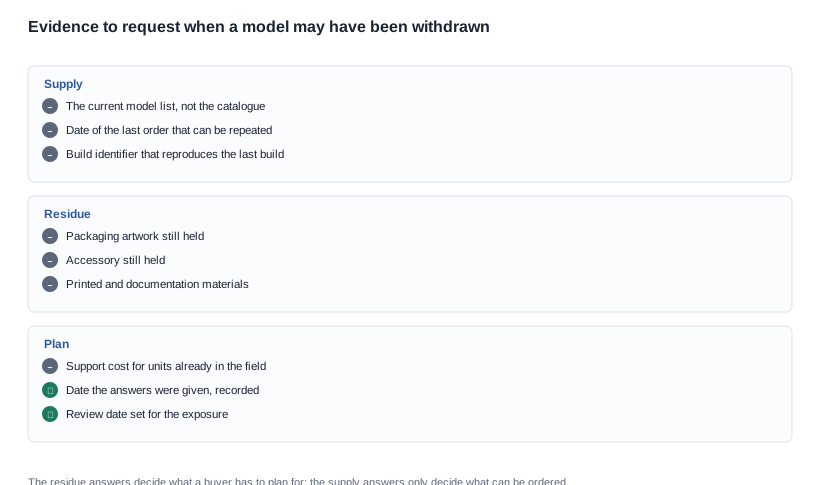
The three together are enough, and the order in which to ask them matters. Ask for the current model list first, because it is the cheapest and it is the most likely to be answered accurately — a factory knows which models it is selling. Then ask what remains, because that answer tells you whether the model is merely closed to new orders or genuinely finished. Then ask about the residue, because that answer tells you what your own operation has to plan for.

Smart eyewear range discontinued categories: what changes commercially when a model goes
A withdrawal is not only a supply event. It is a set of consequences for a buyer that sit in four different places, and the reason buyers are surprised by withdrawals is that they look at the first one and not at the other three.
The continuity of the listing. A channel that has a live listing for a model that is withdrawn does not discover it as a supply failure; it discovers it as a review, a complaint or a cancellation, because the listing is what customers find first. The commercial question is what replaces it, and that is a question about the range rather than about the model.
The support obligation. Units already sold are still in the field, and the cost of supporting them does not stop when the model is withdrawn. What stops is the supply of spares, the packaging, the accessories and the documentation. A buyer who has not asked what remains has a support cost with no visibility on it.
The repeat order. A first order creates an expectation of a second one, and a withdrawn model breaks that expectation at the worst point in the relationship. The way to protect the relationship is to have the answer before the customer asks — which means asking the supplier the question at the point where the first order is placed rather than at the point where the customer asks for more.
The inventory. Stock of a withdrawn model is not a loss, but it is a stock with a date on it, and the date is not published. What a buyer can do is limit the exposure deliberately: hold less of a model whose next-order date is unknown, and record the date the answer was given so that the exposure can be reviewed on a schedule.
None of this makes a withdrawal a reason not to order. Most buyers will eventually order from a model that is later withdrawn, because the range is the range. What the discipline buys is that the withdrawal arrives as a planned event with a known set of consequences rather than as a discovery.
There is a fourth consequence that sits outside the buyer's own operation, and it is the one that shapes how the conversation with a customer should go. A channel that has told customers a model exists, sold it, and then finds that it cannot be reordered has a communication problem that is not solved by offering the customer a substitute. The substitution has to be explained in terms of what the customer had, and that means the field comparison has to have been done before the customer asks — because the moment the customer asks is the moment the buyer is doing the comparison under time pressure, with a promise to make at the end of it. Doing the comparison in advance converts a defensive conversation into a service one, and it is the cheapest part of the whole discipline, because the work is a page of field names and the cost of skipping it is a customer conversation.
The fifth and last consequence is the one that decides whether the buyer learns anything from the event. A withdrawal that is absorbed without a record leaves the buyer exactly where they were, with the same blind spot and the same catalogue. A withdrawal that is written up produces three things worth keeping: the date the model came off the current list, the answer about what remained, and the field list of whatever replaced it. Those three items are the raw material of a handover done properly, and they are also the only way a buyer can tell, a year later, whether a capability that appears on one model today is spreading across the range or being quietly retired.
The handover question, and why it belongs before the replacement
The temptation, when a model is withdrawn, is to move to whatever the factory offers next. That is where a mistake is made, because a successor in a supplier's mind is a product in a product family, while a successor in a buyer's mind has to satisfy the same listing, the same customers and the same channel — and the published rows between the two models are rarely identical.
The comparison has to be made field by field, and the fields are known. A charging interface change changes the accessory and the box. A change in cell configuration changes the endurance behaviour and the way the product is described. A feature row that exists on one model and not on the other changes what the listing can say. A camera resolution class change changes the imaging proposition, and in this range the difference between the two published classes is a substantive difference rather than a detail. A change in the case position changes what the customer receives. A change in the radio version changes the compatibility line on the page.
So the question to put to the factory is not "what replaces this model" but "which published fields differ between the outgoing model and the one you would propose, and what happens to my customers' expectations on each". That is a short list, it is answerable, and the answers are what a buyer needs before the listing is changed rather than after.
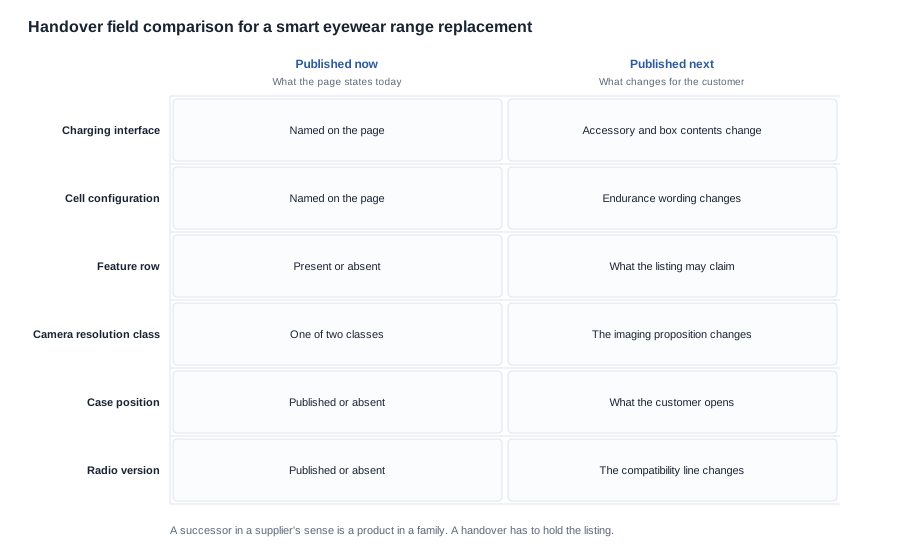
The same comparison runs in the other direction as well, and buyers often skip it. The outgoing model's fields are also the things the installed base is used to, so a handover that changes the accessory, the charging behaviour, the listing wording or the imaging class is a change that the existing customers experience even if the units themselves are identical. Where a field changes, the question is who is told and how — and the answer has to be a decision rather than a silence, because a customer who notices a change nobody mentioned will assume the worst about the product rather than the best.
Keeping your own view of the range current
A buyer who has been burned by a withdrawal usually over-corrects, and starts treating every catalogue page as suspect. That is expensive in a different way, because it means the catalogue stops being usable as a reference and every model has to be re-qualified from scratch each time it is considered. A better response is to keep a small amount of state of your own, and there are only three things in it worth maintaining.
The first is the previous version of the material. The differences between two versions are the earliest available evidence of movement, and a buyer who has the earlier document can read a change without asking anyone. The second is a dated note against each model in the shortlist: when the last order was placed, when the current model list was last confirmed, and who confirmed it. The third is the set of answers already obtained, attached to the configuration they were obtained for, so that a repeat order inherits them.
None of this is a system, and none of it needs to be. It is three habits that cost a few minutes a quarter and that change the character of a withdrawal from a surprise into a scheduled review. What they do not do is remove the need to ask the factory, because the factory is the only party that knows what it is currently taking orders against.
There is also a question about the wider range here, and it is the one that connects this page to the rest of the material. A model can be withdrawn because a configuration was replaced, and whether a capability is spreading across the range or disappearing from it is a question with a series behind it rather than a snapshot. The method for reading that series, and for the questions that turn one catalogue into a history, is set out in the structural reading of a single catalogue snapshot.
What we will not do is state that a model is discontinued, that a model is about to be discontinued, or that one model is the successor of another. The catalogue publishes no status and no succession, and a claim of that kind from us would be a guess dressed as a fact. What we will do is read the pages with you, identify the rows that look like candidates for one of the four states above, and put the three questions to the factory in a form that produces usable answers.
It is worth adding what a good answer looks like, because the three questions are easy to answer loosely. A good answer to the first names the list and its date. A good answer to the second names what is still held, separately for the tooling, the packaging and the printed material, and says how long that is expected to last. A good answer to the third says plainly whether a designation can be created for a row that does not have one, and what has to happen first if the answer is that it can. Answers of the form "normally yes" or "we can discuss" are not refusals, and they are the reason a buyer who keeps them ends up with a withdrawal rather than a plan.
Tell us which model you are worried about losing, and we will return its published fields next to the fields of the models around it, so you can see exactly what a handover would have to preserve.


