

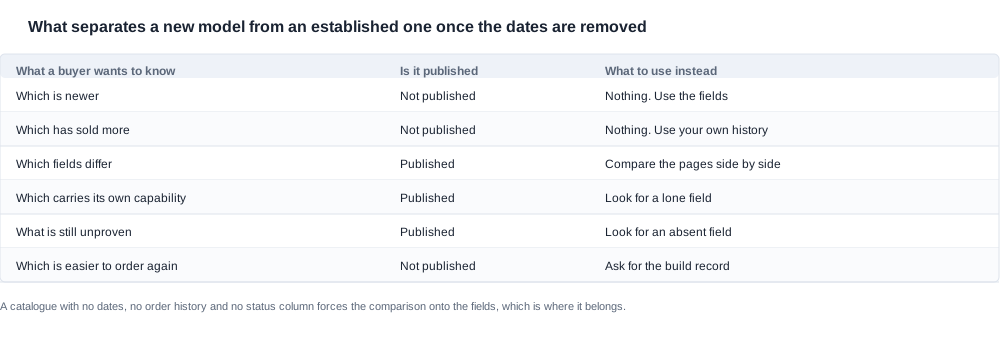
A buyer asking whether to take the new model or the established one is asking a question the catalogue cannot answer, because the catalogue does not carry a date, an order history, a lifecycle status or a sales figure for any model. There is no column that says which is newer and no column that says which has been running in the field. The words new and established describe things the material does not record.
What the material does record is what each page states, and that turns out to be a better instrument than age for the decision a buyer is actually making. A model whose page answers the questions that a first order raises is specified, whatever its age. A model whose page leaves them open is unproven, whatever its age. And the two failure modes that follow — a gap on one side, a drift on the other — are invisible to a buyer who is looking for a date and visible to a buyer who is looking at the fields.
Smart eyewear range new vs established models: the catalogue does not say which is which
It is worth being clear about what is missing, because a buyer who has been told a model is new or established is often working from information that came from a previous conversation rather than from a document. There is no release date, no revision number, no date on a specification row, no order history and no production-volume figure. Two models can sit next to each other in the same range with one of them clearly a later design and one clearly a long-standing product, and nothing in the material marks which is which.
The consequence is that a buyer cannot order by maturity, so the decision has to be rebuilt from what is visible. The visible things are the published fields, and they fall into three groups that behave differently. Some fields are the standard rows that every model publishes. Some fields are published for a model and not for its neighbours, which means the model carries a distinction of its own. And some fields are absent for a model that would obviously need them, which means something has to be asked before the model can be ordered.
Those three groups are the whole basis of the comparison, and they are checkable today on the page, without a sample and without a conversation. A buyer who has them in front of them can answer the new-versus-established question for a specific pair of models in a few minutes, which is a better outcome than a guess about which is newer.
What the buyer should not do at this stage is generalise. "The new model" is not a category with a fixed set of properties. In this range there is a model that publishes a feature row and models that publish nothing beyond the standard rows, and a model that publishes a weight against a range that publishes none. A new model can be better specified than an old one, and an established model can be thinly documented. The comparison has to be per model and per field, and the word new is a description of the factory's intentions rather than a description of the product.

The only visible difference: what the pages state
Three comparisons do the work when a buyer is choosing between a model they know and a model they do not.
What the new model publishes that the established one does not. This is the argument for the new model, and it is the only argument for the new model that survives scrutiny, because it is the only one that is checkable on the page. A capability that appears on the new model and on nothing else — a different charging interface, a case position the established model does not have, a descriptor the established model lacks, a different imaging class in the camera families — is a real difference, and if the requirement needs it then the established model is not a substitute at all. If no field differs in a way the requirement cares about, then the new model's advantage is not visible in the material at all, and the choice becomes a question about evidence rather than about specification.
What the established model has that the new model does not. Here the answer is always the same and it is not a published field: evidence. An established model has been ordered before, so somebody knows what arrived, whether the box was right, whether the accessory was right, whether the documentation set was complete, and what the first batch actually looked like. None of that is in the catalogue, which is why the established model looks thinner on the page and is nevertheless the lower-risk order.
What neither model publishes. The absent fields are the same for both and they are the same list: weight, ingress rating, touch control, acoustic and microphone figures, the charge completion criterion, the camera storage and format questions, the radio version on the models where it is not published. A buyer comparing a new and an established model is therefore comparing two specifications that are both incomplete in the same places, and the comparison has to be about the fields that are present.
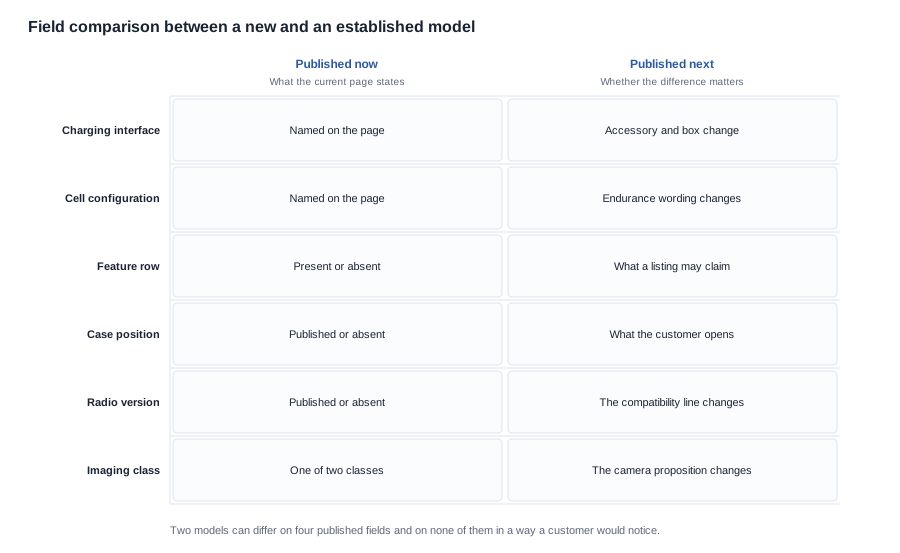
That matrix is the tool, and it takes about ten minutes to fill in. For each field, note what the new model states, what the established model states, and whether the difference matters to the requirement. The third column is the one that decides the order, and the one most often skipped: two models can differ on four published fields and differ on none of them in a way a customer would notice.
What a new model is actually for
A new model earns its place in a range for one of three reasons, and it is worth separating them because they lead to different decisions.
It carries a capability the rest of the range does not. In this range that shows up in a small number of places: a remote photo control that only the sport models publish, a photochromic lens row on a single camera model, a colour line on a couple of camera models, a case capacity published on some models and not others, an ingress marking on two models only, a weight published on one model only. When a requirement needs one of these, the new model is not competing with the established one — it is the only candidate, and the decision is about documentation rather than about the product.
It replaces something. This is the case where a handover has to be handled properly, and it is where the published fields decide whether the replacement is real. A new model that changes the charging interface, the cell configuration, the descriptor, the case position, the radio version or the imaging class is not a drop-in replacement for anything, whatever the factory calls it. The field-by-field comparison is what turns a claim of succession into something a buyer can accept, and the questions to ask are in the handover analysis of a withdrawn model.
It is simply the factory's current direction. This is the weakest of the three reasons and the one that produces the most expensive mistakes, because it is not visible in the material and it is not something a buyer can check. A model that is newer and no different in any published field gives a buyer nothing to put on a listing, and it gives the operation all of the first-order work with none of the accumulated knowledge. The right response is not to refuse the model; it is to treat it as a specification to be established rather than a product to be ordered.
The test that separates the three cases is simple. If a field differs, the new model has a case. If no field differs and the model replaces something, the case is the handover. If no field differs and nothing is being replaced, the case is a factory preference, and the decision should be made on the evidence the factory can supply about its own production record.
That evidence is worth asking for directly, because it is the one place where the factory's own history becomes visible to a buyer who is trying to judge maturity. A factory that can produce a dated record of what it shipped, and in which configuration, has a production history whether or not the catalogue has one. A factory that cannot has a range and a set of products, which is a perfectly workable relationship and a different one from the one where the buyer's ordering history is matched by a supplier's.
The practical consequence is that the new-versus-established question can be made to stand on evidence rather than on description, and the description can be left where it belongs — in the sales conversation, where it is allowed to be enthusiastic.

Smart eyewear range new vs established models: how to order from each
The two order types are different in kind, and using the wrong protocol is the main reason a new model disappoints.
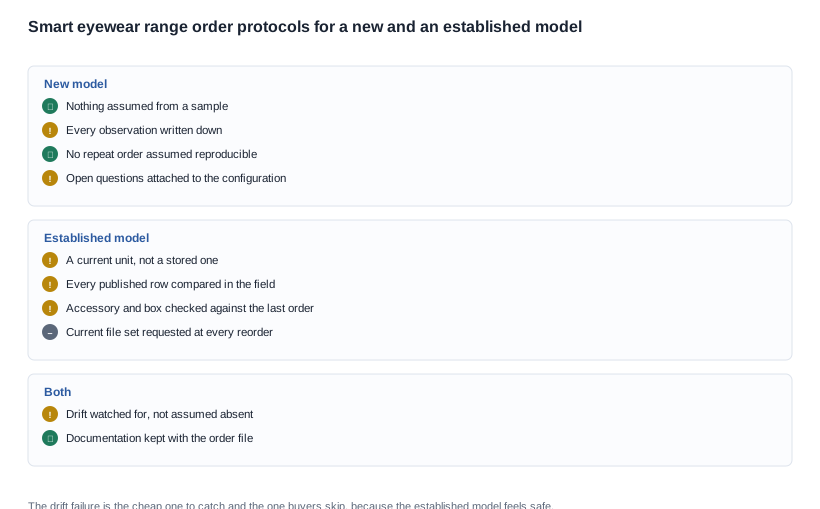
Ordering from an established model is a revalidation order. The product is known, so the order is about confirming that the factory is still producing it as described. What that means in practice is: take a current unit rather than a stored one, compare it against the published rows field by field, and check the residue — the accessory, the box content, the printed material — against what the previous order established. The failure mode here is drift, where the factory has quietly changed something that the page still describes in the old terms, and drift is invisible until somebody compares. It is cheap to catch and expensive to discover in the field.
Ordering from a new model is a protocol order. The first order is not a repetition of anything, so it has to establish the baseline: one unit, everything observed and written down, no assumption that the sample represents the production run, no repeat order assumed to be reproducible. What a protocol order produces is the configuration record that every later order inherits, and the value of it depends entirely on whether it was written down during the first one.

The same distinction changes the review criteria. For an established model, the criteria are about the differences from what was known: has anything moved, and is the difference acceptable. For a new model, the criteria are about completeness: is the specification now complete enough to order again, and is the record good enough to repeat from.

Five questions to put before the choice is made
Whatever the two models are, the decision is made better by asking five questions than by debating the two descriptions. These are the ones that change the outcome, and they are worth putting in writing to the factory, because each of them has a document behind it.
- Which published field differs between the two, and does the requirement care about that difference? A difference in a field the requirement does not touch is a difference the customer will not see, and it is a difference that should not decide the order.
- What is open on the new model's page that is closed on the established one? This is the gap count, and it is the honest measure of how much first-order work each option carries.
- What is open on the established model's page that is closed on the new one? The established model usually has fewer gaps, and the count is what tells you whether the new model is genuinely a better-specified product or simply a different one.
- Can a build record be produced for whichever model is chosen, and how recent is the last one? This is the question that separates an order you can repeat from an order you have to re-argue, and it applies to both sides of the comparison.
- What is the review criterion for the first batch under each option? For a new model the criterion is completeness, and for an established one it is difference from what was known. Writing both down before the order prevents the criterion from being chosen afterwards in whichever direction is convenient.
There is a sixth question that is worth asking even though it has no technical content: what happens to the customer who bought the established model when the listing moves to the new one. The answer is not only about service — it is about whether the channel has a story that connects the two, and a channel without that story has to introduce a new product to a customer who thought it already had one.
The trade-off between the two options is usually described as risk against capability, and it is worth keeping that framing in view rather than collapsing it into a preference. The new model offers capability that the established one does not have, and it asks the buyer to do the first-order work. The established model offers evidence that the new one cannot have yet, and it asks the buyer to check that the evidence still holds. Neither is the safer choice in general, and the choice is not a principle but a situation: what the requirement needs, what is already known, and what the team has time to establish before the season starts.
The two failure modes, and why they look different
The gap failure and the drift failure produce the same symptom from a distance — a customer who says the product is not what was described — and they come from opposite ends of the range. The gap failure is a new model with an open question on its page: the buyer ordered before the question was answered, and the answer turned out to be different from what the listing implied. The drift failure is an established model whose page no longer matches what the factory ships: nothing was open, nothing was wrong at the time, and the product simply moved.
The practical difference is in where the evidence sits. For a gap, the fix is to ask the missing question, and the evidence is a document the factory produces. For a drift, the fix is to compare, and the evidence is a unit the buyer puts next to the page. The second is cheaper and it is the one buyers skip, because the established model feels safe.
There is a third failure that sits between them and is the most awkward to handle. It is a model whose published rows are unchanged and whose product is unchanged, but whose documentation set has moved on — a file that now covers a different build, a packaging artwork that has been revised, a market text panel that has been updated for a requirement that was not there a year ago. Nothing about the product changed and everything about the paperwork did, and the buyer finds out when a shipment is held. The only defence is to keep the documentation with the order and to ask for the current version of the file set at every reorder rather than reusing the copy on file.
It is also the failure that most often gets misdiagnosed, because the symptom — a shipment held at a border or a listing suspended — looks like a product problem and gets worked on as one. The diagnostic question is simple and it is worth asking before anybody starts re-testing hardware: has anything changed in the documents, and when was the last version of each file confirmed? A buyer who asks that question first saves a fortnight of sample work, and a buyer who has been burned by it once will have a habit of asking it for every model rather than only the unfamiliar ones.
There is a fourth pattern that is not a failure but a misunderstanding, and it is worth putting on the list because it is so common. It is the assumption that a model with fewer published fields is a less finished product, and therefore a worse choice. In this range the opposite is often true: a model whose page is thin may simply be a configuration that the factory publishes with less detail, and a model with a full page may be a configuration that has a rich story to tell. What a thin page means, in every case, is that the buyer has more to ask. That is a cost, and it is a different cost from the one the thin page implies.
What we will do with a pair of models is read the two pages side by side and mark, field by field, where they differ and where the difference would show up in a listing, a box or a customer's expectation. What we will not do is tell you which of the two is newer, because the material does not record it, and any answer we gave would be a guess about the factory's history rather than a published fact.
It is worth adding one practical point about how this comparison is usually run, because it is the part that gets wasted. The comparison is often done at the level of the two products, as a conversation about which is better, and at that level it has no resolution — everything reduces to taste, and taste is not a criterion a procurement file can carry. Run at the level of the fields, the same conversation becomes a list of differences, and each difference can be marked as one that matters to the requirement or one that does not. That is the point at which the choice stops being an opinion and becomes a decision somebody can defend later, in a review, without having to remember what was said in a meeting.
The same is true of the review that follows. A first batch judged against a written criterion produces a result; a first batch judged against an impression produces a story, and the story is the thing that gets repeated when the second order is discussed.
Give us the model you already know and the model you are considering, and we will return their published rows side by side with the fields that differ marked, so the choice is made on the specification rather than on a date.


