

Switching and mixing are two different operations, and importers who treat them as one operation get the costs of both. Mixing is the basket: a single order that carries more than one kind of product, and the questions it raises are about minimum quantities, packaging and freight. Switching is the changeover: the decision to move a channel's supply from one product to another, or from one product line to another, and the questions it raises are about what the move costs once the order is already placed. This page is about the second operation, because the published rows make the cost of a switch calculable in a way that the cost of a mixed basket is not, and because a switch is a decision an importer plans over a year rather than a decision an importer makes at a counter.
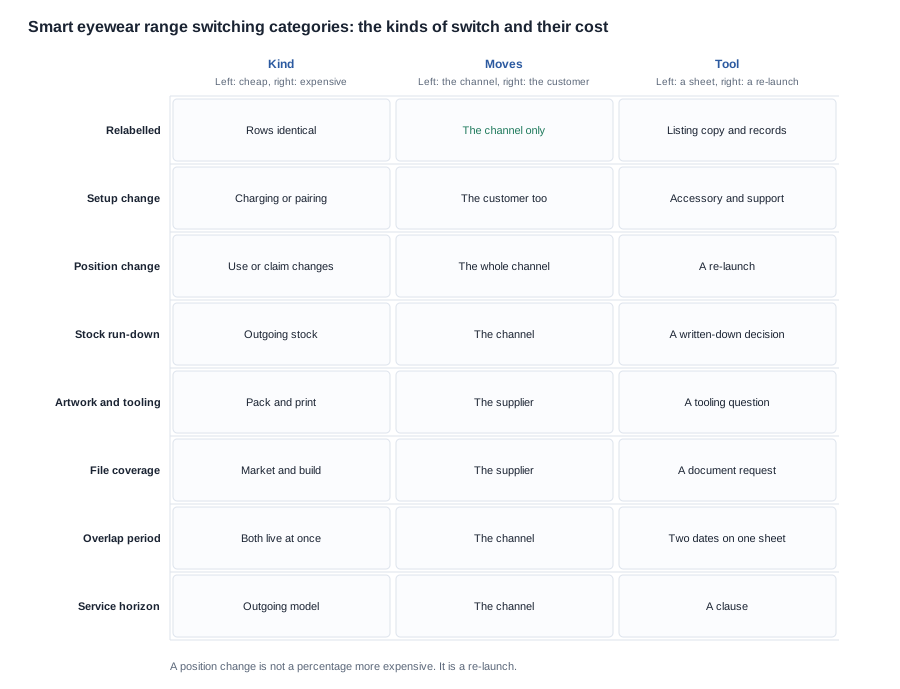
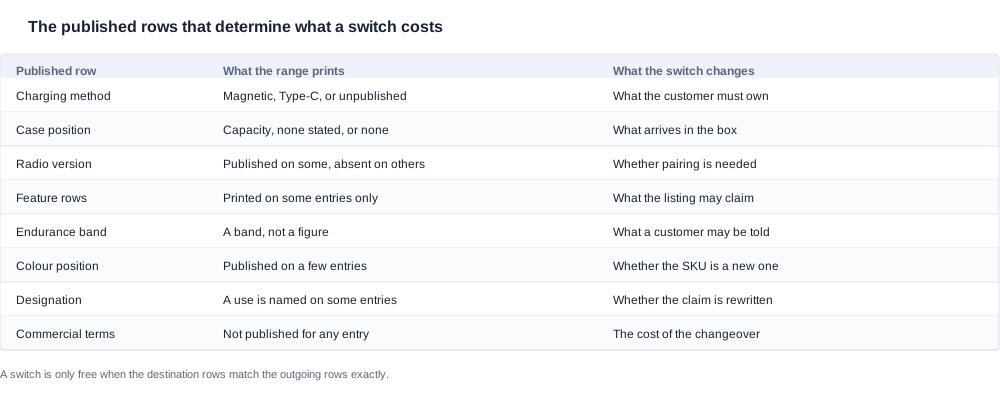
Smart eyewear range switching categories: what a switch actually changes
A switch means that a customer who bought one thing ends up with another. In this range that can happen in three directions: from one model to a neighbouring model inside a line, from one line to another inside the range, or from a position in this range to a position outside it. Each direction has a different cost profile, and the published rows are what let an importer tell them apart before any money is committed.
The starting point is a rule that is easy to state and easy to forget in practice: a switch is only free if the published row set of the destination product is identical to that of the product being replaced. If the rows match, the customer's setup is unchanged, the channel's copy is unchanged, the packaging is unchanged, and the switch is a data exercise. If any published row differs, the switch has a cost, and the cost is determined by which row differs.
That is the whole analytical method, and it is more useful than it sounds because the published rows in this range differ in ways that are easy to overlook. A change of charging method changes what the customer must own and what the channel must stock. A change in the case position changes what arrives in the box, which changes the customer's first ten minutes and the channel's returns handling. A change in the radio version, or a change from no published radio version to one, changes whether the customer has to pair anything at all, and therefore whether the product works out of the box. A change in the feature rows changes what a listing may describe, which means the copy has to be rewritten and the claims reviewed. A change in the published endurance band changes what a customer may be told about use, and therefore the returns pattern.
What does not change is also worth naming, because a buyer who assumes everything has to be reworked wastes money. Where the charging method is the same and the case position is the same and the radio position is the same, the customer's setup is the same even if the model name, the colour, the feature notes and the cell arrangement have all changed. The switch in that case is a channel-side operation rather than a customer-side one, and it is considerably cheaper than the reverse.
The commercial terms are where a switch stops being calculable. Our catalogue publishes no price, no minimum order quantity, no lead time, no sample cost and no warranty term for any model, so the cost of the changeover itself — the tooling, the artwork, the first order, the stock run-down — cannot be read from our material. What our material does give is the configuration delta, and the configuration delta is the part that determines whether the changeover is worth doing at all. An importer who works out the delta first and then prices the transition is doing the work in the right order.

The three kinds of switch, and the one that costs a channel money
The first kind is the relabelled switch, where the destination model publishes the same rows as the model being replaced. There are real examples of this in the range: the K01 and the K02 publish the same radio version, the same cell arrangement, the same endurance band, the same charge ceiling and the same charging method, and neither publishes a feature row. A channel moving between those two is changing a name on a listing, and the cost is confined to the listing copy and the channel's own records. Three questions close the analysis of a switch, and a buyer should put all three to the supplier before the first order.
- Which published rows on the destination model are still open, and what does each one have to be resolved before a listing can be written?
- Which of the outgoing model's published rows are about to change, and does the change fall on the customer, on the channel or on the supplier?
- What is the earliest date on which the destination model can be supplied in volume, and does that date sit before or after the date on which the outgoing model's stock will be exhausted?
The third of those is the one that determines whether the switch is a plan or an accident, and it is the one an importer is most likely to leave until after the first order has been placed. The commercial terms that would allow it to be answered earlier — a lead time for the destination model, a delivery position for the outgoing model — are not published for any entry in this range, so the only way to get them is to ask for them as part of the transition rather than as part of a routine reorder.
The second kind is the setup-changing switch, where the customer has to do something different: a new charging arrangement, a new pairing step, a different box. The third is the position-changing switch, where the customer moves from a product with a published camera to a product without one, or from a connected product to one with no published radio version, or from a general-audio product to one published for a child's use.
The third kind is the one that costs a channel money, and the reason is not the unit cost. It is that the product's place in the customer's life has changed, and so has the claim the channel makes. A channel whose listing copy describes a product as connecting to a phone cannot switch that listing to a product with no published radio version without rewriting the copy and re-reviewing the claims, and a channel whose product is published for a child's use has a different set of obligations around the packaging, the warnings and the age statement than one whose product is not. These are not costs that appear on an invoice; they are costs that appear as a re-launch.
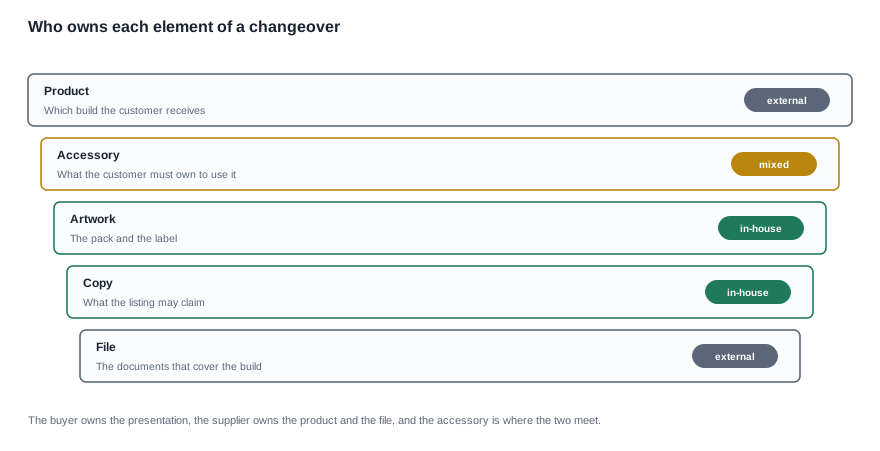
There is a fourth pattern that is not a switch at all but is often mistaken for one, and it is worth putting in the frame because importers plan for it as if it were a switch. A channel that adds a second product alongside the first is running a wider range, not moving between two. The two operations have different failure modes: a switch fails when the old product is withdrawn before the new one is ready, and a wider range fails when the two products cannibalise each other or when the channel cannot carry two sets of copy, packaging and support. The published rows help with the first problem and are largely silent on the second, because whether two products compete is a question about the channel's customers rather than about the products.
The practical test for an importer is this: if the customer is told to do something different, it is a setup-changing switch; if the customer is told to do the same thing with a different product, it is a relabelled switch; if the customer is told the product serves a different part of their life, it is a position-changing switch. The three carry very different amounts of work, and the difference between the cheapest and the most expensive is not a percentage — it is a re-launch.

Reading a switch from the published rows before the quotation
The method for reading a switch off the published rows is to build a delta sheet, and it is the same for every pair in the range. One column per model, one row per published attribute, and the cells that differ are the switch. The attributes worth carrying are the ones that reach the customer or the channel rather than the ones that describe the product internally: the charging method, the case position, the radio version, the feature rows, the published endurance band, the colour position, and the designation printed on the product.
Two examples from the range show why this is worth doing. Moving from a camera model that publishes a case capacity to one that publishes no case row at all looks like a small change in the sheet and is not a change at all in substance: in the first case the case position is settled, and in the second it is an open question to put to the supplier. That difference has to be resolved with the supplier before the switch can be planned, because the first case carries an answer and the second carries an open question. Moving between two models where one publishes a radio version and the other does not is a bigger change than the sheet suggests, because the second product's connection behaviour has to be established rather than quoted.

The delta sheet also settles the order of the two conversations a buyer has to have. The questions about the destination model come first, because they determine whether the switch is possible at all — an unpublished charging method or an unestablished radio position is a question that has to be answered before a channel commits a listing. The questions about the model being replaced come second, and they are about the stock, the artwork and the support window rather than about the product.
What the delta sheet cannot do is price the switch, and a buyer who expects it to is going to be disappointed. The published rows tell a buyer what changes for the customer and what has to be rewritten; the commercial terms that decide whether the change is worth making are all unpublished, and all have to come from a supplier. The sheet is therefore an input to a negotiation rather than a substitute for one, and its real value is that it turns a vague intention into a specific list of changes that a supplier can quote against.
The practical discipline, and the one that saves the most time, is to require the delta sheet to be completed before the first quotation is requested. A quotation for a new model that has not been deltaed against the model it will replace will be a quotation for a product, and the transition costs will arrive afterwards as a change request. A quotation that has been deltaed will already carry the artwork, the packaging and the document consequences, and the comparison between the two options becomes a comparison of totals rather than of unit prices.

The questions a supplier has to answer for a model pair
The request is a request about a pair rather than about a product, and that distinction is what makes the answers usable. A product request gets product answers; a pair request gets the transition answers. The questions below are the ones that have to be answered for a switch, and they are asked of the destination model and of the outgoing model together.
- Is the destination model open for new orders, and is the published configuration the one now in production?
- Does the destination model require new artwork, and can the outgoing artwork be retired, and when?
- Does the packaging change, and does the packaging tooling change with it, and is the change separable from a general refresh?
- Does the customer's setup change — the charging arrangement, the pairing step, the box contents?
- What is the first-order position and the repeat-order position for the destination model, separately?
- What is the minimum order for a transition quantity, and is it the same as the minimum for a normal order?
- Can the outgoing and the incoming models be supplied in the same period, and for how long?
- What is the service and spare-part position on the outgoing model once it stops being ordered?
- Does the technical file for the destination model cover the configuration that will ship, and does it differ from the outgoing file?
- What notice does the channel receive ahead of any change to either model?
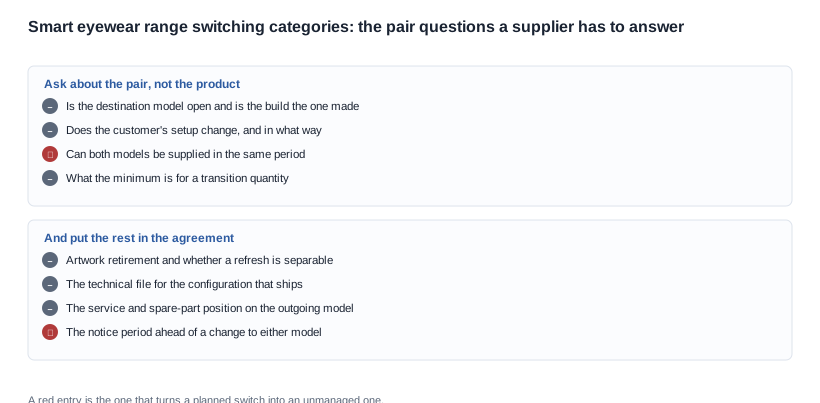
The fourth question is the one that decides the customer experience, and the seventh is the one that decides whether the switch is safe. A switch that cannot be supplied in parallel with the outgoing model is a switch with a gap in it, and a gap in a channel's supply is a period in which the channel has nothing to sell on that line — which is the entire cost of the changeover in one sentence. The third question matters for a different reason: a packaging change that can be separated from a general artwork refresh costs materially less, and most buyers never ask whether it can be.
The ninth question is the one that catches people, because a technical file follows the product and the configuration rather than the model name, and a buyer who assumes the destination model inherits the outgoing model's documentation will find out otherwise at the point where the file is requested for the new market. Asking it costs nothing and prevents a delay that is usually measured in weeks.
The tenth question is the one that has no published answer for any model in this range, and it is the question that turns a planned switch into an unmanaged one. There is no published notice period, no published last-time-buy position and no published service horizon for any model in the catalogue, so a buyer who wants a transition planned has to write the notice into the agreement rather than assume it. That is the same conclusion the range-wide lifecycle work reaches, arriving from a different direction, and it is a good illustration of how a single gap in published data shows up in several places at once.
Transition planning: stock, artwork, copy and the overlap period
The last piece is the operational one, and it is where the cost of a switch actually lands. A transition has four moving parts, and they do not all move at the same speed. The artwork and the packaging move slowly, because they are tooled and because the first order has to be produced against them. The listing copy moves at the speed of the review cycle, because a copy that changes a claim has to be reviewed before it goes out. The support scripts and the warranty position move slowest of all, because a channel that has sold a product for two years carries two years of answers about it. The stock moves fastest, and it is the one that is usually mismanaged: the outgoing model's remaining stock has to be sold, discounted, bundled or written down, and the decision about which of those happens is a commercial decision the importer makes before the first order rather than after the last one.
The overlap period is the parameter that ties the four together, and it is the one an importer should plan deliberately rather than inherit. It has to be long enough for the incoming artwork to be produced and the copy to be reviewed, and it has to be short enough that the channel is not running two products in the same line for longer than the incoming product needs. Nobody can calculate it from our published material, because it depends on the review cycle and the lead time, and neither is published. What an importer can do is state the overlap period as a target, put the two dates on the same sheet, and check them against the supplier's own stated position before the order is placed.
There is also a customer-side version of the overlap, and it is the one that most often gets missed. A customer who bought the outgoing model has an accessory, a charging arrangement and a set of expectations, and a switch that changes the charging arrangement asks that customer to buy something new. Whether the channel absorbs that cost, passes it on, or avoids it by choosing a destination model with the same published method are all commercial choices, and they are cheapest to make before the first order. An importer who has deltaed the pair has this information already; an importer who has not has to discover it from complaints.
A buyer deciding whether to run a switch at all should also apply the criteria it would apply to any other capital commitment, because a changeover is one. The first is total cost rather than unit price, and the total has to include the artwork, the tooling, the stock run-down and the review effort that the switch consumes, none of which appears in a quotation. The second is the risk of a gap: what does the channel do in the weeks when neither model can be supplied, and is there an alternative product already qualified that could carry the line. The third is reversibility, which is the question of whether the switch can be undone, and it is rarely asked. The fourth is the customer cost, which is the accessory a customer has to buy again and the setup they have to learn. A shortlist that scores two candidate switches on those four criteria tells a buyer far more than a comparison of two unit prices, and it is the comparison a buyer should ask a supplier to help with. What to ask, in other words, is the first half of the work, and the answer should arrive as a delta sheet and a quotation against it rather than as a quotation and a question.
The word switching in this context means one product's path from the generation a customer already owns to the generation that replaces it, and it is worth being explicit about that because the same word gets used for something else. A buyer who fills one order with several different kinds of product is not switching; that is a basket decision, and it raises questions about minimums and freight rather than about a changeover. The two operations are confused because they happen in the same planning year, and the consequence of confusing them is that a changeover gets planned like a reorder, which is how a channel ends up with a gap in its line and a stock of the old generation.
The commercial framing of the same exercise, in the terms a channel actually budgets in, is set out in the inventory planning material for a range in transition. What we can add from our side is narrow and worth stating plainly: we publish the rows that determine what a switch changes for the customer, we publish no commercial term of any kind, and we will not invent one. Where the answer to a transition question is a row, we can give it. Where the answer is a price, a lead time, a minimum or a notice period, it has to come from the supplier in writing, and a buyer who has the delta sheet can ask for exactly the right one.


