

Our published position makes the gap visible. The camera tier names an AI voice assistant as a key technology, the audio tier names the same capability, AI translation appears on the K01 with the evidence recorded as observed from our independent site rather than as a published specification, and the smart noise reduction technique is published for the Bluetooth audio family. What is not published, for any model in this range, is whether the processing runs on the device or in a service, whether a subscription is required, what a use costs, where the data is stored, and what the maintenance commitment is.
Smart glasses ai features smart glasses cost factors is therefore built on the cost lines that exist, rather than on the ones that would be convenient. A cost model with a guessed per-use figure is worse than a cost model with an open line, because the guess gets carried into a business case and nobody revisits it. The article separates the one-time engineering from the recurring operating cost, names the drivers in the order they land, and gives the questions to ask that turn an open line into a number or into a decision.
The single most consequential question is the first one: does the feature run on the device or in a service? A service scales its cost with usage rather than with units sold, which makes it a different business from a product with a margin per unit. A product whose feature is used heavily is a product with a variable cost per user, and pricing it as hardware is how a programme discovers the problem in its second year.
Smart glasses AI features: cost inside and outside
Almost none of the cost of an AI feature appears in the bill of materials. That single fact reorganises the entire commercial conversation, because the invoice for glasses and the invoice for the feature are produced by different parties, on different schedules, and with different failure modes.
What is in the hardware cost. The optics, the electronics, the cell, the radio, the enclosure, the assembly and the packaging. This is the number the supplier quotes, and it is the number that gets compared between two quotations. It is also the number that says almost nothing about the feature.
What is in the feature cost, and is not in the quote. The engineering to integrate the assistant or to configure a third-party one. The account, the terms of service and the sign-up route. The application and its store release. The data flow, the privacy statement and the legal review. The per-use or per-month cost of the service, if there is one. The maintenance line: platform releases, model updates, security fixes and the application's own release cycle.
What is neither, and is the line most often missing. The product support cost of a feature that fails silently, and the support cost of a lapsed subscription. Neither appears on any invoice. Both are real, both scale with the size of the launch, and both are invisible until the first month of volume.
A buyer building this model is usually working from a target retail price, a development budget and a launch date, and holds a market list, a channel plan and a set of samples. What they will not hold is the operating cost of the feature, and over a two-year retail lifecycle the operating cost is frequently the larger of the two.
The reason is structural. Development cost is visible, bounded and largely spent by the time anyone reviews the budget. Maintenance cost is invisible until it is incurred, and it is a recurring operating cost rather than a project, which is why it is so consistently absent from a programme budget.
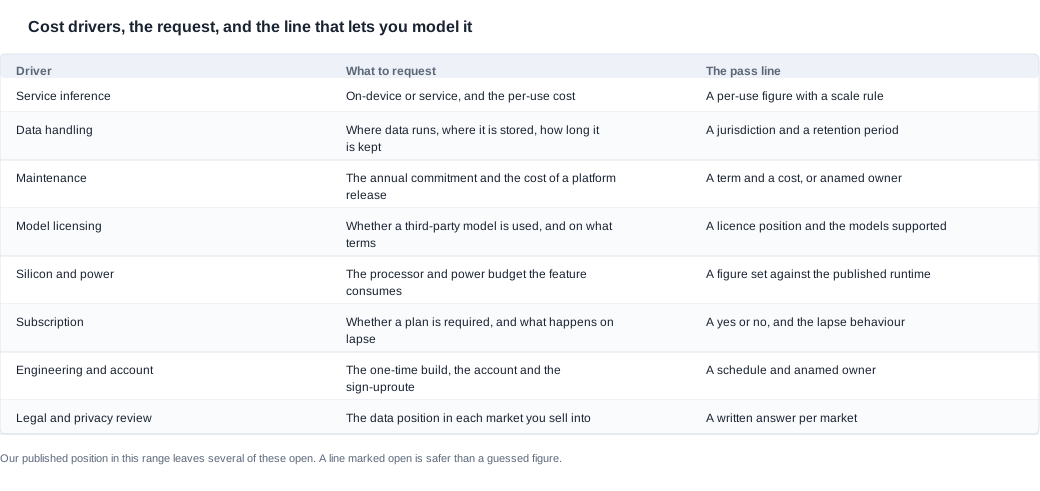
The table below sets out every driver with the request that closes it.
| Cost driver | What to request | The pass line |
|---|---|---|
| Service inference | Whether the feature runs on the device or in a service, and the per-use cost | A per-use figure with a scale rule, or a written statement that there is none |
| Data handling | Where the data runs, where it is stored, and how long it is retained | A jurisdiction and a retention period |
| Maintenance | The annual commitment, and what a platform release costs | A term and a cost, or a named owner |
| Model licensing | Whether a third-party model is used, and on what terms | A licence position, and the models supported |
| Silicon and power | The processor and power budget the feature consumes | A figure set against the published runtime |
| Subscription | Whether a plan is required, and what happens on lapse | A yes or no, and the lapse behaviour |
| Engineering and account | The one-time build, the account and the sign-up route | A schedule and a named owner |
| Legal and privacy review | The data position in each market you will sell into | A written answer per market |
| Certificate numbers | Numbers naming the exact model | With the issuing body and the validity dates |
| Model designation | A published designation for the exact configuration | A series name alone is a soft answer |

The one-time lines: engineering, account, and the legal review
The one-time lines are the ones a buyer can see, so they get planned — and the one that usually gets planned badly is the legal review, because it is treated as a document rather than as a schedule.
Engineering, and the difference between configuring and building. Wiring up a third-party assistant is a configuration task: an account, credentials, a wake word, a command list, and an application skin. Building the brand's own assistant is a development programme with its own design, testing and maintenance cycle. The two are not comparable in cost, and quoting them against each other is how a buyer ends up with a business case that assumes the cheaper one and a schedule that requires the expensive one. The question to ask is not "can you do it" but "which of these am I buying, and what does each cost in engineering time".
The account, the terms and the sign-up route. These look trivial in a requirements document and are an operating cost that runs for as long as the product is on sale. Somebody has to hold the account credentials, somebody has to accept the terms of service, and somebody has to know what happens to the product if the account is suspended. None of that is a project; it is a recurring administrative task that has to be assigned to somebody.
The legal and privacy review. This is the longest single item in practice, and the reason is that it cannot be compressed by asking more urgently. A product with a camera and a microphone creates personal data by default — a device worn in public, on a face, recording what a person says and sees. The questions your own legal function will ask are: what is the data position in each jurisdiction you sell into; what is the consent and disclosure position for a product worn in public; what is the retention and deletion position, and can the customer actually exercise it; and whether the feature is a health or medical claim in any market. A feature that claims to monitor wellbeing crosses a boundary that a feature that translates speech does not, and we make no medical, health or hearing claim for any product in this range.
The questions to ask your own legal function are the same four that a supplier should be able to answer in writing, and a supplier who cannot answer them is telling you something useful about the feature's data path. The compliance context for the radio and the connected product is set out in AI certification requirements.
The recurring lines: inference, data, maintenance, and licensing
The recurring lines are what a launch budget is built around, and they are where a programme runs out of money quietly.
Service inference. If the feature runs in a service, every use costs money to serve, and the cost scales with usage rather than with units sold. This is the first driver because it determines the shape of the whole business. A flat per-unit price against a per-use cost is a margin that moves with engagement, and engagement is a variable nobody controls. The scale rule matters more than the rate: the question is what happens to the cost at ten uses a day per user rather than at one, and the answer is the difference between a product with a fixed margin and a product with a usage bill attached to it.
Data handling. Capturing, transmitting, storing, and possibly transcribing or translating personal data, in a product worn on someone's face. Both the compliance work and the infrastructure work scale with usage, and the storage location is the first question a compliance team asks and the last one a supplier answers. The cost of this line is not only the storage: it is the review, the disclosure work, and the re-review every time the data path changes.
Maintenance. Platform releases, model updates, security fixes and the application's own release cycle. This is the line that most often exceeds the development cost over a product's life, and it is the line most often missing from a programme budget. The questions to ask are specific: what is the annual commitment, what does a platform release cost in effort, and who owns the release when it changes the behaviour of a claim you are marketing on. That last one is a design commitment rather than a cost, and it belongs in the agreement.
Model licensing. If a third-party model is used, its terms are a cost and its expiry is a risk. We publish no model list for any model in this range, which means the licensing position cannot be estimated from our catalogue. A buyer who needs a number has to get it from the manufacturer before the budget is signed, and should ask what happens to the product when the licence changes or lapses.
Subscription and lapse. The position nobody in this category publishes in either direction, and the one that decides whether the product is a device or a service. If a plan is required, the economics, the retention model and the support model are all service-shaped, and a margin per unit is not the right model. If a plan lapses and the feature stops, the customer owns a product that has stopped doing what it was sold to do, and that arrives as a defect report. The subscription question is covered in is there a subscription fee.

The power budget: the constraint the catalogue does publish
There is one AI cost driver in this category that is measurable from published data rather than from a supplier answer, and it is the one buyers forget: the silicon and the power the feature consumes on the device.
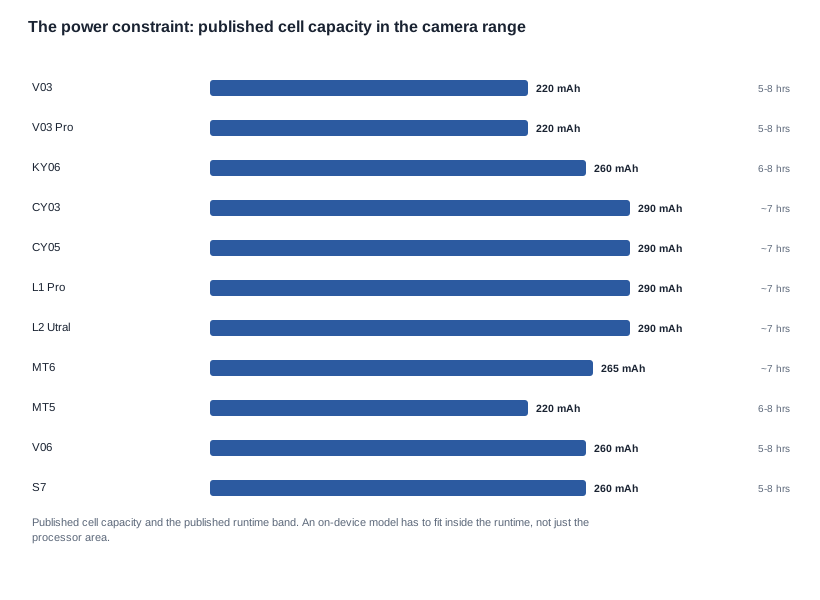
If the assistant runs on the frame's own processor, it competes with the camera and the audio for processor area and for the power budget, and both of those are constrained by the cell. The published cell capacities in the camera tier run from 220 mAh on the V03 Pro and the V03, and the MT5, through 260 mAh on the S7 and the KY06, and the V06, to 290 mAh on the CY03 and the L1 Pro, and the CY05 and the L2 Utral, with the MT6 at 265 mAh. The published runtime bands in the same tier run from five to eight hours.
A feature that fits the processor area but not the power budget is a feature that shortens the product, and a shortened runtime is a specification change that has to be re-published. The question to ask a supplier is therefore narrow and answerable: what does the feature consume, and what is the runtime with the feature running continuously, against the runtime without it. The comparison against the published runtime is the check, and the quality-control process that would catch a variance is described in AI quality control.
Two related power points are worth separating, because they are usually merged. The always-listening draw is the cost of a device that waits for a wake word, and it is a different number from the cost of a device that is actively processing. The active processing draw is the cost of the assistant working. A published runtime figure describes neither, and a buyer who has one of the two numbers and assumes it is the other will be wrong by a wide margin.

Building the lifecycle model, and the questions that unblock it
A cost model for this category is finished when it runs across the retail lifecycle with the recurring lines named, not when the unit cost is signed off. The sequence below is the order that works, because each step unblocks the next.

Step one: split every line into one-time engineering and recurring operating cost. Do this before any number is entered, because the split changes who owns the line. A one-time engineering line belongs in the launch budget and is under a programme manager. A recurring line belongs in the operating budget and is under somebody who will still be in post in year two.
Step two: ask whether the feature runs on the device or in a service, and price both shapes. These are not variants of the same product. On-device means a power cost you can measure and a one-time engineering cost; service means a per-use cost, a data cost and a dependency. If the answer is open, model both and see which one your pricing survives.
Step three: attach the data position to the markets, not to the product. One jurisdiction answer does not cover a multi-market launch, and the legal review is a schedule item per market. This is where the launch date usually slips.
Step four: set the silicon and power figure against the published runtime for each model. Model by model, because the cells differ from 220 mAh to 290 mAh and the runtime bands differ with them.
Step five: run the model across the lifecycle with the recurring lines named. A two-year retail lifecycle, and the recurring lines inside it. If the recurring lines are absent from the numbers, the model is not finished — it is a hardware quote with a feature paragraph attached.
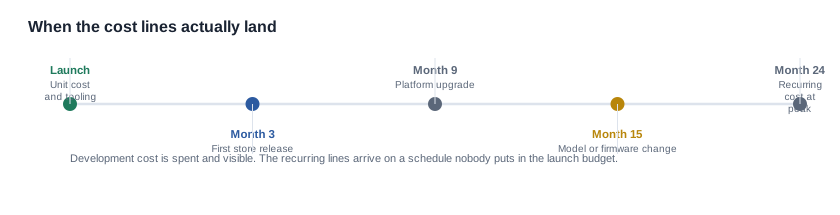
The timing matters as much as the total. Development cost lands at launch and is spent. The store release lands three months later. The platform upgrade lands in year one. The model or firmware change lands in year two, and it is the point at which a claim on a product page can become wrong without anybody deciding to change it. The first recurring invoice is small; the largest one is usually the one nobody modelled.
The checklist to run before the budget is signed
- The architecture question, in writing: on the device or in a service, and who operates it.
- The scale rule: what a heavy user costs per month, not what an average user costs.
- The data position per market: entity, jurisdiction, retention, and the disclosure text that will be built from it.
- The maintenance commitment: the annual term, the cost of a platform release, and the owner.
- The power figure per model, set against the published runtime for that model.
- The subscription position and the lapse behaviour, if a plan applies.
- The criteria for going ahead: what has to be closed before the first order, and what you are willing to carry as an open line.
Those criteria are the ones we would use, and the last one is the one that gets skipped. A buyer who can say which two lines are open, and what the product does if they stay open, is in a better position than a buyer who guessed and got lucky.
The pitfalls are consistent. The most common is treating a development budget as a product budget. The second is pricing a service-shaped product with a hardware margin. The third is assuming that a feature with no usage cost has no cost at all, when on-device inference costs silicon and power and the published runtime is the constraint. The fourth is leaving the legal review out of the schedule, on the assumption that it is a formality.
What we can model today, and what we will not guess
It is worth being precise: we will name the AI capabilities our documentation supports and mark the rest as open, and we will not publish a cost, a performance figure or a data-flow detail we do not hold. We publish an AI voice assistant as a key technology across the camera tier and the audio tier, AI translation on the K01 as an observation from our own marketing material rather than as a specification, and the smart noise reduction technique for the Bluetooth audio family. We publish no cost, no per-use figure, no subscription position, no maintenance commitment and no data-flow detail for any of them.
We will also say plainly which of these cost lines can be modelled from published data today and which cannot. The hardware line, the cell capacity, the published runtime bands, the charging case capacities and the model designations can all be modelled today. The per-use cost, the subscription position, the maintenance commitment, the data position and the licensing cannot, and we will not fill those cells with a typical industry figure, because a typical figure in a business case is indistinguishable from a quoted one once it has been there long enough.
What we can do is tell you which drivers our documentation speaks to, which have to come from the manufacturer, and which need your own legal function, and then help you build the one-page cost structure per option. The channel framing for a product with a content-creation workflow is in AI content creation, and the background is under AI features.
Where the cost model comes from
Send us your market list and your expected usage, and we will tell you which of these cost lines you can model today.


