

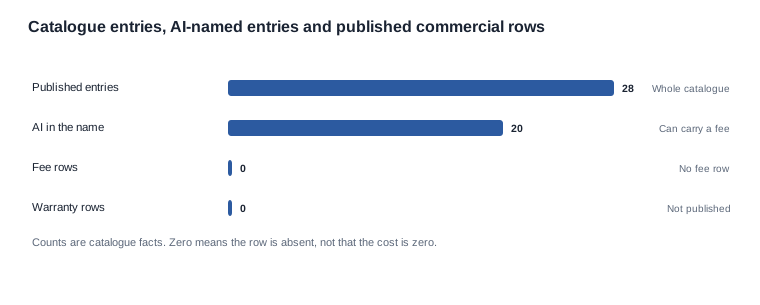
The question that arrives late in almost every smart glasses enquiry is whether a subscription is attached to the AI feature, and the reason it arrives late is that the feature is presented on a product page as though it were a line on a specification sheet. It is not a line on a specification sheet. It may be a device capability, a service relationship, a software update commitment or a combination, and each of those four carries a different recurring cost and a different failure mode. Across the twenty-eight entries in this catalogue there is no subscription row, no fee schedule, no trial period, no service name and no renewal term — not for the eleven camera models, not for the eight audio models, and not for the twenty entries that carry AI in the product name. Nothing published states that no fee exists, and nothing published states that one does. For a procurement team that distinction is the entire answer: a fee absent from the catalogue is a commercial term to be established in writing, not a feature to be checked.
What the catalogue does publish is a complete hardware sheet, and it publishes it with unusual discipline. Charge time is published for every entry. Rated runtime is published for every entry. Charging method is published for twenty-four of them. Resolution is published for the eleven camera models, split eight megapixel across eight models and thirteen megapixel across three. An ingress marking appears on two models only, the V06 and the S7. Colour is published on two models only, three options on the V03 Pro and four on the V06. A weight appears once in the whole range, 158 g for the MT6 assembly. A charging-case capacity is published for five camera models, shown without a figure on two more, and no charging-case row at all appears for four. Every one of those rows can be attached to a named model and defended in a claim. Every one of them is a statement about a device. There is no row anywhere in the same document that describes what happens to a fee after the device has been sold, because there is no row anywhere that describes a service.
That gap has a cost, and the cost is not evenly spread. A buyer who prices the hardware only carries the whole of the recurring exposure in the channel, which is usually where it is least visible and least funded. A buyer who assumes a fee exists without a figure may price a product that customers cannot actually buy at the advertised price. A buyer who assumes no fee exists and is later told otherwise has a landed-cost and a margin problem discovered at the point where it is least fixable, because the unit price has already been printed on packaging, quoted to channel partners and listed on a marketplace that is slow to correct. The three-part structure of the answer below is therefore not a formality: it separates what can be cited from what has to be requested from what has to be written into the agreement, and the third of those is where a fee, if one exists, actually becomes a cost.
The catalogue has no recurring-fee line to read
The absence is worth stating precisely, because "the catalogue says nothing about subscriptions" and "the catalogue publishes nothing about services" are different claims, and only the second one is accurate. The catalogue publishes plenty about the commercial arrangement of a device. It publishes the hardware configuration of every entry. It publishes a charging interface, so a buyer knows whether to stock a cable or a dock. It publishes a charging-case capacity for five camera models, so a buyer can calculate how many spare charges travel with a unit. It publishes a rated runtime for every entry, so a buyer can reason about the interval between charges even though the test conditions behind those runtimes are not published, and that gap matters here for a specific reason: a runtime figure tells a buyer about the device's own power budget, while a fee for a hosted capability tells them about somebody else's compute and hosting budget, and the two budgets are scaled entirely differently.
| Catalogue row | Published for | What it settles for a buyer |
|---|---|---|
| Charge time | All twenty-eight entries | The interval between a unit returning to service |
| Rated runtime | All twenty-eight entries | The gap between charges in a shift |
| Charging method | Twenty-four entries | Whether to hold cables or docks in the channel |
| Case capacity | Five camera models | How many spare charges ship with a unit |
| Ingress marking | The V06 and the S7 | How a returned unit can be handled |
| Warranty period | No entry at all | The largest uncosted line in the file |
| Service or subscription fee | No entry at all | The question that opened this page |
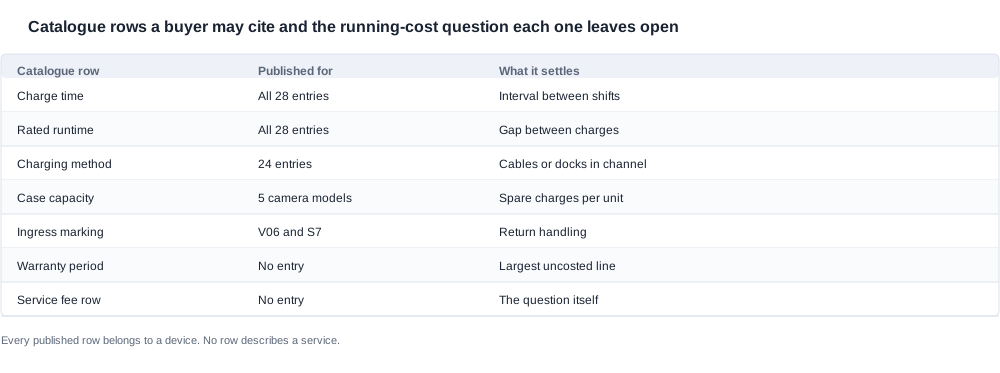
Two rows in that table are absent in a way that is more consequential than the other five. The warranty period is absent for every entry, which means the cost of a failed unit inside the warranty window, the cost of a reverse-logistics round trip and the cost of a replacement are all currently unpriced line items in a landed-cost model. The subscription row is absent for every entry, and it is absent in a way that cannot be reconstructed from the other rows: there is no way to infer from a charge time or a runtime whether an AI capability runs on the unit or in somebody's data centre, because a device capable of running a hosted feature can hold exactly the same published rows as a device that cannot. The catalogue's silence on the second question is therefore structural rather than accidental, and a buyer should treat it as a fact about the category rather than as an omission to be filled in later from a datasheet.
The rest of the published sheet narrows the search in a useful way. The entries that carry AI in the product name number twenty: the eleven camera models — L1 Pro and CY03, MT6 and V03 Pro, CY05 and KY06, L2 Utral and V06, MT5 and V03, and S7 — the eight audio models, and the electrochromic entry published without a model number. The three sport models, the three children's models, the AR entry and the bone-conduction entry carry no AI in the name. A fee question can only bite where a capability is claimed, so the shortlist that matters for this article is the twenty entries, and any supplier answer that comes back at the level of "the range" has not been given for the models that carry the claim.

Four recurring cost lines a buyer has to price
A subscription question is easier to answer once the recurring cost has been decomposed into the lines that can actually recur. There are four of them in this category, and they behave differently enough that they should be priced separately rather than as a single unknown.
- Capability processing. If a feature's work happens off the device, somebody hosts it, and that hosting has a cost that appears either as a per-unit royalty, a per-period subscription, a per-use charge or a cost the supplier absorbs. The catalogue publishes no processing location for any entry, and the published hardware rows cannot establish it. This is the line with the largest potential swing, because a hosted inference on a video or audio stream is a materially different recurring cost from a device-resident routine.
- Firmware and application upkeep. The catalogue publishes no firmware version, no update policy and no release cadence for any entry. A feature that is delivered by updates therefore has a maintenance obligation attached, and the question of who holds it — the supplier, a distributor, or the buyer's own engineering team — determines whether the buyer carries a standing engineering cost that never appears on an invoice.
- Connectivity and account services. Where an application, an account or a cloud console is involved in the product, the buyer inherits the cost of provisioning, of the accounts behind each unit, of the channel through which a customer receives what the device offers, and of the failure path when that channel is unavailable. The catalogue publishes no application row, no account model and no service description for any entry, so nothing here can be treated as a device fact.
- After-sales, warranty and returns. The catalogue publishes no warranty period for any entry, and an AI capability that depends on a hosted service has a failure mode the electronics do not: the unit can be physically perfect and functionally useless. A returns policy that only distinguishes "faulty" from "not faulty" does not describe that state, and a buyer who has not defined it will absorb the cost of it in a channel where returns are hard to police.
The four lines are not equally negotiable, and a procurement file should not treat them as if they were. The first three are costs that recur whether or not a buyer ever complains about them, and they can be reduced or eliminated by design choices: whether a capability runs on the device, whether the update burden is transferred with a written obligation, whether the account model puts the service operator in the buyer's supply chain or outside it. The fourth is a contingency cost, and it is the one most often left undefined because it only becomes visible when something fails. A channel that sells on a narrow margin can absorb an unexpected warranty line for a while; it cannot absorb it twice, and the second occurrence is what turns a support question into a margin review.
There is one further line that is not a supplier cost at all and that belongs in the same model because it changes the decision. The end customer's price is what a buyer is really negotiating when a fee exists, because a fee either sits on the invoice at the point of sale or it is buried in a wholesale price. The two placements produce completely different channel behaviour: a visible subscription is easy to explain and easy to object to, while a buried one produces a refund request, a marketplace complaint or a chargeback when a customer discovers the true recurring cost. That difference is worth a place in the agreement, because it decides whether the buyer is defending a price or defending a surprise.

Where the published rows stop and the service relationship begins
The catalogue's discipline is worth naming because it explains the shape of the silence. Every row it publishes is attributable to a named model and can be measured against that model: a charge time belongs to a cell, a resolution belongs to a camera module, an ingress marking belongs to an assembly, a case capacity belongs to a case. A row that could not be attributed to a model in this way would be a different kind of document, and the catalogue is not that document. The result is that a service row — a subscription, a hosted-processing commitment, an update obligation, an account model — has nowhere to sit in a document built entirely from model-attributable specifications.
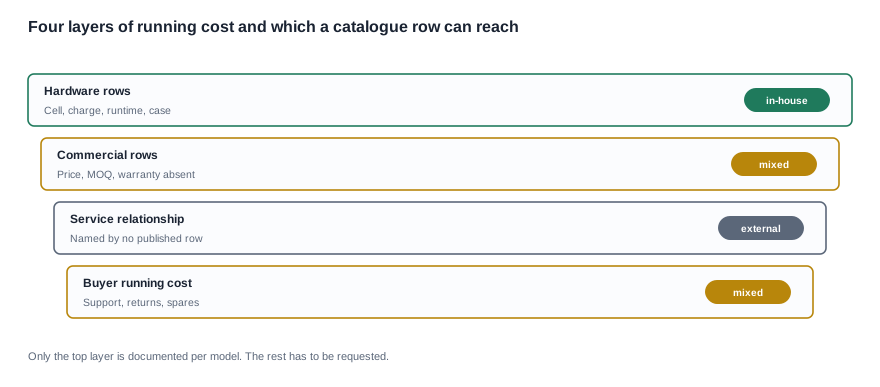
Reading the boundary this way changes what a buyer should do next. If the question were a hardware question, the correct action would be to wait for a datasheet, because a datasheet is the document that closes it. Here the correct action is to make a request, because the answer will never arrive through a document this category produces. The request has to be specific enough to be checkable: a named model, a named feature, a named date and a named person who can answer for it. A request of "do you charge a subscription" produces an answer of "no", which is unfalsifiable, and an answer of "it depends", which is unusable in a landed-cost model.
It is worth being careful about the direction of the negation here, because this is the point where a careful buyer can still make a serious error. The catalogue does not publish a subscription row. That is not a statement that no subscription exists; it is a statement that no subscription has been documented in the material published so far. The difference matters for a procurement file in both directions. It means a buyer cannot write "no subscription" into a customer-facing claim, because there is no published row to support the claim, and it also means a supplier cannot point at the absence of a row as proof that the feature is free. Both of those positions need the same remedy, which is a written answer for a named model.
The other half of the boundary is that some questions about running cost are not service questions at all, and those can be closed today. Whether a unit needs a cable, a dock or a case is published for twenty-four entries and is closed for the camera models that publish a case capacity. Whether a returned unit can be wiped and reissued without a full refurbishment depends on the ingress marking, published for the V06 and the S7 only, and the absence of a marking on the other twenty-six entries is a question to ask rather than a negative claim to make. A buyer who separates the closed questions from the open ones stops looking for a fee where there is only a cable, and stops waiting for a datasheet where the answer has to come from a person.

Five questions that turn the gap into a written position
Each of the four cost lines above becomes one or more requests, and the requests are more useful when they are written against a named model and a named feature than when they are written against the catalogue or the supplier in general. The five below are the ones that change a buyer's landed cost, and they are ordered by how expensive the gap becomes if the answer arrives late.
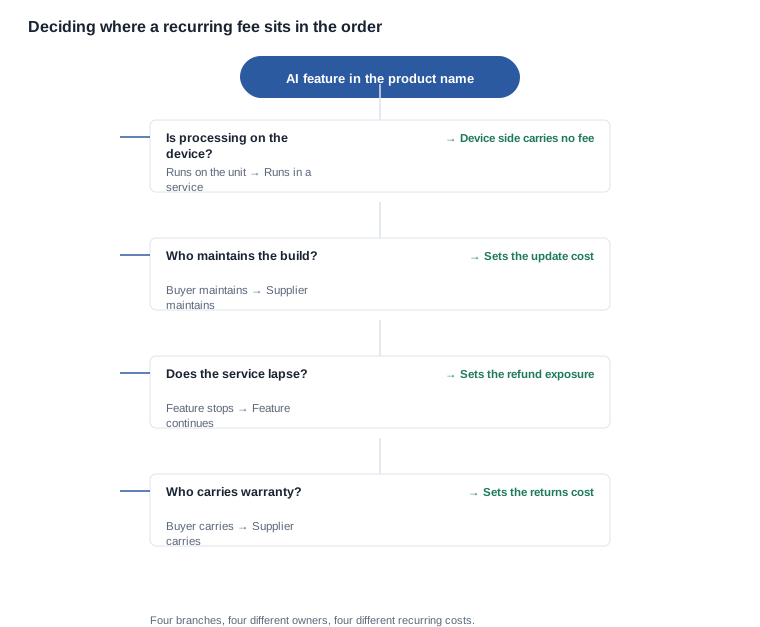
- Does any capability on this model process work off the device? Published: nothing about processing location for any of the twenty-eight entries, and the hardware rows cannot establish it. Not published: whether an AI capability runs on the unit, in a service, or across both. Ask the supplier: a written architecture statement for the named model, naming the layer, and what the product does when the hosted path is unavailable.
- If a hosted service is involved, who holds the account and who pays for it? Published: no application row, no account model and no service name for any entry. Not published: the commercial arrangement between the supplier and any service operator, and whether a per-unit royalty exists. Ask the supplier: the commercial terms of the arrangement for the named model and configuration, including who is the contracting party.
- What happens to the feature when a paid service is not available? Published: nothing about behaviour in any degraded state. Not published: whether the capability stops, reduces, queues or fails silently, and whether the failure is visible to the end customer. Ask the supplier: the defined behaviour, and how it is surfaced, so that a warranty policy can describe it.
- Who maintains the firmware and the application after the first order? Published: no firmware version, no update policy and no release cadence for any entry. Not published: who holds the update obligation, for how long, and what happens to units already in the field when the buyer stops ordering. Ask the supplier: a written update and support obligation with a named duration, attached to the agreement rather than to a support request.
- What is the warranty position and what does a warranty failure mean operationally? Published: no warranty period for any entry. Not published: the warranty length, the exclusions, the reverse-logistics arrangement and the cost of a functional failure on a physically sound unit. Ask the supplier: the warranty terms in the same document as the price, and the process for a unit that fails because a service was unavailable.
A request written in this form produces an answer that can be filed, and a filed answer can be compared with the answer for the next model on the shortlist. That comparison is the actual point, because the answer for one model says nothing about another, and the answers for the same model from two suppliers will differ in ways that only become visible when they sit side by side. Two things make the difference in practice. The first is insisting on a named model in the question, which prevents an answer that is really a statement about the supplier's standard platform. The second is asking what happens when a paid service is unavailable, because that question is answered differently by a supplier who has thought about the failure mode and by one who has not, and the difference shows up later in a returns log rather than in the quotation.
There is one point where the requests stop and the negotiation starts, and it is worth naming it: the unit price is not published for any entry, the minimum order quantity is not published for any entry, and neither is the production capacity. A buyer cannot negotiate a recurring fee against a published unit price, because there is no published unit price. The negotiation therefore happens inside a quotation, and the fee terms have to be written into the quotation and then into the agreement, as lines with owners, rather than negotiated as a conversation that both sides remember differently. The MOQ and order structure note sets out why the order floor and the configuration floor are separate numbers; the same logic applies to a fee, which is a line with a scope and a duration rather than a single number.
Is there a subscription fee: the three-part answer for a procurement file
Published: twenty-eight entries across seven categories, of which twenty carry AI in the product name. On the one-off side of a purchase the catalogue is complete: every entry carries a cell capacity and count, a charge time and a rated runtime; twenty-four of them carry a charging method; the eleven camera models carry a resolution class; the V06 and the S7 carry an ingress marking; the V03 Pro and the V06 carry a colour set; and the eleven camera models carry a charging-case position — a capacity on five, a case without a figure on the KY06 and the MT5, and no case row at all for the V06, the V03 Pro and the V03 or the S7. On the recurring side of a purchase the catalogue publishes nothing at all: no fee, no service description, no update policy, no warranty period, no application or account model. That dividing line is the answer this page opened with, and it falls in the same place on every row. Not published: any subscription row, any service fee, any trial or renewal term, any processing location, any firmware version or update policy, any application or account model, any warranty period, and any per-model certification row — the catalogue text carries no reference to CE, FCC or RoHS, and the company-level export certification page shows ten patent certificates, eight appearance designs and two utility models, which is not a per-model compliance statement. Ask the supplier: the five written requests above, each against a named model and a named feature, together with the warranty terms in the quotation.
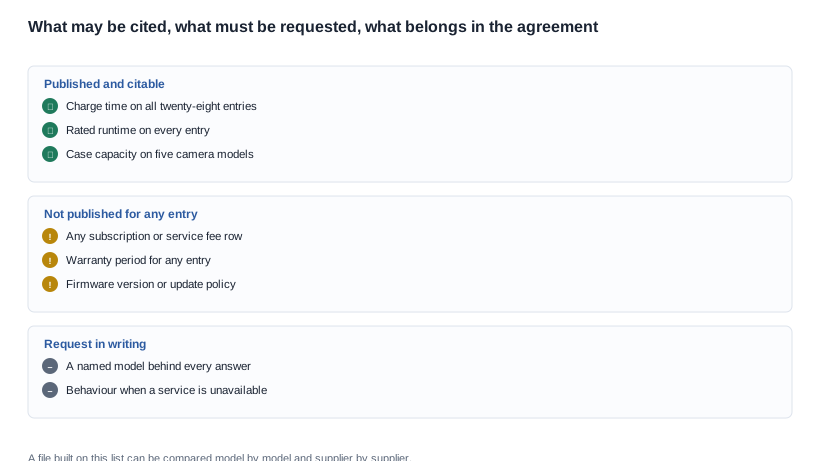
The commercial consequence of that answer is straightforward, and it is the reason this question earns a page rather than a paragraph. If the fee turns out to be zero, the product can be sold on a single-transaction model, the channel's expectation is simple, and the return exposure is limited to hardware faults. If the fee turns out to exist, then the unit price is only one component of the price the customer sees, the relationship between the buyer and the end customer changes, and the warranty question in request five becomes the sharpest term in the file. Those two outcomes produce different products in the channel and different products on a product page, and a buyer who has not established which one applies is making a launch decision on a coin.
The wording that survives scrutiny follows from the three-part answer without much difficulty. A product description may cite the published rows, name the AI capability where the catalogue names it, and describe the device configuration. It may not state that no subscription is required, that a capability is processed on the device, that updates are included, or that a warranty applies for a stated period, because no published row supports any of those four statements for any entry in the range. The trap in that last sentence is the direction of the negation. The catalogue does not publish a warranty period; that is not a statement that the supplier offers no warranty, it is a statement that no warranty term has been documented in the published material, and a buyer who relies on the absence will discover the difference at the first claim.
For a buyer in this position, our position is deliberately narrow: the catalogue publishes no recurring-fee line for any entry, because no service relationship has been documented in the material we publish, and we do not want a published figure to be read as a commitment about a service that has not been described. What the published position does give you is a clean separation between the rows you may cite and the questions you have to ask, and it gives that separation in a form that can be filed against a model string and compared with the answer for the next model on the shortlist.
Related reading
- The same published-versus-unpublished split applied to connectivity — does the AI feature need internet
- Where the application and the brand work sit in an OEM programme — app branding customisation
- The engineering boundary when a capability has to run somewhere specific — app integration customisation
- The clause that carries obligations after the first shipment — OEM contract considerations
- The cost line that sits next to the unit price — warranty policy and after-sales support
The model, the feature and the date you are planning to launch are what the answer turns on; name them and the request can be written against a specific line rather than a general enquiry.


