

Smart glasses AI features: the three deciding questions
The honest answer is that an AI feature is worth buying only when you can describe its failure mode, and in this category most buyers cannot — not because the feature is weak, but because the behaviour lives outside the product. Smart glasses ai features smart glasses do you need it is therefore a three-question test followed by three genuine cases in which the feature earns its place, and one rule that decides both.
The three questions are what happens with no network, what happens when the subscription lapses, and what happens to the data. If you cannot answer all three in writing from the supplier, the correct decision is not whether to proceed — it is what to write in the listing until you can.

Who the buyer is, and what the assistant costs them
The buyer in this category is a brand product manager or a channel buyer, and they are usually adding a voice assistant or a translation layer to a product that already exists. The reason they are considering it is rarely technical. It is that the feature appears in the listings of products they admire, or a customer asked for it, or a competitor's product page has it and the comparison is now in the customer's head.
What the buyer is afraid of is not that the assistant will be bad. It is that the assistant will be good in the demonstration and absent in a customer's basement, a lift or an international flight — and that the resulting complaint will be attributed to the product rather than to the network. The second fear is that a claim about the feature will appear on a listing and then fail, and that the listing review or a marketplace action will follow.
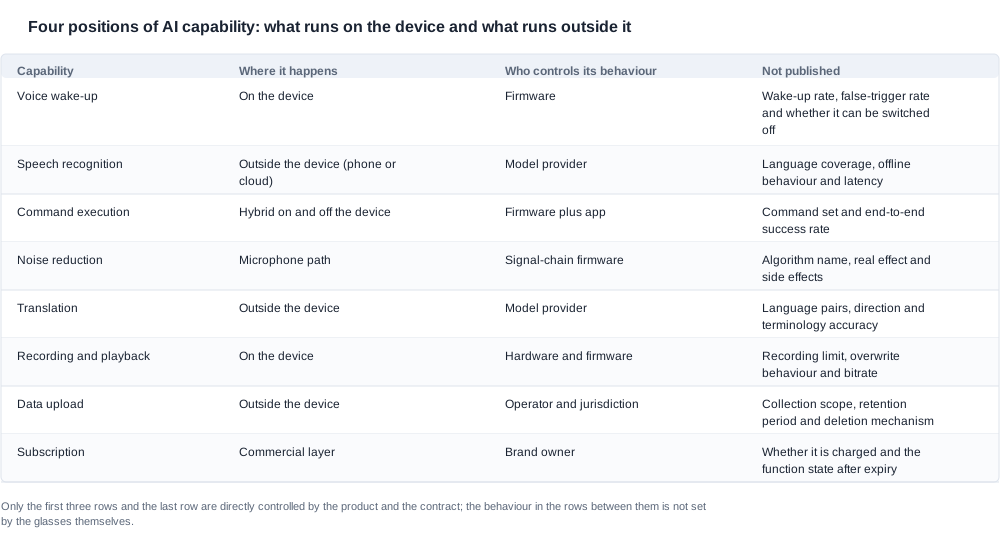
Both fears are cheap to prevent and expensive to fix, because the prevention is a question and the fix is a reprint, a support-script change and a returned unit. The important structural point is that the performance of an AI feature is mostly an experience of the network and of the model. The capture, the playback and the wake-word detection are in the device; the recognition, the answer, the latency and the accuracy happen beyond the frame, on a phone or a server.
That has two consequences a business case should reflect. The performance is not something the brand controls by choosing a better supplier of glasses. And the performance varies with the network, which means the demonstration in an office is not the demonstration at a busy event, and the second one is the one your customer will reproduce.
What an AI feature actually costs to run
The cost of an AI feature is almost never in the bill of materials, and a programme that has not separated the one-off from the recurring has not finished its costing.
Service inference, if the feature runs in a service. Every use costs money to serve, and the cost scales with usage rather than with units sold. A product whose feature is used heavily is a product with a variable cost per user, which is a different business from a product with a margin per unit.
Data handling. Capturing, transmitting, storing, and possibly transcribing or translating personal data, in a product worn on someone's face. The compliance work and the infrastructure work both scale with usage, and the data's location is usually the first question a compliance team asks.
Maintenance. Platform releases, model updates, security fixes and the application's own release cycle. This is the line that most often exceeds the development cost over a product's life, and it is the line most often missing from a programme budget, because it is a recurring operating cost rather than a project.
Model licensing, if a third-party model is used. Some are free to integrate and some are not, and this cannot be estimated from a catalogue that does not name the model.
Silicon and power, if the model runs on the device. An on-device model competes with the camera and the audio for processor area and for the power budget, and both are constrained. The published runtimes in our range — roughly five to eight hours in the camera tier, roughly six to eight in the audio tier, roughly twenty in the children's models — are the constraint the feature has to fit inside.
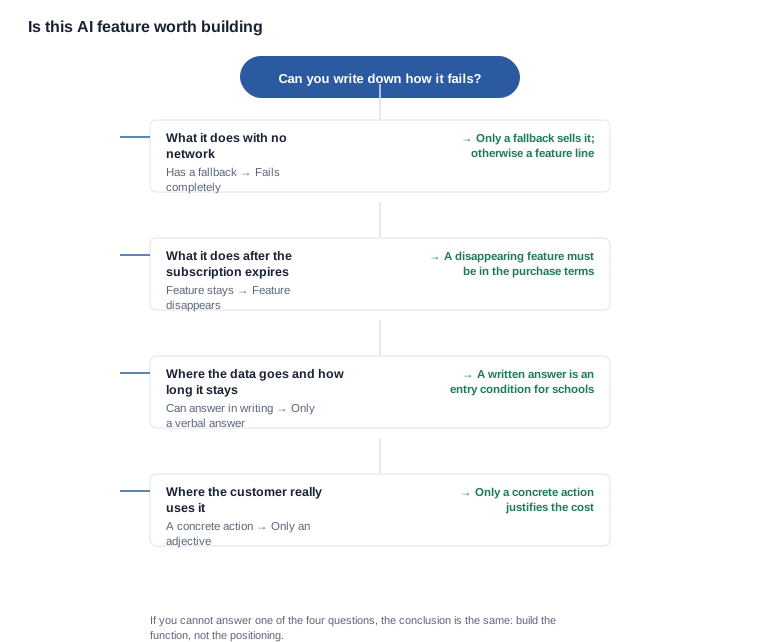
The decision path below reduces the question to something a buyer can answer in a meeting. Note the shape of it: the root question is not whether the feature is good, it is whether you can write down how it fails. That is the same as asking whether you can support it, which is the same as asking whether you can publish it.

The measurements that decide the purchase, and the thresholds to hold
An AI feature is measured in rates, latencies and accuracies, and the measurement is the specification. Below are the measurements a buyer should hold a supplier to, with the condition each one needs, and the form the answer has to take.
| Measurement | How it is measured | The threshold to hold | What a soft answer looks like |
|---|---|---|---|
| Wake rate | Attempts, speakers, environment | A percentage over a stated attempt count, in the target environment | "Highly responsive" |
| False activation rate | Attempts in a quiet and a noisy environment | A percentage, stated separately per environment | Not reported at all |
| Command success rate | A fixed phrase list, a fixed attempt count | A percentage against the buyer's own list | "Understands natural speech" |
| End-to-end latency | Speech end to response, with the network state named | A figure against a fixed threshold | "Very fast" |
| Recognition accuracy | Per language, per condition | A figure for the buyer's languages | "High accuracy" |
| Translation accuracy | Native-speaker judgement, working phrases | A judgement on the buyer's phrase list | "Accurate translation" |
| Offline behaviour | Network physically removed | An enumerated list of surviving functions | "It still works offline" |
| Data path | Observed network behaviour, compared to the documentation | A written description, per market | "Handled securely" |
| Subscription and lapse | What happens per function when the plan ends | A written position per function | "There's an optional plan" |
| Firmware build and update | Build identifier, and how a shipped unit is updated | A build and a notice period | "Updates over the app" |
Four of these deserve a specific comment, because they are the ones that decide whether the feature is a proposition or a line in a feature list.
The false activation rate is the usability gate, not a technical footnote. A device that interrupts a customer's conversation is a product that gets taken off, regardless of how well it works when it does activate. The threshold a buyer sets here is a channel decision: a meeting room and a street are different markets for the same device.
The command success rate only means something against a list you supplied. A high success rate on a phrase list the supplier wrote is worth far less than a mediocre rate on the list your customers actually use, and the second one is the one that predicts returns.
Latency needs a fixed threshold and a named network state. Judged rather than measured, it is a feeling; measured against a threshold with the network named, it is a specification. It also varies with network conditions, which is why the network state has to be part of the measurement rather than part of the test report.
The offline behaviour is an enumerated list, never a yes or a no. "Which functions remain with no network" is the question. "It works offline" is not an answer, and it is the answer that generates the complaints.
One warning applies across the whole table: these figures are not directly comparable across suppliers unless the conditions are stated. A wake rate measured in a quiet office and one measured on a street are two different measurements, and the same applies to latency, accuracy and every other row.

Establishing what the feature does, in writing
Verification of an AI feature is a mixture of documentary and behavioural, and the behavioural half is the one that is usually skipped.
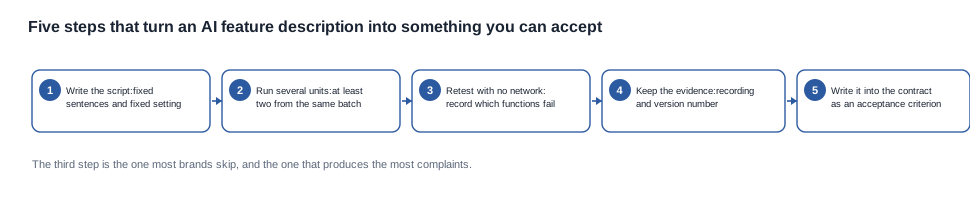
Step one: write the script before the sample arrives. A numbered list of tests, each with a stated condition and a stated pass condition. "The wake word triggers within two attempts in a room at about 60 decibels" is a test. "The voice assistant works well" is not, and the difference between them is the difference between a purchase-order clause and an opinion.
Step two: run it on at least two units of the same build. A feature that works on one sample and fails on another has a yield problem, and a yield problem is invisible in a single-unit test. Two units also tell you something a lab test cannot: whether the product is consistent.
Step three: test with the network absent. This is the step most brands do not run, and it is the step that reveals a service dependency the way a laboratory never does. Record what remains, function by function, and that list becomes your degradation claim.
Step four: test the failure behaviour, not only the success behaviour. What does the user see when the feature fails? A feature that fails silently is worse than one that fails visibly, and both are better than one a support agent cannot diagnose because the device publishes no state. Write the failure state into the instructions and the support script.
Step five: put the criteria and the measurement into the purchase order. A criterion that lives in an email is not binding. A criterion in the order is an acceptance standard, and a lot that fails it is a lot you can refuse.
Six ways an AI programme disappoints after launch
The feature works in the office and not in a basement, a lift or a flight. The symptom is a cluster of returns that all mention the same thing without naming the cause. The root cause is that the offline behaviour was never established. The prevention is the network-off test, and the listing should carry the degradation description rather than the capability description.
A customer stops using the feature in week two, and the returns never arrive. The symptom is a decline in engagement with no complaints at all, which is the hardest kind of failure to see. The root cause is that a feature used ten times on day one and never again is not a feature the product can be sold on. The prevention is the second-week review.
A firmware release changes the behaviour and the listing is now wrong. The symptom is a marketplace query or a support thread about a feature that has changed. The root cause is that there is no notice period and no copy review trigger. The prevention is both, in the agreement.
The data question arrives and nobody can answer it. The symptom is a procurement or compliance review that stalls. The root cause is that the data path was never written down. The prevention is the written description per market, and the privacy statement built from it rather than from a template.
The subscription ends and the customer owns something that has stopped working. The symptom is a support contact framed as a defect. The root cause is that the lapse behaviour was never asked about. The prevention is the question in the brief and the clause in the order.
A competitor ships the same claim and yours is the one that gets questioned. The symptom is a copy claim that no longer distinguishes you. The root cause is that the claim was positioned on the feature name rather than on a measured behaviour. The prevention is to publish the measurement, because a measurement is defensible and a feature name is not.
Where the money in an AI programme can be negotiated
Three things in a voice-assistant programme are worth settling before the launch rather than after, and all three protect a claim you are marketing on. The per-use against per-unit structure of any service cost is worth negotiating in advance, and so is the term against a rolling basis and a floor against a cap. The failure behaviour and the copy review trigger are negotiable design commitments. The number of distinct configurations you commit to is negotiable, and each one carries its own per-unit and per-language minimum. Minimum order quantity is negotiable. Packaging and insert design, including the market labels, the subscription disclosure and the language of the documentation pack, is a low-cost negotiation. Payment points are a standard area: a deposit taken with the order, a balance on the pass before shipment, and a holdback against the paperwork.
Three items sit outside anyone's commercial leverage, and one of them is the fee for the certification itself. Certification cost and certification time are not a commercial lever; the fee is per product family and the elapsed time is set by the test laboratory and the review queue. Tooling is a one-off cost which is usually amortised across the first order, and the questions worth asking are over what volume it is amortised and what happens to the tooling if the programme is discontinued. The regulatory treatment is not negotiable either, because it follows from the functionality and from the wording rather than from the price.
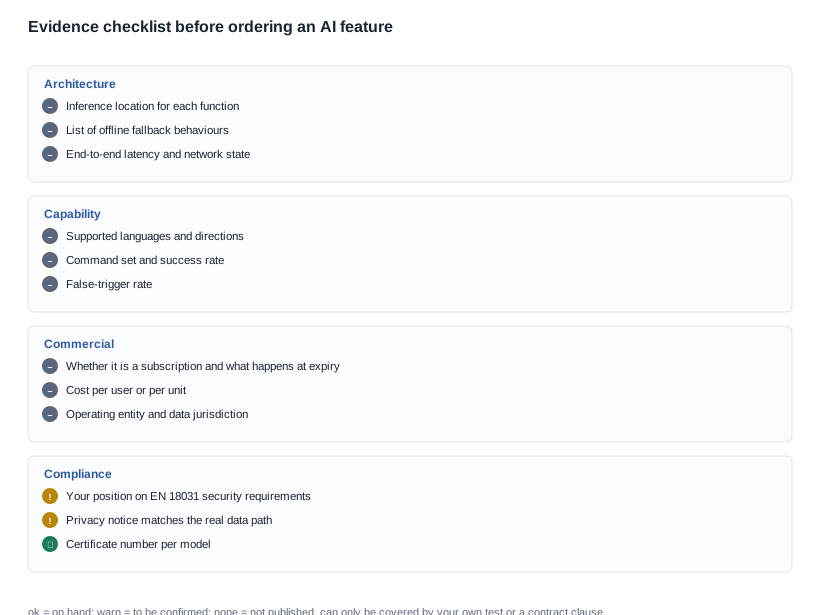
The documents to request before the deposit. The inference architecture, per function. The offline behaviour, enumerated. The command list, the wake word, the false activation rate and the end-to-end latency with the network state named. The language list with the direction of each pair. The data path, the operator entity and the data-storage jurisdiction. The subscription terms, including the lapse behaviour and the per-user or per-unit cost. The firmware build and the update mechanism.
The clauses to write into the purchase order. A clause stating what each feature does when the service is unreachable or the subscription ends. A clause requiring notice before a firmware or model change that alters the assistant behaviour, with a defined period. A clause requiring the privacy statement and the documentation pack to be updated when the data path changes. A clause requiring the marketing and label wording to match the manufacturer's stated capability list. A clause on who bears the cost when the sample does not meet the acceptance criteria.
A worked example: a field-service brand adding a voice assistant
This is a hypothetical scenario rather than a client project, and it is here to show the decision sequence.
Assume a European industrial-services brand, already selling a camera product to site technicians, considering a voice assistant so that hands-free capture does not require reaching for a phone. The technicians work in plant rooms, on scaffolding and in vehicles, often with gloves on. The brand's constraint is that its current product page already makes one claim it cannot evidence and the brand's compliance lead has asked for a change to that.
Step one: the failure questions. The brand asks the supplier the three questions in writing. The offline answer is partial: capture and playback continue, and the assistant does not. The subscription answer is that there is no subscription. The data answer is a named operator entity in a named jurisdiction with a stated retention period. Two of the three have clean answers, and the offline answer is a real degradation rather than a total loss.
Step two: the workflow test. Rather than a demonstration, the brand runs a scripted test in the conditions that matter: gloves, plant-room noise, and a vehicle. Two units of the same build are used, because the brand's own technicians will tell them whether the wake rate survives a helmet.
Step three: the scope decision. The workflow test shows the assistant works but the false activation rate in a noisy plant room is high enough that it fires during unrelated conversation. The brand's conclusion is not to drop the feature but to change the trigger strategy, and that is a firmware conversation, so it happens before the first order rather than after it.
Step four: the claim. The copy describes first-person capture with a voice assistant that works where there is network, and it states the offline degradation explicitly. It is a narrower claim than the competitor's, and it is the one the brand's compliance lead can defend, which resolves the older unevidenced claim as well.
Step five: the commercial structure. The brand puts the offline behaviour and the notice period into the purchase order, and it negotiates the per-configuration minimum against a committed combination count rather than a unit count, because the trigger strategy will be tested on more than one variant.
The result is a feature with a documented failure mode, a narrow claim, and one firmware change made before the first order rather than after a return trend. The decisive step was the first one: two of the three failure questions had clean answers, and the third had a degradation that could be described rather than a blank that could not.
What our own catalogue can and cannot evidence
Here, we publish the AI capabilities our documentation supports and mark the rest as open, and we would rather a buyer removes a claim than publishes one it cannot defend.
What we publish: an AI voice assistant as a key technology across the camera tier — the 8 MP group on the V06 and the CY03, the V03 Pro and the MT5, and the V03 and the KY06, and the MT6 and the CY05, and the 13 MP group on the L1 Pro and the L2 Utral, and the S7. AI translation on the K01, which is an audio model, so we treat that as an observation from our own marketing material rather than as a published specification. The smart noise reduction technique for the Bluetooth audio family.
What we do not publish, and will not estimate: the inference architecture, the offline behaviour, the language list, the latency, the accuracy, the false activation rate, the subscription status, the data-flow detail and the model list, for any model in the range. We also publish no verified device list for the assistant, and we will not produce one retrospectively from memory, because a compatibility list is only useful if it is accurate at the moment it is read.
We will also apply the same rule to our own pages. If we cannot source a claim from the manufacturer, we mark it open rather than approximate it, and we decline briefs that ask us to position AI capability in a way we cannot evidence.
The three questions to send in the next brief
Send the three failure questions as a list, in writing, before the quotation. What happens with no network, what happens when the subscription lapses, and where the data goes and for how long. A supplier who answers all three has a documentation habit, and that habit is worth more than the feature.
Send the measurement script with the brief, not after the sample. The numbered tests, each with a stated condition and a stated pass condition, and the instruction that the tests run on at least two units of the same build, with the network absent in one of them.
Send us the workflow, the market and the price band. We will tell you which rows our documentation answers today, which have to come from the manufacturer, and which need a test on your own units. The camera range is at AI camera glasses, the audio range at Bluetooth audio glasses, and the background is under AI features.
Where the decisions come from
Tell us the workflow, and we will say which of the three questions you have to ask before you can publish anything.


