

If you are new to this category, the most useful first move is not to read the feature list. It is to check which family the feature attaches to, because a listing that promises a voice assistant on an audio model describes a product that does not exist, and that particular mistake is the most common one in the first month.
Smart glasses ai features smart glasses for beginners is a primer in four parts: how the range is structured, what each family actually carries, the ten words you will hear in a supplier meeting with the question behind each one, and what to do with a sample the afternoon it arrives. It ends with the three things to settle before you put an AI claim on a product page.
The structural fact that makes the rest make sense is this: in this category, the AI feature usually lives beyond the product. The capture, the playback and the wake-word detection are in the device. The recognition, the answer, the latency and the accuracy happen on a phone or on a server. A buyer who reads a feature list and assumes the feature is a property of the glasses has misunderstood what they are buying, and every question that follows — offline behaviour, data location, subscription, cost per use — is a consequence of that one fact rather than a separate topic.
Smart glasses ai features: start with the family
The range in front of you is not a single product with options. It is several families that happen to be sold from the same catalogue, and the AI capability is published at model level rather than at family level. That sounds pedantic until you write a sentence for the audio family and discover it is only true of one model inside it.
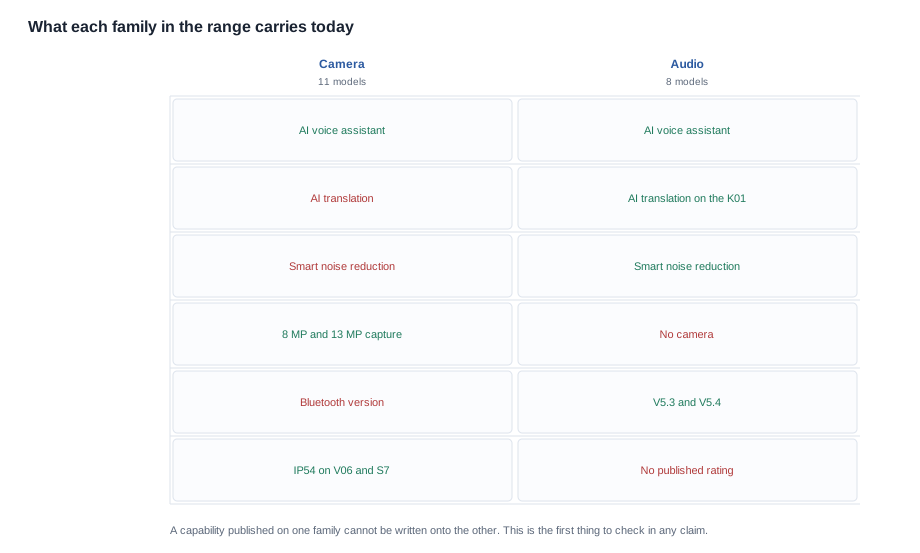
The camera tier is eleven models with a published AI voice assistant as a key technology: the CY03 and the MT5, the L2 Utral and the MT6, the S7 and the KY06, the V03 and the V06, the L1 Pro and the V03 Pro, and the CY05. Eight of them are published at 8 MP and three at 13 MP. Two of the eleven — the V06 and the S7 — carry a published IP54 rating, and the other nine do not, which is the first example of a capability that exists at model level and not at family level.
The audio tier is where the AI voice assistant appears alongside a second capability: the smart noise reduction technique. The catalogue names that technique in its company-level description, but no audio model page publishes it as a row, so it cannot be written into a model-level sentence. The models in that group are the K01, the K02, the D11, the D12, the LC-105 pair, the G07 and the YK12.
The K01 is the odd one out, and it is the model buyers ask about most. It is an audio model, and it is the only model in the range for which our own site records an AI translation capability. The catalogue publishes no translation row for any model, so we treat that as an observation from our own marketing material rather than as a manufacturer specification — a distinction that is small on paper and significant when a buyer restates it on a product page.
The models with no published AI row are the A05 and the A06 children's protective glasses, the AR glasses row, the YKC02, the D17, the ZH12, the photochromic model and the bone conduction model. Eight rows, and a buyer who writes "AI voice assistant" across a landing page that includes any of them has created a false claim.
Here is the beginner's trap, and it is worth naming precisely. It is not that a model has a feature you did not expect. It is that a model lacks a feature you assumed was standard, and you find out from a customer rather than from a spec sheet. The fix costs nothing: put the model designation in every sentence, and treat any sentence that does not name one as unfinished.
Two more structural points round out the orientation, because they change what a spec sheet can tell you.
The published rows are not uniform. Some rows are missing rather than wrong, and a missing row means the answer has to come from a sample or from the manufacturer. The Bluetooth version is published for the audio models — 5.3 on the K01 and the K02, 5.4 on the D11, the D12, the LC-105 pair, the G07 and the YK12 — and it is not published for the camera tier. The cell capacity is published across the camera tier, from 220 mAh on the MT5 and the V03 Pro, and the V03 through 260 mAh on the S7 and the KY06, and the V06 to 290 mAh on the CY03 and the CY05, and the L2 Utral and the L1 Pro, with the MT6 at 265 mAh. The published runtime bands run from five to eight hours in the camera tier and around six to eight in the audio tier, and the children's rows are published at around twenty hours.
The accessory coverage is also per model. The L1 Pro and the CY05, and the CY03 are published with a 1400 mAh charging case, the L2 Utral with a 900 or 1400 mAh case, and the MT6 with a 1200 mAh folding case. The KY06 and the MT5 are published with a magnetic charging case whose capacity is not published. The D17 and the ZH12 are the two rows published with a remote shutter.
The ten words you will hear, and the question behind each
Every term in this category is a category label first and a specification second, which is why the vocabulary is unusually misleading. Each term below is defined by the question a buyer should ask behind it, because the question is the part that has contractual meaning.
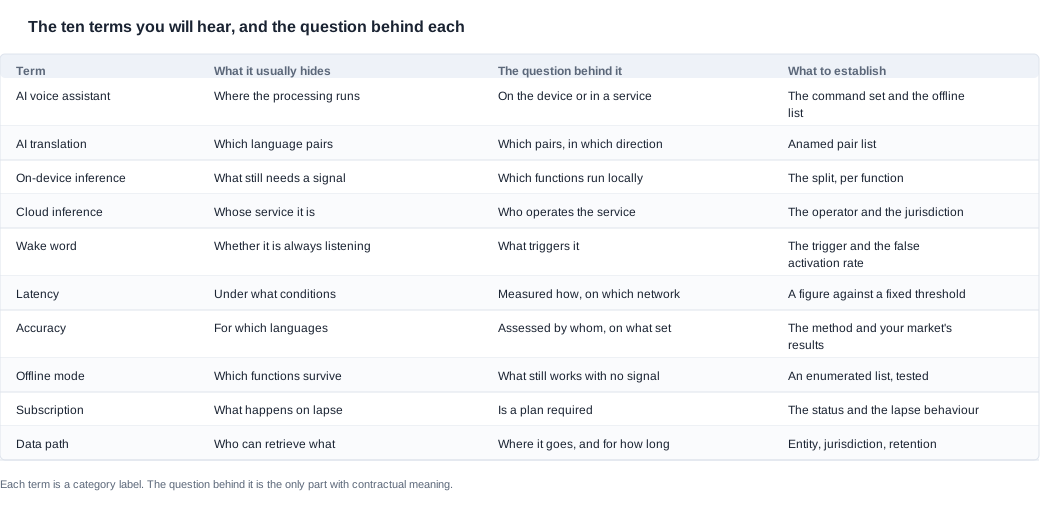
| Term | What it usually hides | The question behind it | What to establish |
|---|---|---|---|
| AI voice assistant | Where the processing runs | On the device or in a service | The command set and the offline list |
| AI translation | Which language pairs | Which pairs, in which direction | A named pair list |
| On-device inference | What still needs a signal | Which functions run locally | The split, per function |
| Cloud inference | Whose service it is | Who operates the service | The operator and the jurisdiction |
| Wake word | Whether it is always listening | What triggers it | The trigger and the false activation rate |
| Speech recognition | Speech turned into text | On the device or off it | The method and the retention of the audio |
| Latency | Under what conditions | Measured how, on which network | A figure against a fixed threshold |
| Accuracy | For which languages | Assessed by whom, on what set | The method and your market's results |
| Offline mode | Which functions survive | What still works with no signal | An enumerated list, tested |
| Subscription | What happens on lapse | Is a plan required | The status and the lapse behaviour |
Three of these ten deserve more than a table row, because they are the three a beginner most often gets wrong.
"On-device" and "cloud" are the same question asked twice, and the answer decides everything else. If the recognition happens off the device, then the product with no signal is a different product, the latency belongs to the network, and the data path belongs to somebody else. For our range, the offline behaviour is not published for any model, which means a buyer cannot currently write a sentence about what the product does in a basement — and until they can, they should not write one.
"Real-time" and "live" are latency claims without a threshold. A latency figure with the network state named is a specification. The same figure without the condition is a feeling, and a feeling cannot be put in a purchase order or defended in a review. The measurement method is in how to measure AI features.
"Supports 50 languages" is a number with no method. A count is only meaningful with a named list, a stated direction for each pair, and a stated assessment. We publish no language count for any model in this range, and the reason is not scepticism — it is that we do not hold the list the number refers to.
The quickest way to test whether a supplier has documentation is to ask the ten questions in the table and watch which ones come back with a document attached. A supplier who answers all ten has a documentation habit, and that habit is worth more than the feature itself. The specific questions for a factory are in AI supplier verification.
Your first afternoon with a sample
A demonstration is the cheapest evidence in this category and most buyers pay for it without knowing they are getting it. A written script, an afternoon, two units and a set of observations produce more usable evidence than a week of reading, and they produce it in a form that can be attached to a purchase order as an acceptance criterion.

First, check what you actually hold. Read the model designation off the sample and match it against the capability list. This is the step that catches a product that does not have the feature you were sold, and it takes two minutes.
Second, write the script before you touch the sample. Ten commands, in the condition you will sell into, with a pass condition for each line. "The assistant responds to a request for the current time" is a test. "The assistant works well" is not, and the difference between the two is the difference between a purchase-order clause and an opinion.
Third, run it on two units of the same build. A feature that works on one sample and fails on another is a consistency problem, and consistency is invisible in a single-unit test. Two units also tell you something a laboratory cannot: whether the product feels the same in the hand, which matters if the channel is going to sell it as a wearable rather than as a demonstration.
Fourth, turn the network off. This is the step most brands skip, and it is the one that reveals a service dependency the way a laboratory never does. Write down what still works, function by function. That list is your degradation claim, and it is the only wording you can safely use for the offline behaviour.
Fifth, write the listing sentence from what you observed. Not from the feature list, and not from the demonstration. The sentence you can defend is the one that names the model, names the condition and stops there.
If you only do four of the five, do the fourth. The network-off test is the single most informative hour a buyer can spend with an AI feature, because it converts an assumption about a dependency into an enumeration of functions.
The three things to settle before you commit a product page
The final step for a first-time buyer is not technical. It is deciding what you are going to say, and the three things below are the ones that have to be settled first.
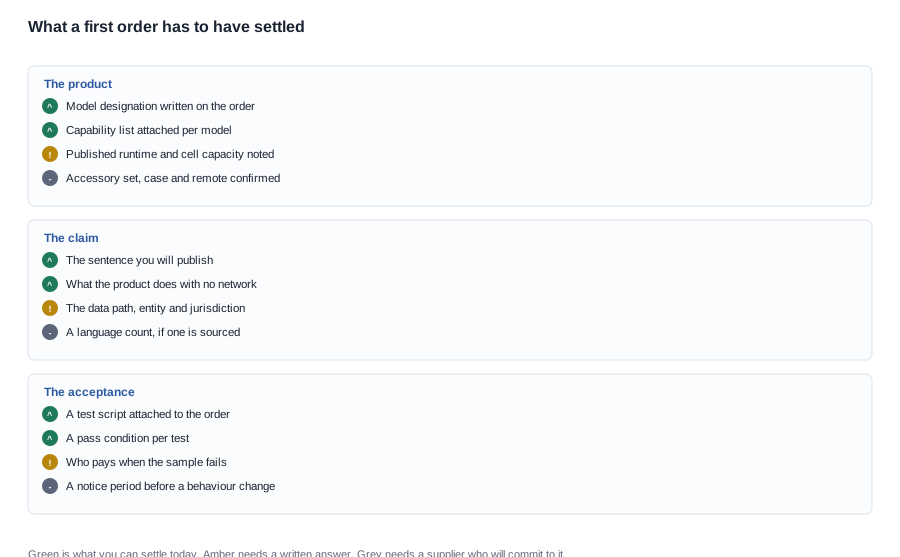
One: which model, and therefore which capability. Name the designation on every line of the brief and every line of the listing. If the claim is written at family level, it will eventually appear on a model page for a model that does not carry it, and you will find out from a customer.
Two: what the product does with no network. Either you have the enumerated list from your own sample, or you write no offline claim at all. This is not a position to take lightly: a product sold into a market with uneven connectivity and described as working offline is a product that fails in a review.
Three: what the data path is. The operating entity, the jurisdiction and the retention period, per market. A privacy statement written from a template rather than from the data path is a liability, and the question for your own legal function is not whether the supplier has a policy but whether the policy describes the product you are shipping.
Three further items belong on the same list but are not decisions: the accessory set as shipped, the certificate numbers naming the exact model, and the build identifier, so that a later firmware change can be recognised as a change. A deposit, a balance on inspection before shipment and a retention held against the documentation package is the standard payment structure, and the retention is the term that protects you on the failure that costs most.
The pitfalls are worth a short list of their own, because they are specific to a first programme. Writing the claim before the build. Testing on one unit. Publishing a count with no list. Copying a supplier's capability list wholesale without checking it against the model you ordered. And asking for a compatibility list that was never tested, which produces a document that is wrong in the one place it matters.

Picking the model to start with
A first programme rarely needs eleven models, and picking the wrong one to start with costs a month. The choice is not about which model is best — it is about which model makes the fewest assumptions about the rest of the programme.
Start with the family your channel already understands. The camera tier carries a published AI voice assistant and a published capture specification, so a buyer selling into field work or content creation is working with rows that are documented. The audio tier adds the smart noise reduction technique to the same assistant capability, so a buyer selling calls and everyday carry is working with the other set. Switching families mid-programme means re-testing the voice, the accessory set and the listing language, which is why the first family choice is expensive to reverse.
Then pick the model that makes the fewest claims about things you have not tested. Two published rows are worth more than a longer specification: a cell capacity and a runtime band. In the camera tier those are published for every model, from 220 mAh on the V03 Pro and the MT5, and the V03 to 290 mAh on the L2 Utral and the L1 Pro, and the CY03 and the CY05, with runtimes between five and eight hours. A model whose charging case capacity is published is easier to write about than one whose case exists but whose capacity is not stated, and the CY03 and the CY05, and the L1 Pro, with a 1400 mAh case, are the clearest examples in the range.
Watch the two rows that carry extra published facts. The V06 and the S7 are the only models with a published IP54 rating, and the MT6 is the only model in the whole catalogue with a published weight, at 158 g, on a folding 1200 mAh case. Those facts are useful precisely because they are rare: a published figure is something you can put on a product page, and a row with no published figure is something you have to ask about. The MT6 is an AI camera model with a folding case — it is not a children's frame, and its weight must not be quoted as one.
Do not start with the model that has the most features. A model with a remote shutter, a case and a published rating is a richer product and a longer evaluation. If the goal of the first programme is to establish what a claim is worth and how a sample behaves, one well-documented model with two units is a better use of a month than a range.
The questions to ask a supplier while choosing are short: which rows do you publish in full for this model, which rows are missing, and what would you have to test to close them. A supplier who answers with a list of missing rows rather than a reassurance is giving you the useful answer, and it is the same answer you will want at the acceptance stage.
One practical note on the order of work, because it is the part beginners most often reverse. The model choice comes first, the sample second, the script third and the claim last. Reversing any two of those puts a claim on a page before there is anything to support it, and no amount of testing afterwards repairs a listing that has already been indexed, reviewed and shared. The order is also the cheapest one: a model choice costs a conversation, a sample costs a shipment, a script costs an afternoon, and a claim costs a reprint.
What we can tell you on day one
Concretely, we will name the AI capabilities our own documentation supports and mark the rest as open, and we would rather help you write a narrower true claim than a wider one you cannot defend. We publish an AI voice assistant among the key technologies for the camera tier and the audio tier, and the smart noise reduction technique for the Bluetooth audio family. Our independent site describes AI translation on the K01, which is an audio model, so we treat that as an observation from our own marketing material rather than as a published specification.
We publish no offline behaviour, no language list, no latency, no accuracy figure, no subscription status, no per-use cost and no data-flow detail for any model in this range. We also publish no verified device list, and we will not produce one retrospectively from memory.
What we can do is take your first sample and work the ten questions with you, so that the second product page you write is written from a demonstration rather than from a deck. Send us the model designations you are considering and the market, and we will tell you which rows our documentation answers today, which have to come from the manufacturer, and which need a test on your own units — and which single model we would start with, given the market you named. The camera range is AI camera glasses and the background is under AI features.
Where the beginner's guide comes from
Tell us the model you are looking at, and we will tell you which of the ten terms applies to it.


