

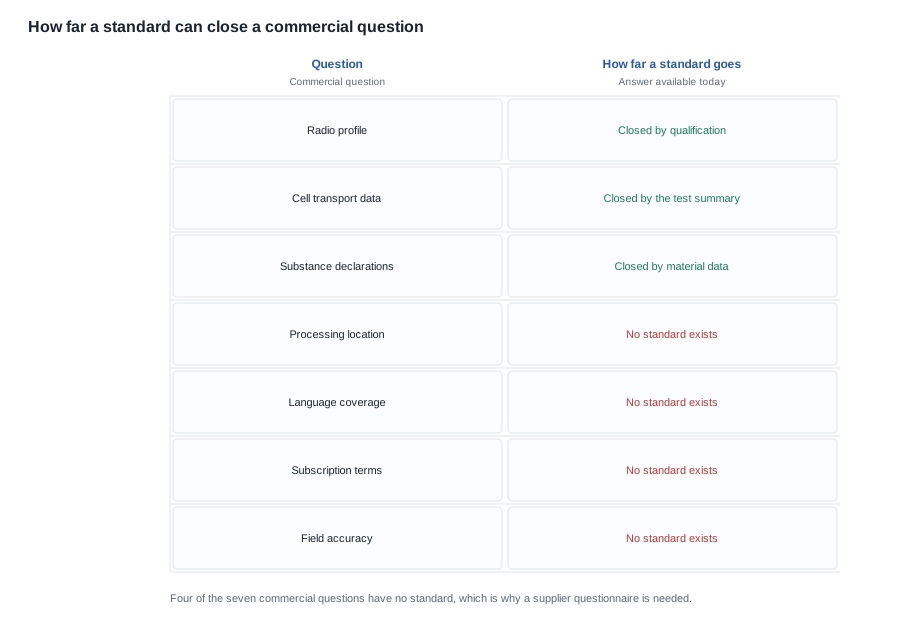
Buyers ask for an industry standard when they want to stop asking questions. The request is entirely reasonable and the answer is usually disappointing: there is no standard that governs the AI layer of smart glasses, and there will not be one for some time. What exists is a set of general regulatory frames and one piece of radio qualification that say nothing whatsoever about an assistant, a translation function or a language set. So smart glasses ai features smart glasses industry standards is best understood as a map of which questions have an answerable form, which are answered with adjectives, and what a buyer has to do about the difference. The practical consequence is that a supplier questionnaire replaces a standards reference, and the questionnaire has to be built carefully, because in the absence of a standard nobody else will build it for you.
Smart glasses ai features: the standards map
The buyer behind the standard request
The reader is usually a product or sourcing manager who has been told that a competitor product is "compliant" or "certified" or "to standard" and has been asked to match it. That single phrase is the beginning of most of the confusion in this category, because the word gets attached to very different objects. A product can be radio-qualified, carry a cell transport test summary, sit under a general market safety regime, and still have no published answer to whether its voice assistant works without a network.
What the buyer actually needs is a shortlist of markets to clear and a defensible answer for each one, and the reason they cannot get it from a catalogue is structural. The AI layer in this range is documented as a capability. An AI voice assistant is named as a key technology across the camera tier, and AI translation is noted for the K01 as an observation from our own independent site rather than as a published specification. A capability is not a specification, and a specification is what a standards reference would have to resolve.
The failure mode for this buyer is not that they pick a bad supplier. It is that they select a supplier on the strength of the one document that is easy to produce — the radio declaration — and then discover, weeks later, that the commercial risk in the product sits in a layer that document does not mention.
Where the standards actually sit
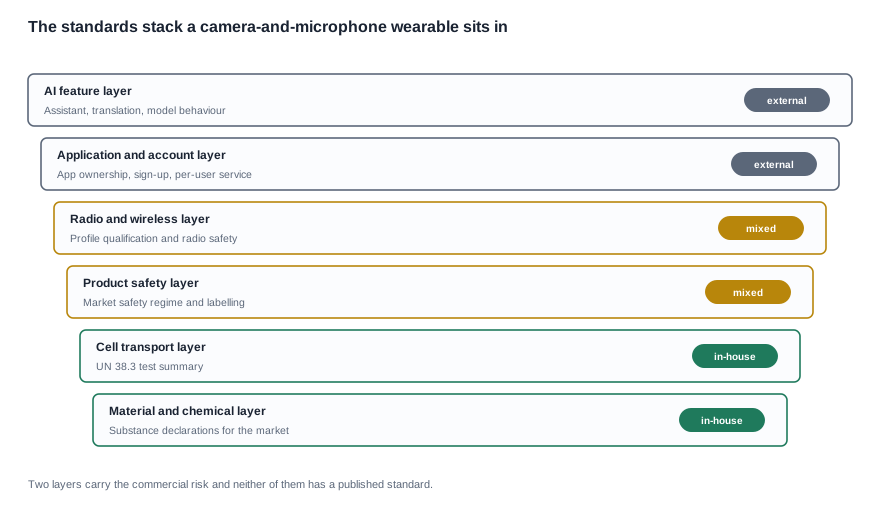
It helps to picture the product as a stack, because the standards and the gaps are not distributed evenly across it. The bottom of the stack is well covered. The top is not covered at all.
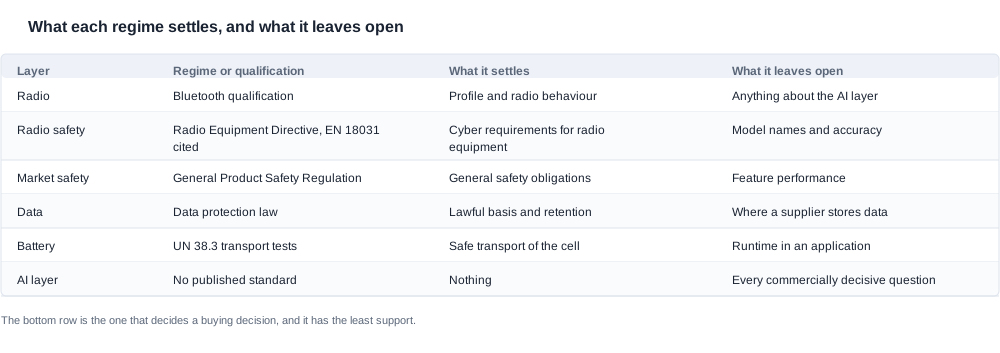
At the bottom, the cell needs a UN 38.3 test summary before it can travel, and that summary is a document every qualified factory can produce. Above it, materials reach a market under the RoHS and REACH regimes, which is a substance declaration rather than a performance claim. Above that sits the product safety layer: in the European Union the General Product Safety Regulation (EU) 2023/988, which applied from 13 December 2024, layers general safety obligations on top of the sector rules. Above that, the radio and wireless layer, covered by qualification and by the radio safety framework, which in the European Union means the Radio Equipment Directive (EU) 2014/53/EU with its cited harmonised standards including EN 18031 for the cybersecurity requirements of radio equipment.
Above all of that sit two layers with no published standard at all: the application and account layer, and the AI feature layer. That is where the subscription question lives, the data jurisdiction question lives, the offline question lives, and the accuracy question lives. In other words, every question a buyer actually has to make a commercial decision on is in the one part of the stack that standards do not reach.

What radio qualification settles, and what it leaves entirely open
The part of the file that a factory can close
Radio qualification is the most mature piece of documentation in this category and the one buyers ask for first, because it is concrete and it is per-model. It establishes that the radio behaves within the limits of the applicable profile for the market, and in most markets it arrives as a test report plus a declaration of conformity. For the European Union, the radio safety framework adds the cited cybersecurity requirements for radio equipment, which is where the update mechanism and the vulnerability handling process enter a technical file.
There is a genuine commercial value here, and it is worth stating plainly so that the rest of this article is not read as a dismissal of the standards. A radio-qualified, transport-tested, substance-declared product clears the majority of the mechanical entry requirements for a market in a way a product without that paperwork cannot. It is the reason the lower two-thirds of the stack is a solved problem for a brand working with a qualified factory, and it is the reason the AI layer stands out as the residual risk.
The part that the radio document says nothing about
Radio qualification describes the transmitter. It does not describe the application, the account, the model, the network, or the data. It says nothing about whether the assistant recognises speech well, how long the response takes, whether it keeps working when the signal drops, what happens when a customer's plan ends, or which jurisdiction a recording lands in.
Buyers who have been through a radio file before sometimes assume that the technical file is broader than it is, because the technical file also contains the software description for the connected application. The software description is real, and it is useful, but it is written to evidence the radio's cybersecurity posture. It is not written to evidence an assistant's behaviour, and the two documents have different authors, different owners and different update cycles.
The practical test is simple. Take any claim a supplier makes about their AI feature and ask which document in the technical file contains it. If the answer is "none of them", the claim is unsubstantiated by the standards regime, and it has to be substantiated by a supplier statement, a test result, or a contract term. There is no third option, and there is no standard to fall back on.
Safety, substances and cell transport: the parts of the file that are standardised
Three areas where a buyer can rely on the framework
These three are worth handling separately because they have different failure consequences and different evidence.
Cell transport. The UN 38.3 test summary is a well-established document with a stable format, and a buyer can usually obtain it for a given cell and a given model without a special request. Its limits should be understood: it establishes that the cell is safe to transport under defined conditions. It does not establish the runtime, the charge time, or the behaviour of the cell in the customer's application. In our catalogue the camera models run on cell capacities from 220 mAh to 290 mAh, with published charging ceilings and runtime bands from about five to eight hours, and the transport summary sits alongside those numbers without describing them.
Substance declarations. RoHS and REACH obligations are answered with material data, and the answer is a document rather than a claim. This is the easiest of the three for a factory, because the factory controls the bill of materials and the file is maintained as part of the product record rather than as a project.
Product safety. The General Product Safety Regulation in the European Union established general safety obligations across the product range from 13 December 2024, and the practical effect for a buyer is a requirement to know what the product is, who the responsible party is, and what the traceability looks like. That is a documentation discipline rather than a design constraint, and it is the part of the launch a brand's operations team usually handles well.
Where even the standardised parts need care
Two cautions apply even here, and both have cost buyers money.
The first is that a transport summary for the cell is not a summary for the finished product with a charging case attached. A camera model sold with a 1400 mAh case, or a foldable case, or a magnetic charging dock, is a different assembly for transport purposes than the bare device, and the buyer should ask whether the summary covers the configuration being shipped. Our range includes models with charging cases at 1400 mAh, a folding 1200 mAh case, and models where the case capacity is not published, so the question of configuration is a live one rather than a theoretical one.
The second is that standardised obligations attach to the product as placed on the market. A private-label programme that adds an application, a login flow or a subscription to a qualified model has changed the product, and the buyer should establish whether the change affects the documentation that already exists. This is a due diligence question, and it is cheap to ask.

The seven commercial questions with no standard behind them
The list, and why it is seven
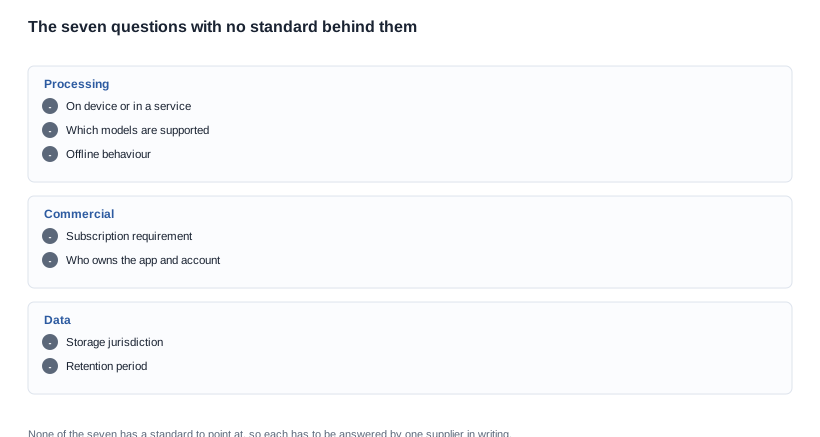
Because no standard covers the AI layer, the questions that decide a buying decision have to be generated by the buyer. We use seven, and they are the same seven wherever the product comes from.
- Does the feature process data on the device, on the phone, or in a named service.
- Which models are supported, and what happens on an update that retires one.
- Is a subscription required, who pays it, and what happens when the plan lapses.
- What works with no network connection, and what the customer is told.
- Where the data is processed and stored, in which jurisdiction, and for how long.
- Who owns the application, the developer accounts and the customer accounts.
- What happens to the product when the service behind the feature is unavailable or ends.
None of the seven has a standard to point at. Each has to be answered by one supplier, in writing, and each has a form of answer that is acceptable and a form that is not.
What an answer has to look like
The useful distinction is between an answer that closes a question and an answer that postpones it. For these seven, the closing answers are specific: a named architecture statement for the first, a list for the second, a written commercial term for the third, an enumerated set of surviving functions for the fourth, a document naming jurisdiction and retention for the fifth, a register of domain names and developer accounts held in the brand's name for the sixth, and an agreed degradation behaviour for the seventh.
The postponing answers have a recognisable shape. "That depends on the configuration" means the capability varies and the variation is not documented. "We can discuss that later" means the answer has not been established. "Our AI partner handles that" means there is a dependency that has not been named. "It is handled securely" is a statement about intent rather than about architecture, and it closes nothing.
The cost of accepting a postponing answer is that it reappears later as a commercial dispute, usually at the moment the brand has the least leverage: after launch, after a listing is live, after the customer has formed an expectation.

Turning the absence of standards into a supplier questionnaire
Building the questionnaire once, and reusing it
The practical output of this article is a questionnaire that can be sent to any supplier and compared across two of them. That comparability is the point: in a category with no standard, the only way to compare two suppliers on the AI layer is to ask both of them the same questions in the same order and to record the answers in the same shape.
Three design rules make the difference between a useful questionnaire and a long one. First, ask the questions in dependency order, so that the architecture answer arrives before the data, the offline behaviour and the commercial questions that depend on it. Second, give the supplier the answer format, because a question without a format invites a description. Third, require the answer to name a document where one exists, because a document is what survives into a technical file and what a buyer's auditor can reopen.
A worked structure looks like this. Section one, architecture and processing location, answered with a statement of where each function runs. Section two, behaviour, answered with an enumerated function list and the conditions under which each was verified. Section three, data, answered with a document naming the operator, the jurisdiction, the retention period and the deletion path. Section four, commercial, answered with written terms for any plan, the account model, and the notice period for behaviour-changing changes.
Routing the answer by market
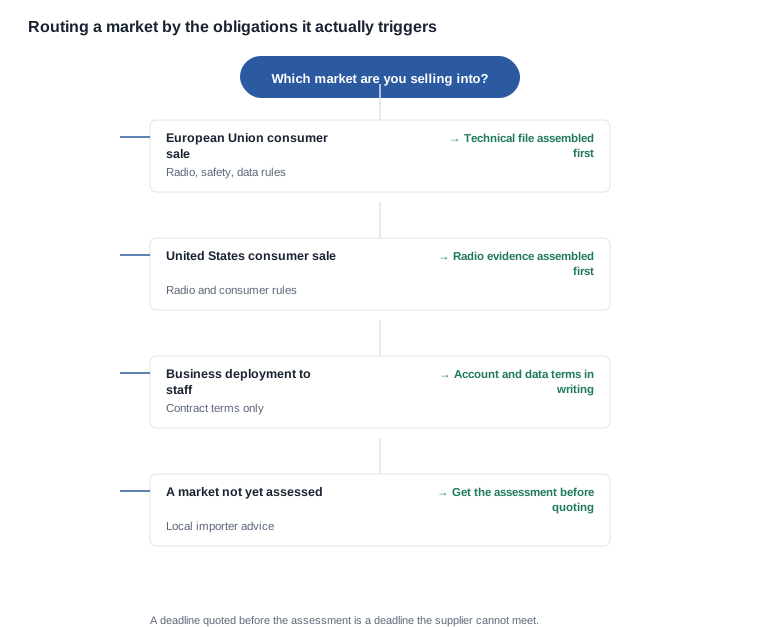
The questionnaire is a platform-agnostic instrument, but the launch is not. A buyer clearing several markets should route by the obligations each market actually triggers, because the effort is not the same everywhere and quoting a single date across markets is how a launch misses one.
In the European Union a consumer sale combines radio, safety and data obligations, and the technical file has to be assembled before the listing goes live. In the United States a consumer sale combines radio and consumer rules, and the radio evidence is the gating item. A business deployment to staff does not create a consumer listing obligation at all, and the relevant documents are the contract terms, the account arrangements and the data position. And a market that has not been assessed should be assessed before a date is quoted, not after.
How to verify what came back
Verification here is a comparison exercise rather than an audit exercise, because there is no standard against which to audit. The method is to set the answer formats before sending the questionnaire, then check three things on receipt.
The first is consistency across suppliers. If two suppliers give different answers to the architecture question, one of them is describing a different product, and the buyer needs to know which. The second is evidence form. A number attached to no condition is worse than no number, because it will be copied into a specification sheet by somebody who will not remember the condition attached to it. The third is completeness against the seven: a supplier that answered five of them cleanly and left two blank has told you something about the maturity of the feature, and the blanks are the two to push on before you order.
There is also a total cost calculation that only becomes possible once the answers arrive, and it belongs in the evaluation rather than afterwards. The recurring service cost, the support cost of a feature that needs a network, and the cost of the compliance work that a narrow claim avoids are all inputs, and a buyer who has only compared unit prices has compared the smallest part of the picture.
Where our own catalogue stops, and what a buyer should do with the gap
What we publish, and what we do not
On the AI layer of this range, that we publish the capability as the catalogue states it, and we publish the empty rows next to it rather than filling them with values borrowed from another product.
What we publish: an AI voice assistant named as a key technology across the camera tier, and AI translation noted for the K01, recorded as an observation from our own independent site rather than as a published specification. We also publish the hardware rows in full — cell capacity, charge time, runtime band, charging method, and for the eleven camera models the resolution tier from 8MP to 13MP, with IP54 marked on V06 and S7 and the 158 g published weight on MT6.
What we do not publish, and will not estimate for any model in the range: the inference architecture, the offline behaviour, the language list, the latency, the accuracy, the false activation rate, the subscription status, the data-flow detail, the app operator and the data-storage jurisdiction. We publish no per-model certification rows either. The export certification on the catalogue cover is a company-level capability, and a company-level capability does not establish that a particular model carries a particular certification.
What that means for a buyer comparing suppliers
The gap is not a weakness to be talked around; it is a fact to be used. A buyer who receives two specification sheets, one of which has every AI row filled with a language count and a latency figure and another of which is honest about having no architecture statement, has a choice to make explicitly. The first sheet's numbers are only usable if the conditions behind them are stated and verifiable. If they are not, the number is a marketing artefact, and it will behave like one in a return.
What we can do is take a supplier specification sheet and classify it — to say which of the seven questions it actually answers, which of the seven it leaves open, and what has to be established before any of it goes into a listing. We will also decline briefs that ask us to position an AI capability in a way we cannot evidence, and we would rather a buyer narrows a claim than publishes one it has to defend later.
The questionnaire you intend to use
Send us the questionnaire you intend to use, or send a specification sheet you have received, and we will mark it against the seven questions and tell you which rows are answerable from a catalogue and which need a written statement from the platform owner. The platform background is under AI features in smart glasses, and the ownership question that sits at the top of the stack is covered at smart glasses OEM IP protection.
Related reading
- AI features in smart glasses
- AI features and platform ownership
- smart glasses OEM IP protection
- AI feature documentation obligations
- How to compare two suppliers on this axis
Tell us the AI function your channel depends on and we will say what we can confirm about it.


