

Smart glasses AI features: a dependency with a feature attached
Comparing smart glasses AI features is unusually hard, because in this category the two products you are comparing almost never publish comparable data. When no supplier publishes accuracy, latency, offline behaviour or architecture, the comparison methods people fall back on are the ones that tell you the least.
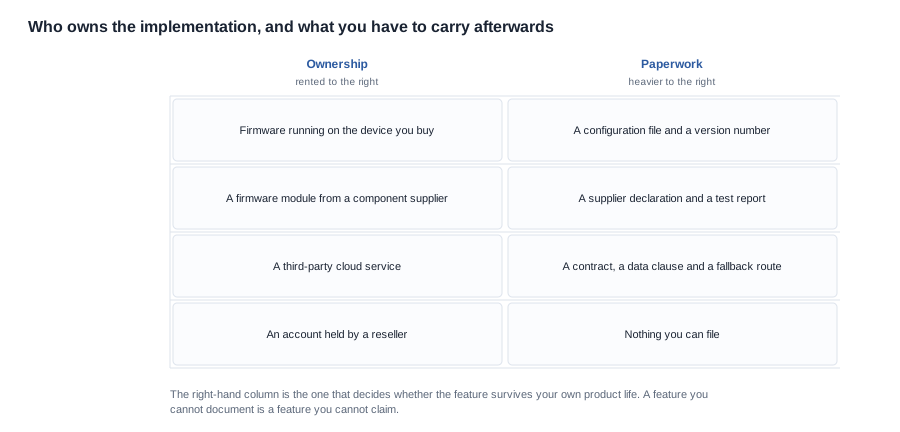
Here is what actually decides it, and it is not the feature. The decisive variable is ownership of the implementation. A capability that runs in firmware you will own behaves one way. A capability provided by a third party you will depend on behaves another way, has a different lifecycle, carries a different exit cost, and creates a different documentation obligation for your own listing. Two products can carry identical AI names, identical published rows and identical marketing, and one of them can be a product that still works in three years while the other becomes a product with a feature that quietly stopped.
So the comparison is not a feature comparison. It is a dependency comparison, and the method below is built around that: establish the requirement set before you look at anyone, separate the hardware from the dependency, test your own content on both, test the failure modes rather than the successes, and price the exit.

The buyer who has to defend an AI claim, and the four comparisons that fail
The roles that arrive at this comparison
A brand product manager is deciding whether an AI capability can carry the proposition. The question is not whether it works — the demonstration will show that — but whether it keeps working after the launch, after the contract ends, and after the language pair the channel needs turns out to be one the service dropped.
A procurement manager is comparing two quotations where the AI line is the reason the price is what it is, and needs to know whether the price reflects a capability the brand owns or one the brand rents. Two suppliers quoting the same unit price for the same-looking product can be quoting a very different commercial structure, and the difference shows up in year two rather than in the quotation.
A channel buyer is writing the listing and has to decide what may be claimed. This role is the one that discovers, after the artwork is printed, that the claim in the listing has no document behind it.
A compliance or quality lead has to sign the file for the shipped configuration and has to be able to say, in writing, what the product does and does not do. The question here is the documentation obligation, and it is the question nobody asks until it is the only one left.
Why feature counts settle nothing
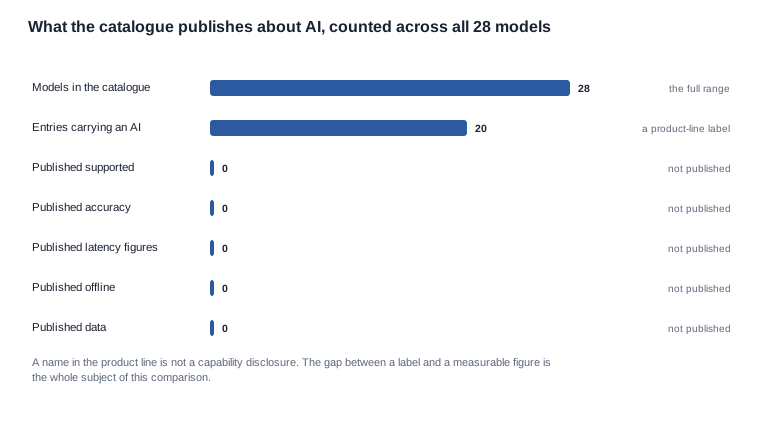
The product with more listed features is not the product with more capability. Feature lists in this category are marketing inventories, and several listed features may be unavailable in your market, dependent on a service you have not contracted, or limited to a firmware build that the shipped configuration does not carry. Twenty of the twenty-eight entries in our catalogue carry an AI name in the product line. That is a naming convention, not a capability disclosure, and the gap between the two is the entire subject of this comparison.
Why a language count, a demonstration, an accuracy figure and a price each fail
A language count. "Supports 168 languages" and "supports 40 language pairs that work well" are very different products, and only the second number is useful. Nominal coverage is a licensing arrangement; usable coverage is a quality measurement. The pass line is a list of pairs with the direction of translation stated, not a total.
A demonstration. A prepared demonstration shows the cases the supplier selected. It is worth watching and worth nothing as a comparison, because both suppliers will have chosen their own easiest examples. The rule is simple: a demonstration is a marketing asset, and the moment both sides run one, the comparison has stopped producing information.
A published accuracy figure. Without a stated condition — language pair, domain, audio conditions, and how errors were scored — an accuracy number is not comparable to anything, including itself measured on different content. An accuracy figure with a condition attached is a real number and a starting point; without one, it is decoration.
Price as a proxy. Price tracks the hardware and the supplier's cost structure. A product with a stronger AI dependency may cost less, because the capability is rented rather than built. Using price to rank AI capability is therefore not merely imprecise; it is inverted, because the more of the capability you own, the more it costs up front.
The nine rows that decide an AI comparison
The ownership row, and the rows that hang off it
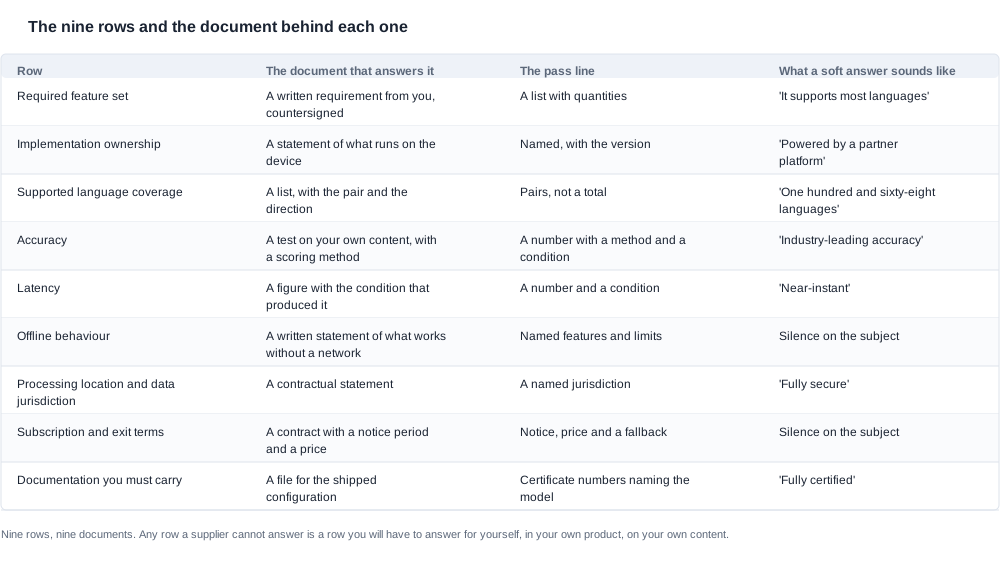
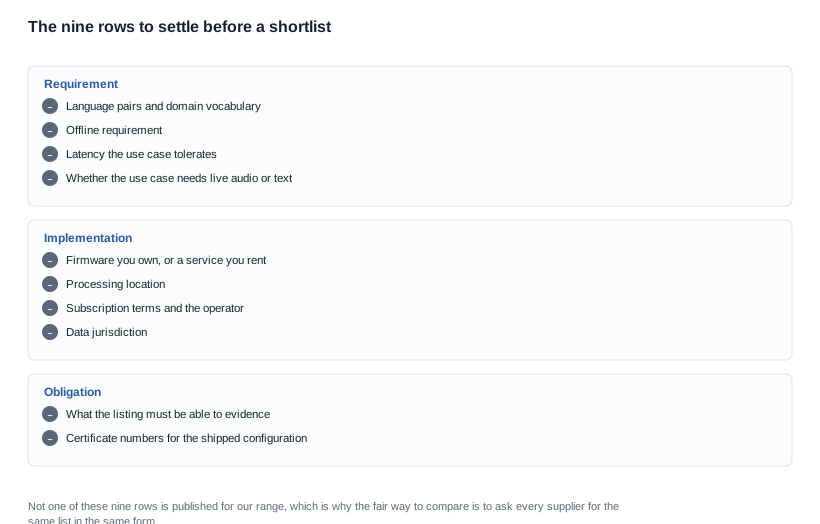
Nine rows, each with a document behind it. Send the list unchanged to every candidate, because the point is not to find the best answer but to find the supplier who answers all nine.
- The required feature set. Your own written list, with quantities: language pairs, domain vocabulary, offline requirement, latency tolerance, and whether the use case needs live audio, recorded audio or text.
- Implementation ownership. Whether it runs in firmware on the device you will buy, in a module from a component supplier, or on somebody else's server. The pass line is a named implementation with a version, not a partner's brand.
- Supported language coverage. A list, with the pair and the direction, and a statement of what is nominal and what is tested.
- Accuracy. A figure with a scoring method, a content set and the conditions behind it.
- Latency. A number with the condition that produced it, including whether the measurement was on a network, on a cellular connection or on a congested one.
- Offline behaviour. A written statement of what works without a network and what does not. Silence on this subject is common and is a finding.
- Processing location and data jurisdiction. Where the audio and the text go, and under which jurisdiction they are processed.
- Subscription and exit terms. The price, the notice period, the renewal terms, and what the product does when the subscription ends.
- The documentation you must carry. Certificate numbers naming the exact model designation, and the file the compliance lead will have to sign.
Rows 2 and 8 are the two that decide the durability of the comparison, and they are the two most often unanswered. Everything else is measurement; those two are a commercial relationship.
The nine questions to ask, in the order to ask them, are these. Before you send them, write down the criteria you are actually using to decide, because a request with no criteria behind it produces answers that cannot be compared.
- What runs on the device, and what runs on a server?
- Which language pairs, in which direction, and which are tested rather than nominal?
- What is the accuracy figure, on what content, scored how?
- What is the latency, and under what network condition?
- What still works with the network off?
- Where is the audio and the text processed, and under which jurisdiction?
- What does the service cost after the included period, and what is the notice period?
- What happens to the product when the service is unavailable or ends?
- What documentation names the exact model designation and the version the claim is evidenced against?
A supplier who answers all nine has a documentation habit. One who answers two is telling you something you need to know before the deposit, and it is not about the feature.
The obligation row: what your listing has to be able to evidence
The ninth row deserves its own treatment because it is the one that arrives last and costs the most. A listing that says the product transcribes and translates is a claim, and a claim has to be evidenced by something. If the capability is owned by a third party and licensed to the supplier, the evidence chain runs through a contract you do not hold, which means your compliance file depends on a third party's willingness to continue.
This is why the independent-site translation description and the AI voice assistant capability that our documentation references cannot simply be carried into a customer-facing listing. The capability may be real and the product may work; what is missing is the file that lets you say so. We publish no supported language list, no accuracy, no latency, no offline behaviour, no processing location, no subscription terms, no app operator, no data jurisdiction and no certificate number for the AI capability, and we will not fill those rows from typical values.
The practical rule for a buyer: a claim you cannot evidence is not a claim you can make, and the cost of discovering that after the artwork is printed is a reprint, a delay, and a channel relationship.

How to build a comparison when no supplier publishes the data
- Define your required set before you look at anyone. Write down the specific language pairs, the domain vocabulary, the offline requirement and the latency you need. This is the step that makes the comparison decidable, and skipping it is why these evaluations go in circles.
- Separate the hardware from the dependency. For each feature, establish whether it is implemented in firmware you will own or provided by a third party you will depend on. The second kind has a different lifecycle and a different exit problem, and the difference is invisible in a feature list.
- Test your own content on both. Build a set of fifty sentences resembling what your customer will actually say, including proper nouns, numbers, and deliberately ambiguous phrases that should be refused. Run both products. Record what fails and how. This is the only comparison method that produces a number you own rather than a number you were shown, and it costs about a day.
- Test the failure modes, not just the successes. Turn the network off. Test low light. Test wind noise for anything involving voice. A product that degrades honestly is more usable than one that returns confident nonsense, and this is invisible in a demonstration.
- Price the dependency. Ask what happens to the feature if the third-party relationship ends, and whether the product still meets your written requirement set without it.
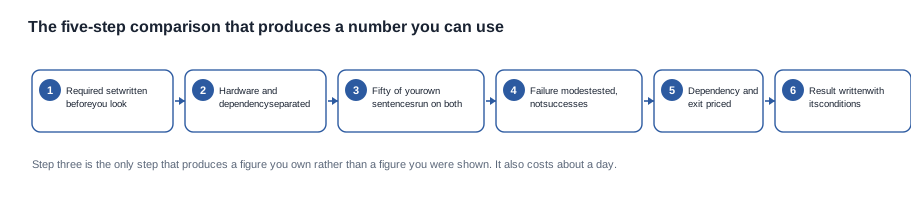
Two of the five steps are about your own product rather than about the suppliers, and that is the point. Steps one and three produce evidence that belongs to you, cannot be re-presented by a competitor, and stays valid when the supplier's marketing changes.
The breakdowns that make an AI claim undefendable
Four breakdowns and the claims they leave undefendable
The comparison is settled on the feature count. Symptom: the product with more features loses on price, and nobody can say what the buyer gave up. Root cause: the feature list was treated as a capability map. Prevention: use the nine rows and treat a row that cannot be answered as unanswered rather than as equal.
A demonstration is run on both sides and treated as a result. Symptom: the chosen product disappoints in the customer's language and domain. Root cause: both suppliers showed their easiest cases. Prevention: run your own content set, on both, with the failures recorded.
The dependency is discovered after the launch. Symptom: a service change removes or degrades a feature the listing promised, and the brand has no contractual route. Root cause: the exit terms were never asked for, because the feature appeared to be built in. Prevention: make rows 2 and 8 conditions of the purchase order.
The claim outruns the file. Symptom: a marketplace reviewer or a retailer's technical team asks what the AI claim is based on, and the answer is a marketing page. Root cause: the copy was written from the product name rather than from the documentation. Prevention: write the listing from the ninth row, and if the ninth row is empty, the claim is empty too.
There is a fifth pattern that belongs to the commercial structure rather than to the evidence. The subscription is bundled into the unit price. A quote that shows one number for the whole product, with a service component hidden inside it, prevents the buyer from seeing what happens when the service component is priced separately, and the discovery arrives at the renewal rather than at the order.
What an AI dependency costs, and who owns the exit
The commercial shape of a rented feature, and the clauses that protect the claim
When part of what you are buying is a rented feature rather than a box, the commercial shape matters more than the unit price, because the renewal is where the margin either appears or disappears. The terms worth negotiating time on:
- Minimum order quantity.
- The unit price and volume tiers, and whether a service or subscription component can be quoted separately from the hardware so that its renewal is visible as a renewal.
- Packaging and insert design, including the wording that describes what the feature does and what it needs.
- Delivery splitting against a sample-approval milestone.
- Payment node structure, with a balance on inspection before shipment and a retention against the documentation package.
- The warranty period with a stated response, and specifically what happens to the warranty when a service dependency is unavailable.
Three lines in a feature-led programme cannot be negotiated away. Certification cost and certification lead time follow the process and the testing body. Tooling appears as its own line, amortised across the first order. And the third-party relationship itself sits outside the supplier's control in the same way that a laboratory's queue does: the elapsed time and the availability of a third-party service are not commercial levers for either party, and a programme that depends on one has to plan around it.
The clauses that protect an AI claim are these: the exact model designation with the certificate numbers attached, and the firmware or software version the claim is evidenced against; a notice obligation before any change of firmware, model or service dependency, since each of those can invalidate a claim; a clause fixing the processing location and the data jurisdiction for the shipped configuration; a clause stating the required set, the evidence file, and what happens to the listing if a row cannot be evidenced; a clause on the subscription or service terms — the price, the notice period, the renewal behaviour, and the state of the product if the service is unavailable or terminated; and a clause requiring an alternative path, or an explicit acceptance that the feature is unavailable, rather than a silent degradation.
The file to request before the deposit on a feature-led order is: the nine rows answered in writing, the certificate numbers with issuing body and validity dates, the data processing and jurisdiction statement, the service agreement terms including the notice period, and the file your own compliance lead will have to sign.
A worked example: a brand comparing two AI camera lines
The following passage is a constructed illustration. Its purpose is to show how the feature questions are sequenced, not to report what a buyer chose.
Assume a consumer-facing brand with a camera product line in two markets, planning a launch in which an AI assistant and translation are part of the proposition. Two suppliers quote. One quotes a hardware unit price. The other quotes a lower unit price and mentions, in a footnote, that a service is included for a period.
Step one, the required set. Before looking at either quote, the brand writes its requirement set: two language pairs for its launch markets, one domain vocabulary list, an offline requirement for the camera's own functions only, and a latency tolerance for live interpretation. Everything else is out of scope, and saying so is what stops the evaluation expanding.
Step two, ownership. Both suppliers are asked what runs on the device and what runs elsewhere. The first supplier's assistant runs on the device, with a named implementation and a version. The second supplier's translation runs on a service, with a data jurisdiction and a notice period stated. This single answer reframes the comparison: the two products are not competing on the same axis, and the brand now has a durability argument to make rather than a feature argument.
Step three, the footnote. The second quote's service component is pulled out and quoted separately. The unit price rises by less than the buyer assumed, the renewal becomes visible, and the budget conversation changes from a unit-cost discussion to a total-cost discussion. The first supplier's price now looks different, not because it changed but because it is being compared against a number that was never a like-for-like number.
Step four, the fifty sentences. The brand builds a content set from its own support data: product names, order numbers, a phrase that is deliberately ambiguous and should be refused, and a phrase in a regional accent. Both products are run. The first product refuses the ambiguous phrase; the second does not. That single observation is worth more than every feature name on both lists, and it belongs to the brand.
Step five, the failure modes. The network is turned off. The first product keeps its camera and its local functions and loses the assistant. The second loses the translation, which the brand now knows is the entire proposition in the second market. The brand asks whether it is willing to ship a product whose headline feature depends on a connection it does not control.
Step six, the decision. The brand launches the first product with the assistant in both markets, and the second product only where the service is contractually guaranteed for the launch period, with the listing worded to describe the mechanism rather than the capability. The clauses follow: the service terms are fixed for a defined period with a notice obligation, the offline behaviour is documented in the insert, and the listing says what the product does when the network is unavailable.
The result is a launch that can be defended, a claim that is narrower than the marketing, and a renewal that is a known number on the calendar rather than a surprise. Every decisive step was a question about ownership and terms, and none of them was about a feature list.
What our own documentation supports, and what it does not
Stated plainly: we are a poor case study for AI comparison, and we would rather say so than present a favourable one.
Our documentation references an AI voice assistant capability across the camera platforms and describes AI translation support on the independent site. It publishes no supported language list, no accuracy, no latency, no offline behaviour, no processing location, no subscription terms, no app operator, no data jurisdiction and no certificate number. Twenty of the twenty-eight entries in the catalogue carry an AI name in the product line, which is a naming convention rather than a capability disclosure.
So if you are comparing us against another supplier on AI, our published position is that we cannot be scored on most of the rows — and the fair thing to do is ask us for the underlying detail rather than score the absence of a marketing page as a product weakness. We will not publish a number we have not been given, and we will not present the absence of a number as a strength.
Where we can be useful is narrower than it may appear: telling you which rows we could answer for a specific configuration once the information is obtained, and which of them would then become part of your documentation obligations rather than ours. The feature background is at AI features in smart glasses, the procurement framing is in the nine-row AI feature checklist, and the documentation obligations are in what an AI claim obliges you to file. Getting answers you cannot get in writing is covered at sample evaluation.
The request that opens an AI comparison
Send us your required set — the language pairs, the domain vocabulary, the offline requirement and the latency you need — and we will tell you which of the nine rows our documentation can currently support, which have to come from the factory in writing, and which are questions about a third-party relationship that we would have to name before we could answer them. We will also tell you plainly if your required set and our published position do not match, because that is a cheaper discovery now than after the sample order.


