
An AI claim is easy to make and hard to falsify, which is why this category needs a reading method rather than general scepticism. Most manufacturers publish the same four or five claims in slightly different words, and a buyer's real problem is not detecting a lie. It is deciding what a true-sounding phrase actually asserts, and therefore what has to be established before the phrase goes into a specification, a listing page or a purchase order. Smart glasses ai features smart glasses manufacturer claims is best handled by classifying each claim against the specific thing that would substantiate it, and by reading the shape of the answer rather than only its content.
Smart glasses ai features: classify the claim first
The buyer, and the moment the claim gets written down
The reader here is usually a sourcing buyer or a product manager doing due diligence on a specification sheet, a supplier deck or a competitor's product page. They are not trying to catch anyone. They are trying to establish what a piece of copy will cost them if it turns out to be narrower than the sentence suggests, because the sentence is about to be pasted into their own documentation.
That is the point at which classification is worth the effort. A claim is easy to accept and hard to unpick once it has become a row in a specification sheet, a line in a listing, or a line in an agent's answer to a customer. The cost of reversing it rises with every document it has propagated into, and the number of documents is where the damage usually happens rather than in the original deck.
The method has four steps. Decide what the claim asserts. Decide what would substantiate it. Decide whether that substantiation is something a supplier can provide, something a buyer has to test, or something nobody can provide. Then decide what happens next — accept it, narrow it, or remove it.
The three outcomes of classification
Not every claim deserves the same treatment, and treating them alike is what makes a reading method slow.
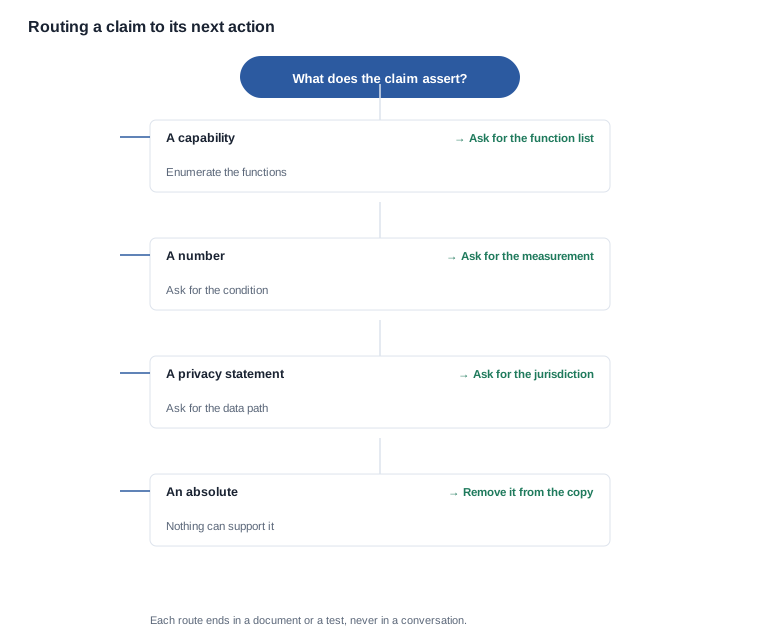
A capability claim asserts that a function exists. It can be substantiated by an enumeration, and it is safe to carry into a specification if the enumeration is attached. This is the safest category and the one most suppliers offer.
A performance claim asserts a number. It can be substantiated by a measurement with a stated condition, and it is only safe to carry if the condition travels with the number. A performance claim without its condition is not a performance claim; it is a number.
An absolute claim asserts that something is always true. It cannot be substantiated at all, because there is no condition under which it would be false and therefore no threshold that could be breached. Any absolute in an AI specification should be removed rather than tested, and its presence is a signal about the rest of the document.
Four capability claims that look like specifications
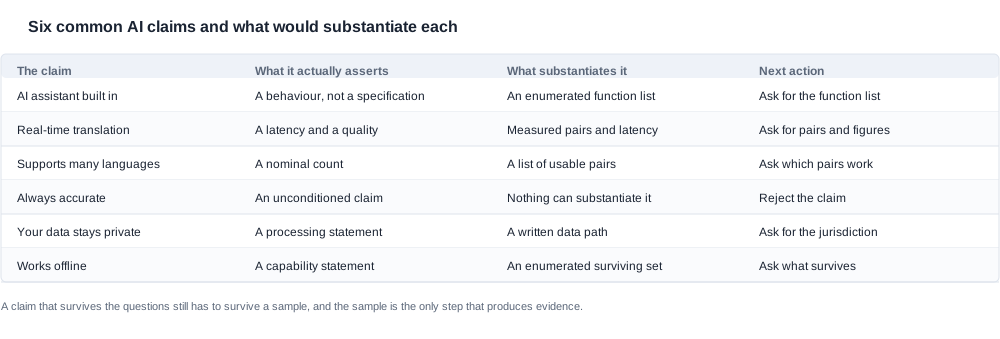
"AI assistant built in"
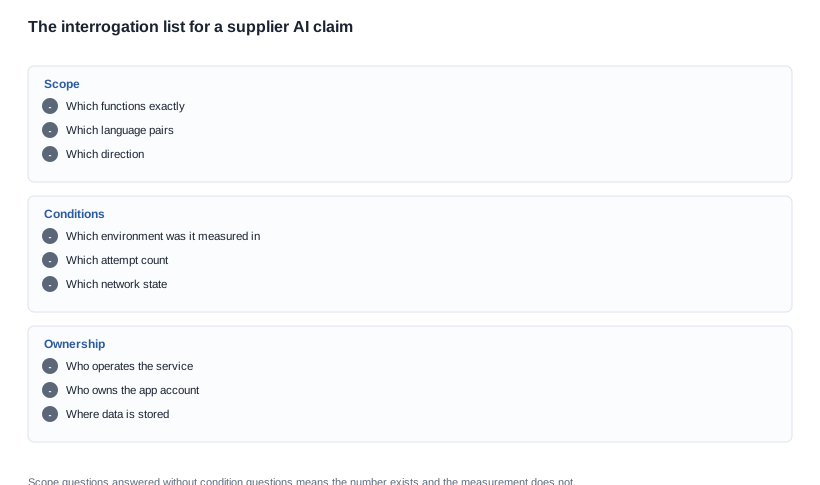
Which functions, exactly. A voice assistant that answers questions, one that controls the device's features, one that translates, and one that captures and summarises are four different products, and the phrase "AI assistant built in" covers all four plus several more.
The substantiation is an enumerated function list, and the enumeration should be specific enough that a customer could tell which item on it they had used. If the list contains "intelligent interaction" as an item, the list has not been written yet.
"Supports real-time translation." Which language pairs, in which direction, and at what latency. "Real time" without a figure describes a demonstration rather than a product, because real time is the condition the demonstration was engineered to satisfy and not a property of the product.
"Supports multiple languages." A count says nothing about which pairs are usable. Forty pairs that work and a hundred that nominally load are different products with different costs behind them, and a count is the most common way of making the second look like the first.
"Always accurate." This is the one that should stop a buyer immediately, because it is unconditionable. Accuracy varies by language pair, by domain, by audio conditions and by how errors were scored, and a supplier making an unconditioned accuracy claim is making a marketing statement rather than a specification. It should be removed from the copy, not negotiated.
The claim about the battery that hides inside the AI claim
There is a fifth claim that does not announce itself as an AI claim, because it appears in the runtime row of a specification sheet. A published runtime figure says nothing about whether it was measured with the assistant running. In our catalogue the camera models publish runtime bands from roughly five to eight hours with charge times at or under two hours, across cell capacities from 220 mAh to 290 mAh, and the band is a hardware statement. If the assistant is running, the customer experiences something shorter than the band, and the band is what the listing will say.
The question to ask is whether the published runtime includes the feature. It costs nothing to ask and it has ended more listings in this category than any accuracy claim, because the accuracy claim is visibly an AI claim and the runtime figure is not.
Three architecture claims and what would substantiate them
"Your data stays private"
Ask where the data is stored and which legal entity operates the backend. If either answer is missing, the claim is not substantiated, and the missing answer is more likely to be missing because it is complicated than because it is simple. The substantiation is a written data path naming the operator, the jurisdiction, the retention period and the deletion route.
There is a version of this claim that is subtler and should be handled separately: "your data stays on your device". That is an architecture statement disguised as a privacy statement, and it is falsifiable by a single observation about whether the product pairs with a phone and what the application does when it does. Ask for the architecture, not for the reassurance.
"Works offline"
Ask which functions specifically remain. A feature that degrades partially and a feature that stops completely are both describable as offline-capable, and the difference between them is the difference between a product with a documented limitation and a product with a broken promise. The substantiation is an enumerated list of surviving functions, and it should be enumerated at the level of a user-visible task rather than at the level of an internal module.
"No subscription"
This one has a written answer and it should be obtained in writing, because it changes the post-sale model permanently and it is the easiest of the three to confirm and the most expensive to discover late. The answer needs three parts: whether a plan is required for the feature, what happens to the feature when a plan lapses, and who the plan is billed to — the end customer or the brand.

The shape of a supplier's answer tells you what the supplier knows
Specific questions get slow answers
There is a pattern in how suppliers handle AI claims, and it is more informative than any single answer. Broad questions get fast answers. Specific questions get slow ones, or a deflection. If you ask what AI features a product has, you will get a paragraph. If you ask which language pairs, in which direction, and at what measured latency, you will get either a number or an evasion.
The evasions themselves are informative, and they are worth learning by heart. "That depends on the configuration" usually means the capability varies by market or by firmware version, and the variation is not documented. "We can discuss that later" usually means the answer has not been established, and the reason is usually a dependency on a third party. "Our AI partner handles that" means there is a dependency you need to know about and a party you may need to contact. "It is handled securely" is a statement about intent rather than about architecture and closes nothing.
Timing is a diagnostic
There is a second signal in the answer, and it is not a technical one: how long the answer takes. A supplier who answers the architecture question in a day has probably answered it before. A supplier who takes three weeks on the same question has either just asked their platform owner or has discovered the question had not been asked. Both are useful to know, and neither is visible from the content of the answer alone.
A third signal is consistency across the answer set. A supplier who gives a precise answer about wake behaviour and a vague one about the data path is telling you something about where the maturity is, and the pattern is usually that the vendor-controlled answers are precise and the third-party answers are vague.

Turning a claim that survives the questions into evidence
The sample is the only step that produces evidence
If a supplier answers all of the questions, one step remains, and it is the only step that produces evidence rather than assurances. Test on a sample.
Build fifty phrases resembling what your customer will actually say, including proper nouns, numbers, names of products and phrases that should be refused. Run them through the sample. Record what fails. Then turn the network off and run the same set again, because the second run is the one that establishes whether the feature is an enhancement or a dependency.
That produces a number specific to your product, which is worth more than any claim on any website, and it costs about a day. It also produces the two artefacts that a buyer needs later and that no supplier will provide: the enumeration of what worked, which becomes the supported task list in the support script, and the enumeration of what did not, which becomes the copy.
Where the result has to be written down
An acceptance criterion that lives in an email is an opinion. A criterion in the purchase order is an acceptance standard, and a lot that fails it is a lot you can refuse. The criteria that matter here are short: the number of the fifty phrases that succeed, in the environment the buyer specified; the number that succeed with the network removed; the enumeration of surviving offline functions; and the failure behaviour in four cases, namely unclear input, an out-of-scope request, a request in a second language, and a request made in a loud environment.
There is also a commercial consequence to writing them down, and it is the one buyers forget. A criterion that the supplier did not agree to in advance is a criterion the supplier will treat as a new requirement, and the cost of that treatment falls on the buyer's schedule. Agreeing the criteria before the order is what keeps the acceptance stage from becoming a negotiation.
The claims that cannot be tested, and what to do with them
Two things in this category resist testing. The data path cannot be tested by a buyer; it can only be documented, which means it belongs in the request for quotation as a document requirement and in the order as a delivery obligation. And the long-term behaviour of a third-party service cannot be tested at all, because the test would need the future.
For both, the practical answer is a commitment rather than a measurement: a notice period before a behaviour-changing change, a written position on what happens to the feature when the service ends, and a clause requiring that the copy be updated when the behaviour changes. Those three are what turn an untestable claim into a manageable exposure.
What a wrong claim actually costs
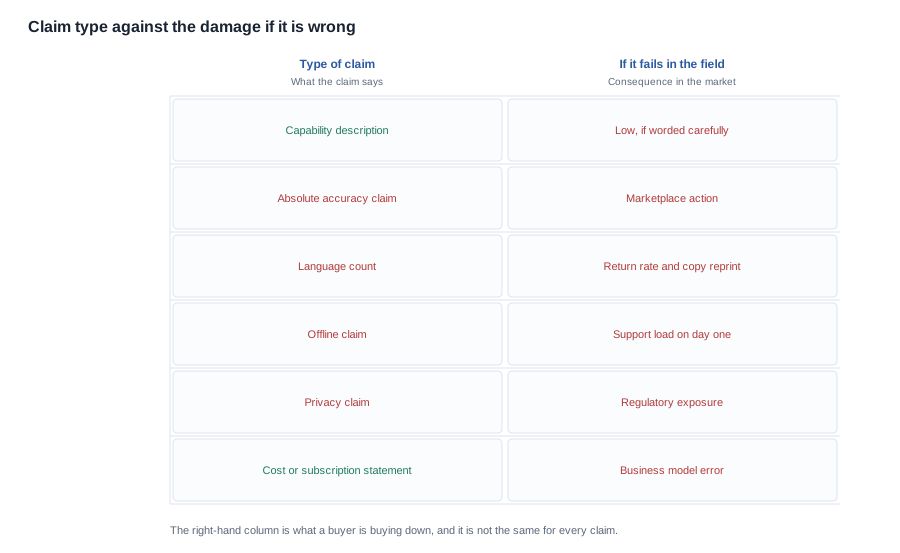
The damage from a claim that turns out to be narrower than the sentence is not uniform, and the differences determine how hard a buyer should push. A capability description that turns out to be narrower than expected costs a copy revision and some confusion, and it is recoverable. An absolute accuracy claim costs more, because it is the kind of claim that gets quoted by a third party, by an agent, or by a reviewer, and every repetition of it is another thing to retract. A language count that turns out to describe nominal support rather than usable pairs produces a return rate that scales with how prominently the count appeared, and it produces a reprint of every page the count appeared on. An offline claim that turns out to cover only the capture function creates a support load on day one that scales with how many of your customers are in places with poor connectivity. A privacy claim that turns out to be wrong is the most serious of the six, because it is the one that creates an exposure rather than a complaint, and an exposure does not have a refund rate.
That ordering is worth holding on to when a buyer is deciding where to spend the negotiating effort. The claims at the top of this list deserve a written answer before the order. The claims at the bottom deserve a written answer before the copy goes live. Neither group can be handled by a sample test alone, and the first group cannot be handled by a sample test at all.
Where the claim becomes a commercial term
Some of what has been described above belongs in the purchase order rather than in a request for quotation, because a request produces an answer and an order produces an obligation. Three clauses carry most of the weight.
The first states what each feature does when the service is unreachable or the plan ends, expressed as a behaviour rather than as an intention. The second requires notice before a firmware or model change that alters the assistant's behaviour, with a defined period, so that the copy can be corrected before the change reaches customers. The third requires the marketing and label wording to match the manufacturer's stated capability list, which sounds bureaucratic and is in fact the clause that stops the drift between a specification sheet and a listing page.
The negotiation around those clauses is ordinary. What is not negotiable is the underlying position: certification cost and certification lead time belong to the test laboratory, and the fee is per product family. What is negotiable is the evidence package, the notice period, the number of configurations the brand commits to, and whether a second evaluation round is funded if the first fails the acceptance criteria. The rest of the commercial terms follows a standard pattern: a deposit on the paperwork, a balance tied to the inspection outcome, and a holdback released against the documents rather than against units, because in this category the documentation is the part most likely to arrive incomplete.
How we grade our own catalogue copy against the same test
Applying the test to ourselves
It would be inconsistent to write this article otherwise, so the same four steps have been applied to our own material.
Our documentation references an AI voice assistant capability across the camera platforms and describes AI translation support on the K01 via our independent site. Applying the classification: the assistant is a capability claim, and it is substantiated by the enumeration of the models that carry it. The translation reference is a capability claim with a weaker source, and it is recorded as observed rather than as a published specification, which is the correct treatment for a claim that comes from our own marketing material rather than from the product catalogue.
Applying the substantiation step to everything else: the inference architecture, the supported model list, the offline behaviour, the language list, the latency, the accuracy, the false activation rate, the subscription status, the app operator, the data-storage jurisdiction and the per-model certification rows are all absent from our published material for every model in the range.
So our own position on the table at the top of this article is that the substantiating detail is absent. We are not going to attach a language count or an accuracy figure to a capability we cannot evidence, because a plausible number on an unevidenced capability is worse for a buyer than an acknowledged gap: one gets used in a specification, the other gets resolved.
What that means when you are comparing us to somebody else
It means you will not find a filled-in AI table on our pages, and it means the comparison you are trying to make cannot be made on paper. The alternative to that is a comparison made on claims, and claims are what this whole article is about.
What we can do instead is grade a claim. Send us a specification sheet, a deck, or a competitor's product page, and we will classify the AI claims in it, say what each one actually asserts, and say what has to be established before it can go into your listing. That is a service we can perform without publishing anything we cannot evidence, and it is more useful to a buyer than a filled-in table would be.
We will also decline briefs asking us to position a product's AI features in a way that implies a capability we cannot evidence. A vague AI claim is commercially weaker than a precise one and legally riskier, and the buyer who understands that asks better questions at the outset.
An AI claim, and what it rests on
Send us an AI claim you have received and we will tell you which of the questions it leaves open, what would substantiate it, and whether that substantiation is something the supplier can give you or something you have to test. The feature background is under AI features in smart glasses, the warning signs in an AI claim are in ai features red flags, the comparison method for two suppliers is in how to compare ai features, and producing evidence on a sample is covered at sample evaluation.
Related reading
- Warning signs in an AI claim — ai features red flags
- Comparing two suppliers on this axis — how to compare ai features
- Producing evidence on a sample — sample evaluation
- How to measure AI features
Send us an AI claim you have received and we will tell you which of these questions it leaves open.


