
An AI features spec sheet in this category is short, confident and made almost entirely of words that describe categories rather than products. That is why a buyer needs a method for reading it rather than a list of parameters to rank. The words on an AI sheet do not fail loudly — they fail by being unfalsifiable, and an unfalsifiable row is indistinguishable from a strong one until somebody has to defend it in writing.
Our own published position is a fair example of what a sheet appears as in this category. The camera tier names an AI voice assistant as a key technology. The K01 entry notes AI translation with the evidence recorded as observed from the independent site rather than as a published specification. Everything that would make either of those evaluable — which models are supported, whether processing is on the device or in a service, whether a subscription is required, where data is stored, and what the latency and language pairs are — is marked as not published.
A procurement team that misreads a sheet does not lose an hour. It loses a programme. The sheet becomes the basis of a technical file, the technical file becomes the basis of a customer claim, and the claim becomes the basis of a warranty position — and every one of those inherits the vagueness without ever flagging it. By the time a market surveillance question arrives, the sheet is several documents old and nobody can reconstruct what was assumed. Reading the sheet properly is therefore not an editorial exercise; it is the cheapest risk control in the whole procurement chain.
So smart glasses ai features smart glasses spec sheet explained is a reading method: five kinds of row, the unit traps inside them, the condition column that is almost never printed, and a marking convention that turns a blank into a work list rather than an assumption.
Smart glasses AI features: five row types and what each is worth
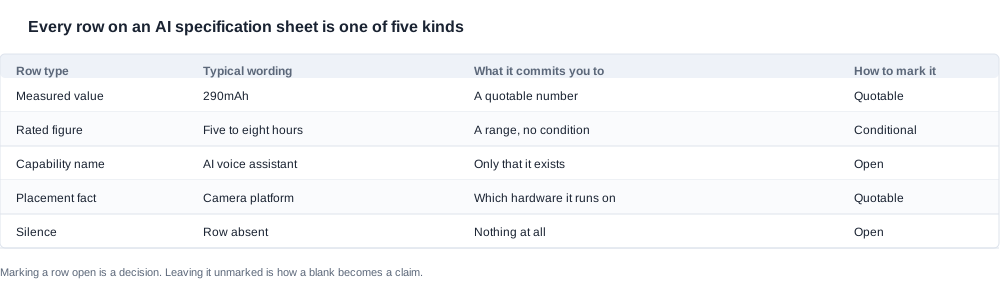
Every row on an AI sheet falls into one of five categories, and the first thing a buyer should do is sort the rows into them, because the five carry very different weight and are usually presented in the same typeface. Sorting them takes about ten minutes and changes the character of the entire document, because a sheet that reads as a list of features turns into a list of obligations.
The capability name
"AI voice assistant", "AI translation", "AI noise reduction", "intelligent recognition". The row tells you that a capability is claimed and it tells you nothing about what it does. It carries no information about the language, the direction, the latency, the network requirement, the accuracy or the cost. On a product page it is worth a line; in a technical file it is worth a question.
The placement fact
The row that says which platform the capability belongs to. In our range this is a camera tier and an audio tier, and the AI assistant is attached to the camera side. A placement fact has genuine evidential weight, because it tells you which hardware the feature runs on and therefore what it can possibly do. It is still not a specification, but it is a fact rather than an adjective, and it is worth more than a capability name by an order of magnitude.
The measured value
A number with a unit and a method: cell capacity in mAh, charge time in hours, a Bluetooth version, a camera resolution. These rows are quotable, comparable and defensible. They also have a characteristic that AI rows lack, which is that they can be checked against the physical unit in your hand, so a discrepancy is caught immediately rather than at review.
The rated figure
A number with a unit and no method: "five to eight hours", "roughly seven hours". This is the most deceptive category because it reads exactly like a measured value in a table. The tell is the absence of any accompanying condition, and the consequence is that the figure cannot be compared with another figure, including another from the same supplier.
The silence
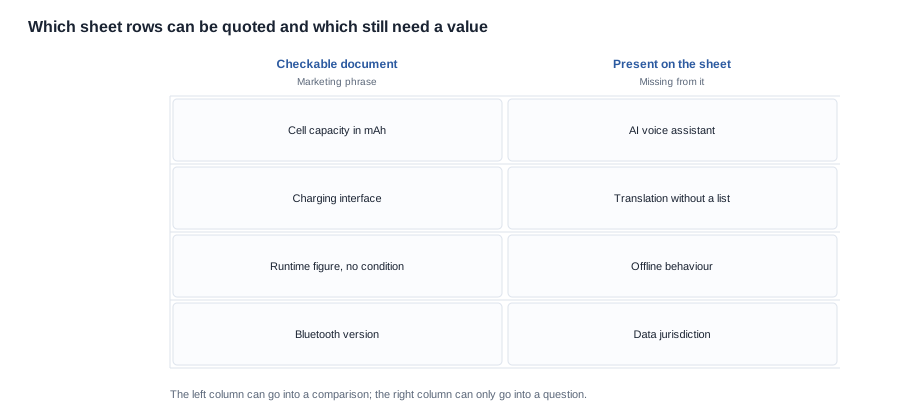
Everything absent — models, architecture, subscription, data location, latency, language pairs, offline behaviour. The silence is the sheet's most informative feature, because it marks precisely the rows a buyer has to establish. The mistake is treating the silence as an absence of information rather than as a list of open items, and the correction is simply to write the missing rows down.

Reading a capability row without being misled by the wording
The wording on a capability row is designed to be true while carrying as little as possible, and there is a small number of constructions that recur. Learning to dismantle them is the whole skill.
"Supports translation." Translation is a set of language pairs, in a set of directions, and each pair behaves differently. Some are neural and some are term-substitution based, some are downloadable and some are streamed, some work with no network and some do not. The row without a list is not a claim about translation; it is a claim about the existence of a word.
"Real-time translation." Real time is a latency claim, and latency is a sensation unless it is measured. The number to establish is the wait between speaking and hearing the result, and the number to establish it against is the longest wait your use case tolerates. A translation that is accurate and slow is a different product from one that is fast and approximate, and which of the two you need depends on whether the customer is a person or a workflow.
"Powered by a leading model." The model name is the specification. "Leading" is not a specification at all, and a buyer who has read a model name into this phrase will eventually be asked which model and will have nothing to answer with.
"AI-enhanced imaging." An enhancement is a processing result, not a capture specification. What the customer receives downstream of the sensor is a processing chain whose parameters are not published, and the raw capture is the only part with a published resolution. A listing that promises an enhanced result is promising something about a model rather than about a camera.
"Multilingual support." Which languages, in which direction, and whether each is a voice model or a translation pair. This is the row where the count-versus-pairs distinction bites hardest, and it is covered in the next section.
The general test for any of these is simple and worth applying every time: ask what the row would still be worth if the model behind it were replaced tomorrow with a worse one. If the answer is "nothing", the row is about the marketing of a dependency rather than about the product you are buying.
The unit traps: hours, counts, pairs and the words around the number
A specification sheet fails through its units and its qualifiers with much greater frequency than through its numbers, and both failure modes are invisible until two sheets are placed side by side.
The range against the point. "Five to eight hours" and "roughly seven hours" describe different things. The first is an honest way of publishing a number whose condition was not fixed; the second is a claim about a condition that was never stated. When a buyer has two sheets, one range and one point, the correct comparison is not between the numbers but between the methods behind them.
The count against the pair. A language count that mixes input and output overstates the usable capability by roughly a factor of two, and the supplier's own marketing may not know the difference either. A count that also includes languages available only through a separate download is overstated again. The unit to insist on is the pair with a direction attached.
The percentage without a base. "Ninety per cent accuracy" has no denominator until you know what was being recognised and what counted as an error. Word error rate, character error rate, sentence-level correctness and human judgement of usefulness produce four different figures for the same system, and a supplier who moves between them in the same document has not chosen a metric.
The millisecond against the second. Latency in a voice interaction is usually quoted in milliseconds for a component and in seconds for the experience. Both are true and they answer different questions. A component figure of four hundred milliseconds tells you the recogniser is fast; it does not tell you the end-to-end wait, which also includes network round trip, model queueing and playback.
The qualifier around the number. "Up to eight hours" is a ceiling, not an expectation. A capacity that is quoted with "up to" or "up to" in a product listing will be read by a customer as a floor, and the gap between the two readings is where a return rate is manufactured. The same applies to "fast charging", "long battery life" and "extended use", which are qualifiers with no unit attached at all.
The decibel that is not a battery figure. One entry in our catalogue carries an amplification gain of 35 dB, and it is worth noting because a figure like that belongs to a completely different measurement family from the hours and the mAh on the same sheet. A buyer who reads a sheet row by row and compares the numbers against each other will eventually compare incompatible units, which is why the sheet has to be sorted by measurement family before it is sorted by importance.

The condition column that is almost never printed
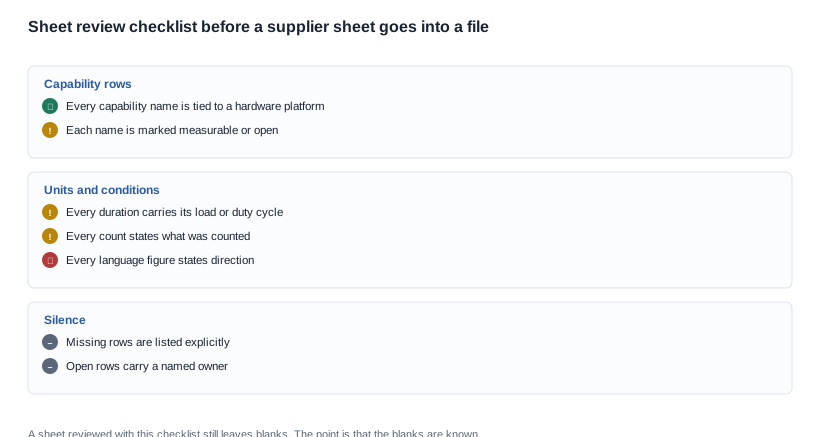
If you take one thing from a specification sheet that does not print it, take the condition. Every meaningful figure on an AI sheet is a function of at least five conditions, and a sheet that publishes the figure without them has published a result rather than a specification.
The load. What the device was doing while the number was measured. A camera platform measured with the camera capturing continuously and a camera platform measured paired and idle are two different products, and the published runtimes in our range reflect a mixed-use assumption that nobody has stated. This is the single most consequential omission, because the load determines whether the figure is achievable in your customer's hand.
The volume and the acoustic condition. For anything measured in hours on an audio platform, the output level and the environment are part of the figure. A figure measured at a moderate volume in a quiet room does not describe a device used on a construction site.
The connection state. A connected device and an idle one do not consume the same power, and the radio environment during a test changes the result. A unit on a bench beside a router is a different test from a unit in a building with a weak signal.
The temperature. Cell behaviour is temperature dependent in both directions, and a figure that holds in a temperate climate does not automatically hold in a hot warehouse or a cold delivery vehicle.
The network state. For anything involving an AI feature, whether the network was present is the condition that decides whether the number describes a product or a service.
The build and the sample. Which firmware build, how many units, and how many runs. A single unit measured once is a data point; a figure with a stated sample size is a result.
The practical technique for the reader is to write the six conditions in the margin of every figure on the sheet and then mark how many can be answered from the sheet itself. On a typical AI sheet in this category, the answer is zero for every figure, and that single count is more informative than any amount of reading the adjectives.

Marking a sheet up so the blanks become a work list
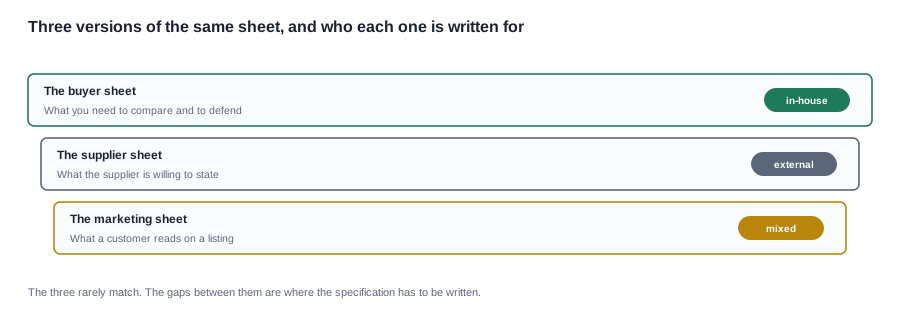
The reason a sheet review often stalls is that it produces opinions. "The spec is vague" is an opinion and it cannot be actioned. A mark-up produces three categories, and every row lands in exactly one of them.
Quotable. The row can go into a comparison sheet, a technical file and a customer-facing claim in the form it is written. The condition, if any, travels with it.
Conditional. The row is usable provided a stated condition is attached — for example, a runtime figure that is quotable only as a mixed-use figure with no load stated, or a capacity that is quotable only for the specific cell part number named alongside it. Conditional rows are still quotable, and the condition is what protects them.
Open. The row cannot be used at all until someone produces a value. The capability names on an AI sheet sit here by default, along with every absent row. An open row is not a problem; an unmarked open row is.
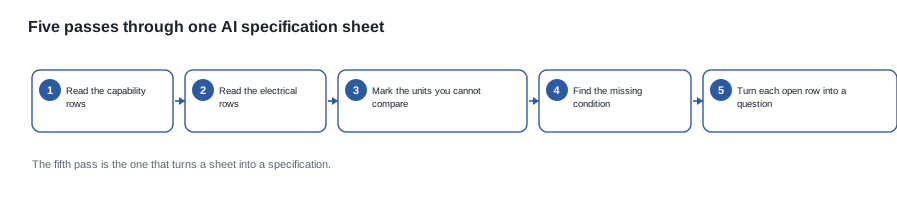
The mark-up itself is one column added to the sheet, with three values, and it takes perhaps forty minutes on a short document. Its output is a work list: every open row becomes a numbered question with a named owner and a date. That list is the thing that makes a supplier comparison meaningful, because it converts the comparison from a reading task into a response task, and it is the only format in which two suppliers' answers can be set against each other.
One warning about the conditional category, because it is where the marking process most often fails silently. A conditional row tends to migrate towards quotable over time, usually without a decision: somebody quotes the figure in a deck, somebody copies it into a listing, and two quarters later the condition has been separated from the number and cannot be recovered. The defence is to write the condition inside the same cell as the number every time, so that the two travel together by construction.
What a marked-up sheet tells you about the supplier
The mark-up is also a supplier evaluation instrument, and this is the part buyers tend to miss. A sheet that arrives with every condition printed is rare; a sheet that arrives with no condition printed is common; and a sheet that arrives with conditions printed but rows quietly omitted is the one that matters. The pattern of omission is itself a finding, because it tells you which parts of the product the supplier has documentation for and which parts they have only ever described in conversation.
This is worth recording because supplier evaluation in this category is usually conducted on price, on lead time and on the factory visit, and none of those three things will reveal a documentation gap. A factory visit shows you the line and the people on it; it does not show you whether a data processing description exists, because that document lives in a different department and in most cases in a different company. The sheet is the only artefact a supplier produces on purpose for you to read, so the quality of that artefact is genuine evidence.
The practical consequence for due diligence is that the marked-up sheet should be part of the supplier file rather than a private working note. When the relationship continues past the first order, the file becomes the reference that explains why a particular row was accepted as open and what was agreed in its place. That record is worth more than the answers themselves.
Turning the open rows into a request for quotation
A mark-up is not useful until it becomes a list somebody has to answer. The conversion is mechanical: every open row becomes a numbered question, every question is addressed to the party that can answer it, and every question carries the condition that would make the answer quotable. Written that way, the work list becomes a request for quotation supplement, and the supplier's replies can be pasted directly back into the mark-up column.
The wording matters more than it seems. A question that asks for a value produces a value; a question that asks for a description produces a paragraph. Asking for the language pairs with the direction attached produces a list; asking which languages are supported produces a count. Asking what accuracy means produces a definition; asking what the accuracy is produces a number without a condition. When you write the questions, state the form of the answer you will accept, because a supplier will generally take the question as a description of the answer required.
The questions to ask are therefore the same eight or nine for every supplier, whatever the product, which is worth knowing before the first request for quotation is sent. Send them before you order, in a single numbered list, and treat the completeness of the return as part of the supplier evaluation rather than as a separate exercise.
Two questions deserve to be attached to every open row before the list goes out. The first is what the answer will be used for, stated plainly: a technical file, a customer claim, a price comparison, or a market-access file. Suppliers respond differently to each, and a row that will end up in a customer claim needs a condition, while a row that only informs a price comparison may not. The second is what happens if the answer cannot be provided, because the acceptable fallback for an open row — a documented limitation, a reduced claim, or removing the feature from the product — is a decision your own team needs to make before the supplier answers.
Two sheets, one selection decision
Once two suppliers have returned marked-up sheets, the comparison is no longer a reading task. The sheets have the same structure, because you imposed the structure, and the rows line up. What differs is the number of open rows, the conditions attached to the conditional rows, and the commercial structure behind them. Those three are the criteria for the selection, and they are the only criteria that survive contact with a customer.
The comparison is also where the total cost question finally becomes answerable. A sheet with more open rows is not merely less complete; it is more expensive, because every open row becomes either a documentation task, a test cycle, a constrained product claim, or a support burden later. Two quotations at the same unit price can carry completely different totals once the open rows are counted, and the difference between them is usually larger than the difference in the quoted price. A buyer who compares at the price line has compared the smallest part of the decision.
The last step is the one most shortlists skip. Mark the losing sheet's open rows with the reason it lost, in one line each. When the second programme arrives, that file is the only thing that stops the same evaluation from being repeated from zero.
The limit of what our own AI rows can be marked against
We publish the AI features as the catalogue states them, and we will not attach a model name, a language count, a language pair, a latency, an offline claim, a subscription position or a data location to any model in this range, because none of those is published to us. Applying the mark-up to our own sheet, the capability rows are open, the placement row is quotable, and the electrical rows are quotable or conditional depending on whether a load is stated — which, for the runtime figures, it is not.
We will also be direct about the consequence. This category's published AI position is thin enough that a buyer has to ask rather than read, and the AI features quality control piece describes the acceptance script that produces an answer you can rely on when the sheet cannot.
If you send us a sheet with your mark-up applied, we will tell you which of the open rows we can close from our documentation, which have to come from the manufacturer, and which are only obtainable by running a test on your own units. That is a more useful exchange than a second sheet, and it is the fastest route we know from a blank row to a written answer.
Related reading
- AI features technology
- AI features what the spec sheet omits
- AI features for beginners
- AI content creation solutions
Tell us the feature and the channel and we will say which question to chase.


