

An AI feature is a supply chain decision before it is a marketing decision. What you can sell is bounded by what the supplier can demonstrate on a unit, on a network, in a language, and under a privacy regime — and a buyer who skips that check ends up with a listing that cannot be defended in the market it is sold in. The feature name on the product page is the least informative part of the whole arrangement. The rows that matter are the ones that describe what the feature needs in order to run, what it does when one of those needs is missing, how long the supplier will stand behind it, and who carries the data.
Smart glasses AI features: commitment with a horizon
What the AI designation does and does not mean
The designation itself is a name, and it is worth being precise about what it tells a buyer. In our catalogue, twenty of the twenty-eight entries carry an AI designation in the product title, and eight do not: the display entry, the YKC02 and the A05, the A06 and the D17, and the A07 and the ZH12 and the bone-conduction entry. The designation marks the tier the product sits in. It does not describe the function, and it certainly does not describe the conditions under which the function works.
| Where the designation appears | Entries | What it tells a buyer |
|---|---|---|
| Camera tier | 11 of 11 | The tier carries the designation; the function behind it is not described |
| Audio tier | 8 of the audio entries | The same, for a different form factor and a different use case |
| Electrochromic display entry | 1 of 1 | The designation sits alongside a lens control path |
| Entries without the designation | 8 of 28 | No AI function is claimed for these |
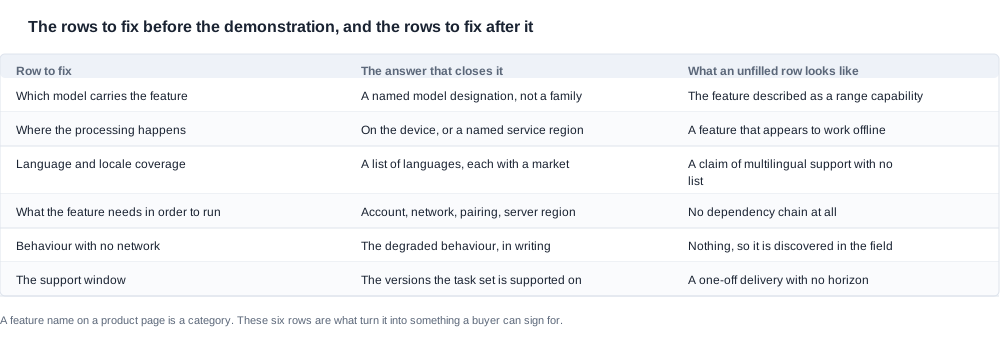
What is missing from every one of those rows is the thing a buyer actually needs: which model runs which task, whether the work happens on the device or in a service, what it depends on, and how long it will be kept. Those are the rows this article is about, and they are the rows a supplier has to fill from an engineering file rather than from a product page.
We will also state the other half plainly. A translation capability has been observed for the K01 from an independent source rather than published by us, which means it is a lead worth chasing in a due-diligence conversation and not a specification to put on a product page.
The buying task behind the question
The typical reader is a brand-side product owner or a product manager who has been asked to evaluate an assistant line, and who is looking at two or three suppliers whose brochures all show a voice interface. The comparison they are making on paper is unit price against unit price, and it says nothing about the thing they are about to buy.
What they are afraid of is specific. The first is a claim that cannot be defended: a product page that says the assistant handles every language, and a customer in a market that was never in the language list. The second is a feature that stops working in a place the brand does not control, because the service region or the account requirement was never in the file. The third is a support volume that arrives in the second year rather than the first, because the feature was delivered once and the agreement said nothing about the horizon.
Each of those is cheap to prevent at the quotation stage, and each is expensive to prevent afterwards, because the evidence lives in a file that runs on the supplier's engineering cycle rather than on the brand's marketing one.

The dependency chain decides whether the feature works at all
An assistant that needs an account, a network connection and a particular server region inherits the reliability of all three, and the buyer has to decide what the product does when any one of them is missing. That decision is a product decision, and it is usually made by the supplier whether the buyer makes it or not.

The four dependencies that matter are these. An account requirement turns a self-contained product into one that has to be registered, and it is the single most common cause of a first-week support spike. A network requirement means the product does something different in a basement, a lift, a rural road or an aircraft seat than it does in the showroom. A pairing requirement means the customer's phone is part of the product, and the phone is a variable the brand does not control. A server region means that a regulatory decision in one market changes what the feature does in another, and that decision is made by somebody else, on somebody else's schedule.
The questions that close this row are not a technical one. It is: what does the product do when the dependency is not there? The answers that close it are a described degraded behaviour, a defined offline mode, or an explicit statement that the feature is unavailable. What does not close it is silence, because silence produces whatever the firmware happens to do, and the firmware was written by someone who was not thinking about your market.
Translation and localisation are different commitments
The distinction is worth its own paragraph because it is the one that most often breaks a launch. A translated assistant renders the request into another language and renders the answer back. A localised assistant handles the conventions of the market: how names are spelled and pronounced, how a telephone number is read, how an address is parsed, how a date is interpreted, and how a refusal is worded.
The places where the difference becomes visible are exactly the places where customers return products: a name that is mangled, a number that is read as a different number, a street address that the assistant cannot place, a refusal that says the wrong thing in a regulated conversation. A language list is therefore necessary and not sufficient, and the question that follows the list is how the market's own formats are handled. That question is cheap to ask and expensive to discover from a return.
A second commitment follows from the same distinction, and it is the one that tends to be missed. If the assistant can hold a conversation in a language, the supplier has to keep that language working as the underlying model changes, and a buyer who has not asked about the window is buying a language support that ends without notice.
A demonstration that tests the product rather than the script
The demonstration is where most of these gaps surface, and the reason so many buyers are surprised by a demo is that they watch a prepared one. A prepared demonstration shows the product's best case: a rehearsed task, on a known network, in a language the speaker chose, on a unit the supplier chose.
Your own demonstration is different in four ways, and each of them is cheap. You write the tasks, so the inputs are the ones your customers will actually use. You run them on a unit of the configuration you intend to order, so the behaviour is the behaviour of the product you will receive. You use the names, the numbers, the addresses and the accents of the target market, which is where translation and localisation separate visibly. And you break the dependency on purpose, by disconnecting the network or by refusing the account, so that the degraded behaviour is observed rather than described.
The demonstration script is worth writing down before the supplier arrives, for the same reason the acceptance criteria are worth writing down before the sample ships: a script written afterwards will confirm whatever you have already decided.

The rows to fix, and the order to fix them in
The order matters more than the list, because the rows have different costs of being left open. A row left open before the first sample is a question. The same row left open after the first shipment is a claim on a product page, a return, and a support cost.
Before the demonstration. Which model carries the feature, named as a model designation rather than as a family. Where the processing happens, on the device or in a named service region. Which languages and locales are covered, and whether the behaviour is localised or translated, which are different things and which separate in exactly the places customers complain about: names, numbers, addresses and refusals. What the feature needs in order to run, written as a chain rather than as a sentence. The degraded behaviour when the network or the account is unavailable. And the data handling position for the destination market, in writing.
After the demonstration. The support window: the versions on which the task set is supported, and what happens to the feature at the end of that window. The data position again, but now as a commitment with an owner, because a written position in an agreement behaves differently from a written position in a policy document. And the defect remedy for a feature that stops working inside the window, which is a different remedy from the one for a physical defect because the product is physically fine.
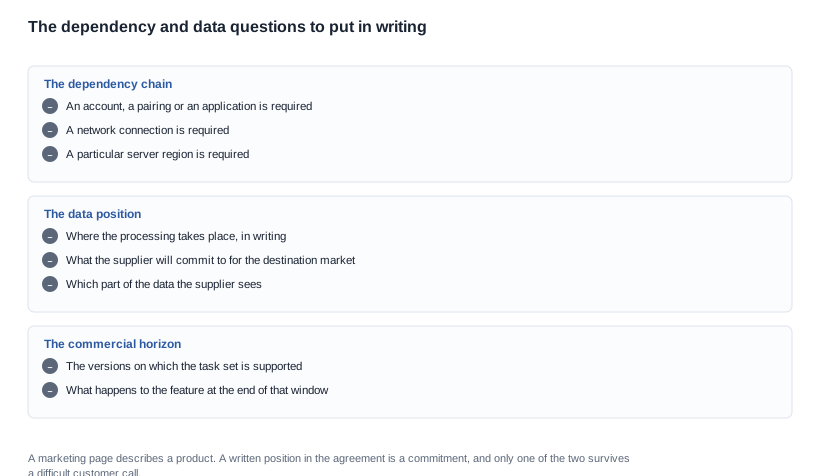
The distinction between a demonstration result and a contractual commitment is the one that matters most in this category, and it is the one most often lost. A demonstration is a statement about an afternoon. A commitment is a statement about a horizon.
The questions to ask before you order an AI feature
- Which model designation carries the feature, and is the capability written against that designation in the order?
- Does the feature run on the device, in a service, or in both, and which of those does the customer experience?
- What does it require: an account, a network, a pairing, a particular server region?
- Which languages are supported, per market, and is the behaviour localised or translated?
- What happens when the network is slow, and what happens when it is absent?
- Where does the processing take place, and what is the written position on data handling for the destination market?
- Which versions is the task set supported on, and what happens to the feature at the end of that window?
- What notice is given before the feature set changes?
- What remedy applies if a feature that is inside the window stops working?
- Which claims may appear in marketing, and what evidence supports each of them?
The tenth question is the one that protects the brand rather than the buyer, because a marketing claim is a promise made to a customer and the evidence behind it is rarely checked by anyone except the customer. A buyer who has the evidence in the file can defend the claim; a buyer who has a demonstration can only repeat it.

What an AI feature costs to support, and where to put it in the agreement
The commercial questions around an AI feature are about scope rather than unit price. The supplier's commitment to support a language, a region or a task set is a maintenance obligation with a cost and a horizon, and a buyer who treats it as a one-off deliverable discovers the gap at the second software update, when the feature set changes and the marketing page has not.
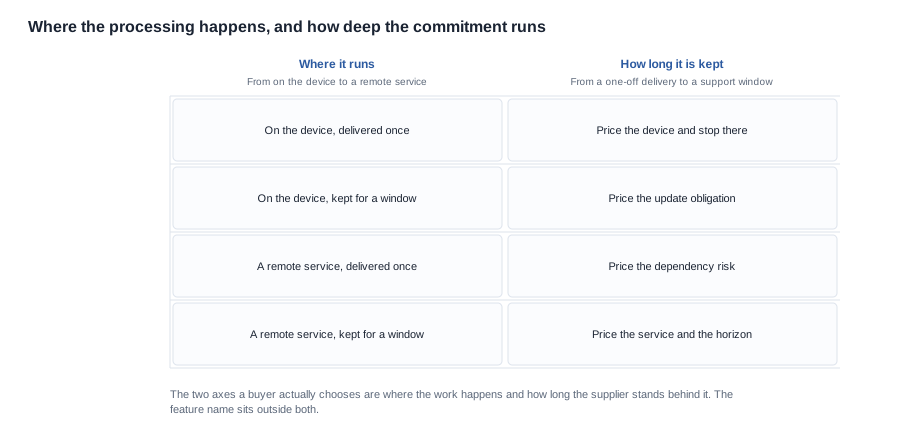
Two axes decide how deep that obligation goes. The first is where the work happens. A feature that runs on the device inherits the device's limitations and needs no service relationship; a feature that runs in a remote service inherits that service's availability, and with it a dependency the buyer cannot audit. The second is how long the supplier stands behind it. A delivery once and a maintained window are different products commercially, even when they are identical on the shelf.
The clauses that earn their place in this category are these. The capability list as a defined document, with a version and a date. The language and locale coverage, per market. The dependency chain, written out. The degraded behaviour when the network or the account is unavailable. The support window for the feature, and the notice period before the feature set changes. The data handling position for the destination market. And, where the feature appears in marketing, a clause stating which demonstrable claims may be used, because a demonstration a supplier ran once in a showroom is not a commitment to a marketplace.
The total cost of an assistant line is the unit price plus the software support that includes the feature plus the returns reserve for a product whose behaviour depends on a network plus the cost of the claims you chose not to make. Which of those to press hardest depends on where your own programme is weak, and the trade-off is settled in the agreement rather than in the price list.
A worked example: a brand opening an assistant line for two markets
This is a hypothetical case rather than a real engagement, and it exists to make the order of decisions visible rather than to report an outcome.
Assume a brand with an established camera line and a retail buyer asking for an assistant capability in two markets, one of which has a data regime the brand has not handled before. The binding constraint is the claim: the buyer wants to advertise a multilingual assistant.
The capability is pinned to a model. The brand asks which model designation carries the feature and writes that designation into the purchase order, so that the capability belongs to a product rather than to a family. The retailer's listing is then written against that same designation.
The language list is requested, per market. The supplier returns a list, and the brand compares it with the two markets. One market is covered with the localisation it needs; the other has the language but with translation rather than localisation, which the brand tests with local names, local number formats and local addresses. Two of the three fail, and the brand removes the second market from the launch rather than discovering it in the field.
The dependency chain is written down. The feature needs an account and a network. The brand decides what the product does when the account is missing, and asks for the degraded behaviour to be described rather than demonstrated, because a demonstration of an absent feature is not possible and the description is what will be in the firmware.
The demonstration is written before the supplier arrives. Five tasks using the brand's own inputs, run on a unit of the ordered configuration, with the network disconnected on the fifth. The prepared demo would have passed all five; the brand's own script passes four.
The claim is narrowed to what the file supports. The listing describes the languages in the file, for the market in the file. The retailer accepts a narrower sentence because the sentence now matches a document, and a document is what a marketplace reviewer will ask for.
The horizon goes into the agreement. The support window for the task set, the notice period before the feature set changes, and the data position per market are all clauses rather than intentions.
The result is a launch into one market instead of two, with a claim the brand can defend and a feature set somebody is contractually obliged to keep working. The decisive decision was the one about the market list, and it was taken before the first sample arrived.
Our published position on the AI tier, and what to send us
The boundary we hold: we publish the rows we hold and mark the ones that are open, and in the AI tier the published set is a designation rather than a specification. We publish the AI designation as it appears against the twenty entries that carry it, together with the electrical rows for each of those entries, so that a buyer can read the gaps honestly rather than having to guess where the boundaries are.
The rows we do not publish are these. Which model runs which function is not published. Where the processing happens, on the device or in a service, is not published. Whether a subscription is required is not published. The language list, the server region, the degraded behaviour and the support window are not published for any entry. We will not fill any of these with a number that cannot be traced to a document, and we will not describe an AI designation as a capability.
What we will do is take a use case, a configuration and a market, and tell you which parts are settled, which are open, and which have to come from a sub-supplier. That is the difference between a designation and a specification, and it is the difference between a feature you can put on a product page and one you can defend on it.
If you are evaluating this category, send us the models, the markets, the quantities and the claim the channel wants to make, and we will tell you which parts of the AI feature scope are settled, which are open on the published data, and which of the open rows a sample could close. The background is under AI features technology, and the reading method is set out in AI features datasheet reading method.
Related reading
- AI features technology
- AI features datasheet reading method
- AI features quality control in practice
- AI content creation solutions
Send the configuration, the quantity and the market, and we will say which parts of the AI feature scope are settled and which are yours.


