

Battery compliance is one of those areas where buyers assume a single certificate covers it, and where the assumption creates a customs problem. The honest position is that a lithium cell inside a radio product is covered by several separate regimes, none of which is a substitute for the others, and each of which fails in a different place, at a different time and to a different person.
The important structural point for battery certification requirements in this category is that most of these obligations sit on the party placing the product on the market, not on the factory that assembles it. That is a legal question with a jurisdictional answer, and it is worth resolving before a purchase order rather than at the port. The factory's certificates are an input to your compliance file; they are not your compliance file.
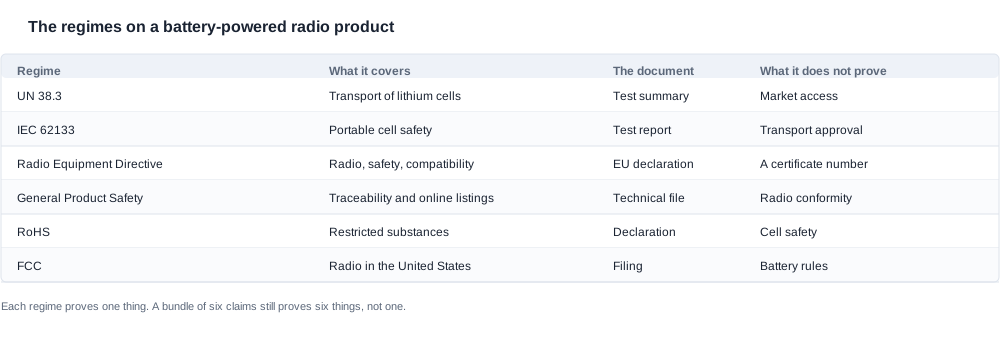
Smart glasses battery life: four compliance stacks on a radio product
It helps to think of the obligations as four separate stacks rather than one pile, because they are assembled, evidenced and enforced independently, and a buyer who treats them as one pile will end up with a file that covers two of them.
The transport stack. This is the lithium regime. It governs how the product may be shipped by air, sea and road, and it is the stack that stops a consignment at a port. It is concerned with the cell rather than the finished product, and it is the reason every model in this range carries packaging, labelling and documentation obligations that non-battery electronics do not.
The market-access stack. This is the radio and safety regime for the finished product, and it is jurisdiction-specific: the European Union, the United States and other markets each have their own framework and their own evidence. This is the stack that stops a product being placed on a market rather than a shipment being moved.
The product-safety stack. This covers traceability, the named responsible economic operator and the information that must accompany a product offered to consumers online. It is the stack that a retailer will raise, and it is the one a brand with a compliance function will ask about in the first meeting.
The substance stack. This covers restricted substances in the electronics, and it is a category-wide declaration that nevertheless has to correspond to the actual product in front of the customer.
A fifth group deserves naming because it is the one buyers forget: the cybersecurity obligations that have become part of radio equipment market access in the European Union. The cybersecurity requirements of the Radio Equipment Directive become a mandatory part of CE marking on 1 August 2025, described by the EN 18031 series of harmonised standards, and they reach secure communication, encryption, secure storage, user consent and a process for handling identified vulnerabilities. A product with a camera, a microphone and an application is squarely inside that scope, and a compliance file assembled before that date needs the new obligations added to it.
Who actually carries the obligation
The party that assembles the product is usually not the party that carries the compliance obligation, and in a private-label arrangement the difference decides how much work the brand has to do. There are three positions a buyer can be in, and they are worth establishing in writing before the first order rather than inferring from the quotation.
The brand is the manufacturer. This is the usual position for a private-label programme: the brand designs, specifies and markets the product, the factory manufactures it, and the brand is the party that places it on the market. In this position the Declaration of Conformity, the product-safety obligations and the named responsible economic operator are all the brand's work, and the factory's certificates are inputs rather than deliverables.
The factory is the manufacturer. This happens when the factory designs the product and the brand resells it under an existing model designation. The obligation largely stays with the factory, and the brand's work is to obtain and file the documents rather than to create them. The complication is the model list, because the brand's own variant names will not appear on it.
A third party is the manufacturer. This occurs where a distributor or a regional entity places the product on the market in its own name, and the brand's obligation becomes contractual rather than regulatory. It is a legitimate structure and it changes who answers a market surveillance question.
The practical advice is short and slightly unglamorous: establish which of the three positions your programme is in, and write it into the supply agreement. Most of the confusion in this category comes from a brand assuming it holds a position it does not hold, and the cost of that assumption appears during a review rather than during a purchase.

What each regime covers and which document proves it
Each regime has one document that proves compliance, and the documents are not interchangeable.
UN 38.3. This is the transport regime. Lithium cells and batteries must be tested against a defined set of tests and accompanied by a test summary when shipped by sea or air. It is not a quality mark and it does not appear on the product. It is a shipping document, and carriers check for it. The document that proves it is the test summary, and the document that makes it useful is the cell part number printed on it.
IEC 62133. The safety standard for portable lithium cells and batteries, and the one most commonly referenced in battery safety documentation. Coverage varies by market and by product category, and its test report is a separate document from the transport summary even though both concern the same cell.
The Radio Equipment Directive. In the European Union, the RED covers radio characteristics, safety and electromagnetic compatibility together for any product containing a radio. A smart glasses product with Bluetooth is inside its scope regardless of whether the buyer thinks of it as a radio device. The document is the Declaration of Conformity, and there is a point about it that catches buyers out: CE marking is a manufacturer self-declaration, CE is not issued by an authority, and there is no CE certificate number to look up. The declaration is the document, it must name the model, and the model list on it is what you check.
The General Product Safety Regulation. Applicable to consumer products placed on the European Union market, with obligations around traceability, a named responsible economic operator and online listing information. This is the framework behind most of the marketplace requirements a European retailer will face, and it is the reason a brand needs to be able to answer a question about a product it bought rather than made.
RoHS. Restricted substances in electronics. Category-wide, but the declaration has to correspond to the actual product, which is why a declaration cannot simply be copied from another model in the range.
The US framework. FCC for the radio, and a separate set of consumer product and battery rules that are not covered by the FCC filing. A buyer who treats the FCC filing as the American equivalent of a European Declaration of Conformity is missing a stack.

What a missing document costs, regime by regime
The reason to hold the stacks apart is that each one fails at a different point and with a different consequence. A buyer who knows the failure mode of each stack knows which one to chase first when the schedule is under pressure.
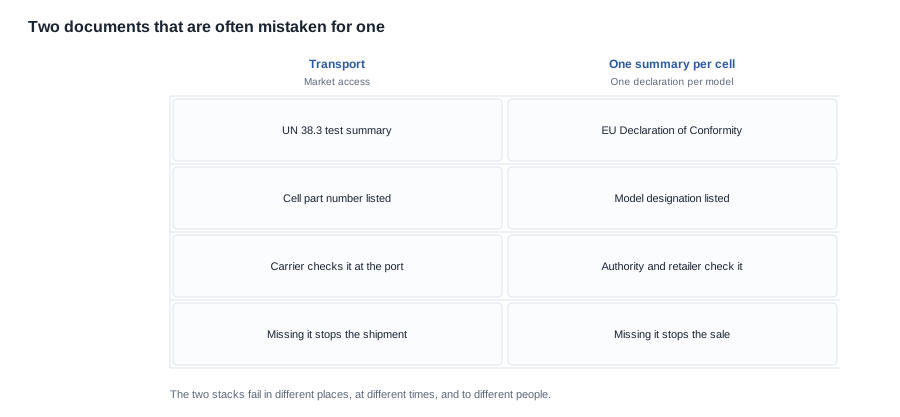
A missing transport summary stops the shipment. It fails at the port or at the carrier, and the consequence is a delay, a re-labeling exercise or a freight cost, on a schedule that was already committed. It is visible immediately, which makes it the easiest of the four to fix — provided the document was requested before the production date rather than after it.
A missing or non-matching Declaration of Conformity stops the sale. It fails at the point of placing the product on the market, usually through a retailer or a marketplace that has asked for it, and the consequence is that stock already manufactured cannot be sold into that market. The cost is a warehousing position rather than a delay, which is why it is sometimes cheaper to hold stock than to recall it.
A missing product-safety position surfaces as a channel question. The consequence is that a retailer's compliance function raises a question that has to be answered in writing, and the answer usually requires a named entity and a traceable supply chain. This is the stack where a private-label buyer discovers that their own supplier structure has not been documented.
A missing substance declaration surfaces last. It usually appears during a market surveillance review or a product test programme, which is a considerably more expensive place to find it than any of the others.
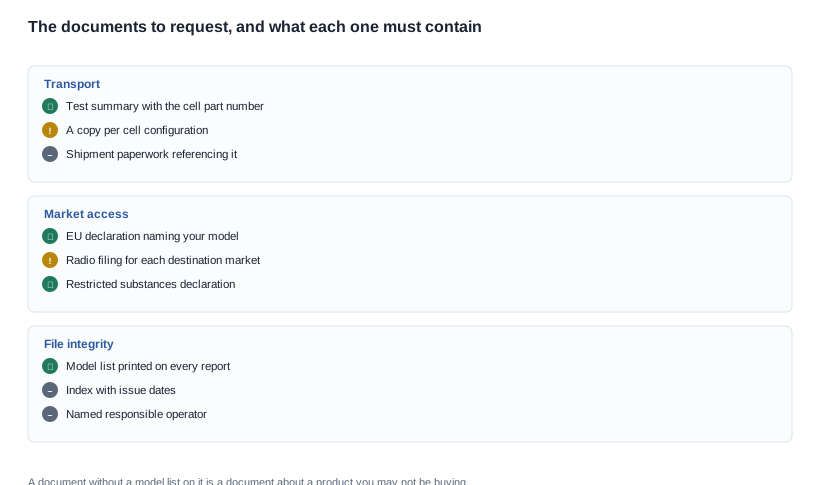
What to actually obtain, and what each document proves
Four documents, and they are different documents with different jobs.
- The test reports, with the standard, the laboratory name, the date, and the model list printed on the report. Check that your exact model designation appears. Family-level reports covering a variant are the most common finding in this category.
- The Declaration of Conformity for the European Union, naming your model and the directives it covers. Not a certificate number — CE has none.
- The battery test summary for transport, confirming the cell is covered, with the cell part number printed on it.
- A written statement of what the supplier can and cannot supply, so you know in advance whether a market you did not plan for is available.
The fourth document is the one buyers skip and the one that saves the most time, because it converts a series of surprises into a single conversation. For how long a certificate stays valid and what renewal involves, see how long a certificate is valid.

Model coverage: why one certificate does not carry to the next variant
A report that covers the platform but not your SKU tells you about the platform. If your product has a different cell, a different radio configuration or a different charging interface, the coverage may not extend to it. This is not a supplier failing to be honest — it is how the certification system works, and it is a verification step the buyer has to perform.
There are three specific reasons a document covering one model will not automatically cover another, and it is worth knowing which one you are dealing with before you assume coverage.
A different cell. The cell is a component with its own test evidence, and the transport summary is tied to a specific cell. A variant with a larger cell has a cell whose transport summary is a different document. This is the most common gap in this category, and it is also the one with the sharpest consequence, because it affects the shipment rather than the sale.
A different radio configuration. A change to the antenna, the radio module or the firmware that changes the radio behaviour can require a new conformity assessment even when the model designation is unchanged. The practical question to ask is whether the model designation on your purchase order and the model designation on the declaration are the same string.
A different charging interface. A Type C configuration and a magnetic configuration on the same platform are not the same product for a compliance file, and a declaration covering one does not carry to the other.
Our own catalogue's export-certification page carries ten patent certificates, eight appearance-design patents and two utility-model patents, and names no CE, FCC or RoHS marking, and the model-specific conformity documents have to be obtained in writing — and a patent certificate says nothing about the cell configuration, the UN 38.3 test summary or the charging interface that a compliance file does cover. That is exactly why we tell buyers to obtain the documentation rather than relying on a catalogue row: a catalogue row is not the document.
A related point on the published specification rows. The IP rating appears on only two models in the catalogue, the V06 and the S7, and the catalogue's export certification statement is a company-level capability rather than a per-model line. Neither can be converted into a per-model certification claim, and a buyer who tries will produce a specification that cannot be defended. Ask for the model list instead.
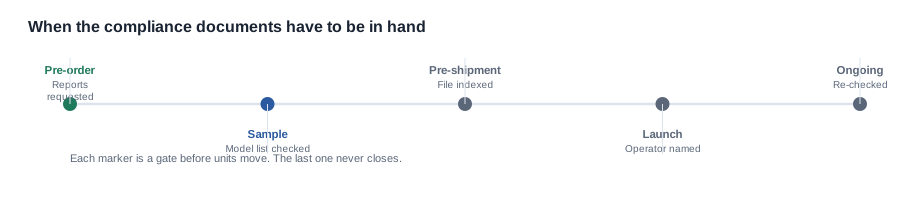

Building a compliance file a broker and a retailer can both use
The deliverable of this work is a single indexed file, and the indexing is what makes it useful to two different audiences who want different things from it.
A broker wants to know, for the consignment in front of them, which document covers which cell in which model, and whether it is present. A retailer wants to know, for the product on their platform, who the responsible economic operator is, what the declared compliance is, and where the supporting evidence sits. A brand's own compliance function wants the third thing: the model list on each document, so that it can confirm the file covers what it claims to cover.
Six steps produce that file, and they are deliberately in this order.
- List the models and the variants. The variant list is what everything else is checked against, and it is the step most often left until the end.
- Match each model to its reports. Each cell configuration, each radio configuration and each interface separately, because that is how the evidence is structured.
- Check the model list printed on every report. This is where most files fail, and it is the cheapest step to do.
- Name the responsible economic operator. One name, one address, one role, consistent across every document and every market.
- Assemble the file with an index. One page listing every document, what it covers, its date and who issued it.
- Re-check before every market launch. A file is a live document, because models are added, suppliers change and certificates are re-issued.
The two stacks most often confused are the transport summary and the market-access declaration, and the chart below is the one we put on the wall. They fail in different places, at different times, and to different people, which is why a file that covers both still needs to cover them separately.
The re-check cycle, and the three changes that break a file
A compliance file is not a document you assemble once. It is a living index that has to be re-checked, because three changes invalidate it more often than anything else does, and none of them announces itself.
A new model or variant. Every new model designation added to the programme has to be checked against the model list on every document, and the check has to be recorded. This is the most common reason a file goes stale, because variants are added continuously during a programme's life and the file is usually assembled once at the start.
A cell or component substitution. A new cell means a new transport summary, a new cell part number and a new entry in the technical file. This is where the substitution clause written into the purchase order pays for itself, because a written notification obligation gives you the trigger event rather than leaving you to find out from a carrier.
A supplier or a legal entity change. If the manufacturer changes, the Declaration of Conformity changes with it, because it is issued by the manufacturer. This is the change that most often happens without anyone noticing, because a price change and a supplier change frequently arrive in the same email.
The three checks are simple enough to run on a fixed cycle, and the useful discipline is to attach the check to something that already happens — a new order, a new variant, a market launch — rather than to a calendar reminder that nobody owns. A file that is only checked when something changes is a file that is checked.
What our catalogue claims and what it does not prove
Concretely, we will state which certifications are claimed in our catalogue and be explicit that no certificate numbers, issuing bodies or validity dates are published to us. We will not present a claim as a certificate, and we will not tell you a certificate covers your model without seeing the model list on the document.
That is a deliberately narrow position, and it is worth explaining why it is the right one for a buyer. A certificate number quoted from a catalogue is a number nobody at that supplier can necessarily produce either, and a buyer who has built a technical file around it will find at the worst possible moment that the document does not exist. An honest gap, by contrast, can be planned around: you know which document to request, you know from whom, and you know that its absence is a fact rather than a suspicion.
We will also say plainly what is not ours to decide. The obligation to place a compliant product on a market sits with the party placing it there, not with the factory that assembled it, and the regulatory treatment follows from the functionality and from the wording rather than from the price. A buyer who wants to know who carries that obligation in their particular structure should settle it with their own legal function before the first order, not at the port.
Tell us the markets you intend to sell into and we will tell you what the compliance scope is likely to involve, and which parts of it you will need to obtain yourself.
Related reading
Tell us the markets and we will say what compliance scope to expect and which documents you must obtain.


