

A smart glasses unit can connect perfectly to a phone and still deliver less runtime than the catalogue claims, because the radio stack, the host operating system and the charging hardware already sitting in the channel all draw from the same cell. Connection is the easy part of compatibility; the expensive part is what the connection costs in hours. This article treats battery compatibility as a charge-budget question rather than a link question, and it sets out four axes that a buyer can actually check: the radio stack, the host operating system, the charging hardware in the field, and the devices already deployed. It does not cover how to choose a model — that is the selection stage, and the buying guidance for this range handles it — and it does not cover the operating rules after the units arrive. What it covers is the set of checks that establish whether a unit will perform at its published rating in the environment it is actually going into.
Smart glasses battery life: a compatibility question is a runtime question
The word compatibility is doing too much work in this category. A buyer who treats it as a binary — it connects or it does not — will sign off a product that meets its specification in the laboratory and misses it in the field, and the miss will be attributed to the cell. That is the wrong attribution, and it is expensive, because the factory cannot fix what the host operating system is doing to the connection.
Three separate things can happen when a unit is introduced into an environment it was not tested in. It can fail to connect at all, which is obvious and cheap to discover. It can connect and draw more current than it did in the laboratory, because the host keeps the radio bus active, or because a background service polls the accessory, or because the host's own power management holds a link it does not need. And it can connect and draw exactly what it did in the laboratory, but the charging hardware around it cannot keep up, so the operator ends the shift with less charge than the rating promised. Only the first of these is what most people mean by compatibility.
This distinction is why the battery category needs its own compatibility treatment. The published runtime on any model in this range is a rating produced under one stated set of conditions. The cell capacity is published per model. The charging interface is published on the twenty-four rows that carry one, and the capacity of the charging case is published where the catalogue states one. What is not published, for any model, is the drain attributable to a particular host combination, the time to complete a charge on a particular dock, or the top-up count a case delivers when the units in the channel were not made for it.
So the compatibility work a buyer has to do is bounded and specific. Four axes, each with a threshold, each producing a record, and each owned by a different side of the business:
- The radio stack, checked against the published version on the catalogue row, owned by the product engineer.
- The host operating system, checked on the build the order names, owned by the software lead and the pilot team.
- The charging hardware in the field, measured on the docks and cases already installed, owned by the facilities or operations team.
- The fleet already deployed, recorded as a composition note, owned by the brand.
None of them is expensive to check once the method is written down, and all four of them are expensive to discover after a launch.
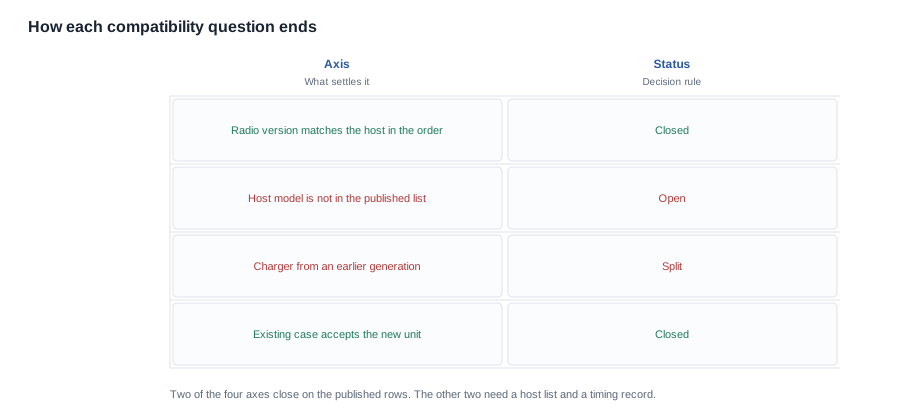
The matrix above shows how each of the four axes ends. Two of them close against published rows alone. Two of them require a host list and a timing record, and those two are where the commercial exposure sits, because they are the axes on which a buyer's environment rather than the factory's product decides the outcome.

The radio link and the standby drain it creates on battery
The radio is the largest controllable load in a smart glasses unit, and it is the load that a compatibility check is usually aimed at. It is also the load that most often gets checked only for version compatibility and not for what it does to the charge budget.
The published version is a floor, not a guarantee
Our catalogue publishes a Bluetooth version for the rows where one is published, and the audio models carry version 5.3 or 5.4 depending on the model. The camera models, which include the eleven rows with a camera, do not have a Bluetooth version published on their catalogue row, and the honest line for those rows is that the version is not published rather than a number copied from an audio row. The children's protection models A05 and A06 carry no published version either.
A published version is the minimum a buyer can rely on when writing a host requirement. It is not a guarantee that the unit will connect to every host, because host support is a property of the host as much as of the accessory, and it is not a guarantee about drain, because the version number describes the radio standard in use rather than the profile, the codec and the connection-maintenance behaviour that the unit is running.
The practical consequence is that a version comparison settles a screening question — can this unit go on the shortlist at all — and nothing beyond it. A buyer who treats the published version as the compatibility answer has answered a question that was never the expensive one. The questions that do matter are the ones a supplier can answer in writing if you ask them in the right form: what radio qualification the unit was tested against, what the factory's own host list is, and what the connection records for the models already in production read like. A factory that holds that evidence produces it in a day; a factory that does not hold it will produce an estimate instead, and the estimate is what arrives on your site.
Connection maintenance, and the drain nobody measures
The load that compatibility quietly adds is not the data transfer. It is the maintenance of the link itself: the interval at which the unit and the host check in with each other, the behaviour when the host moves between networks or when the unit drifts out of range and back, and the behaviour of a host that keeps a link alive for a peripheral it is not currently using. Each of these adds a small amount of current, and the amount is a function of the host rather than of the accessory.
This is why the drain has to be measured on the host that the order names. A unit measured against one host and then deployed against another has an unquantified load difference, and there is no published figure anywhere in the category that closes that gap on your behalf. The measurement itself is simple: run the unit on the named host for a stated period with the stated features active, and compare the result against the same run on the reference host used for the published rating.

The order of the checks in the flow above is deliberate. The host list comes first because a check run against a list nobody agreed is not evidence, and the radio version comparison comes second because it is the cheapest screen and it removes candidates before any time is spent on them.
The host operating system and what it takes out of the charge budget
The host is the part of the compatibility picture that moves. A radio standard is fixed when the unit is designed; a phone operating system is revised every few weeks, and the revision is the point at which a previously working configuration can start to behave differently.
Background radio behaviour on the named host
The mechanism that matters is specific and testable. On any given host, the accessory may or may not be polled by a background service, may or may not be included in the host's own power-saving rules, and may or may not be given a connected slot that the host re-establishes whenever it wakes. Each of those three behaviours changes the average current draw, and each of them is a property of the host build rather than of the unit.
The test is therefore not a connectivity test. It is a charge test run on the specific host build, with the operating system configured the way the end customer's device will be configured, and with the background behaviour left alone rather than tuned out. A pilot in which every test unit is on a developer build with developer settings applied will produce a number that no customer will reproduce, and the gap between the two is indistinguishable from a cell fault once the units are in the field.
The operating system build and the pilot window
The second decision is which build the pilot runs on and how long it stays there. A pilot that pins a build for its duration and names the build in the test record produces evidence. A pilot that tracks the latest release produces a moving target and produces no evidence at all, because there is no fixed configuration against which a later claim can be assessed.
Where the programme is large enough to justify it, the sound approach is to name one build as the qualification build and to state a rule for what happens when the host releases a new one. That rule is a decision to make before the first shipment rather than during the first complaint: whether a new build triggers a re-test, and what a re-test costs in schedule. The battery side of that rule is a runtime re-test under the same written condition used in the acceptance procedure, because a build that changes the charge behaviour changes the thing you are certifying.
The compatibility record has to carry three fields for the host: the model, the build number, and the date the connection was verified. Without the build number the record cannot be reproduced, and a record that cannot be reproduced is an anecdote.
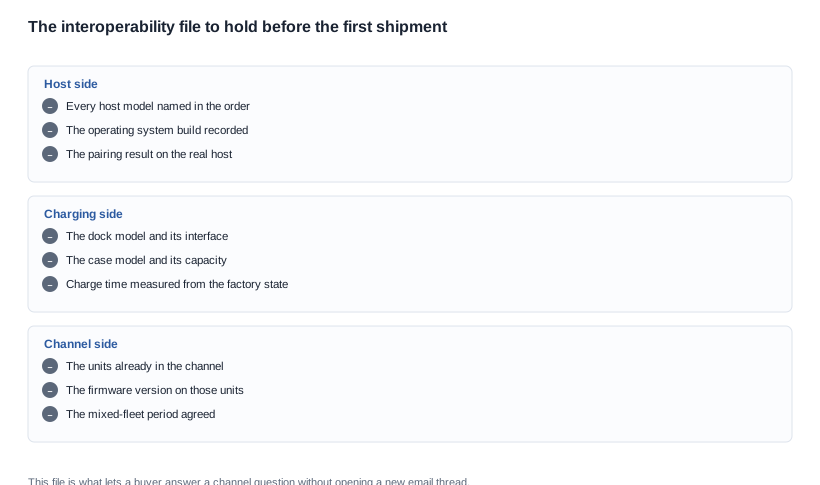
The checklist above is the file, and it is organised by who owns the answer. The host side is verified by your own team, the charging side by whoever owns the docks in the field, and the channel side by a single note recording the fleet that exists today. Those three answers are what a buyer needs when a distributor asks whether the new units work with what they already own.

The charging hardware already in the channel and its battery effect
The fourth axis is the one that most often invalidates a compatibility assumption, because it involves hardware the buyer did not choose and cannot easily replace. The docks and the cases in the field were bought for an earlier generation of products, and the units arriving now have to work with them.
The dock that is already on the shelf
Compatibility with an existing dock is not a question of whether the connector mates. It is a question of how long the charge takes on that dock, and therefore of how the operating pattern has to be arranged around it. A dock that completes a full charge in ninety minutes and a dock that completes it in three hours produce entirely different shift routines from the same units, and the difference falls directly on the runtime budget that the catalogue rating describes.
Two further questions belong here and both are common. The first is whether the dock charges a unit while the unit is running, which determines whether a docked unit is actually available or merely present. The second is whether the dock in the field is the one the units were qualified against, because a dock with the same connector and a different charge profile is a different accessory. The published charging interface on each row that carries one — the magnetic contact on most rows and the wired Type-C connector on a smaller set — tells you what the unit accepts, but it does not tell you how fast any particular dock delivers.
The case and the declared top-up count
Where the model carries a charging case, the compatibility question becomes a capacity question. The catalogue publishes the case capacity where it is published: 1400 mAh on the CY03 and the CY05, and the L1 Pro, 900 mAh or 1400 mAh on the L2 Utral depending on which case is selected, and 1200 mAh on the folding case of the MT6. Two further models carry a case whose capacity is not published, and one camera model has no charging-case row.
The number that matters commercially is not the case capacity but the top-up count, because the top-up count is what the operating instruction has to be built on. A case of 1400 mAh against a unit with a 290 mAh cell produces a theoretical count, and the practical count is lower because the case does not transfer all of its charge and because the unit does not accept a full charge every time. Where the count has not been measured on the actual units, it has to be measured before the case goes into the box as a routine part of the working day.
A compatibility question on the case therefore has a hard answer and a soft answer. The hard answer is whether the case in the channel accepts the unit at all, mechanically and electrically. The soft answer is how many top-ups it delivers, and that number is the one that determines whether the shift works.
There is a commercial question underneath both, and it should be raised with the supplier before the order rather than discovered afterwards. Accessories have their own minimum order quantity, their own tooling, their own lead time and their own packaging specification, and a case bought separately at a small quantity is priced on a different basis from a case shipped in the box with the units. Where the programme intends to sell the case as a standalone item, the quotation has to carry that case as a separate line with its own unit price, its own compliance file and its own quality control rather than as an accessory that appears for free in the box contents. The same applies to a dock: a dock that your customers have to buy separately changes the landed cost of the programme whether or not it appears on the product page.
Thresholds that close each of the four compatibility axes
A compatibility check without a threshold produces a feeling rather than a decision, and feelings do not survive a quarterly review. Each of the four axes needs a number, a method and a record, and the table below sets them out.
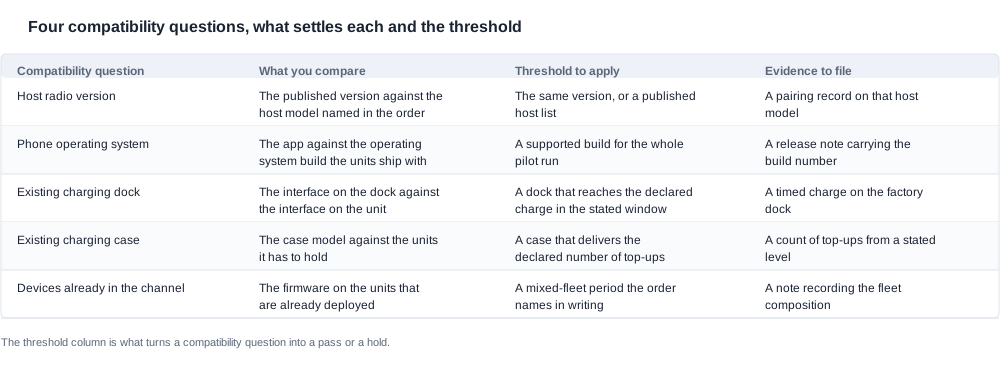
Each row names what you compare, the threshold that applies, and the evidence to file. Two observations about the table are worth making directly. The first is that only two of the five questions can be closed against published data; the other three need a host list, a build number or a timing record, which is why the interoperability file exists as a separate artefact rather than as a line in a specification sheet.
The second is that the threshold on the charging dock is the one most likely to be set informally. If the dock in the field charges a unit more slowly than the operating pattern allows, the units will not reach a usable state between shifts and the workaround will be to carry more spare units than the plan assumed. That workaround is a real cost and it belongs in the compatibility decision rather than in a site report six months later.
A note on what these rows cannot settle. None of them tells you which model to choose, and none of them changes the published rating for a model. The rating is a property of the unit; compatibility determines what happens to that rating in your environment. Two ranges can be perfectly compatible and still be the wrong range for a programme, and the criteria that decide that are covered in the buying guidance for this range, with the charging interface decisions set out under charging solutions.
The interoperability file, and what we will not answer about compatibility
The interoperability file is the deliverable. It is a folder rather than a document: the host list, the connection records against named builds, the charge timings on the docks in the field, the top-up counts on the cases, and the note recording the fleet already deployed. Each entry carries a date and a person, and the file is kept somewhere other than one person's machine.
It also belongs next to the rest of the technical file for the programme, because a distributor or an importer will eventually ask for the evidence behind the product rather than for the product itself. Where a market requires a radio conformity assessment or a battery transport document, the file is what shows that the unit you shipped is the unit that was assessed. A supplier who produces that file on request has a mature quality control system; a supplier who cannot produce it has a packaging routine, and the difference between the two is worth more than the unit price difference between their quotations.
On compatibility, a narrow one and we will state it plainly. We publish the charging interface for the twenty-four models that carry one, the Bluetooth version for the rows where the catalogue publishes one, the cell capacity, the rated runtime, and the case capacity where the catalogue states one. We do not publish a drain figure for any host combination, a measured charge time on the dock you intend to install, or a top-up count for any case, and we will not quote a typical figure for any of those, because a typical figure is one you cannot verify and one that will be quoted back at you as though we had measured it. The published charge time is a reference figure from the factory setup, not a figure for your dock.
What we will do is narrow a compatibility question down to the two or three checks that will actually close it. Send us the models you are considering, the host devices your customers use, the docks and cases already in your channel, and the markets you are shipping into, and we will tell you which of the four axes is the one that decides your programme and which figures you will have to measure yourself. The runtime measurement method is set out under smart glasses battery life and power, the charge-handling rules that follow delivery are covered in battery life common mistakes, and the rows to request before you commit are in the battery buying checklist.
Before you order, the sensible order of work is short. Write the host list down first, because it is the only input that changes the answer and it is the one that takes longest to obtain. Then screen the models against the published versions, which is free. Then measure the dock and the case, which is a day of work and settles the operating pattern for the whole programme. The compatibility question that remains after those three steps is usually not a technical one at all, and it should be settled as a commercial decision rather than as a laboratory project.


