

A battery buying checklist for smart glasses looks redundant, because the battery row is the one row every supplier publishes. What the checklist actually does is check whether the published row is usable, and that is a different job entirely. It is also a different job from what happens after the goods arrive: this checklist is entirely about the selection stage, and it ends when a candidate model enters the shortlist.
The published data across this range is a good illustration of why. Runtime figures run from roughly five to eight hours in the camera tier, six to eight hours on several camera models, roughly six to eight hours in the audio tier and roughly twenty hours in the children's tier. Cell configurations run at 40 mAh on the A05 and the A06, 55 mAh × 2 on the LC-105 pair, the G07 and the YK12, 70 mAh on the A07, 90 mAh × 2 on the K01 and the K02, 100 mAh on the D11 and the D12, 115 mAh on the D17, 220 mAh on the V03 and the V03 Pro, and the MT5, 260 mAh on the V06 and the S7, and the KY06, 265 mAh on the MT6 and 290 mAh on the CY05 and the L2 Utral, and the L1 Pro and the CY03. Among the sport models, the YKC02 runs 70 mAh × 2, the D17 115 mAh and the ZH12 a single 100 mAh cell. Every one of those figures is stated without a test condition.
So smart glasses battery life smart glasses buying checklist is a checklist for the things the row does not say, applied to the selection stage only.
Smart glasses battery life: the selection stage ends at the shortlist
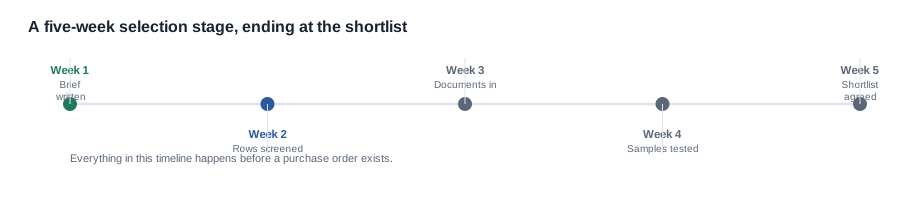
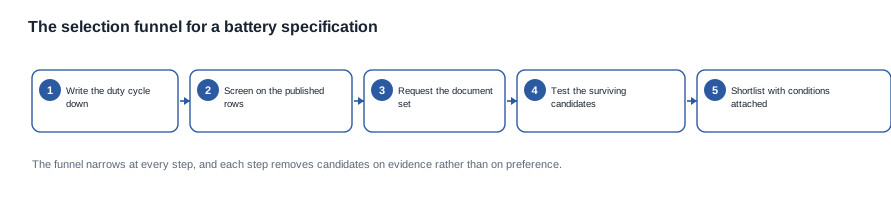
Before the first gate, it is worth being precise about where this exercise stops, because a battery programme has at least two more stages after it and the documents differ completely. The selection stage is the part before a purchase order exists: defining the requirement, screening candidate models on published rows, collecting the documents that make those rows usable, and deciding which candidates enter the shortlist. Everything after that — what happens to a consignment when it arrives — is a separate exercise with a separate set of papers and is deliberately not covered here.
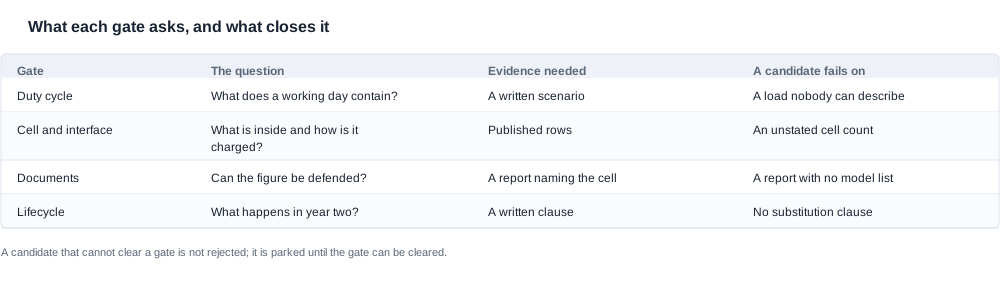
Knowing where the boundary sits changes how the checklist is used. In the selection stage, a candidate is not "good" or "bad"; it is cleared or not cleared, and a candidate that cannot be cleared on a gate is parked rather than rejected, because the gate may close later. This is the difference between a screening tool and an inspection tool, and confusing the two produces checklists that are either uselessly vague or inappropriately final.
The output of the selection stage is a shortlist sheet, and the shortlist sheet has a specific shape. It names each candidate model, it states which gates that candidate cleared, it lists the gates still open with a named owner for each, and it carries the requirement the candidates were screened against. A shortlist without the open gates on it is not a shortlist; it is a preference list, and the difference becomes obvious the first time a supplier asks you to confirm that you are accepting a configuration with a documented limitation.

Gate one: the duty cycle your product actually creates
This is the gate most often skipped and the one that determines whether every later number is relevant. Until the load is written down, a runtime figure cannot be compared, a cell cannot be selected, and a supplier cannot be asked a question whose answer would be useful.
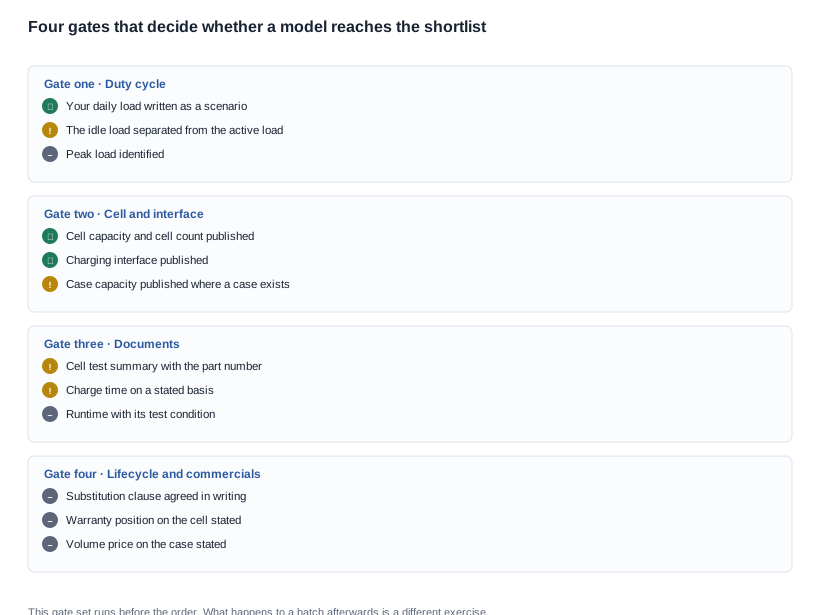
Write the duty cycle as a scenario, not as a duration. Not "six hours of use" but "a field technician who captures intermittently through a two-hour site visit, with the device paired to a phone for most of it". The second version tells a supplier what to measure, tells an engineer what to design for, and tells a buyer what to test later. The first version only tells you how long somebody might need the device to last.
Separate the idle load from the active load. In this category the two are far apart. A device that is paired and idle draws a different amount than one that is capturing, and the published runtimes are mixed-use figures that do not say how the mix was constructed. Ask the supplier to split them, because the split decides whether a model with two small cells serves your use case better than one with a single large cell.
Identify the peak. The peak is the moment the device is asked for the most: a burst of capture, a call at the end of a long session, a translation request while the radio is already working. A requirement written around the average will fail at the peak, and the peak is what a customer remembers.
Turn the scenario into a requirement in hours. The requirement is a number with the scenario attached, and it is the number every subsequent comparison uses. If you cannot convert the scenario into a requirement, that is a product decision that has not been made, and no supplier can answer it for you.
Ask what to ask. The question to put to a supplier in writing is: given a duty cycle of this description, what runtime do you measure for this model, and under what conditions? A supplier who answers with a figure and a condition has given you a usable answer. A supplier who answers with the catalogue figure has given you a figure with no condition attached, and the difference is the gate.
Gate two: the cell and interface rows that have to be quotable
Gate two is about the rows that determine what the product physically is, and about the two architecture questions that quietly change everything downstream.
Cell configuration has to include the cell count, not just the capacity. The dual-cell arrangements in this range are real and common: 55 mAh × 2 on the G07 and the LC-105-1, and the LC-105-2 and the YK12, 70 mAh × 2 on the YKC02, and 90 mAh × 2 on the K01 and the K02. A 90 mAh × 2 model and a 90 mAh single-cell model are different products with different transport documentation, different failure behaviour and different service economics. A comparison sheet that reduces both to "90 mAh" has lost the only number that mattered.
The charging interface has to be quotable. The range splits between magnetic charging and Type C: magnetic on the majority of the models, Type C on the V03 Pro, the L2 Utral, the D11, the D12, the D17, the ZH12 and the bone conduction entry, with the L2 Utral row also listing a 900 or 1400 mAh case option. This row determines what goes in the box, what the customer has to keep, and what a customer who buys a third-party charger experiences.
The case capacity has to be quotable where a case exists. The published case capacities are 1400 mAh on the CY05 and the CY03, and the L1 Pro, 900 mAh or 1400 mAh on the L2 Utral and 1200 mAh in the foldable case on the MT6. The KY06 and the MT5 ship with a case whose capacity is not published, and the V03 Pro has no case. A case with an unstated capacity is an open gate, because it changes the customer's day and the landed cost at the same time.
The charge time should be published on a basis. Two hours or less across nearly the whole range, with around one hour on the D17 and the ZH12. Ask on what basis it is measured and from what state, because a charge time from an empty cell is a different commitment from one from a partial charge.
One protection row deserves attention at selection. The IP rating appears on only two models in the catalogue, the V06 and the S7. It is easy to read a category-level impression from a catalogue that mentions protection elsewhere, and it is exactly the kind of inference that turns into a claim. If your application needs a rating, the model list is the thing to check, and a model without one is a model you cannot describe as protected.
Two questions about the cell count that belong at selection. The first is what happens when one cell of a pair fails. A single-cell product with a failed cell is a dead product, while a dual-cell product with one failed cell may degrade rather than stop, and the difference determines whether the failure presents to the customer as a defect or as a shortened runtime. The second is how a pair is handled in the transport file, because two cells travelling together are documented differently from one cell in a single-cell product. Neither answer is published for any model in this range, and both belong on the shortlist as open items rather than being inferred from the capacity figure.
One question about the interface that only matters at volume. A magnetic interface that has to be reworked later is a tooling change and a certification question, while a Type C interface is a commodity. If your volume is uncertain and the configuration might change, the standard interface buys an option that the proprietary one does not. If your volume is certain and the configuration is fixed, the reverse is often true, because the proprietary interface supports a branded accessory business and a docking story that a standard port does not. Neither answer is universal, and the question to put to a supplier is which interface the existing tooling is already set up for.
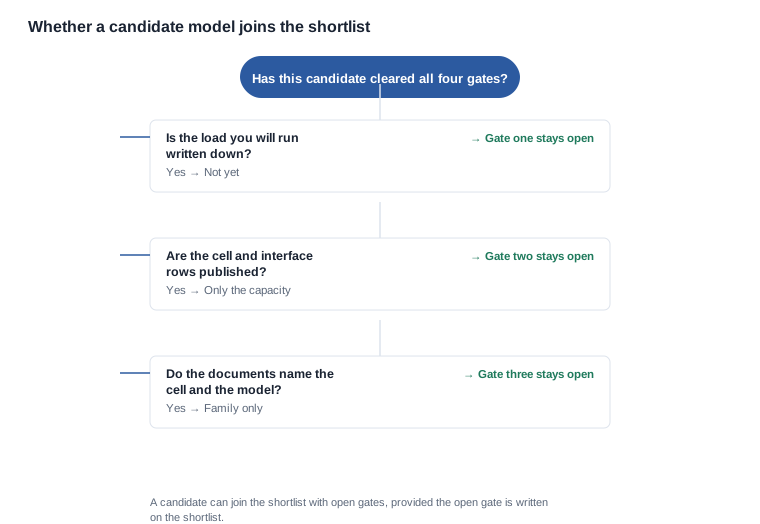

Gate three: the documents that make a runtime figure usable
A runtime figure is not a specification until it has a condition, and the condition usually arrives in a document rather than in a reply. These are the documents to request at selection, with the reason each one is needed.
- The cell test summary, with the cell part number on it. The transport test summary covers a specific cell, so a substitution invalidates it even when the finished product is unchanged. This is why the part number belongs in the file and not merely the capacity.
- The Declaration of Conformity for the target market. In the European Union this is a manufacturer self-declaration covering the applicable directives, and there is no CE certificate number because CE is not issued by an authority. The document that matters names your model.
- A statement of what the supplier can and cannot supply. A written answer prevents the discovery, later, that a market you had not planned for is not covered by the documentation you hold.
- The cell chemistry and the cycle life, if they exist. Both are absent from our published rows for every model, and asking is worthwhile because a supplier who holds them will send them and a supplier who does not will say so.
- The test condition behind the runtime figure. Not the figure — the condition. If the supplier has one, ask for it. If the answer is that the figure was measured under mixed use, record that and treat the figure as conditional for the rest of the programme.
The battery transport compliance material covers the transport obligations that apply to every model in the range, and the how to compare battery life discussion sets out the comparison basis these documents support. A candidate whose documents cover a family rather than a model designation belongs on the sheet with that gap named, because a family-level report is the most common finding in this category and it is the one a buyer is most likely to overlook on a busy week.

Gate four: the lifecycle and commercial terms that filter a shortlist
The last gate is where the candidates that survive the technical screen are separated from each other, and it is the gate that most often gets skipped because it is the least technical and the most consequential.
The substitution clause. Ask whether the supplier will state the cell part number on the file and notify in writing before any substitution. The second half is the one that matters, and a supplier who agrees to the first but not the second has not agreed to anything, because the notification is what makes the part number usable.
The warranty position on the cell. Whether the cell is covered by the product warranty, whether it has a separate treatment, and what the position is on a unit that fails because of an aged cell rather than a fault. In this category that answer is not published for any model, and it is the kind of answer that becomes a customer complaint when it is absent.
The volume price on the case. A case raises the achievable basket value and adds packaging volume, shipping weight and a failure surface. Pricing the glasses and discovering the case later is the single most common way the landed cost of a battery programme exceeds its plan.
The commercial basics. Minimum order quantity, lead time, payment structure, and whether tooling or NRE applies to the configuration you are selecting. These are ordinary commercial terms, but a candidate that only clears the technical screen and then turns out to require a tooling commitment at a volume you cannot justify is not a candidate that cleared gate four.
What to ask. The questions to put to each candidate are the same four, which keeps the comparison honest: what is the cell part number and what happens on substitution, what is the warranty position on the cell, what is the price of the case at the planned volume, and what is the lead time on the configuration rather than on the model. A supplier who answers all four has told you enough to build a shortlist sheet.
What can still be negotiated at this stage. The terms a shortlist stage has the most room on are the ones that depend on the volume you eventually commit to rather than on the product itself. The price tier at your planned volume, the minimum order quantity across configurations rather than per configuration, the payment structure, and the retention held against the documentation package are all still open while the order is still theoretical. The terms that are already fixed are the ones that follow from the design: the tooling cost, the certification cost and the elapsed time of the test laboratory. A buyer who knows which is which can negotiate hard on the first group without wasting credibility on the second, and a buyer who treats all of them as negotiable tends to end up paying for a delay in the second group.
What a candidate carries forward, and what our own rows can clear
The shortlist sheet is the deliverable of the selection stage, and it should have four columns that correspond to the four gates. Each candidate model appears as a row, and each cell contains either a cleared result or an open item with a named owner and a date.
The requirement column holds the duty-cycle scenario and the runtime requirement derived from it, so that every candidate is judged against the same yardstick.
The hardware column holds the cell configuration including the cell count, the interface, the case capacity and the charge time, with the source document named for each.
The evidence column holds what has arrived and what has not: the report received, the report requested, the model list checked, the part number confirmed.
The open items column holds the gaps with an owner and a date, and it is the column that makes the sheet useful later. A shortlist sheet with the open items on it is the artefact you take into the next stage, and it is also the artefact that stops the same questions being asked from scratch in six months.
Two rules keep the sheet honest. A candidate never leaves the sheet with a blank cell; an unasked question is written down as an open item rather than left empty, because a blank reads as "not applicable" and an open item reads as "we know". And every cleared result carries the document that cleared it, because a clearance without a source is an opinion that will not survive the next conversation with the supplier.
The battery key specifications piece sets out which published rows to prioritise, and the measurement methods behind the figures are set out under battery life and power.
Where our own rows stop short of clearing a gate
Concretely, we publish the electrical rows as the catalogue holds them — the cell configurations, the runtime figures, the charging methods, the charge times and the case capacities — and we will not treat a mixed-use figure as though it were a continuous-use one, because every check in this list is applied to a figure, and a figure whose load was changed on the way to the listing cannot be checked at all.
Several of these checks will end in a blank, and a blank is a legitimate result. We will not publish a runtime for a condition we have not measured, and we will not fill the cell report and the protection rows with typical values from other products, so where the supplier has no measurement the honest entry on a checklist is "not published", and the line stays open until the evidence arrives rather than being closed with a plausible number.
We will also say plainly that a buyer-run test on a fixed protocol across a sample from the production batch is worth more than the catalogue figure, because it is a measurement of your units under your conditions. Record the protocol and the result is comparable; skip it and it is not.
Related reading
- Battery transport compliance
- Battery key specifications
- Battery life and power
- How to compare battery life
Tell us the load profile your users create and we will say which of these checks are already answered for you.


