
The mistakes that cost a buyer money in this category rarely happen at the moment of purchase. They happen in the weeks after delivery, in the stores and the warehouses and the sites where the units are actually charged, handled and left standing overnight. A unit that was specified correctly, built correctly and shipped correctly can still deliver half of its published runtime within a month, and the factory will be the first person blamed for it. This article is about those post-delivery errors: the six that recur most often, the evidence each one leaves behind, and the operating instruction that removes them. It is not about the errors of selection — choosing the wrong model, reading the wrong row, signing the wrong order — because those are made once, before the goods exist, and they are covered in the separate buying guidance for this range.
Smart glasses battery life: six errors that appear after shipment
The distinction that separates a technical fault from a handling fault is simple and it is worth stating at the outset: a technical fault is present in the product when it leaves the factory, and a handling fault is introduced afterwards. The first is settled by the production record and the test data. The second is settled by the operating procedure, the storage conditions and the charge routine. Mixing the two up is the most expensive mistake in this list, because it sends a claim to the wrong party and leaves the real cause in place.
There is a structural reason why these errors cluster after delivery. The unit is designed, assembled, calibrated and tested inside one organisation, under controlled conditions, with people whose entire job is to get that right. After the carton is sealed, the unit passes to a distribution network, a retail chain, a warehouse and eventually a site, in each of which the handling is incidental to somebody else's main job. Nobody in that chain is instructed to protect a cell. Somebody has to instruct them, and in most programmes nobody does.
That is why the errors below are described the way they are. Each one names the operating habit that causes it, the physical mechanism behind it, the way it appears in the data that eventually reaches you, and the specific clause that prevents it. The clauses are deliberately short enough to be lifted directly into an operating instruction, a distribution agreement or a supplier quality annex.
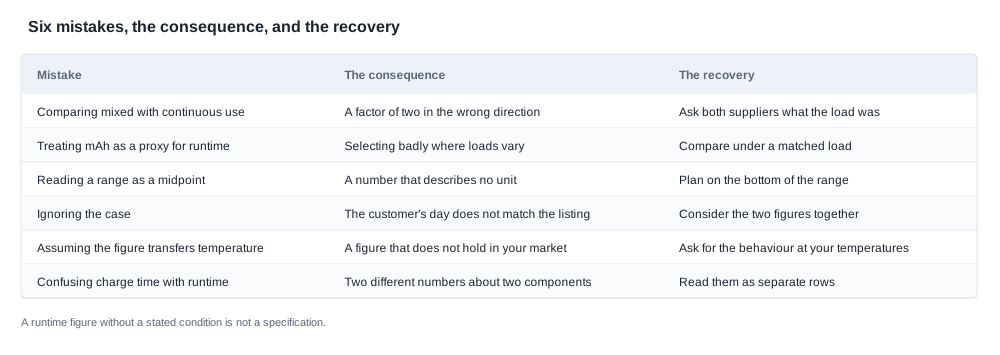
Three of the six are charge-handling errors and three are storage and transit errors. Two further misreadings are covered separately at the end, because they are errors of interpretation rather than of handling — the units are fine, but the data has been read wrongly, and the cost of that misreading is a claim against a supplier who did nothing wrong.
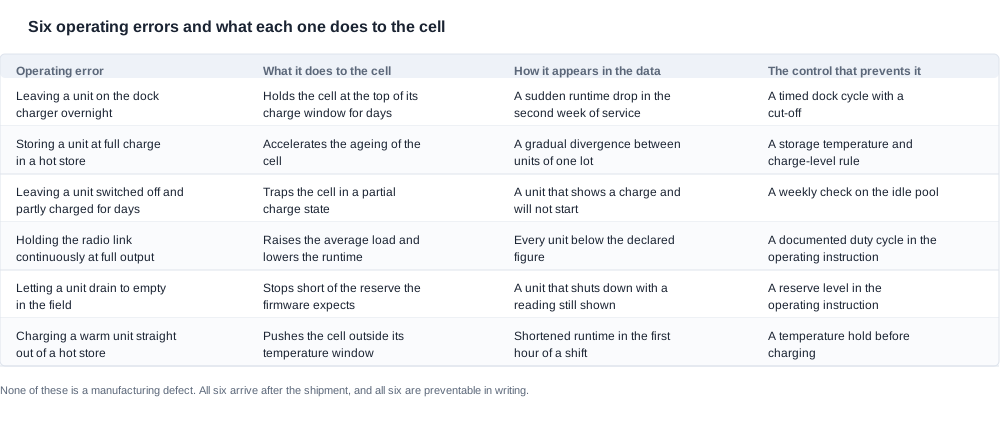
The table is the summary. The sections below give the mechanism and the control for each error, because the control is the part that goes into the operating instruction and the table is the part that goes into a supplier conversation.

Charge handling: the three errors that shorten a cell fastest
A lithium cell in a head-mounted unit is a component with a working envelope, and the three errors below are the ways a fleet operation walks a unit out of that envelope without anybody noticing on the day it happens. None of them produces a visible fault. All three of them produce a gradual shortfall that only shows up weeks later, which is exactly what makes them hard to attribute.
Leaving a unit on the dock across a weekend
A charging dock with no cut-off holds a cell at the top of its charge window indefinitely. For a weekend that is three days at high state of charge; for a unit in a retail back room it can be a month. The cell is not damaged in the way a deep discharge would damage it, but it is held in the condition that accelerates ageing the fastest, and the damage compounds over the life of the unit rather than showing up immediately.
The way it appears in the data is a sharp step rather than a slope. Units that were cycled through the dock in a working week and units that sat on the dock over the weekend will diverge from each other within a fortnight, and the divergence reads like a batch problem to anyone who has not been told what happened at the dock. A factory investigating that batch will find nothing wrong with the build, because nothing is wrong with the build.
The control is unglamorous and effective: a timed dock cycle with an automatic cut-off, and a rule that no unit is left connected across a weekend. Both belong in the operating instruction and both have to be verified at the site, because a dock that ships with a timer that the site staff do not know about is exactly the same as a dock with no timer.
Charging a warm unit straight out of a hot store
Temperature is the second half of the cell's working envelope, and it is the half that operations teams tend to leave unaddressed, because the store temperature feels normal to the people working in it. A unit that comes off a warm shelf and goes straight onto a charger is being charged at a cell temperature that is outside the range the cell was qualified for, and the charge acceptance will be reduced. The unit reaches a lower charge than the indicator implies, and the first shift of the day starts short.
The signal in the data is time-of-day. If the shortfalls cluster in the units that are issued at the start of a shift rather than in the units that have been running for an hour, the cause is a charge temperature, not a capacity problem. This is worth writing down because it is a pattern that is easy to see and easy to misattribute.
The control is a temperature hold before charging: units acclimatised at the charging point for a stated period rather than carried in from the store and connected immediately. Where the site is hot enough for this to matter, the hold period is worth writing into the instruction as a number rather than as a principle.
Leaving a partly charged unit idle for days
The third charge error is the quietest. A unit that is switched off at a partial charge and left in a drawer or on a shelf for several days does not simply sit there; depending on the cell and on the temperature, it drifts down, and on some designs it drifts down to a point where the charge controller will not start the unit when it is switched on again. The visible symptom is a unit that reports a charge and will not power up, and the usual reaction is that the unit is faulty.
This error is also the easiest to detect, because it produces a discrete failure rather than a gradual one. The control is a weekly sweep of the idle pool: every unit that is not in service gets checked, and any unit that will not start is put on charge rather than being written off. A weekly sweep costs minutes. A written-off unit costs the unit, and it costs the argument with the factory when the factory asks for the data.

The flow above shows how a single routine turns into a fleet-wide pattern. The important observation is at the bottom of it: by the time the runtime falls below the published figure, the cause is weeks in the past and the routine that caused it is not connected to the claim in anyone's mind. That is why the fix is preventive and written down, rather than a conversation at the end of the year.

Storage and transit: the errors that damage a battery lot before anyone opens it
Storage errors are the ones that damage a whole consignment at once, which makes them both more expensive and more visible. A single unit that is mishandled is an isolated problem. A pallet of two thousand units that spends a week at a high charge level in a warm warehouse is a lot-level problem, and the factory is the only party that can explain it — except that the factory cannot, because the condition was created after the units left.
Full charge plus heat, held for a week
The combination is what matters. A cell held at a high state of charge ages faster than one held at a lower state, and it ages faster in a warm environment than in a cool one. The two effects multiply. A consignment that is charged, boxed and then held in a warm warehouse for a week carries both at once, and the units that come out of it will be measurably weaker than the units that came out of the same production window a fortnight earlier.
There is a published figure in this range that makes the point in a way buyers often miss. The children's models on the catalogue publish a runtime of around twenty hours on 40 to 70 mAh cells, which is a very high ratio of runtime to capacity and therefore a very sensitive platform. A high-runtime cell is a cell with a thin margin for storage abuse, and the models that appear the most forgiving on the catalogue are often the least forgiving in a warehouse.
The control is a storage rule written with two numbers in it: a temperature band and a charge level. Not "store in a cool place" but a band the warehouse can hold and a level the receiving team can verify. Where the site cannot hold the band, the answer is a shorter stock period, not a better-intentioned instruction.
The condition of arrival is not the condition of the sale
The second storage error is a documentation failure rather than a physical one, and it is the one most likely to turn into a dispute. Cycle life, the tolerance band around a rated runtime and the gauge accuracy are not published for any model in our range. The cell capacity, the charge time and the rated runtime are published per model, and the charging interface for the twenty-four rows that carry one — the charge time as ≤ 2h on most rows and ~1h on the two Type-C sports models, and without the starting state or the end point that would give it meaning. So the buyer has a figure for what the cell should do and no figure for how it is expected to arrive.
The result is a consignment that arrives in an unspecified condition and is sold on the assumption of an ideal one. The units in the bottom of the pallet, or in the carton that sat in the sun on the dock for a day, are no longer the product the specification describes. If nobody recorded the condition at arrival, there is no way to establish which units those were.
The control sits in two places at once. The purchase order should state the condition the units are expected to arrive in, and the receiving record should state the condition they actually arrived in. The second is free once the habit exists, and it is the only thing that separates a lot issue from a transport issue when the claim eventually arrives.
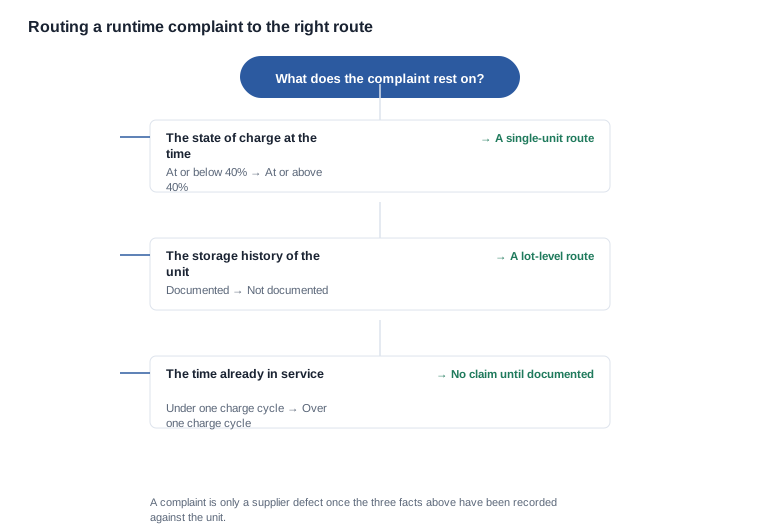
The decision tree above is the routing that turns a complaint into either a supplier defect or a handling defect. Every branch depends on a fact that has to have been recorded at the time. A complaint investigated three months later with no recorded state of charge and no recorded storage history cannot be routed at all, which means it is settled by whoever is more persistent rather than by what happened.

The two battery misreadings that turn a normal discharge curve into an incident
Not every runtime problem is a handling problem. Two of the most expensive errors in this category are made by reading a correct number in the wrong way, and both of them cost a supplier relationship that was never at fault.
Reading a partial-charge reading as a flat battery
A unit that has been sitting on a dock for an hour with a partly drained cell will report a lower state of charge than a unit taken off the same dock at the start of the shift. The difference is often large enough to read as a fault, and the instinct is to raise it as one. What has actually happened is that the reading was taken at a different point in the charge cycle from the one the comparison assumed.
The way to avoid this is not to be more careful with the readings but to fix the reading point. Any runtime figure in a fleet report should be taken from a unit at a defined state, and the state has to be written into the report template. Where the reading is taken from a unit in service, then the comparison is against other readings taken in service, and the difference between the two groups disappears.
Reading a first-hour drop as a cell fault
The second misreading concerns the shape of the discharge. A cell that has just come off the charger does not deliver a flat output. The early part of the discharge is steeper than the later part, and on some designs the firmware also draws a burst of current at start-up that shows up as an apparent drop. A reader who samples the runtime at one-hour intervals and does not account for the start-up behaviour sees a curve that appears to fall away and concludes that the cell is weak.
The correction is to use the end point rather than the curve. The runtime that matters is the time to the point at which the unit stops doing its job, and that point has to be defined before the test starts. A test whose end point is "when the unit switches off" and a test whose end point is "when the reading reaches ten per cent" produce two different numbers from the same unit, and only one of them is a runtime.
There is a third version of this misreading that sits between a handling fault and an interpretation error: the case of one unit out of a sample. A single short unit inside a good lot is a defect, and it should be recorded as one. A single short unit inside a sample of several is a data point. The difference between those two statements is the difference between a quality action and a batch claim, and it is decided by the size of the sample and by how the sample was drawn.
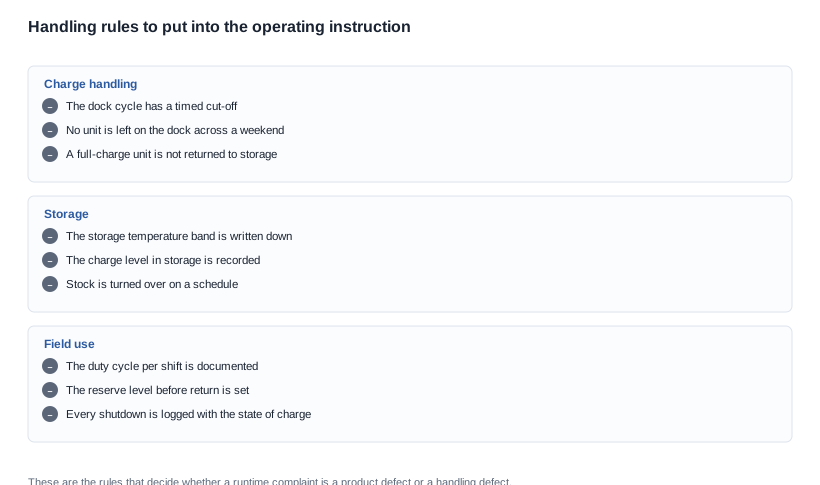
The rules on the checklist are the ones that remove the six errors. They are short, they are testable at the site, and each of them maps directly to one of the errors above. A rule that cannot be checked by a site supervisor without a laboratory is not a rule; it is an aspiration, and aspirations are what the first six failures come from.
Putting the six battery errors into the operating instruction
The operating instruction is the deliverable that turns this article into something. It is short, it belongs to the brand rather than to the factory, and it is the only document that reaches the people actually causing most of these errors. Written correctly it has three parts.
The first part is the rules themselves, and they are the nine criteria a site supervisor can audit without a laboratory. Each is a number rather than a principle, because a principle cannot be checked and a number can:
- A timed dock cycle with an automatic cut-off, verified on site.
- No unit left connected across a weekend or a shutdown period.
- A temperature hold at the charging point before connection.
- A weekly sweep of the idle pool, with failures put on charge rather than written off.
- A storage temperature band and a storage charge level, both written as numbers.
- A stock turn-over schedule that keeps the pallet age bounded.
- A documented duty cycle for each shift pattern in the operation.
- A reserve level before a unit is returned to the pool.
- A shutdown log that records the state of charge at the moment the unit stopped.
The second part is the roles. It states who owns the dock, who owns the store, who owns the fleet data and who receives a claim from the field. This part matters commercially rather than technically: a fault report that arrives without the state of charge, the storage history and the time in service cannot be routed, and the report becomes a deduction rather than a claim. Making the report a defined artefact with defined fields is what stops the deduction.
The third part is the interface with the supplier. It states what the supplier is told when a fault is found, what data accompanies it, and what the supplier's obligation is once it has been sent. It also states the supplier's obligations to you, which is where this becomes negotiable rather than merely procedural. Before you commit to a supplier on this basis, the red flags worth checking are listed in the buying guidance for this range, and the questions to ask belong in the supplier questionnaire rather than in a conversation. A supplier who can see your runtime data by batch, and who knows the handling rules that produce it, is a supplier you can have a technical conversation with. A supplier who sees only a return rate is a supplier who will offer a replacement rather than a cause.
The short answer: a narrow one and it is worth stating. We publish the electrical rows for every model in the range, and we will give you the cell capacity, the rated runtime and the case capacity for the models that carry a case, and the charging interface for the twenty-four that carry one. We publish a charge time for every model — ≤ 2h on most rows and ~1h on the two Type-C sports models — but we publish it without the starting state or the end point behind it. We publish no cycle life, no gauge accuracy and no test condition behind a rated runtime for any model, and we would rather tell you that than quote a figure that cannot be verified. Where a weight has been published it is the weight of the glasses body, including the cell and the camera and excluding the charging case, and only one model in the range carries a published weight at all. Before you order a fleet, the criteria that matter are the ones the pilot measures rather than the ones the brochure states, and the trade-offs between them are worth settling in writing before the deposit.
What we will do is work on the operating side with you. Send us the duty cycle, the shift length, the storage conditions and the dock arrangement, and we will tell you which of the six errors above is most likely to occur in that operation and what the control for it is. The measurement method behind the published figures is set out under smart glasses battery life and power, the way the runtime figure is produced is covered in how the runtime figure is made, and the incoming side of the same problem is in battery life quality control in practice. The failure signatures worth watching for are listed separately in battery life red flags.


