

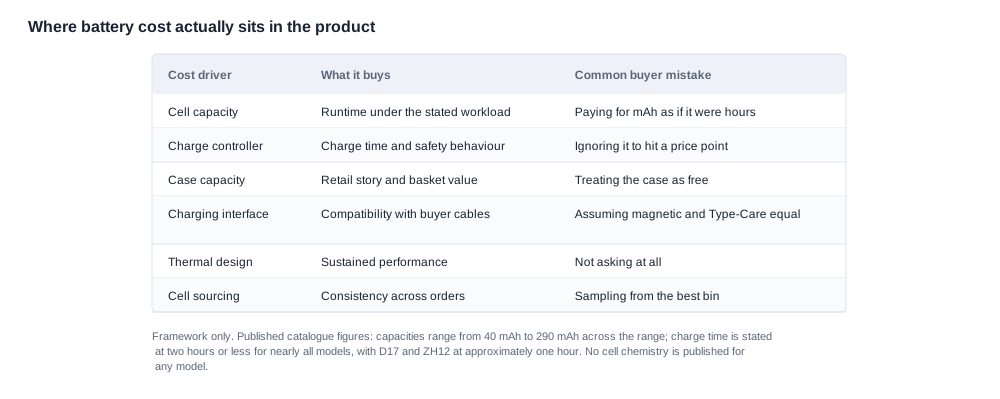
A budget for smart glasses does not buy hours in a straight line, and the reason is that the four things a buyer can spend money on inside the battery subsystem pull against each other. More cell capacity means a longer time to reach a full charge. A faster charge means a smaller cell inside the same envelope. A bigger charging case means a second cell in the carton and a second compliance file. A lighter unit means less capacity. The trade-offs are structural, they are known before the quotations arrive, and the right answer for a warehouse shift is not the right answer for an outdoor survey team. This article sets out the four levers, the thresholds that decide between them, and the cases where the cheapest answer is to spend nothing at all and change the operating procedure instead. It assumes the model has already been chosen. If it has not, the selection criteria for this range are set out in the buying guidance, and the structure of what each element costs is covered in the separate breakdown of battery cost factors.
Smart glasses battery life: what the budget buys at each battery tier
Start with what the catalogue publishes, because the published figures define the tiers a budget can be spent within. The range does not offer a continuous choice of runtimes. It offers a small number of distinct platforms, and the published ratings fall into recognizable groups.
The audio models cluster at the lower end. Two models publish around six hours on two 55 mAh cells. A set of models publish around seven hours on 100 to 115 mAh cells over a wired connector. A larger group publishes around eight hours, including models with two 90 mAh cells, models with two 55 mAh cells, and a sports model with two 70 mAh cells. The camera models sit at a different point entirely, because the camera is the dominant load. Four rows publish five to eight hours on 220 to 260 mAh cells, two publish six to eight hours on 220 and 260 mAh, and five publish around seven hours: the four built on the 290 mAh cell, and the MT6 on a 265 mAh cell with a folding case. At the other extreme, the three children's rows publish around twenty hours on 40 to 70 mAh cells.
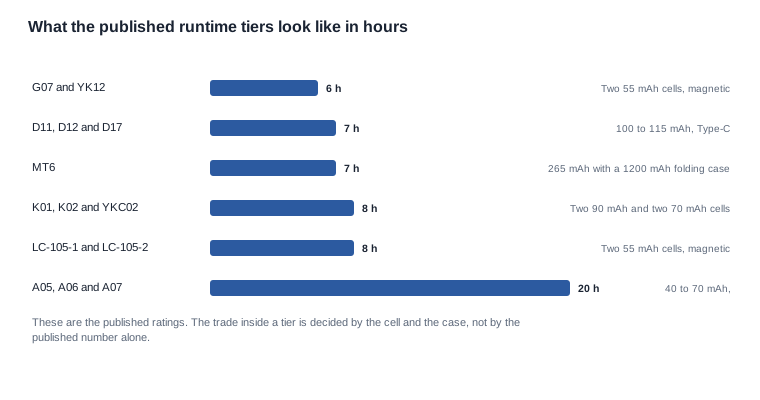
Those tiers are the menu.
The tiers can be listed as a buyer would write them:
- Around six hours, on two 55 mAh cells, in the entry audio group.
- Around seven hours, on 100 to 115 mAh cells, in the mid audio group.
- Around eight hours, across two-cell 55, 70 and 90 mAh audio and sports platforms.
- Five to eight hours across four camera rows on 220 to 260 mAh cells.
- Six to eight hours across two camera rows on 220 and 260 mAh cells.
- Around seven hours across the 290 mAh camera platforms, and on the MT6 at 265 mAh with a folding case.
- Around twenty hours on the three children's rows at 40 to 70 mAh.
The gap between the six-hour and seven-hour groups is one hour of published rating, and it is the gap at which a buyer is most tempted to think that a small amount of money buys a small amount of extra runtime. It does not. The groups are separate platforms, and moving between them means a different product, a different bill of materials, a different certification position and a different tooling history. The runtime difference between them is one hour; the commercial difference is a new platform. A budget cannot buy a runtime between six and seven hours; it can only buy a platform, and then it can buy things around the platform that change how usable the platform is. That is an important distinction, because a buyer who expects the budget to fine-tune the hours will be disappointed, and one who understands that the budget buys a platform plus accessories will make better decisions about where the money goes.
There is a fourth thing the budget can buy, and it is regularly the cheapest. It can buy a better operating procedure. If the published figure already covers the duty cycle, then the correct answer to a runtime constraint is a change to how the fleet is charged and used, and that change costs nothing per unit. It costs management attention, which is a real cost, and it is almost always cheaper than the alternative.

Four battery thresholds that settle the shortlist before pricing arrives
The thresholds below are the ones that decide which lever is worth pulling, and all four can be evaluated before a single quotation is opened. Each of them is a comparison against your own operation rather than against another supplier.
Threshold one: the duty cycle against the published rating
Write the duty cycle down in hours, and write down what runs during it. A shift of seven hours with the radio connected throughout and the camera recording for two of those hours is a different product requirement from a shift of seven hours with the radio connected for one hour. The published rating is produced under one stated condition, and your duty cycle either sits inside that condition or it does not. Where it sits outside, the gap between the published figure and the achievable figure is the size of the problem, and it is the first thing a supplier should be asked to price.
The way to express the duty cycle so that it can be priced is to describe it in terms a factory can reproduce. Write it as a sequence rather than as a summary: radio connected throughout, camera recording for the first two hours and inactive for the remaining five, audio at a stated level, screen on a stated duty. A supplier can price a sequence. A supplier cannot price "a normal working day", and the difference between those two descriptions is the difference between a quotation and an estimate. This is the same discipline the measurement procedure requires, and the procedure is set out in how to test smart glasses battery life.
Threshold two: the turnaround window against the charge time
If the units are recharged between every shift, the charge time has to complete inside the break, and the charge time has to be measured from a stated starting state. This is the threshold where charge speed beats capacity, because the constraint is not how long the unit runs but how long it takes to become usable again. It is also the threshold that most often exposes a gap in the published data, because the published charge time names neither the starting state nor the end point. The catalogue gives ≤ 2h on most rows and ~1h on the two Type-C sports models. Ask what those two hours are measured from and to what end point, and treat the answer as a specification line rather than as a convenience.
There is a reason this number is worth chasing so hard. Charge time is the number a factory quotes most confidently and measures least rigorously, because it is easy to report a figure from a bench and hard to report the same figure from a unit that has been in service for a year. The figure you need is not a laboratory charge from empty; it is a charge from the state in which units actually arrive at the dock, on the dock that is actually installed, over a period of years. Where the factory cannot produce that figure, it is at least worth asking for the first-cycle figure on the production dock, because a dock that is slower than the design assumes is a throughput problem that will surface as a shortage of usable units rather than as a complaint.
Threshold three: the docking opportunity against the case capacity
If the units reach a dock during the shift, the case is an accessory rather than a necessity, and a larger cell inside the unit is the better spend. If the units do not reach a dock, the case becomes the system that carries the programme, and its capacity, its top-up count and its charging turnaround all start to matter more than the capacity inside the unit. This threshold is the one that decides the case question, and it is an operational fact rather than a technical one, which means it should be answered by the person who runs the site rather than by the engineer.
There is a second reason the docking opportunity decides this, and it is commercial rather than technical. A case that ships in the box has to be bought in the same quantity as the units, has its own tooling amortised across that quantity, and carries its own compliance file. A case sold as an accessory has its own minimum order quantity, which is usually a fraction of the unit quantity, which pushes the tooling cost per case up, which makes the accessory price higher than the buyer expects and the accessory line in the quotation harder to compare. Deciding where the case sits in the box contents is therefore a decision about order quantities and packaging as much as a decision about runtime.
Threshold four: the mass envelope against the platform
The MT6 is the only model in the range with a published weight: 158 g for the glasses body, including the 265 mAh cell and the camera, and excluding the folding charging case, whose own weight is not published. That figure is worth dwelling on, because it demonstrates the shape of the trade. Adding capacity to a unit adds mass, and the mass lands on the person carrying it, which in an industrial or clinical setting is a fatigue question and a safety question before it is a cost question. Where a programme already sits at the limit of what its operators will accept, spending money on more capacity buys a complaint rather than a benefit.
The published MT6 figure is instructive because it separates the two things. The 158 g is the glasses body with its 265 mAh cell and its camera; the folding case at 1200 mAh is not included, and the weight of the case has not been published. So the number a buyer can quote to an operator is a partial number, and the element that carries the extra mass in the box is precisely the element that would be added to give more hours away from a dock. That is the shape of the trade-off in this category in one sentence: the thing that extends the working day also extends the mass of what has to be carried.
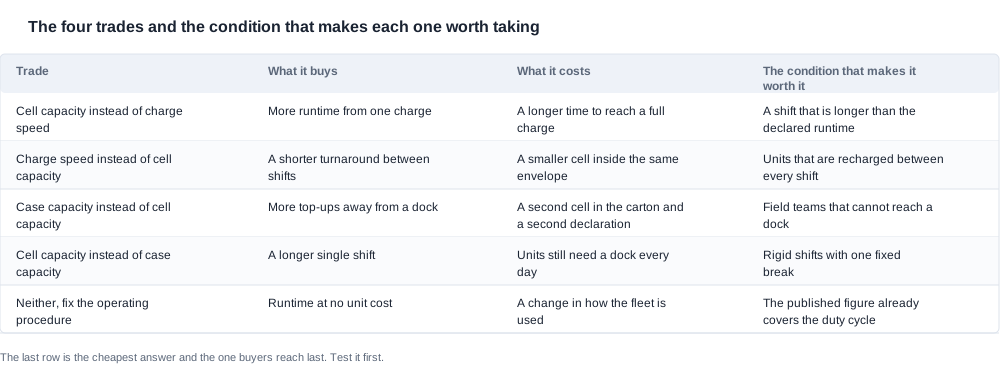
The table sets out the four trades with the condition attached to each. Read the fourth column before the second one. In every case the trade only makes sense inside a particular operating condition, and the condition is usually known to the operations team and unknown to the person holding the budget.

Which battery lever to pull at a given budget
The four levers behave differently, and the difference matters more than the amount of money involved.
Cell capacity is the lever that moves the published runtime and it is the one that changes the platform, so it is the most expensive and the slowest to change. Once the platform is frozen, the cell is fixed, and the cost of changing it is an engineering change rather than a procurement change.
Charge speed is the lever that moves the turnaround rather than the runtime, and it is the cheapest of the three because it is usually a component and firmware decision inside an existing platform rather than a new one.
Case capacity is the lever that decouples the shift from the dock. It is expensive in a way that is easy to underestimate, because the case is a second product with its own tooling, its own minimum order quantity, its own packaging and its own transport documentation.
External power is the lever that decouples the runtime from the unit entirely. It is the most flexible and the least finished as a proposition: it moves the problem from the hardware to the accessory ecosystem, and it creates a dependency on a customer carrying and charging something extra.
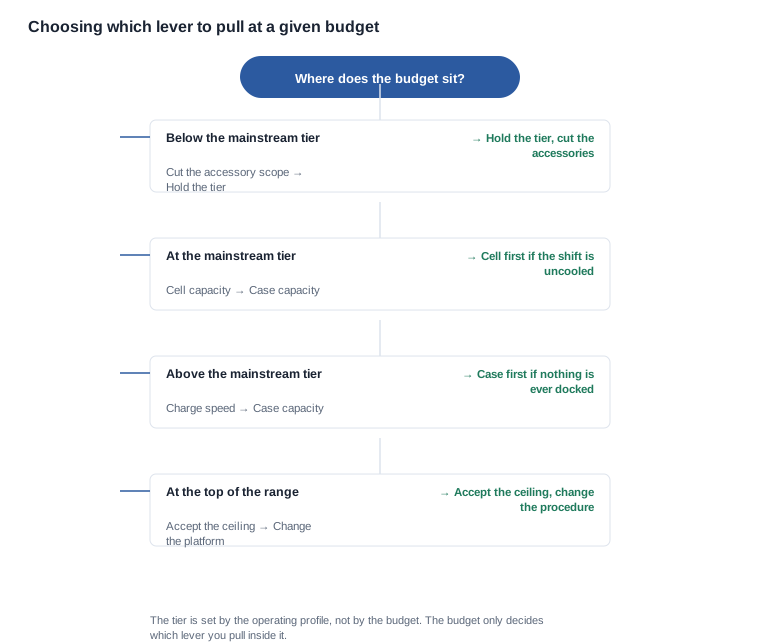
The decision tree above turns the budget into a lever.
The case, and the second order it creates
A case is the only element of the four levers that adds a second product to the transaction, and the second order is where the cost surprises tend to arrive. If the case ships in the box, the unit quantity and the case quantity are the same number, which makes the amortisation easy and the tooling cheap. If the case is sold separately, the case quantity is set by the accessory demand rather than by the unit demand, and the same tooling is spread over fewer units. The commercial consequence is that a buyer who plans to sell the case as an accessory but quotes it as if it ships in the box will be surprised at the point where the first accessory order is placed. Deciding the box contents before the quotation is the only point at which the decision is cheap to make.
External power and the accessory dependency
External power is the lever that removes the constraint rather than moving it, and it is worth understanding precisely what it removes. It decouples the runtime of the unit from the cell in the unit, which means the runtime becomes a property of the accessory ecosystem rather than of the product. For a programme where the operator already carries a battery pack for a phone or a tablet, that is an elegant answer. For a programme where the operator carries nothing, it is a new requirement with a new failure mode, and the customer has to be told to carry something. The accessory also has to be supported, stocked, warrantied and replaced, which puts it on the same footing as the unit in the after-sales budget. The lever is real and it is occasionally the right one, but it should be pulled knowingly. The branch that matters most is the last one. If the budget is at the top of the range and the operating condition still cannot be satisfied, the answer is not to spend more; it is to accept the published ceiling and change how the fleet is used, because beyond a certain point there is nothing left to buy.

Where spending more on the battery buys nothing at all
There are three situations in which a larger budget produces no improvement in the outcome, and all three are common.
The first is where the constraint is the operating pattern rather than the cell. If the fleet is charged once a day and the shift structure makes that impossible, no amount of extra capacity in the unit fixes it; the fix is a second dock, a different shift pattern or a spare pool. Buyers frequently discover this after the first shipment rather than before it, because the shortfall is invisible until the units are actually in the field.
The second is where the constraint is the test condition rather than the hardware. If the published rating was produced with the radio idle and your duty cycle keeps it active, then a unit with twice the capacity will still miss the target, because the load scales with the duty cycle rather than with the hardware. The correct spend here is on the requirement, not on the product.
The third is where the constraint is the platform itself. The camera models in this range publish a runtime that is set by the camera load, and the models with a case publish it alongside a 1400 mAh or 1200 mAh case that extends the working day without extending the single-shift runtime at all. For a programme whose real requirement is "how many hours away from a dock can the team work", the case is the answer and the cell is not, and buying a larger cell would be paying twice for the same hour.
That third case is where the trade-off becomes a packaging decision rather than an engineering one, and it is the one most often decided by whoever is filling the box. The box contents of a camera model with a case are a bigger decision than the runtime figure, because the case changes what is in the carton, what the customer has to charge, what the transport declaration says and what the customer expectation becomes.
On this trade-off, a narrow one. We publish the cell capacity, the rated runtime, the case capacity where a case exists and the charging interface, and we will not publish a unit price, a tooling charge or a price tier, because those are quoted per order and a typical figure is one you cannot verify. We publish a charge time for every model — ≤ 2h on most rows and ~1h on the two Type-C sports models — and we publish it without the starting state or the end point behind it, because a charge time without those two cannot be compared to anything. The number of top-ups a case delivers is not published at all, and it is one of the most useful numbers in the whole category, which is why we will measure it with you rather than estimate it.
What we will do is take your duty cycle, your shift length, your docking opportunity and your mass envelope, and tell you which of the four levers is the one that moves your outcome, and which of them will simply move your invoice. Send us the model, the quantities and the target market and we will tell you which configurations exist and which of them carry a case. The measurement method behind every published figure is under smart glasses battery life and power, the platform electrical detail for the audio class is on the bluetooth audio glasses range page, and the design consequences of a custom configuration are covered under customization options.
The last piece of commercial context belongs here rather than in a separate section, because it changes how the thresholds are applied. A price tier is a statement by the factory about which quantities it expects, and a factory that quotes a first tier at five thousand units and a second at fifty thousand is telling you that the cell and the assembly move at those points. Where the margin on a programme is thin, the thresholds above should be applied against the tier you will actually order, because the trade that makes sense at fifty thousand units is not the trade that makes sense at five thousand. The transport and compliance obligations that sit alongside the battery in the carton are set out under shipping and logistics, and the recurring comparison errors are covered in battery life common mistakes.


