

Every published runtime in this category is a rated figure, and a rated figure is a number with its conditions removed. But the number a buyer should build a return-rate expectation on is not the average either — it is the worst unit in the sample. A mean of six hours across five units where two run five and one runs eight is a different product from one where all five run six, and only the second one has a predictable return rate. So the protocol has two halves: five variables to fix before the first run, and then a per-unit record that you sort rather than average, because the tail is the unit that comes back. Fix the load, the radio bench, the temperature, the starting state and the sample; then run every unit, record every unit, sort the results, and put the acceptance line on the tail rather than on the mean.
Smart glasses battery life: the tail that matters
The buyer who has one sample, one catalogue rating and a complaint
A buyer running this test is usually checking a supplier's rated figure against reality, establishing a number for a listing, or answering a customer complaint that says the product does not last as long as the page said. They will hold a sample, a catalogue runtime and a use case in mind. What they will not hold is a method, and that is the gap: two suppliers' figures for the same model are not comparable unless you know the workload each was measured under.
Our catalogue publishes a runtime for every model and a test condition for none of them. The published figures run from about six hours on some audio models to about twenty on the children's range, with the camera models clustering between five and eight hours. They are all the same kind of claim: an outcome with the method removed.
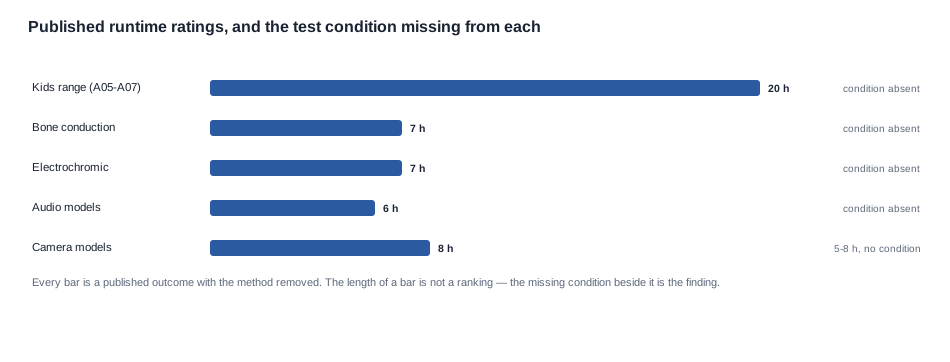
That chart is worth reading carefully, because it looks like a ranking and is not one. The length of a bar is not a comparison between models; it is a comparison between nothing, because each bar is missing the workload, the radio condition, the temperature and the starting state that produced it. The finding is in the memo beside each bar, not in the bar itself.
The three workloads a buyer actually cares about are continuous playback, mixed use and continuous capture, and they are different products in terms of endurance. The first is the easiest to reproduce and the most flattering. The second is what a customer does. The third is the heaviest load, and it is where the two resolution tiers in the camera range would be expected to differ most.
The three mistakes that produce a wrong answer
Changing the workload mid-test. This is the most common version of a bad runtime measurement: a test that starts as continuous playback and becomes a call test produces a number that describes no real usage at all. The rule is that the workload is a list of timed actions, written down, and the list does not change for the duration of the run.
Measuring the case rather than the frame. A charging case has its own battery and its own charge time, and measuring the pair together produces a much larger number than the product delivers. It is the fastest way to end an argument in the wrong direction, because the number is real and the label attached to it is not.
Treating a single unit as a population. One unit, one run, is an anecdote. If a customer complaint is going to be settled with a measurement, the measurement has to be repeatable by somebody else, and one unit is not repeatable by anybody.
The buying task: deciding which percentile your return rate will follow
The tail is the unit that comes back
The reason a buyer should care about the worst unit rather than the average is a distribution fact rather than a measurement fact. Returns do not arrive in proportion to how a product performs on average; they arrive in proportion to how many units fall below the point where the customer stops being satisfied. A customer who expected eight hours and got seven and a half will not return the product. A customer who expected six hours and got four will. The population of units near the bottom of the range is small, and it is disproportionately the population that returns.
That is why the acceptance line belongs on the tail. An acceptance rule written from the mean is a rule that the units that come back will fail, and a rule that fails routinely is a rule that either gets ignored or gets applied to every lot, which is expensive. A rule written on the tail is a rule that is passed by the units you are happy to ship, and the sample size you need to place it is a question of how much tail you want to tolerate.
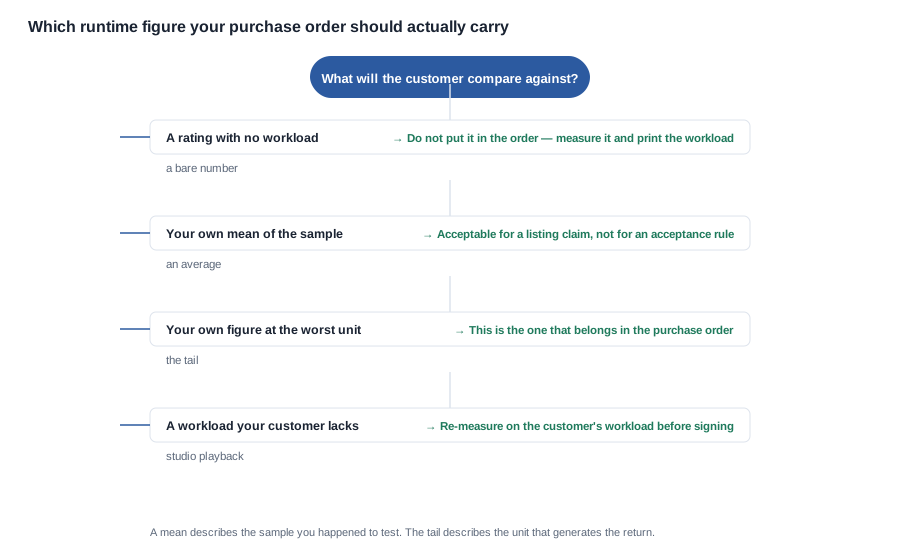
The decision chart above separates the four figures a buyer is likely to end up holding. A published rating with no workload does not belong in a purchase order at all. A measured mean is acceptable for a listing claim and wrong for an acceptance rule. A measured figure at the worst unit is the one that belongs in the order. And a figure measured on a workload the customer does not have has to be re-measured before anything is signed, because it is a description of a different product.
The practical threshold is a percentile rather than a single number. A buyer who cannot yet say which percentile their channel tolerates should say the tenth-percentile unit, because the tenth percentile is the point where a cluster of returns starts, and it is measurable with a sample of a realistic size.

The five variables, and the direction each one moves the result
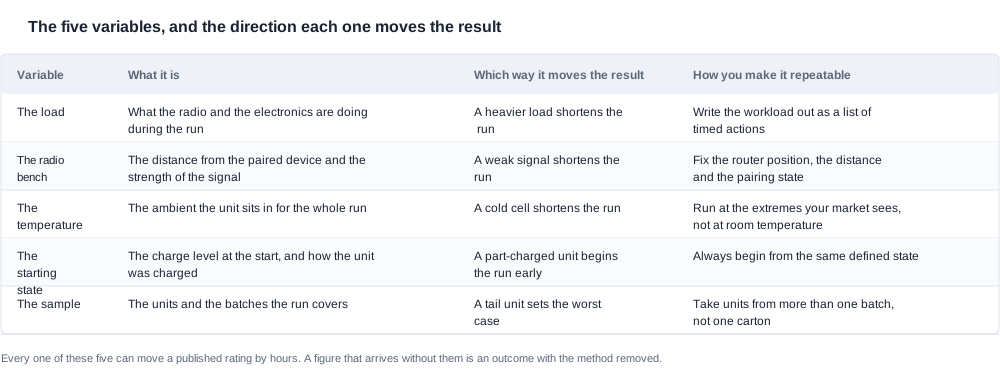
Every one of these five can move a published rating by hours, which is why a figure that arrives without them is not a specification.
The load is what the radio and the electronics are doing during the run, and it dominates everything else. A heavier load shortens the run. The way to make it repeatable is to write the workload as a list of timed actions rather than as a description, because a description is negotiable with whoever is watching the timer.
The radio environment is the variable a naive test gets wrong. A device in a weak signal spends substantially more on transmission, so the same unit in the same room can produce a different number on a different day. Either fix the environment — the same bench, the same distance from the router, the same pairing state — or record it in detail, because a result from two different environments is not a result.
The temperature has to be a range rather than a nominal. Cell behaviour is temperature dependent in both directions, and a test in a temperate room describes a product that will be used in a hot vehicle or a cold street. Running at the extremes the market sees is worth the extra time, because the cold end is where the tail lives.
The starting state of charge has to be specified and used every time. A unit at full and a unit at half are different starting points, and the first cycle from a deep discharge behaves differently from subsequent ones, which is why the first measurement is often the slowest and the second is faster.
The sample decides whether the published figure holds at all. A single unit from one batch tells you about that unit. A sample drawn across units and across batches tells you about the production run, and the spread across batches is often wider than the spread within a batch, which surprises people who test only what arrives in the first carton.
The five variables and the direction each one pushes
The end point should be a defined state rather than "flat". The tail of a discharge curve is long, and the last few per cent take a disproportionate share of the time. Defining the end condition as a specific behaviour — the point at which the device no longer performs its primary function — makes two runs comparable and makes the number mean something.
The behaviour at the end of the run is a separate observation. Does the device report a flat battery, does it still work partially, and for a product with a light-responsive lens, what does the lens do at a flat cell. A product that shuts down cleanly is a product with a support script; one that degrades erratically is a product with a warranty file.
The charge time has to be measured from the same defined start as the runtime, with the same charger recorded, because the two figures are quoted together on a product page and they are not independent of each other.
A derating factor is a commercial decision, not a technical constant. A supplier who offers one without a method behind it is offering a number they have not measured, and the number will be a guess dressed as engineering.

From a bench run to a batch acceptance rule
The six steps, and the acceptance rule each one builds
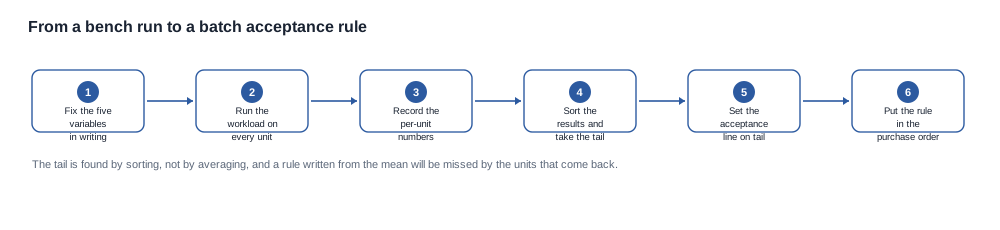
Step one fixes the five variables in writing. The load, the radio environment, the temperature, the starting state and the sample. A protocol designed after the first result is not a protocol, and in this category it is also not evidence, because a supplier disputing it can point at any of the five and ask which one you actually controlled.
Step two runs the workload on every unit. Not a representative subset, not the unit that looks healthy — every unit in the sample, because the point of the exercise is the spread and the spread is what you are looking for.
Step three records the per-unit numbers. A list, not a summary. The moment you write down a mean, the tail has been discarded.
Step four sorts the results and takes the tail. Sort ascending and read off the worst unit, then the second-worst, and the gap between them is itself a finding. A tight tail means the sample is telling you something about the process. A wide tail means you have a manufacturing conversation to have.
Step five sets the acceptance line on the tail. The line is a number in hours, a workload, a temperature and a start state, all four together. This is the criteria that goes into the purchase order and into the incoming inspection sheet.
Step six puts the rule in the order. A rule that lives in a test report is a rule that the incoming inspection team will not apply, because they were not told it existed. A rule in the purchase order is binding, and a lot that fails it is a lot you can refuse or rework.
Making the result repeatable by somebody else
A result is only useful if it can be reproduced, and the fields that make reproduction possible are the same five variables plus the per-unit record. Put the sample identification on the sheet: the unit, the batch or build it came from, the date, the ambient, the charger, and the starting state. Retain the units and the raw readings, because they become the reference against which a later delivery is compared — and a substitution of the cell or the charging circuit would otherwise be invisible.
Two more practices make the measurement worth more. Run the same units more than once, because the first run on a new unit is often not representative and one run cannot separate a systematic result from a lucky one. And repeat the whole protocol on a later production batch, because the batch you tested in the sample stage is not the batch you will ship.
Where a runtime programme loses its margin
A seven-hour rated figure is compared against a mixed-use expectation and the product is called defective. The root cause is that the workload was not stated on either side. The prevention is to put the workload next to every figure the brand quotes, including in the listing, because the customer will reproduce the workload rather than the number.
A measurement is made on the case and reported as the product's endurance. The root cause is that the frame and the case were treated as one object. The prevention is to measure and report them as two products with two figures, and to publish both.
Two units of the same model differ by three hours and nobody notices. The root cause is that one unit was tested and a mean was published. The prevention is to test across units and across batches and to publish the range rather than the average, which is the practice that makes the tail visible to the people who set the return policy.
The product's behaviour at the end of its life is discovered by customers. The root cause is that the end condition was shutdown only, so the degraded phase was never observed. The prevention is to record the point at which the device becomes unusable as a separate observation and to treat erratic behaviour as a finding rather than as noise.
A warranty is set from a rating and the first claim is unanswerable. The root cause is that the rating has no condition, so the claim becomes an argument about which workload the customer was doing. The prevention is to set the warranty against a measured figure on a stated workload, and to write the workload into the support script as well as the listing.
The case recharge count is derived by arithmetic rather than measured. The root cause is that a capacity figure was treated as a runtime figure. The prevention is to count the recharges from a full case on a sample, because the count the customer experiences is the one the hardware produces, not the one the spreadsheet suggests.
A worked scenario: a channel buyer setting a return-rate expectation
This is a hypothetical scenario rather than a client project, and it is written to show the decision sequence rather than to report a result.
Assume a channel buyer with three candidate models and a returns policy that has to be set before the season. The previous season's returns on a similar product were attributed to endurance, and the channel has since received a letter from the brand asking for a lower return allowance. The binding constraint is that nobody can produce a runtime figure that survives the conversation.
The workloads are written down first. The channel's customers use the product in one of three ways, and the buyer writes each as a timed list: continuous playback, mixed use with periodic capture, and capture-only sessions. The decision that matters here is which of the three the return allowance will be built on, and the answer is the mixed use, because that is what most of the sessions are.
The five variables are fixed and written down. The router position and distance, the ambient, the starting state, the sample, and the end condition. The buyer is explicit that the result will describe those conditions and no others, which is what makes it usable in a letter.
Every unit in the sample is run. The result is a list, and the list has a shape: a cluster, and one unit well below it. The mean is close to the published rating. The tail is two hours below it. That is the finding, and it arrives because the units were run individually rather than averaged on the spot.
The acceptance line is set on the tail, not on the mean. The buyer sets the line at the worst unit in the sample, with a stated workload, temperature and start state, and puts it in the purchase order as the criteria for incoming inspection.
The three candidates are compared on their tails, not their means. Two of the three have a tight tail, and one has a wide gap between the worst and the second-worst. The wide-gap candidate is the one with a process question in it, and the buyer opens that question before the order rather than after it.
The return allowance is set from the measured figure. The letter to the brand quotes a figure with its workload, its sample size and its temperature, and asks for the same rigour in the brand's own figure. That request is usually granted, because the alternative is an argument that neither side can win.
The result is a return allowance that the channel can defend and a brand that has been given a figure it can reproduce. The decisive decision was the choice of the tail, and it was made before the order rather than after the first season's data.
What we publish about endurance, and what a rated figure leaves open
The working rule we apply: we publish the rated runtimes exactly as the catalogue states them, and we publish the fact that the catalogue states no test condition for any of them.
We will not invent a condition, and we will not apply a derating factor to a figure we have not measured under your workload, because a derating factor is a commercial decision about your own return rate rather than a technical constant, and a supplier who offers one without a method is offering a number they have not measured. We will also not publish a figure that was measured on a sample in transit and stored, because that state is not the state a customer will compare against.
We will say plainly what your own test cannot tell you. It cannot tell you how the product will perform across the population the supplier ships, because that is a question for a production-side control rather than a bench. What it can tell you is the spread across your own sample, and that spread is the number that decides your return allowance.
What we can do is check your measurement against the published rows for that model and tell you whether the result is consistent with the rated figure and what that implies for the copy. The measurement discipline is under battery life and power, the comparison method is in how to compare battery life, the measurement method is in how to measure battery life, and the production-side control is in battery life quality control.
Four actions for this week
Write the workload as a timed list, not as a description. The questions to ask a supplier about a runtime are what was running, how often, at what volume, and under what radio condition. A supplier who answers all four has a measurement habit.
Run every unit and keep the list. The tail is found by sorting. If you write down a mean, the units that come back have already been discarded from the evidence.
Set the acceptance line on the worst unit. That line, with its workload and temperature and start state, is the criteria that belongs in the purchase order and in the incoming inspection sheet.
Send us the workload and the tail. We will tell you how the result compares with the published rating for that model, and whether the difference is explained by the workload or points at something the product description should say.
Related reading
- The measurement technique — how to measure battery life
- The method used to compare — how to compare battery life
- The production-side control — battery life quality control
- The endurance background — battery life and power
Send us your measurement and the five variables behind it, and we will tell you how it compares with the published figure.


