

This page is a reference, not an argument. It lists the terms a buyer meets in a smart glasses battery conversation, groups them so that related terms sit together, and gives each one the question it should raise rather than a paragraph about it. That structure matters more than it might seem: almost every technical dispute in this category comes from two parties using the same word to mean different things, and a glossary is the cheapest way to find out whether that is what is happening before money is committed.
The grouping is deliberate.
The full list, grouped as it appears below, is:
- Capacity group: capacity, rated capacity, energy, reserve.
- Runtime group: rated runtime, real-world runtime, duty cycle, end point, cut-off, coulomb counting.
- Charging group: charge time, magnetic charging, Type-C charging, charging case, top-up count, state of charge.
- Ageing group: cell chemistry, cycle life, self-discharge, internal resistance, gauge accuracy, end-of-life threshold.
- Contract group: storage temperature band, delivery state of charge, low-battery behaviour, mixed-fleet period, duty cycle tolerance.
Sixteen terms in the first four groups, five in the last. If you read only one section, read the contract group, because those are the five that have no meaning outside an agreement and are therefore the five that cause disputes. The first group describes the cell, the second describes the rating, the third describes how charge gets in and out, the fourth describes how the cell ages, and the fifth collects the operating-condition words and the terms that only make sense inside a contract. A sixth section explains how to move a term from a marketing page into a purchase order, which is the only use of a glossary that really matters.
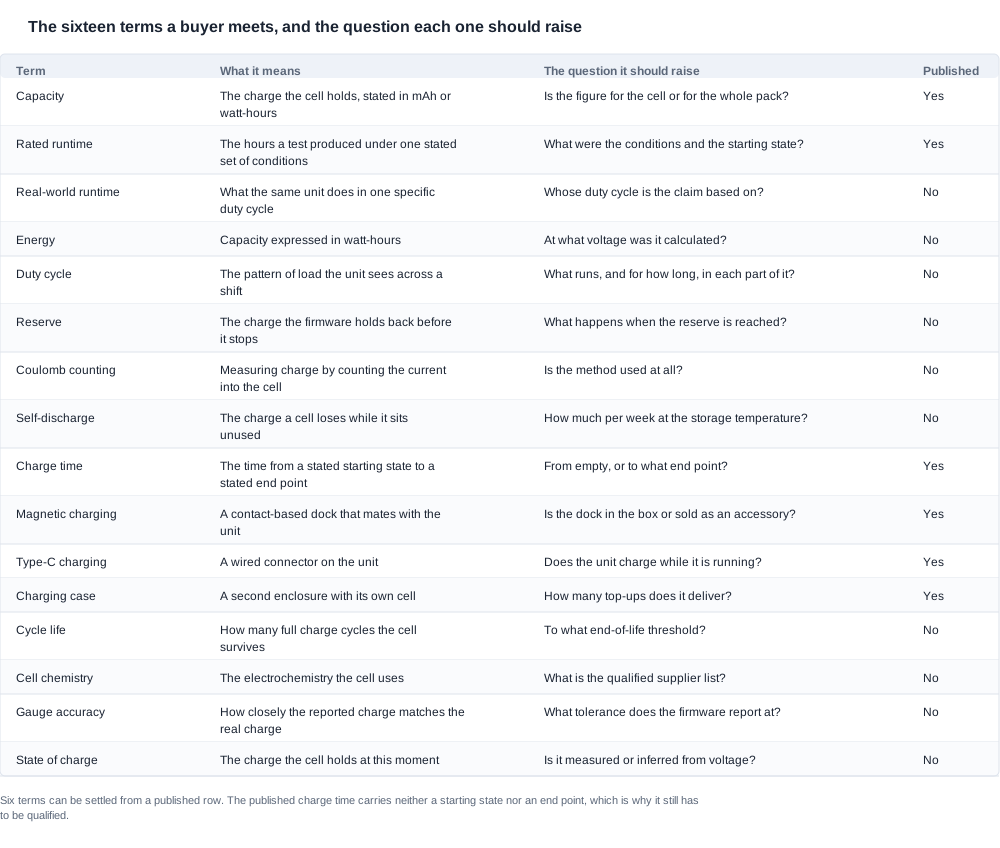
The chart above is the whole list in one table, with the final column marking whether the term can be settled from a published catalogue row or has to be asked for. Six of the sixteen can be settled from a published catalogue row. The other ten are the vocabulary of the questions a buyer has to ask, and that is the honest shape of this category: a small amount of it is public and most of the decision lives in the conversation.
Smart glasses battery life: the four capacity numbers that describe a cell
Capacity is the charge the cell holds, expressed in milliampere-hours or in watt-hours. The first is a quantity of charge, the second is a quantity of energy, and the conversion depends on the cell's rated voltage, which is why the two are not interchangeable at the same number. The question a capacity figure should raise is whether it describes the cell, the pack or the whole device, because a figure quoted for a pack includes the protection circuit and the enclosure and is therefore not the cell's capacity.
Rated capacity is the capacity a cell delivers under a specified test, which is normally lower than its nominal capacity. The difference between the two is the tolerance the manufacturer accepts, and it is the number that decides how two units of the same model behave differently from one another.
Energy is capacity expressed in watt-hours, and it is the more portable of the two because it can be compared across cells with different voltages. In this category it is used mainly for transport classification, where a watt-hour figure is what appears on the paperwork. The question it should raise is what voltage it was calculated at, since a watt-hour figure without the voltage is not reproducible.
Reserve is the charge the firmware holds back before the unit stops working. It is the reason a unit with a given cell capacity delivers less runtime than the cell arithmetic suggests, and it is one of the least commonly discussed terms in the category, because it is a firmware decision rather than a component. The question it should raise is what happens at the end of the discharge — whether the unit shuts down in an orderly way, warns, or simply stops.

Runtime terms: the six words used around a rating
Rated runtime is the hours produced by one test under one stated set of conditions. It is a rating, not a property, and the conditions are the term that gives it meaning. The question it should raise is what the four conditions were: the load, the radio state, the temperature and the starting state.
Real-world runtime is what the same unit does in one particular duty cycle, which is a function of the operation as much as of the product. It is a term that appears in conversations rather than on specifications, and it is almost always used loosely. The question it should raise is whose duty cycle the figure is based on.
Duty cycle is the pattern of load the unit sees across a period of work. It is the single most useful term in the list, because it converts a vague requirement into something a factory can quote against. Write it as a sequence — what runs, for how long, in what order — rather than as a summary, and the quotation will be comparable.
End point is the moment at which the unit is counted as having stopped, and it can be defined in several ways: when the unit switches off, when the charge reaches a stated level, or when a particular function becomes unavailable. Two tests with different end points produce two different runtime figures from the same unit, which is why the end point has to be written down before the test rather than interpreted afterwards.
Cut-off is the charge level at which the unit stops drawing from the cell, and it is a design decision rather than a property of the cell. It interacts directly with the reserve: a firm that cuts off early protects the cell and shortens the runtime, and a firm that cuts off late extracts more of the charge and ages the cell faster.
Coulomb counting is a measurement method
A sixth term belongs in this group and is used more loosely than it should be. Usable runtime is the runtime available to the functions that matter in a given operation, as opposed to the runtime until the unit stops entirely. The two differ by whatever the product does after the useful function is over — a unit that keeps a radio connected while the camera has already stopped is still drawing current. The question it should raise is which function the figure is measured against, because that is the function the operator is actually buying. that determines charge by counting the current flowing into and out of the cell, rather than by inferring it from the voltage. The question it should raise is whether the method is used at all in the product you are buying, because a gauge that infers rather than counts will behave differently as the cell ages.
Charging and interface terms
Charge time is the time from a stated starting state to a stated end point. It is the term most often quoted without either of its two qualifiers, and a "two-hour charge" means nothing until you know whether it is from empty and whether it means a full charge or a usable charge. The question it should raise is both of those. Our range publishes the figure — ≤ 2h on most rows and ~1h on the two Type-C sports models — and publishes it without either qualifier, which is exactly why it cannot be compared against a break in a shift.
Magnetic charging is a contact-based interface where the unit mates with a dock. In this category it appears on the majority of models, and it implies a dock exists somewhere in the box contents or in the accessory line. The question it should raise is which dock, and whether it is included.
Type-C charging is a wired connector on the unit. It appears on a smaller set of models. The question it should raise is whether the unit can charge while it is running, because that determines whether a docked unit is available or merely present.
Charging case is a second enclosure with its own cell that the unit is placed into. It is a second product with its own tooling, its own packaging, its own quality control and its own transport documentation. The published capacities across our range are 1400 mAh on three camera models, 900 mAh or 1400 mAh on one model depending on the case selected, and 1200 mAh on the folding case of one model; two further models carry a case whose capacity is not published.
Top-up count is the number of times a case can bring a unit back to a usable state. It is the number that decides whether a case-based product works across a working day, and it is not the same as the case capacity divided by the cell capacity, because the transfer is never complete and the unit does not accept a full charge every time. It is not published for any model.
State of charge is the charge the cell holds at a given moment. It appears on a transport declaration and on a receiving record, and the question it should raise is whether it is measured or inferred — which brings back the coulomb counting question above.

Cell chemistry and ageing terms
Cell chemistry is the electrochemistry the cell uses. It is the input to most of the other ageing behaviour, and it is not published for any model in our range. The question it should raise is what the qualified supplier list is, because that list is what determines whether a substitution is a procurement decision or a re-qualification.
Cycle life is the number of full charge cycles a cell survives before it reaches a stated end-of-life threshold. It is the figure that decides the warranty economics on a long programme, and it is meaningless without the threshold, because a cell rated to eighty per cent remaining capacity and one rated to ninety per cent are different products. It is not published for any model.
Self-discharge is the charge a cell loses while it sits unused, and it is strongly affected by temperature. It is the term that explains why a consignment held at a high state of charge in a warm store arrives weaker than the same production window shipped earlier. The question it should raise is how much per week at the storage temperature that applies to the programme.
Internal resistance is how much the cell opposes current. It rises as a cell ages, and a rise in internal resistance is what turns a partially charged unit into one that will not start. It is not published, and it is the mechanism behind the failure that operations teams most often misattribute to the firmware.
Gauge accuracy is how closely the reported charge matches the actual charge.
Two further terms belong in the ageing group and are worth knowing because they appear in warranty conversations. Capacity fade is the gradual loss of the capacity a cell can deliver, expressed usually as a percentage of its original figure, and it is the mechanism behind the observation that a fleet's runtime declines over the first year of service. Self-healing recovery describes the partial recovery a cell can show after a period at a low state of charge, and it matters because a unit measured too soon after such a period will read worse than it will later. The question it should raise is when the measurement is taken, since a measurement taken at the wrong moment in the recovery will understate the cell. It determines whether the indicator the operator reads is trustworthy, and it interacts with the reserve and the cut-off: a gauge configured loosely will show a full reading shortly before the unit stops.
End-of-life threshold is the point at which a cell is considered no longer suitable for a given duty. It is the term that makes a cycle life figure usable, and it belongs in the warranty definition rather than in the technical description.
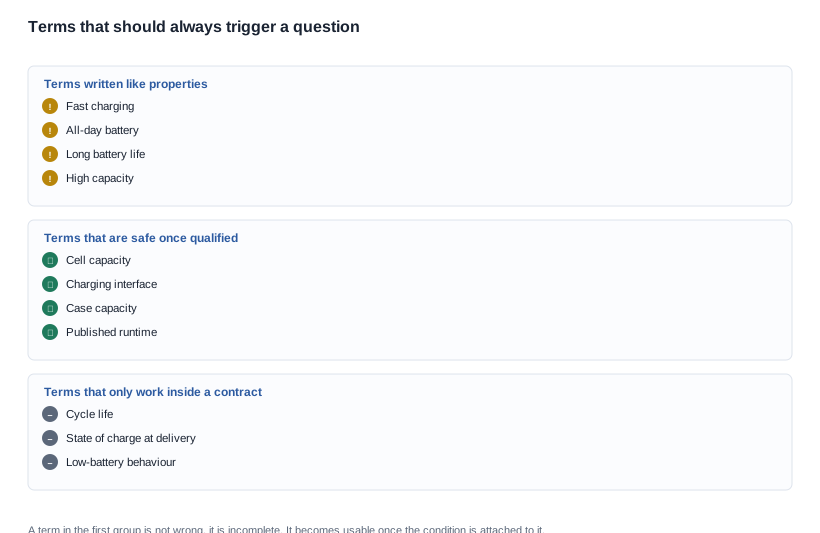
The checklist above sorts the vocabulary three ways. The terms written like properties are not wrong, they are incomplete, and they become usable the moment a condition is attached. The terms that are safe once qualified can be settled from a published row. The terms that only work inside a contract have no meaning at all until somebody agrees what they mean.

Operating condition terms, and the ones that only work in a contract
The final group is the one that most often does not appear in a glossary at all, and it is the group that decides whether a battery programme runs without friction.
Storage temperature band is the range in which the units are held before use. It is a contractual term rather than a technical one, because the band is agreed between the buyer, the supplier and the warehouse, and the consequence of exceeding it has to be defined.
Delivery state of charge is the charge level at which units are accepted on arrival. It is set by the transport arrangement and it is the term that separates a lot issue from a transport issue when a claim arrives.
Low-battery behaviour is what the unit does as the charge falls: whether it warns, what it stops first, and whether it saves state. It is the term that determines whether an operator experiences a full shift or a shortened one, and it is a firmware behaviour that has to be specified rather than discovered.
Mixed-fleet period is the interval during which units built to different configurations coexist in the field. It is the term that makes a claim against a production window meaningful, because it tells a supplier which units a claim applies to.
Duty cycle tolerance is the permitted variation in the load pattern of a shift,
Storage temperature band and delivery state of charge are related in a way that is worth stating, because they are normally set by different people in different organisations and they interact. A consignment can arrive at the delivery state of charge and still be weaker than the production window it came from, because it spent its time after charging inside the storage band of a warehouse rather than in a transit container. The band is therefore a condition on the charge as much as on the temperature, and a programme that specifies one without the other has specified half of a condition. Where a claim about an early-life shortfall arrives, these two terms are the first two to check, before anyone examines the cell. and it is the term that decides whether a runtime figure is a specification or a description.
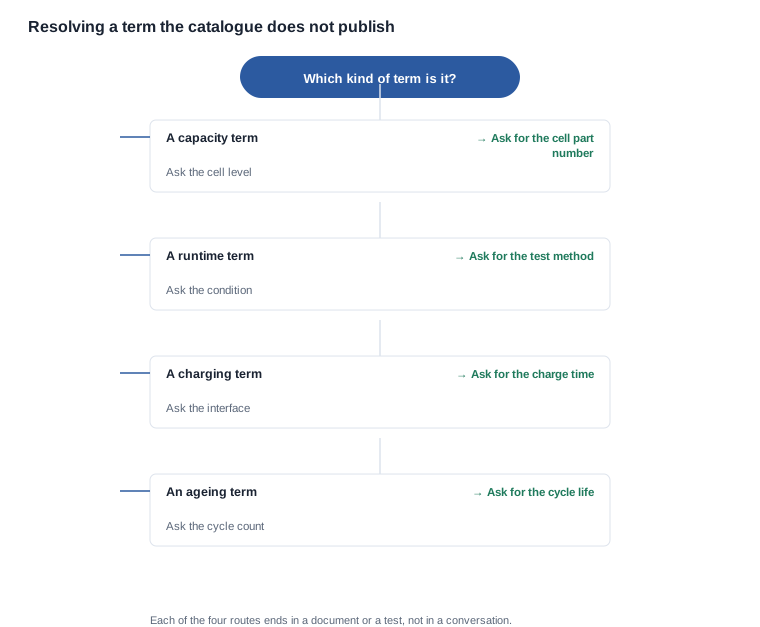
The decision tree above is the short version of how to handle the eleven terms that are not published. Each route ends in a document or a test. A term that cannot be resolved by any of those four routes is a term that should not appear in the order.
Turning a term into a line in the purchase order
The reason to keep a glossary is not reference.
There is one more practical reason to define terms before they are used, and it is the reason most disputes in this category are avoidable. Two documents can use the same word and mean different things by it, and neither party is being dishonest. One factory measures cycle life to ninety per cent remaining capacity; another measures to eighty. One quotes a two-hour charge from empty; the other quotes two hours from a part charge. One describes a runtime that ends when the unit switches off; the other describes one that ends when the camera stops. Every one of those pairs is defensible in isolation and unresolvable in combination, and the resolution has to come from the definition rather than from a disagreement about who was right.
The way to prevent it is to attach the qualifier to the term at the moment of use, in writing, from the beginning. It costs two clauses. It is also the reason that a supplier who resists being precise about a term is telling you something worth knowing before the order rather than after it, because precision is a burden that a supplier accepts easily when the underlying engineering is mature and resists when the answer is an estimate. It is that a term used in a specification without its qualifiers is a term that will be interpreted differently by the two parties to the contract, and the disagreement will surface at the least convenient moment.

The flow above is the method, and it takes five lines. Take a term out of the marketing copy and put it on a specification line. Write the condition that gives it its meaning. Write the measurement method that produces the number. Write the tolerance and name the person who signs the result. Write the consequence if the result falls outside the tolerance. A term that cannot survive those five lines does not belong in the order, and removing it is a legitimate outcome.
Applied to two examples, it is easy to see the value. "Fast charging" becomes a stated starting state, a stated end point, a stated window and a tolerance. "Eight hours of battery life" becomes a stated load, a stated radio state, a stated temperature, a stated starting state, a stated end point and a tolerance. Neither of those examples is hard; both of them take a page. The saving is that the page exists before the order rather than after the complaint.
On vocabulary, that we will publish the terms we can stand behind and we will not publish the ones we cannot. On our range the published rows carry the charging interface, the rated runtime, the cell capacity, and the charging case capacity where a case exists. The starting state and the end point behind the published charge time, cycle life, gauge accuracy, the reserve and the test condition behind a rated runtime are not published for any model, and we will say so rather than quote a typical figure. The method behind the published runtime figures is covered under how the runtime figure is made, the interface decisions are under charging solutions, and the rows to request before committing are in the battery buying checklist. The published electrical rows themselves are collected under smart glasses battery life and power.
Send us the terms your programme uses that we have not defined here,
There is a second, more commercial use of this page, and it is the one that saves the most time in a procurement cycle. Before you commit to an order, run the sixteen terms as a checklist against the supplier's own documents rather than against the catalogue. For each term, the question is narrow: is this stated, and is it stated with its qualifier attached? A supplier whose specification sheet names the end point, the starting state and the end-of-life threshold has told you that its engineering is documented well enough to answer questions about them. A supplier whose specification sheet says "long battery life" and "fast charging" has told you that the qualification is going to be conducted at the receiving desk, one unit at a time, on your schedule. Both are workable, and the second one is considerably more expensive.
The trade-off to weigh between them is not price and not quality in the abstract; it is the cost of the conversation. A precise supplier answers a technical question in a day, because the answer exists in a document. An imprecise supplier answers it in a week, because the answer has to be created. Over a programme with a long product life and several suppliers, that difference in conversation cost is often larger than the difference in unit price, and it is the reason the criteria in this glossary are worth applying to a shortlist rather than only to a contract.
These are also the red flags worth watching for in a battery specification: a cycle life with no threshold, a charge time with no starting state, a runtime with no end point, a capacity with no indication of whether it describes the cell or the pack, and a weight quoted without saying whether it includes the case. Each of those five is a one-line fix in the order and an expensive ambiguity in the field. and we will add them. A glossary that is built from the vocabulary of real conversations is more useful than one written in advance of them.


