

There are four ways to get charge into a pair of smart glasses, and once a programme has chosen one of them, most of the battery decisions that follow are already made. The four are a removable cell, a high-capacity integrated cell, a charging case, and external power. They differ not only in runtime but in what they do to the box, the tooling, the paperwork, the after-sales burden and the mass that the operator carries. This article compares them against each other and against the published rows of our range, so that a buyer can see which architecture a given model belongs to and what that architecture commits the programme to. It does not cover how a model is chosen once the architecture is settled — the selection criteria are in the separate buying guidance — and it does not cover the cost structure inside the battery itself, which is covered in the breakdown of battery cost factors.
Smart glasses battery life: four power architectures and what our range uses
The published catalogue does not offer a continuous choice of runtime.
Before the four are described in detail, it is worth listing them the way a buyer would write them, because the list itself is the comparison framework:
- Integrated cell — one cell inside the enclosure, charged through a magnetic contact or a wired connector. The default, and the cheapest to ship.
- Case-based charging — an integrated cell plus a second product with its own cell that extends the working day away from a dock.
- Removable cell — a cell the operator can exchange, turning a runtime constraint into an inventory problem.
- External power — the runtime comes from a source the operator carries, and the product becomes a fixed, lighter terminal.
Two of the four are inside the product and two are outside it, and that single distinction explains most of the differences that follow: the cost, the mass, the box contents, the paperwork and the after-sales load all sit on one side of that line or the other. It offers platforms, and each platform embodies one of the four architectures. Understanding which architecture a model belongs to is therefore the first thing a buyer can learn from the range, and it is more useful than the runtime figure because it tells you what the product will present in the box and what will have to be done in the paperwork.
The integrated cell. Most of the range is built this way: a cell inside the enclosure, charged through a magnetic contact or a wired Type-C connector, with the charge controller and the fuel gauge on the same board. The audio models are the purest expression of it, with published cells between 55 mAh and 115 mAh and published runtimes between six and eight hours. The camera models are the other expression: a larger cell, from 220 mAh to 290 mAh, with the camera as the dominant load.
The case. Several camera models ship with a charging case: the L1 Pro and the CY05, and the CY03 carry a 1400 mAh case, the L2 Utral is published with either a 900 mAh or a 1400 mAh case, and the MT6 carries a folding case at 1200 mAh. Two further models carry a case whose capacity is not published, and four camera models publish no charging-case row at all — the V03 and the V03 Pro, and the V06 and the S7. This is the only architecture in the range that adds a second product to the carton.
The removable cell. No model in our range is described with a user-replaceable cell. Every row in the catalogue describes an internal cell, and a claim otherwise would be a claim we cannot support. That does not make the architecture irrelevant — it makes it a decision you would be taking in a design review rather than a line you would find on a catalogue page, and it is worth comparing on that basis.
External power. Also absent from the range, for the same reason: it turns the runtime into a property of an accessory ecosystem rather than of the product. It is worth comparing because it is sometimes the right answer for a specific operation, and it is worth comparing carefully because it moves the burden onto the customer.
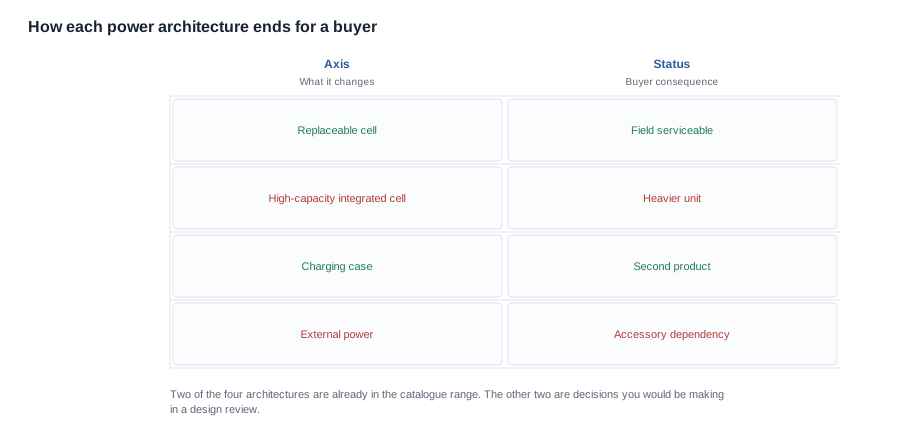
The matrix above gives the first-order outcome of each architecture. Two of the four change what the customer has to carry or do; the other two change what the factory has to build and document. Which matters more depends entirely on the operation, and that is why the next four sections each state the conditions rather than giving a ranking.

The removable cell: what it fixes and what it adds to the cost
The removable cell is the architecture that the rest of the industry in adjacent categories converged on, and the reason is straightforward. It converts a runtime constraint into an availability problem, and availability is something a site can solve with inventory rather than with engineering. A technician who can swap a cell at the start of a shift does not need a long-running unit, and a programme with a spare pool does not need the pool to be charged on a schedule.
What it adds is a second product, a mechanical interface and a process.
The criteria that decide this architecture are narrower than they first appear, and they can be listed. The removable cell is the right answer when the operator has to work away from any charging point and cannot swap during a shift, when the site already has a disciplined spare-parts process, and when the programme is prepared to run the cell as a revenue-bearing accessory. It is the wrong answer when the product is sold as a single retail unit, when the operator is at a desk, and when the accessory business would be an unplanned addition to the commercial model. A buyer evaluating this architecture should ask what the accessory operation involves in year two, and the honest answer is that most programmes have not thought about it. The cell becomes a separately orderable part with its own part number, its own minimum order quantity, its own warranty, its own transport documentation and its own place in the accessory line. The enclosure has to carry a door, a latch, contacts and a sealing arrangement, and every one of those is an engineering cost that appears once in the tooling and then in every unit that carries it. The quality control has a new failure mode, because a cell that is inserted incorrectly can produce a unit that appears to work and does not, and that failure is harder to detect at the dock than a dead unit is.
The commercial consequence is usually decisive for a programme at volume. A removable cell makes the accessory business a real part of the programme, with its own revenue line and its own operational load, and a brand that did not intend to run an accessory business discovers that it now has one. For a retail product sold as a single unit, the cell is almost always an accessory that the customer will not think to order.
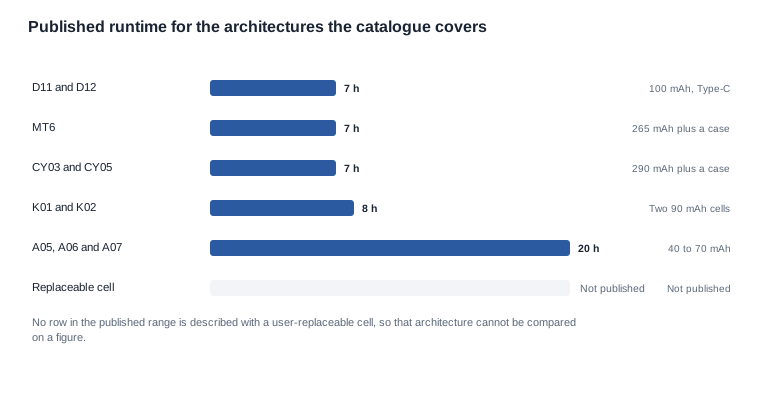
The chart shows the published runtimes for the architectures our range actually covers, and the final bar is the honest statement of the position: the removable-cell architecture has no published figure in our catalogue because no model in the range uses it. That row is not published rather than zero, and the distinction matters for anyone building a comparison on published data.
The high-capacity integrated cell: where the weight and the charge time go
The integrated cell is the default, and the reason it survives is that it is the cheapest way to ship a product with a runtime: one cell, one enclosure, one set of tooling, one quality control path, one transport file. Every alternative pays a penalty that the integrated cell does not.
The first penalty is mass, and it lands on the operator rather than on the invoice. Our range publishes one weight, and it is instructive about how partial a published weight usually is: the MT6 glasses body is 158 g including its 265 mAh cell and its camera, and the folding charging case at 1200 mAh is excluded, with the weight of the case itself not published. So the number that can be quoted to an operator describes the part of the product the operator carries all day and none of the part that makes the product work away from a dock.
The second penalty is charge time, which grows with capacity inside a fixed thermal envelope.
The integrated cell also has a decision cost that is easy to overlook, because it is invisible until it is incurred. It fixes the runtime of the product at the point the enclosure is designed, and it does so at a moment when the duty cycle is usually least well known. The criteria that decide whether that is acceptable are simple: whether the shift length is settled, whether the load profile is understood, and whether the programme expects to change the operating pattern after launch. If any of those three is uncertain, the integrated cell has locked in a decision that will be expensive to reopen, because reopening it means a new enclosure and a new certification position. This is also the point at which the total cost of a runtime constraint becomes visible: it is the cost of the tooling that has to be repeated for every revision, which is a figure that does not appear on any quotation. The catalogue publishes a charge time for every model — ≤ 2h on most rows and ~1h on the two Type-C sports models — so the direction is on the record even though the figure carries no starting state, and it is the reason the integrated cell is the wrong answer for a short-turnaround operation.
The third penalty is flexibility of the range itself. Because the cell is inside the enclosure, adding capacity to a model is a design change rather than a configuration option. That is why our published range clusters around a small number of platforms rather than spanning a continuum: 40 mAh on the smallest children's rows, 55 to 115 mAh across the audio models, 220 to 290 mAh across the camera models. The steps between them are platform decisions, and each one carries a new tooling and a new certification position.

The charging case: a second product inside the box
The charging case sits between the integrated cell and the removable cell, and it is the architecture most often chosen by accident rather than by decision. It buys hours away from a dock without changing the unit, and it costs a second product, a second cell and a second transport file.
The cost side is worth quantifying in structure even where the numbers are not published. The case needs its own cell, its own enclosure tooling, its own electronics, its own assembly slot on the line, its own quality control checks, its own packaging artwork and its own entry in the transport declaration, because a second lithium cell travelling in the carton changes the classification and the documentation. If the case ships in the box, its quantity follows the unit quantity and the tooling amortises easily. If it is sold as an accessory, its quantity follows accessory demand, the same tooling is spread over fewer units, and the accessory price per unit rises above what the buyer expected.
The benefit side is that the case extends the working day rather than the single-shift runtime,
The criteria that decide the case are about access rather than about hours. The case is the right answer when the operator spends part of the shift away from a dock, when the unit's own runtime clearly covers the period between dock visits, and when the programme accepts a second product in the carton. It is the wrong answer when the operator is at a dock continuously, when the customer expectation it creates is that the product simply runs all day, and when the transport documentation for the second cell has not been costed. Before you order, what to ask the supplier is specific: the measured top-up count on the production units rather than on the engineering sample, the number of full charges the case itself needs between shifts, and the lead time for the case as a separate line in the quotation. and it extends it without making the unit heavier in the hand. For a profile where the operator works away from a dock, that is exactly the right shape of solution; for a profile where the operator is at a dock all day, it is an accessory the customer pays for and does not use.
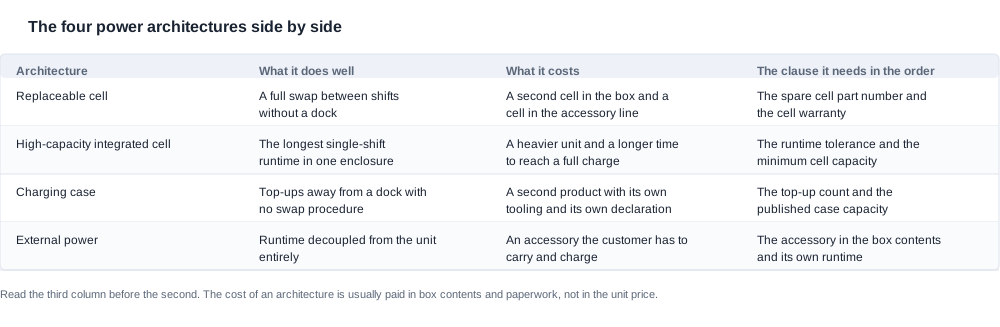
The table sets out the four architectures with the clause each one needs in the order. Read the third column before the second one, because the cost of an architecture is usually paid in box contents, in tooling and in paperwork rather than in the unit price, which is the number most buyers compare first.
The top-up count is the figure that decides this architecture in practice, and it is not published for any model. A case of 1400 mAh against a 290 mAh cell produces a theoretical count that no operating procedure can rely on, because the transfer is never complete and the unit does not accept a full charge every time. A buyer who specifies a case without measuring the count on the production units is specifying an aspiration.

External power: the runtime you buy as an accessory
External power takes the constraint out of the product entirely. The unit runs from a removable or rechargeable source that the operator carries and charges separately, and the runtime becomes a property of what the operator brings rather than of what the manufacturer built. For an operation where people already carry a battery pack for a phone or a tablet, this is an efficient answer: the marginal cost of another hour is the cost of another pack.
The trade-offs are real but they are different in kind from the others, because they fall on the customer rather than on the factory. The unit has to expose a power input that accepts an external source, which constrains the enclosure and the connector and adds a port to a product that otherwise has none. The accessory has to be supported, stocked, warrantied and replaced, which puts it on the after-sales footing of the product itself. The customer has to be told to carry it, and that instruction has to appear in the manual, the product page and the training, because a customer who leaves the external source at home has a unit that does not work.
The commercial question is whether the accessory is a product you intend to sell or a dependency you are passing to the customer.
The criteria for external power are narrower again, and they are about the customer rather than about the product. It is the right answer when the operator already carries a battery source as part of the job, when the operating environment makes a port on the enclosure acceptable, and when the brand is prepared to support, stock and warrant the accessory. It is the wrong answer in retail, where the instruction to carry an extra item is an instruction that will not be followed, and in any market where the return rate on a product that does not work without an accessory will be attributed to the product. A buyer should treat external power as a decision about the accessory business first and about the hardware second, because in practice it is the accessory business that determines whether it works. A brand that is not prepared to run an accessory line has very little business making the runtime depend on one.
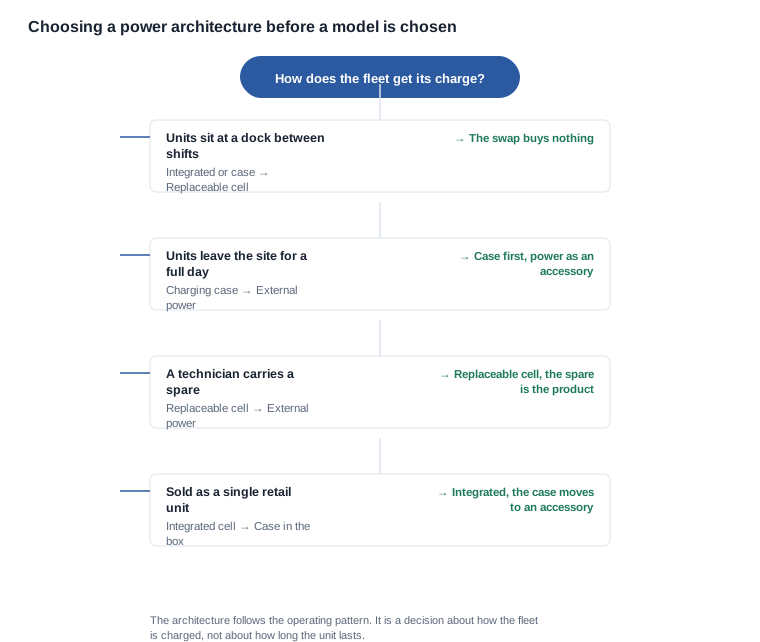
The decision tree above routes the choice by the way the fleet is charged rather than by the hours it needs. That is the right order of questions, because the architecture follows the operating pattern and the operating pattern is usually known while the runtime requirement is usually an estimate.
The battery comparison matrix, and where it stops short of a decision
Read together, the four architectures separate along two axes that are worth naming explicitly, because a buyer who does not name them will compare the wrong things.
The first axis is where the constraint is solved. The removable cell and the integrated cell solve it inside the product; the case and external power solve it outside it. A buyer who wants the constraint solved inside the product is buying a design decision and will pay for it in tooling and in mass. A buyer who wants it solved outside is buying an ecosystem and will pay for it in the accessory business and in the customer's behaviour.
The second axis is who carries the burden. The integrated cell carries it on the operator's head and on the factory's paperwork. The removable cell and external power carry it on the operator's logistics. The case carries it on the operator's hands, on the customer expectation and on the transport declaration.
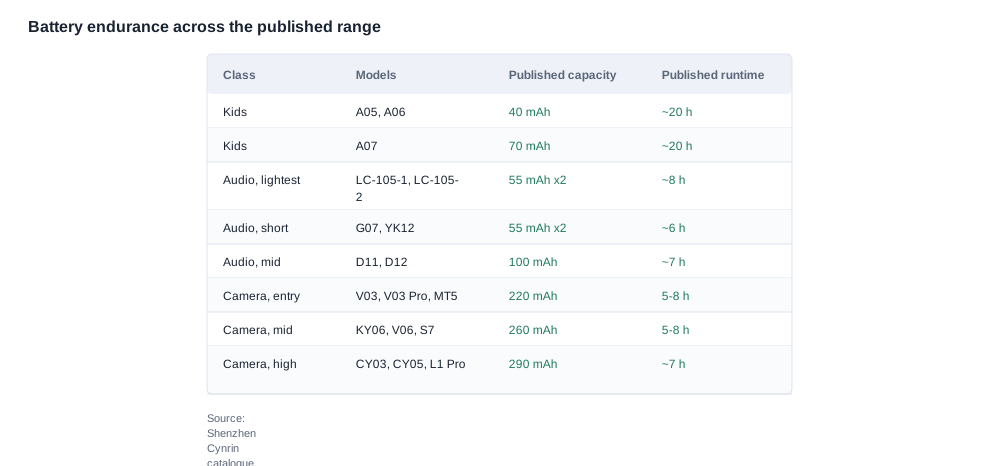
Two limitations of this comparison should be stated rather than glossed over. The first is that we publish no unit prices, no tooling charges and no lead times for any of the four architectures, because those are quoted per order and a typical figure is one you cannot verify. The second is that the runtime figures published for our range are ratings produced under one stated condition each, and comparing a rating with a rating across two architectures is only meaningful if the conditions are the same. The method behind them is set out under smart glasses battery life and power.
What we can say is which architecture each published model belongs to, which is the useful starting point. The camera models with a case are case-based. The audio models are integrated, with a magnetic contact or a wired connector. The children's rows are integrated with a very high runtime-to-capacity ratio. The camera platform detail that decides the rows is on the camera imaging page, and the audio models are listed on the bluetooth audio glasses range page.
The comparison stops at the sample. Every architecture above produces a different answer to the question "how long can this unit do its job", and none of them can be settled from a catalogue, because the answer depends on the load, the temperature, the starting state and the end point. The protocol is in how to test smart glasses battery life, the sample process is on the sample evaluation page, and the recurring comparison errors are in battery life common mistakes.
Send us the models you are considering, the operating pattern and the duty cycle, and we will tell you which architecture each model belongs to, what each one commits the programme to, and which of the two axes is the one that decides your case.


