

Ask a smart glasses supplier which battery standard their product meets and the usual answer is a battery capacity in milliamp hours. That is not a standard, it is an inventory figure, and the distance between the two decides whether your product page can say anything a customer will test. Our own catalogue makes exactly the same kind of statement: it publishes capacity, charge time and rated use for each model, and it names no test standard, no cycle life and no battery chemistry for any of them.
That gap is worth examining rather than tolerating, because battery life is the specification customers compare most often and understand least. A standard is not paperwork to be collected after the product is designed. A standard is the document that defines what a number means, and when the number arrives without the standard, the buyer has to supply the definition or do without it.
The map below is organised as a stack, from the binding requirement at the top to the data at the bottom. The purpose is not to make a buyer an engineer. It is to let a buyer ask a supplier the one question that separates a usable answer from a brochure line, and to know what to do with the answer: file it, request it, or write the specification themselves.
Smart glasses battery life: the standards stack behind a battery specification
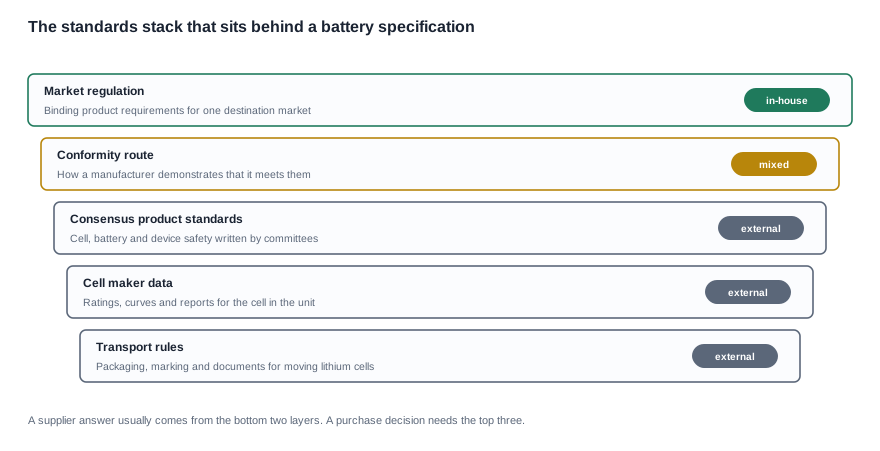
Market regulation is the only binding layer. It says what a product must satisfy to be placed on a given market, and it is written by a regulator rather than a committee. Everything below it exists to provide evidence that the requirement has been met, and nothing below it can override it. A consensus standard that has not been cited in the relevant regulatory route is a good practice document, not a permission to sell.
The conformity route is the path a manufacturer follows to demonstrate compliance, and it defines the artefacts: the assessment, the technical file, the declaration, and the marking. In the European Union this is the route under the radio equipment framework, Directive 2014/53/EU. In the United States it is the equipment authorisation route under the FCC rules. The route determines who does the work, whether a third party is involved, and what the buyer is entitled to ask for.
Consensus product standards are written by technical committees and describe how to test a thing. They cover cells, batteries and devices, and they are the layer that gives a capacity or a safety figure its meaning. A test report against a named standard is worth considerably more than a capacity printed in a table, because the reader can reconstruct the method.
Cell maker data is the bottom layer and the most specific: the rating, the discharge curve, the test report and the batch records for the actual cell that goes into the product. This is where a supply chain failure starts, because a cell can be swapped at this level without changing any of the documents above it, and the documents above it will still look valid.
Transport rules sit alongside the stack rather than within it, because they apply to the shipment rather than to the product. The UN 38.3 test criteria, derived from the Manual of Tests and Criteria, are the most frequently quoted battery document in this category, and they are also the most frequently misunderstood, because a summary for a cell is regularly presented as though it were a certificate for the finished product.
The ordering has a practical consequence for a buyer. When a supplier answers a standards question, the answer will usually come from the bottom two layers, because that is where the supplier's own information sits. A purchase decision, however, needs the top three, because that is where the obligation and the evidence sit. The gap between the two is the gap a buyer has to close.

A test report, a certificate, a declaration and a technical file are not interchangeable
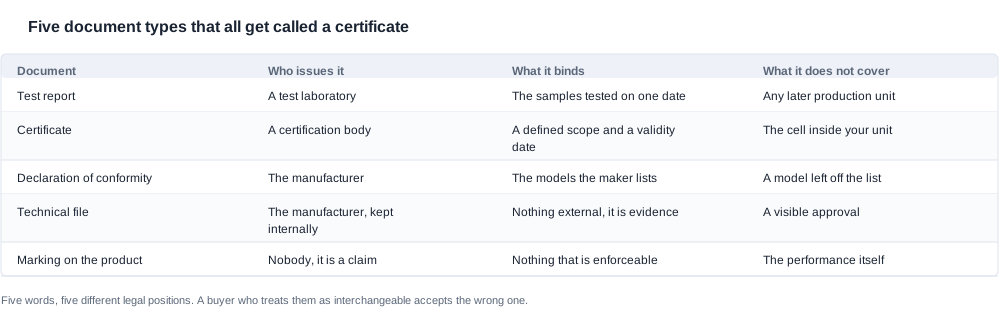
The single most common failure in this category is a vocabulary failure. Five different document types are all called a certificate in ordinary supplier conversation, and they carry entirely different legal positions.
A test report is issued by a test laboratory. It binds the samples tested on a particular date under a particular standard. It says nothing about any unit produced later, which means it is an input to a conformity file rather than a substitute for one. A buyer who receives a report should check the model, the date, the standard and its edition, and should understand that the report describes a sample rather than a product.
A certificate is issued by a certification body against a defined scope, with a defined validity and a certificate number. The scope is the important part. A certificate can cover a product family, a specific model, a specific configuration, or a specific cell. A buyer who has a certificate and has not read the scope has not established anything.
A declaration of conformity is issued by the manufacturer, not by a third party. It binds the manufacturer to the models it lists, and a model that is not on the list is not covered. This is the document that most often bites a private-label buyer, because the factory's own item number and the brand's item number are different numbers and only one of them appears on the list.
A technical file is kept by the manufacturer and is not issued to anyone. It is the evidence that supports the declaration, and the buyer is entitled to see it or to see the parts of it that matter, but it is not an approval and it carries no mark.
A marking on the product is a claim by the manufacturer, and nothing more. CE, UKCA and the various national marks are self-declarations in the majority of routes, with a third-party involvement only in specific cases. A mark on a product without a declaration behind it is a claim, and a claim is exactly what a compliance review tests.
The buying implication is direct. When a supplier offers a document, the useful follow-up is not "is that valid" but "which of these five is it, who issued it, what scope does it name, and does the scope contain the model I am ordering". A buyer who cannot answer those four questions cannot use the document in a due diligence file, and cannot use it in a technical file of their own.
Cell standards, device standards and radio standards each solve a different problem
Three families of standard are relevant to a battery-powered connected product, and confusing them is the second most common failure after the vocabulary problem.
Cell and battery safety standards exist to establish that a cell will not ignite, vent or short-circuit in a defined set of abuse conditions. In Europe the reference is the IEC 62133 series for portable secondary lithium cells and batteries; the United States route adds its own certification requirement for lithium batteries, and a buyer shipping there needs the applicable document from a certification body rather than a laboratory report. These standards are about survival under abuse, not about runtime, and a test report against them says nothing about how long the product works.
Battery performance standards exist to establish how a cell behaves under a defined discharge, and the IEC 62660 series is the relevant reference for portable secondary lithium cells and batteries. This is the family that actually speaks to the buyer's question about runtime, because it defines the method: the discharge profile, the cutoff, the temperature and the endpoints. A cell tested under this family can be compared with another cell tested under it, and a cell tested under something else cannot.
Device safety standards apply to the product rather than to the cell. IEC 62368-1 covers audio and video and information technology equipment, which is the closest fit for a connected wearable, and the charger supplied alongside it may sit under a different framework from the device it charges. These standards address thermal, fire and electric shock risk for the assembled product, and they touch the battery because the battery is usually the largest energy source in the device.
Radio and electromagnetic compatibility rules are the fourth leg and are the one buyers are most used to. They cover the radio behaviour and the emissions of the product rather than its cell, and they produce the assessment and the declaration that a market expects. The Bluetooth trademark and licence terms are a separate obligation again: qualification of the product against the Bluetooth specification is what allows the mark to be used, and the qualification listing identifies the qualified design.
Environmental and substance frameworks produce a declaration covering restricted substances in the product, and that declaration is written against part numbers rather than against product names. A cell substitution therefore produces a new substance question even when the finished product is unchanged.
Management system standards are a category a buyer should classify separately. ISO 9001 for quality management and ISO 14001 for environmental management are factory-level certificates. They say that the factory operates a documented system. They say nothing about the cell in your unit, nothing about your model, and nothing about the product you receive. Treating a management system certificate as a product approval is a category error, and it is one of the most common red flags in supplier documentation.
The standard families that address the lens rather than the cell
A separate set of standards governs eye protection, with ANSI Z87.1 in the United States and the EN 166 family in Europe as the familiar references. These matter to a buyer of the children's protection models and to any configuration sold into occupational or safety use, because they define lens impact performance and the marking that has to accompany it. Our catalogue carries no lens standard marking for any model, and we will not infer one from a product description. The question to ask is whether a specific lens configuration in a specific colour was evaluated against a named standard, and the document that answers it has to name the configuration.

There is no runtime standard for this category, and what fills the gap
The uncomfortable finding for anyone comparing battery claims is that there is no consensus standard for the runtime of a wearable device. There is a standard for cell performance, a standard for cell safety, a standard for device safety and a set of radio rules. None of them defines how long a pair of smart glasses should last.
Three things fill the gap, and a buyer should know which of the three a supplier is relying on.
The first is a laboratory method borrowed from cell testing. This is a legitimate approach: discharge the assembled product under a stated profile and record the result. The problem is that the profile has to be published with the result, and where it is not, the number cannot be compared with any other number, including the same supplier's number on a different model.
The second is a working party or an industry association guideline, which is softer than a standard and better than nothing. It typically sets out a duty cycle rather than a continuous discharge, which is closer to real use and further from a laboratory, and it is still a document with a defined method that a buyer can ask for.
The third is a manufacturer's own published figure, which is what most of this category actually offers. Our catalogue is an example: the camera models publish a mix of ranges and point figures, the audio models publish point figures, and none of them carries a stated condition. The V03 and the V03 Pro publish five to eight hours, the V06 and the S7 publish five to eight, the KY06 and the MT5 publish six to eight, the L1 Pro and the CY03, and the CY05 and the L2 Utral publish roughly seven, the MT6 publishes roughly seven, the D11 and the D12 publish roughly seven, the K01, the K02 and the LC-105 pair publish roughly eight, the G07 and the YK12 publish roughly six, the sport models publish roughly eight on the YKC02 and the ZH12 and roughly seven on the D17, the children's models publish roughly twenty, the AR entry publishes roughly eight, the electrochromic model publishes roughly seven and the bone conduction model publishes roughly seven. Every one of the twenty-eight publishes an hours figure, and not one of them publishes the condition behind it.
The observation that matters for a buyer is not that the numbers are wrong. It is that a figure without a method is a claim rather than a measurement, and a claim is something the brand's own customer will test. Where a supplier will not supply the method, the buyer's only route to a comparable number is to create one: fix the duty cycle, fix the temperature, fix the signal condition, fix the starting state, measure a sample from the actual production batch, and publish the protocol alongside the result. A laboratory's competence under ISO/IEC 17025 is worth asking about for the same reason, because it tells you whether the measurement is repeatable by someone else.

Reading a supplier's compliance sentence character by character
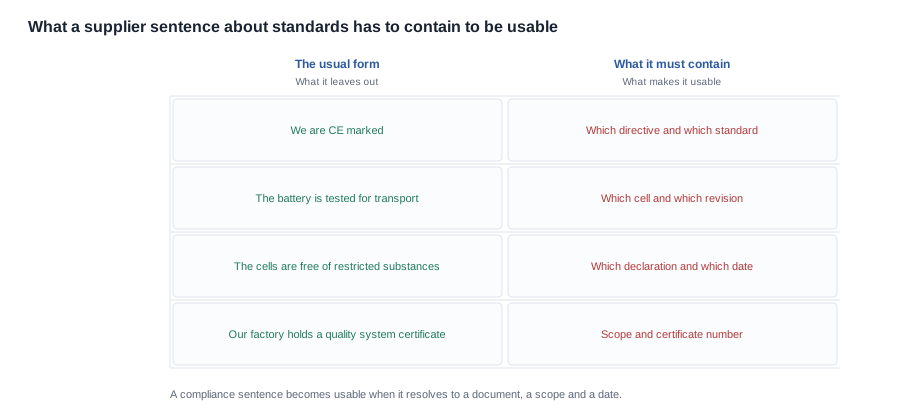
Compliance sentences are short, and every one of them has a specific missing clause. These are the four that appear most often, and what has to be added to each.
"We are CE marked." The missing clauses are which directive or regulation the marking rests on, which standard or essential requirement was applied, whether a third party was involved, and which models the declaration lists. Without all four, a buyer cannot tell whether their branded configuration is covered.
"The battery is UN 38.3 tested." The missing clause is which cell, and the summary should carry the part number. It should also say whether the document covers the cell alone or the assembled pack, because a buyer who assumed the pack is covered has a gap in their transport file that only surfaces at the forwarder.
"The cells are RoHS compliant." The missing clauses are which declaration, which date, and which part numbers. A substance declaration is written against parts, not against a product, so it does not survive a cell substitution.
"Our factory is ISO 9001 certified." The missing clauses are the scope, the certificate number and the site. This is a factory statement, and the buyer's question should be about what the certificate covers, not whether it exists.
The same exercise applies to the Bluetooth claim. "Bluetooth 5.4" is a version, and the version is only half the statement. The other half is the qualification listing, which names the qualified design, and it is that listing which tells a buyer whether the product they will receive is the one that was qualified. It also has a commercial dimension: a licence arrangement attached to the mark has conditions that a buyer distributing in volume needs to know about.
What a standards gap actually costs a buyer
A gap in the document set is not an abstract problem, and the total cost of closing it late is worth naming, because it is the argument that gets a compliance request prioritised inside a buying organisation.
The direct cost is a supplier-side engagement. Every document that has to be sourced after the order is placed is a document someone has to chase, and the chase is charged to a person rather than to a process. That is a real cost and it is small, but it is the cost buyers underestimate because it does not appear on a quotation.
The schedule cost is larger and it is not proportional. A transport file that is not ready stops a consignment rather than delaying it, because a carrier declines. A declaration that does not list the buyer's configuration stops a sale, and the correction is a new document, not an amended one. A substance declaration that does not cover the substituted cell creates the same class of problem at a different layer, and it is discovered at the port rather than at the factory.
The commercial cost is the one that is hardest to see. A brand that has launched on a runtime claim with no condition behind it discovers the exposure through a customer rather than through a review, and the remedy at that point is a product page change, a support script change and possibly a withdrawal from a marketplace. Compare that with the same claim rewritten around a figure the brand measured on its own production batch, where the exposure was closed before the first order.
That is the argument to make internally, and it is a stronger one than a request for documentation. The due diligence question is not whether a supplier holds a certificate. It is whether the brand can say, in writing, what the number on its product page means, and back that sentence with a document that names the model the customer will receive.
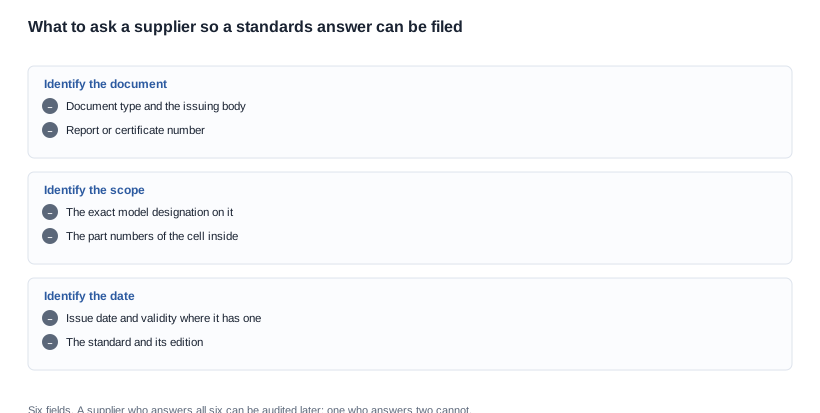
The practical request, therefore, is six fields: document type, issuing body, report or certificate number, exact model designation on the document, issue date and validity, and the standard with its edition. A supplier who answers all six can be audited by a third party later. A supplier who answers two has given a marketing line, and the buyer's due diligence has to supply the rest.
The standards questions to attach to a battery specification
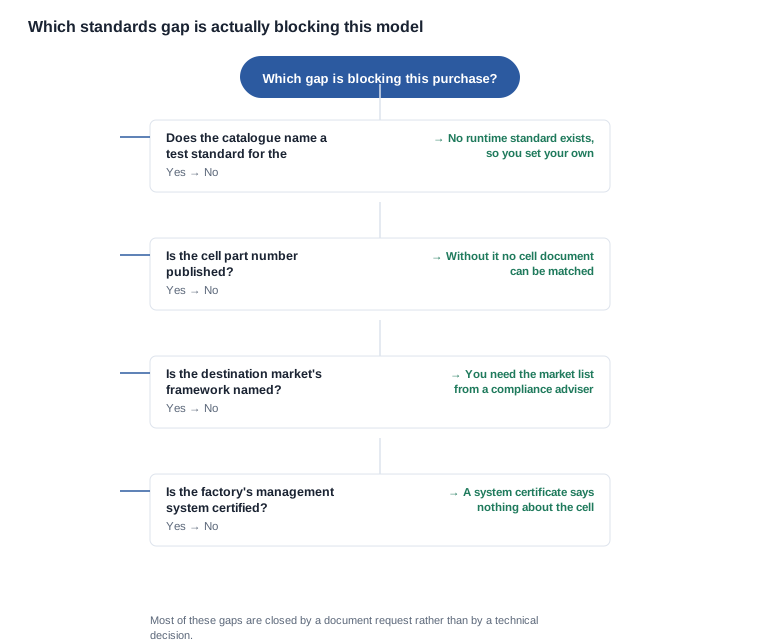
The six fields above are the file. The questions below are the specification, and they are the ones that change what a buyer can promise downstream.
- Which test standard was the rated runtime produced under? If there is one, the answer comes with a method. If there is not, the buyer writes the method, and the supplier either measures against it or declines to.
- What is the cell part number, and which cell documents name it? A part number is the join key between the product and every document in the stack.
- Which document names the model being ordered? The model list on the declaration is the document that decides whether a branded unit is covered.
- What is the cycle life figure, or what is the test plan? This is the row that decides the second-year warranty, and it is the row most often missing.
- What is the battery chemistry, and what are the transport consequences of that chemistry? It changes the cell document set, the low-temperature behaviour and the shipping profile.
- Which standards position the product, and for which configurations? A family answer is a screen. A configuration answer is a specification.
Two red flags deserve their own name. The first is a supplier who attaches a standard name to a published runtime without a method, which is worse than attaching nothing, because it invites a buyer to skip the question. The second is a document for a different model with a similar name, which in a range like this is easy to miss: the LC-105-1 and the LC-105-2 differ by a single character, and the V03 and the V03 Pro differ by a suffix, and in both cases an unchecked reference can point at the wrong unit.
Our own position is that we publish the capacity, the charge time, the rated runtime, the charging interface and, on the models that carry one, the case capacity, exactly as the catalogue states them, and that we will not attach a standard name, a test condition or a cycle life figure to a number that arrived without one. The catalogue's front page carries a company-level export certification page the content on it being images rather than text, the catalogue text leaves CE, FCC and RoHS unmentioned, and there is no per-model certification row for any of the 28 models, so a model-level certification claim cannot be derived from it, and the applicable scope for a model and a market is written material to be requested and filed before the order. We publish no runtime of our own, because producing one would mean choosing a test condition on the manufacturer's behalf and presenting the result as though it were a specification.
There is a commercial side to this, and it is where a buyer can get a real concession rather than a courtesy. A specification that names a test condition, a cycle count and an end-of-life capacity is a specification a supplier can be held to, and holding a supplier to it is worth more than a small unit price reduction. Equally, a supplier who will not agree to a condition on a runtime figure is telling the buyer something about how the rest of the programme will run, and that is information worth having before the deposit rather than after it.
If you need the chemistry, the cycle life, the transport test status or the specific certification position for a particular model, ask us and we will tell you whether the source can answer. Where it cannot, we will say so rather than substitute a plausible value.
The published rows are at battery life, the interface and charge time side is at charging solutions, the transport position is at certification requirements, and the obligations these documents discharge are set out in how regulations affect battery life.
Related reading
- Reading rated-use figures honestly — battery life
- Interface and charge time — charging solutions
- What the transport position looks like — certification requirements
Tell us the models you are comparing, the target market and the runtime your customer needs and we will come back with what is published.


