

The battery is frequently the component that decides the delivery date, and the reason is not a manufacturing insight so much as a procurement one. A cell is bought from somebody else's factory, on somebody else's minimum, behind somebody else's queue, and almost everything else in the product can be built in parallel with it while the cell cannot. A programme with a well understood electronics schedule and an unconfirmed cell schedule has, in practice, a battery schedule.
This is a page about how to see that schedule before you commit to it, rather than about a number. We do not publish our own lead times, our production capacity, our minimum order quantities, our cell lead times or our tooling lead times, because a general figure on a website is a promise nobody can keep and a buyer cannot act on. What we can do is set out the dependencies that actually sit on the critical path in this category, and give a buyer the questions that find them in a quotation.
The commercial argument for doing this early is simple. A date that turns out to be wrong is not an administrative problem. It moves a launch, it moves a marketing commitment, it moves a payment node, and it moves the point at which the buyer's own packaging and distribution work has to start. A buyer who learns the constraint in week one can change the plan; a buyer who learns it in week six has to absorb it.
Smart glasses battery life: a lead time is a dependency chain

The most common way a quoted date goes wrong is that it is a sum rather than a maximum. Everything on the chart above happens, most of it happens in parallel, and the programme finishes when the longest chain finishes. A supplier who adds the cell, the tooling, the validation and the freight to produce a total is describing a programme where nothing overlaps, which is not how any factory actually works and is therefore a number with no basis in either.
The second way a quoted date goes wrong is a change of basis. Ex-works and delivered dates differ by a shipping period and by the risk that sits in between, and a programme that has been planned against one and contracted against the other carries the difference as a surprise. A date that does not say which basis it is on is not a date, it is an intention.
The third is an unstated assumption about what already exists. A programme that is a first production run on an existing platform is a different programme from one that includes new tooling, a new lens and a new dock, and a quoted date that silently assumes an existing tool is not optimistic, it is simply wrong. The assumption has to be named in the quotation, because it is the assumption that will be discovered to be false.
The fourth is the one that catches most first orders. A factory runs several models on the same line, and a model with a long queue behind it will not be moved forward for a small order. A buyer who asked for one model's lead time has asked about the model, not about the line, and the answer they got is a statement about a queue they are standing behind rather than a promise about their own units.
The four things that have to be true for any quoted date to hold
- The cell is booked on a date, not promised on a date. A booked date is a position in the cell maker's queue. A promised date is a guess about that queue. Only one of them can be checked.
- The tooling exists or has a try-out budget. A mould has to be cut, polished, fitted and tried, and the try-out is iterative. The number of iterations is not predictable in advance, which is why a tooling programme carries a contingency that a quotation rarely shows.
- The validation units are accounted for. Every unit consumed by measurement is a unit not available for sale, and the first shipment is usually the shipment where this hurts.
- The transport file is ready before the goods are finished. Documentation that has to exist before a consignment can move is a production-scheduling item, not an administrative one.

The cell, the case and the lens are the three queues a buyer cannot see
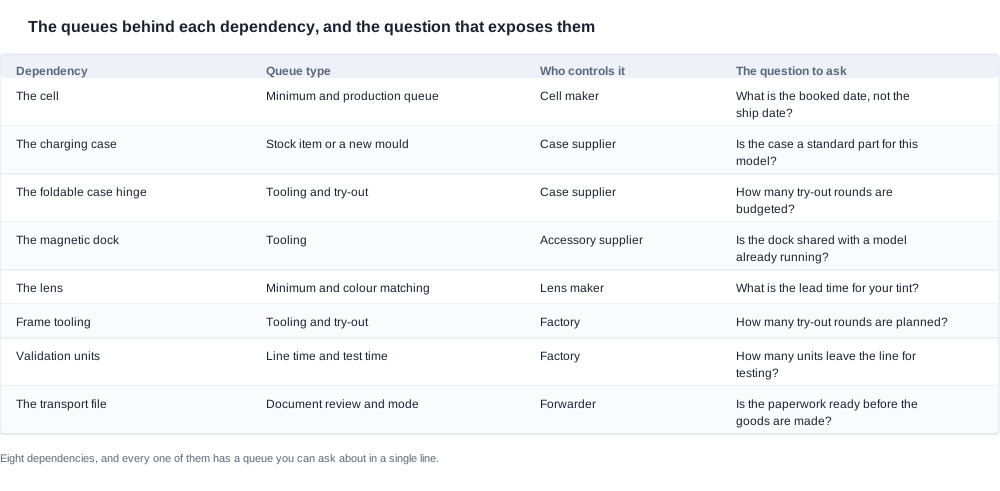
Three dependencies sit outside the factory's own control, and all three are queues rather than work.
The cell is the usual longest item. Cell makers plan to their own production, work to their own minimum order quantities, and hold a queue for any given model and rating. A product that specifies a common cell in a common rating will be served faster than a product that specifies something slightly unusual, and the difference between the two is not a fraction of a week. This is why the cell has to be settled earlier than the rest of the electrical design. A programme that will decide the cell when the case is designed has already lost a month, whatever the quotation says.
The published capacities in our range make the point, because each is a separate purchasing conversation. Forty milliamp hours on the A05 and the A06, fifty-five on each of two cells in the LC-105-2 and the LC-105-1, and the G07 and the YK12, seventy on the A07 and on each of two cells in the YKC02, ninety on each of two cells in the K01 and the K02, one hundred on the D11, the D12, the ZH12, the AR entry and the electrochromic model, one hundred and fifteen on the D17, two hundred on the bone-conduction entry, and two hundred and twenty to two hundred and ninety across the camera models.
The case is a second component with its own tooling and its own cell, and it is the item most often assumed to be free because it is already in the box. The CY05 and the L1 Pro, and the CY03 carry a 1400 mAh case, the L2 Utral carries a 900 mAh or a 1400 mAh case, and the MT6 carries a foldable 1200 mAh case that adds a hinge and a tolerance stack to a schedule. A case that is a standard part for an existing model is a different proposition from a new mould, and the MT6's foldable case is a good example of the difference: a folding mechanism is a mechanism, and mechanisms have try-out rounds.
The lens is the least visible item on the schedule and frequently the longest. A custom colour-change lens carries the lens maker's minimum and a colour-matching step, and the AR entry and the electrochromic model in our range are the configurations where a buyer should expect it. A programme that adds a tinted or photochromic configuration to an existing platform is adding a supplier, and a supplier with its own minimum, to a date that was probably quoted without it.
The practical consequence is that the cell, the case and the lens have to be identified as separate dependencies with separate owners, and their queues asked about separately. A buyer who receives one date for the programme has not received the information needed to manage it.
Tooling, validation units and the arithmetic of the first shipment
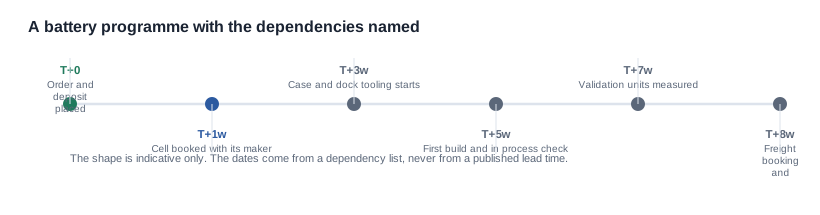
The timeline above is indicative rather than a promise, and it is drawn the way a buyer should draw it: as a set of named dependencies with a sequence between them, so that when one moves, the buyer can see which part of the plan absorbs it.
Tooling is the item buyers most often forget to ask about, and the one with the least predictable duration. A mould has to be cut, polished, fitted and tried, and the try-out is where the iterations happen. A supplier who has run this tool before will do it faster, and a supplier who is cutting it for the first time will not, and the difference between those two cases is the difference between a two-week item and a two-month item. The question that separates them is simple: how many try-out rounds are budgeted, and has this tool run before.
The charging dock is tooling too, and it is tooling that is frequently shared. A magnetic dock that already exists for a model in production is a procurement item. A new one is a tooling programme with a case and a design freeze in front of it. The question is whether the interface is shared with a model that already has it, because that is the difference between a week and a month.
Validation units are the quiet item that changes the first shipment. The charge time and the runtime have to be measured on production-intent units, and every unit consumed by measurement is a unit not available for sale. For a first order this matters more than for any other order, because the first order is usually the smallest one, and the validation quantity is a percentage of it. A buyer who asks how many units validation consumes has asked the one question that changes the arithmetic of the shipment.
The compliance assessments are the item where an existing platform has a genuine commercial advantage. Where an assessment is already held for the model code, that work is off the critical path, and a programme built on an existing platform starts shorter than a programme built on a new one for reasons that have nothing to do with the battery. The check is which assessments are already held for this model, and the answer needs to be per model and per market.
The shipment itself is constrained by the cell in the product. A restricted state of charge affects the mode, the paperwork and the cost, and a programme that leaves the mode undecided until the goods are finished has a transport delay waiting for it. The transport documentation and the packing instruction are set out under battery transport, and the wider logistics structure is at shipping and logistics.
Asking for a schedule that is a dependency list rather than a single number
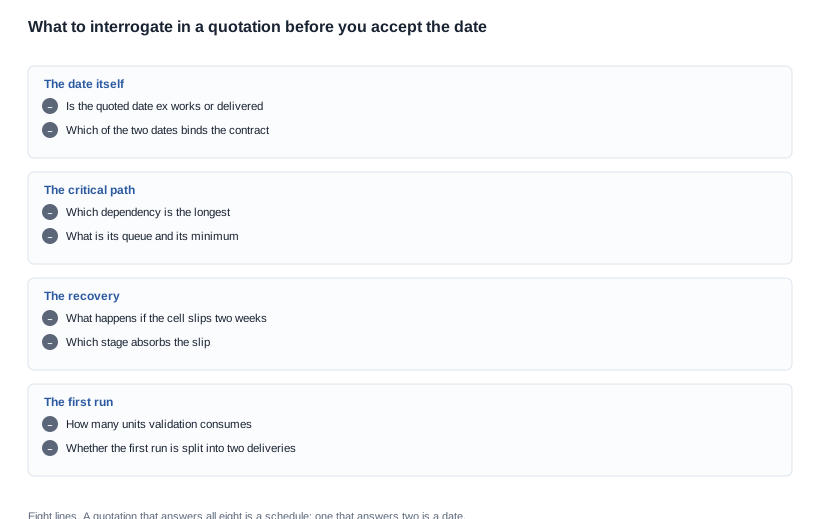
The single biggest improvement a buyer can make to a battery programme is to stop asking for a lead time and start asking for a dependency list. The request is eight lines, and every one of them has a checkable answer.
On the date itself. Is the quoted date ex works or delivered, and which of the two is binding in the contract. A programme planned against one and contracted against the other carries the difference as a surprise, and the surprise arrives at the port.
On the critical path. Which dependency is the longest, and what is its queue and its minimum. The answer to this question is the answer to every other scheduling question a buyer has.
On the recovery. What happens if the cell slips by two weeks, and which stage absorbs the slip. A supplier who has thought about the recovery has thought about the programme; a supplier who has not is assuming it will not happen, and the assumption will be tested.
On the first run. How many units validation consumes, and whether the first run is split into two deliveries. Both answers change the shape of the first order rather than just its date.
Two red flags are worth naming here. The first is a date with no dependency list attached, which usually means the date is a factory average rather than a commitment for this order. The second is a cell ship date presented where a cell booked date was needed, because a ship date leaves the entire queue unexamined.
There is a third, quieter one: a schedule that assumes the compliance work is already done. Where a programme is on an existing platform with held documents, that assumption is fair. Where it is a new model, a new market or a new configuration, the assumption transfers work to the buyer's team without moving any date, and it transfers it to the team that has the least schedule authority.
How to evaluate a schedule that has been given to you
The eight questions produce an answer, and the answer needs a criteria set to be evaluated against, otherwise a buyer is comparing one supplier's optimism with another supplier's optimism.
Three signs distinguish a schedule that was built from dependencies from one that was built from a template. A dependency-built schedule names the item that gates the finish, and that item is usually something outside the factory, most often a cell or a case. A template-built schedule shows every activity with similar durations and no item that is visibly longer than the others. A dependency-built schedule states a booked cell date and a separate cell ship date; a template schedule has one date and calls it the cell date. A dependency-built schedule names what happens if the longest item moves; a template schedule assumes everything holds.
When to escalate from a request to a negotiation is also a straightforward judgment. The answer is the dependency list plus the recovery plan: if the supplier can name the critical path, the queue behind it, and what moves if the critical path moves, the schedule is a real one and the buyer can plan around it. If the supplier can only offer a date, the buyer is not managing risk, they are accepting a number, and the total cost of that acceptance is a launch that slips and a payment node that fires against goods that are not finished.
The trade-offs are worth making explicit, because they are the ones that get made anyway. A shorter programme against a smaller validation sample trades a defensible number for a faster date, and the number is what the warranty conversation will need in year two. A faster programme against a standard cell trades product specification for queue position, and it is a trade the buyer should make deliberately rather than discover in a quotation. A faster programme against a shared existing tool trades customisation for schedule, and it is the only one of the three that is genuinely free.

What actually compresses a battery programme, and what only moves the pain
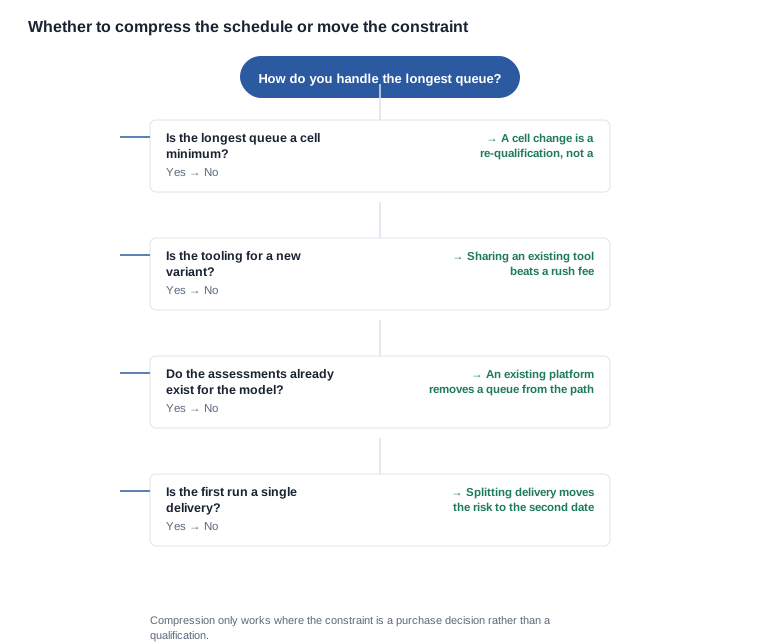
Compression means moving the finish date earlier without moving risk somewhere less visible. The four levers below are the ones that work, and the list of what does not work is just as important.
What works: sharing an existing asset. An existing mould, an existing dock, an existing case, an existing compliance position. This is the only lever that removes work rather than adding urgency, and it is the reason buying an existing platform is usually faster than commissioning a new one, even when the unit price is higher.
What works: choosing a cell from a stocked range. The cell that a maker holds in inventory is not the same as the cell that a maker would make for this programme. The buyer pays for that in a slightly less desirable specification, and receives it in a queue that is short.
What works: splitting the first run. Two deliveries against two payments moves the exposure from the second date to the first, and it lets the brand validate the first delivery with real units in the field before committing the rest of the volume.
What works: agreeing the design freeze date in the contract. A change after tooling costs far more than a change before it, and a contractual change window turns a schedule risk into a commercial one.
What does not work: a rush fee. It moves the factory's own sequence and usually displaces another order, which is a cost the supplier absorbs and a relationship cost the buyer does not see.
What does not work: a smaller validation sample. It produces a number that cannot be defended later, and a number that cannot be defended is not worth the days it saved.
What does not work: shipping a compliant configuration and fixing the paperwork afterwards. The paperwork is what the buyer discovers first, and it is discovered by somebody with no authority to fix it.
Where the commercial terms and the schedule are traded against each other
Stated plainly: a lead time is a schedule for a specific order in a specific configuration, and a general figure published on a website is a promise nobody can keep. We do not publish our lead times, our production capacity, our minimum order quantities, our cell lead times or our tooling lead times. We do publish the battery capacity, the charge time, the rated runtime and the case capacity for each model, and the charging interface for the twenty-four that carry one, which is the data a buyer needs in order to judge whether the product fits the use case at all.
What we will do is quote a schedule for a specific configuration, with the dependencies named, so that you can see which part is the constraint and which part is merely waiting for it.
The commercial terms are where a buyer has the most room, and several of them are schedule levers rather than price levers. The share of units taken at a pilot tier rather than a run tier changes the first shipment. Splitting a first run into two deliveries against a staged payment changes the exposure. Asking the supplier to fund a baseline measurement on the production batch changes the document that answers every complaint in the second year. The number of configurations committed to changes both the minimum order quantity and the artwork round count, and a configuration per colour is a configuration against the case and the dock as well as the frame.
The list below is what a buyer should negotiate for when the schedule is the problem, and it is deliberately not a price list. Before you order, the questions to ask are the ones above, and the negotiation that follows is about the dependency with the longest queue.
- A split first run with a payment node against the inspection, rather than a single delivery with a single node. This converts a schedule risk into a commercial one and costs nothing at the unit price.
- A baseline measurement funded by the supplier on the production batch. It is the document that answers the year-two complaint, and it is cheap for a supplier who already knows the result.
- A design freeze date written into the contract, with a change window that has a price attached. A change before the freeze is a conversation; a change after it is a cost.
- The share of units at a pilot tier, which reduces the exposure of the first shipment without reducing the eventual volume.
- The validation quantity stated in the order, so that the arithmetic of the first shipment is a number the buyer has agreed to rather than a number discovered on the packing list.
Two of the commercial terms are fixed rather than negotiable, and it is better to say so early. Certification cost and certification time are a fixed cost per configuration and a queue at the laboratory, and the elapsed time is set by the laboratory rather than by the order size. The tooling charge is normally a one-off cost amortised across the first order, so the questions worth asking are over what volume it is amortised and what happens to the tool if the programme is discontinued.
The remaining question is where the pressure belongs. If a programme is being asked to move faster without removing anything from the chain, the schedule will move and the risk will move with it, usually into a cell substitution or a shortened validation, and both of those land on the buyer's own quality file later. If a buyer names the dependency that is actually the constraint, a supplier can usually do something about it, because the answer is frequently a commercial decision rather than a production one.
Send us the model, the configuration, the volume and the destination market, and we will give you a schedule with the dependencies named, an indication of which one is the constraint, and the commercial levers that are actually available for that configuration. The published rows are at battery life specifications, the charging decisions that affect the schedule are at charging solutions, and the wider variables behind a delivery date are at lead time considerations.
Related reading
- The published battery rows — battery life specifications
- The charging decisions that affect the schedule — charging solutions
- The shipment side of a battery product — battery transport
- The variables behind a delivery date — lead time considerations
Tell us the model, the configuration and the volume, and we will give you a schedule with the dependencies named.


