

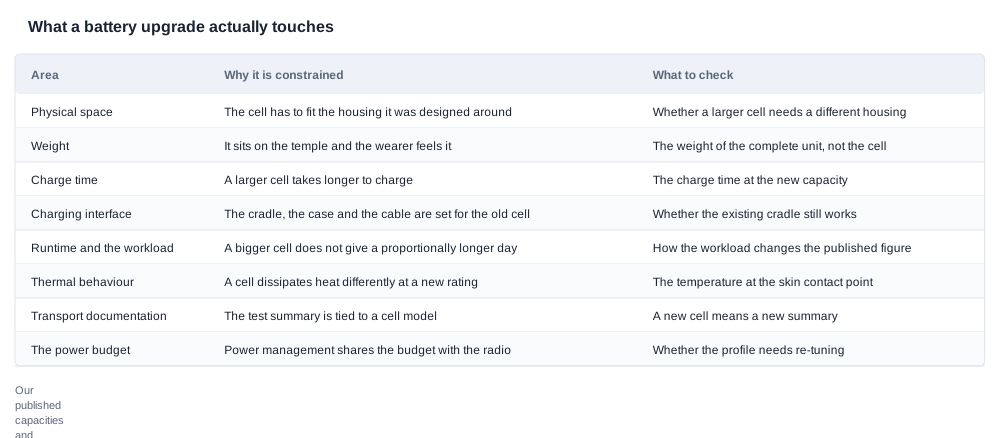
A battery upgrade sounds like a procurement decision and is actually a design change, and the reason is that the cell in this product form factor is not a self-contained part. It shares a physical space with the electronics, a weight budget with the temple, a thermal path with the housing, a charging interface with the cradle and the case, a power budget with the radio and the camera, and a set of transport documents with the shipment. Change one of those and you have changed the product.
For a buyer who already sells a model, the harder question comes first, and it is not technical: should you replace the product at all? This article sets out the triggers that justify pricing a replacement, the three answers a replacement decision can take, and the migration cost that sits behind the one that looks cheapest on a spreadsheet.
Smart glasses battery life: four triggers for a replacement worth pricing
A replacement is worth pricing when something has changed that the existing product cannot absorb. There are four such triggers, and they are worth separating because each one points at a different kind of spend.
The cell has aged out of the duty cycle. The most common trigger in this category, and the one that arrives as field data rather than as a decision. A product that was specified against a fresh cell reaches the end of its service life with less available capacity than it started with, and at some point the figure the customer experiences stops matching the figure the listing promised. The trigger is not a feeling that returns are rising; it is a measurement — the same workload, run on units of different ages, producing a gap wide enough to matter. A platform whose published runtime is about eight hours and whose field figure has drifted to five is a platform whose specification no longer describes the product.
The supplier has withdrawn or changed the platform. The second trigger, and the one with the least warning. A cell maker changes, a platform is retired, a charge path is revised, or a supplier restructures its line and the model moves to a different cell with a different charge curve. The trigger here is documentary rather than operational: a change notice, a new build sheet, a revised transport summary, or simply a supplier who stops answering the question about which cell is fitted.
The commercial case has moved. Unit price, minimum order quantity, tooling cost, packaging cost and freight profile all change over the life of a programme, and at some point the total cost of the existing arrangement exceeds the total cost of starting again. The trigger is the total cost comparison rather than the unit price, because the unit price is rarely the line that decides it.
The requirement has changed. A new market rule, a new market, a new feature demand, or a customer requirement that the current hardware cannot meet. Here the replacement is not optional in the way the other three are, and the question is not whether but how wide the change has to be. The European product safety framework is a live example of the shape of this trigger: the General Product Safety Regulation applies from 13 December 2024, and a requirement of that kind does not arrive as a request for a different product. It arrives as a documentation expectation attached to the product you already sell, and it moves the boundary between keeping, re-specifying and replacing. The practical response to this trigger is to scope it before deciding, because the scope determines whether the existing configuration can carry it.
The important discipline is to record which trigger fired. A programme that replaces a product without naming the trigger will make the same decision again in two years, because the reasoning that justified the first change is not written down anywhere.
Replace, re-spec, or keep: three answers and the evidence for each
There are three answers to a replacement question, and the mistake is to treat them as one. Each has its own evidence, its own cost profile and its own failure mode.
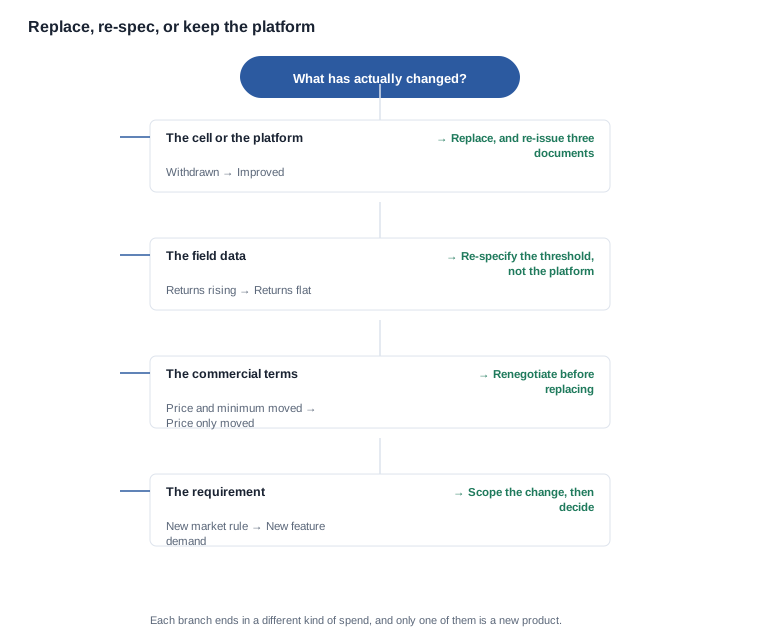
Keep is the right answer when the trigger is soft. A platform whose field figure has drifted slightly, whose unit price has risen modestly, and whose specification still describes the product closely enough for the channel does not need a new product; it needs a corrected claim, a revised warranty threshold and a renegotiated supply agreement. The evidence for keeping is the measurement: the same workload on current production units, compared against the same workload on units from three years ago, plus a total cost comparison across the next two supply cycles. The failure mode of keeping is denial — treating a drift as noise until the returns arrive.
Re-spec is the right answer when the platform can do the job but the specification does not describe it accurately. Re-specifying means changing the claim, the acceptance criteria, the warranty threshold or the configuration, without changing the product. It is the cheapest of the three answers and the one most often skipped, because it produces no new product and therefore no new launch date and no announcement. The evidence for re-specifying is a specification audit: which published row no longer holds, which condition was never stated, and which claim in the channel copy depends on the number that has drifted. The failure mode is re-specifying without correcting the copy, which produces a product that is accurate on paper and still wrong in the listing.
Replace is the right answer when the trigger is structural: the platform has been withdrawn, the cell cannot be sourced on the required terms, or the requirement cannot be met by any configuration of the current design. The evidence for replacing is documentary: a withdrawal notice, a component change, a regulation that applies to the new configuration, or a physical constraint in the housing. The failure mode is replacing what could have been re-specified, which converts a margin problem into a tooling problem.
The test that separates them is worth keeping in one sentence: if the cell, the housing and the charge path can stay, the answer is keep or re-spec. If any of the three moves, the answer is replace. Everything else in the decision is commercial.
Collecting the evidence for each answer is a smaller task than buyers expect, because most of it already exists in one form or another. For the keep option, the evidence is a measurement rather than a document: the same workload on current production units and on units of different ages, with the spread recorded rather than summarised. For the re-spec option, the evidence is a specification audit with three outputs — the published rows that no longer hold, the conditions that were never stated, and the listing claims that depend on the drifted number. For the replace option, the evidence is documentary and usually already in hand: a withdrawal notice, a revised build sheet, a transport summary for a different cell, or a requirement that the current housing cannot meet. The reason to gather all three sets before deciding is that they are cheap together and expensive separately, and because a trigger that looks structural can turn out to be a documentation gap that a re-specification closes.
The migration cost that never appears in the quotation
A replacement quotation contains the unit price, the tooling cost and the lead time. It does not contain the nine costs that make a replacement a project rather than an order, and the total of those nine is frequently larger than the tooling.
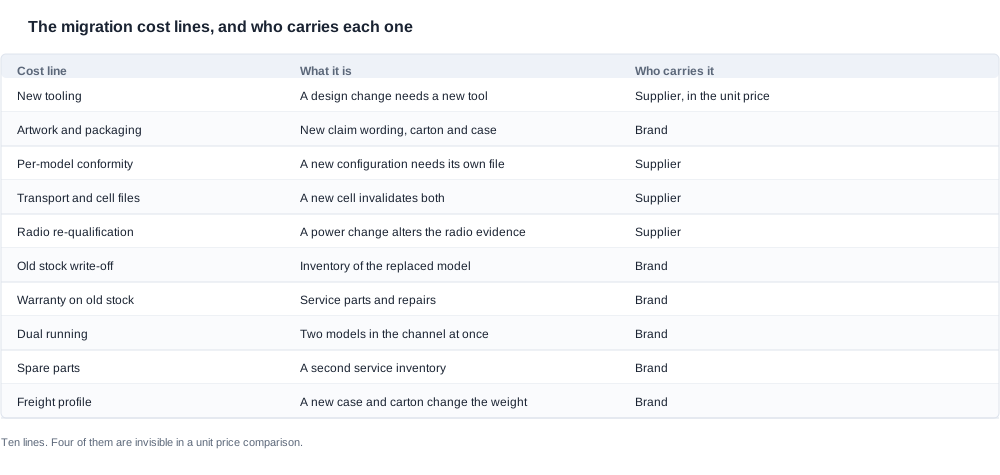
Tooling and the mould. A changed cell, a changed housing or a changed charge path usually means a new tool, and a new tool means a new minimum order quantity before the unit price reaches its final tier. The trade-off is between amortising the tool over a larger volume and carrying the inventory risk of a longer campaign.
Artwork, packaging and the claim. The listing changes, the carton changes, the manual changes, and the case may become a new SKU with its own packaging and its own freight weight. This is brand-side work, it is rarely in a supplier's quotation, and it is on the critical path for a launch date.
The per-model conformity file. A new configuration needs its own conformity position, and a family-level document does not cover it. This is the item most often discovered late, because it is invisible until the file is requested.
The transport and cell files. A new cell means a new transport test summary under the United Nations Manual 38.3 test standard and a new product cell file under the portable lithium cell safety standard, IEC 62133. Both must match the cell in the goods, and both are invalidated by exactly the change that triggered the replacement.
The radio re-qualification. A change to the power management or the update behaviour is a change to the assessment behind the radio, and the Bluetooth SIG declaration covers the design. A firmware change that arrives with the new platform has to be recorded against that declaration.
Old stock, warranty and dual running. Inventory of the replaced model has a value and a shelf life. The warranty on units already in the field needs spare parts and a service procedure. Running two models in one channel costs listing space, support scripts, packaging SKUs and forecasting accuracy.
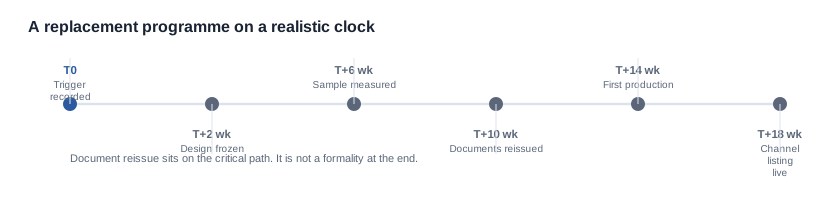
The schedule itself. A replacement on a realistic clock runs from the trigger through a frozen design, a measured sample, reissued documents, first production and a live listing. The document reissue sits on the critical path rather than at the end of it, which is why a programme that plans the documents last is a programme that launches late. The schedule risk is usually understated in the quotation, because a supplier quotes the time to build units and not the time to have the documents for those units. Two consequences follow for the buyer. First, the lead time in the quotation should be read as the time to build, and the launch date has to be derived from the documents rather than from the factory. Second, a replacement that is triggered late in a selling season either misses the season or ships with the old specification still on the listing, and both outcomes cost more than the schedule saving.

What a replacement does to the rest of the programme
A replacement is rarely one product. It moves four layers at once, and most replacement budgets price only the first of them.
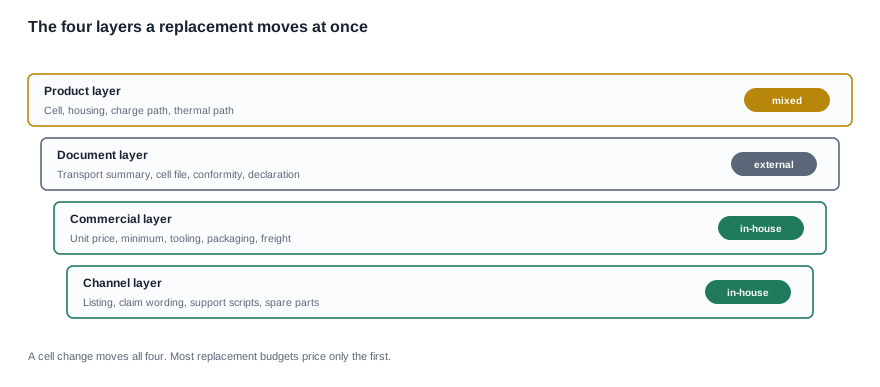
The product layer. The cell, the housing, the charge path and the thermal path move together, and the constraint that binds first is usually physical rather than electrical. A larger cell does not simply occupy more of the housing; it displaces the electronics, and in a product this small the electronics are what determine what the product can do. A larger cell in this form factor frequently means a smaller camera module, a shorter antenna, a moved driver circuit or a thinner temple. The weight consequence lands on the temple, which is the worst place on the body for it, and it arrives as a comfort complaint rather than as a specification issue, which makes it very hard to diagnose later.
The document layer. Three documents are invalidated by a cell change and one is invalidated by a firmware change, which is why the change-control obligation belongs in the agreement rather than in a purchase order for the first lot.
The commercial layer. The unit price, the minimum order quantity, the tooling amortisation, the packaging cost and the freight profile all move, and the movement is not proportional. A change in cell capacity can move the freight weight of the shipping carton more than it moves the unit price, and freight is a recurring cost while tooling is a one-off.
The channel layer. The listing, the claim wording, the support script and the spare parts inventory all have to change together. A claim that describes the previous model is worse than no claim, because it is a claim the company made and cannot support.
The point of the four layers is that they are usually owned by four different people inside a buying organisation, and the replacement decision is usually made by one of them. The technical team prices the tooling, the logistics team prices the freight, the compliance team discovers the documents, and the channel team discovers the copy. A decision taken without all four produces a quote that is wrong in three of its four dimensions.

Pricing the decision before you commit to it
The decision should be written down before it is made, in a form that a finance reviewer can accept. A short memo with five sections does it.
State the trigger and the evidence. Which of the four triggers fired, and what measurement or document establishes it. If the trigger is ageing, the memo carries the measured drift. If the trigger is a supplier change, it carries the notice.
Price the keep option. Two supply cycles forward, including the unit price at each tier, the minimum order quantity, the tooling amortisation already committed, the inventory write-down you are avoiding, and the warranty cost of the units already in the field. This is a number, and it is usually higher than the team expects because it includes the cost of a platform that no longer performs as published.
Price the re-spec option. The cost of correcting the specification and the copy, the cost of a revised warranty threshold, and the cost of the measurement that produces a defensible field figure. This is usually the smallest number on the page and it is frequently dismissed without being priced.
Price the replace option. The ten lines from the table above, plus the schedule from the timeline, expressed as a total cost across the campaign rather than as a unit price. Compare it against the keep number over the same period.
Decide, and set a date to revisit. The memo should end with a decision and a date. A replacement decision without a review date becomes an annual argument, because nothing in it forces the question to be asked again.
The trade-off that usually decides it is time against money: replacing buys a product that matches the current specification and costs a campaign, a set of documents and a period of dual running; keeping costs a specification correction and carries a platform whose published figure no longer matches its field figure. The question of which to choose is rarely technical.
A finance reviewer will challenge the memo in two specific places, and it is worth preparing for both. The first is the horizon: a keep number computed over one year always wins, because the replacement costs land in year one and its benefits land in year two and three. The memo should state the horizon explicitly and compare both options over the same period, which usually narrows the gap considerably and makes the decision about risk rather than about arithmetic. The second challenge is the treatment of the sunk items — the tooling already paid for, the artwork already approved, the certificates already obtained. Keeping those on the balance sheet as an argument for keeping is a common error, because they do not move when the cell moves and they are not recoverable if the platform is withdrawn. What they do determine is the cost of the re-spec option, which is the option most often undervalued in the first instance and most often correct in the end.
The boundaries of what we can tell you about an upgrade
It is worth being precise: a cell change is a design change with a new baseline, not a swap, and we say so whenever one is proposed.
We publish the battery capacity, the rated runtime and the case capacity for each model, along with the charging interface for the twenty-four that carry one and the Bluetooth version for the fourteen models that carry one. We do not publish a usable capacity, a test condition, a cycle life rating, a charge curve or a thermal figure for any model, and we will not estimate them. That last point is the reason we cannot tell you whether an ageing platform still meets your duty cycle: the number that decides it is the cycle life, and nobody has measured ours.
The same applies to weight, and the scope matters more than usual here because a weight is one of the constraints a larger cell tightens. The catalogue publishes one weight in the entire range: 158 g for the MT6 glasses body, including the 265 mAh cell and the camera, and excluding the foldable charging case. The case holds 1200 mAh and its own weight is not published. No bare frame weight is published for any model, so we cannot tell you how a cell change affects the frame weight, and we will not offer a typical figure you cannot verify.
What we will do is take a model and a target runtime and tell you what would have to change to reach it, including the parts of the change that are not the cell — which in this product form factor is usually most of them. Give us the model, the current field figure, the target figure and the session length you are trying to protect, and we will tell you which published rows apply, which are open, and what the change touches. The published figures and the rows behind them sit under battery life specifications, the charging decision a bigger cell affects is treated in charging solutions, the documents a new cell requires are under battery transport, and the stage a design change is approved at is described in quality gates.
Related reading
- The published figures and the rows behind them — battery life specifications
- The charging decision a bigger cell affects — charging solutions
- The documents a new cell requires — battery transport
- The stage a design change is approved at — quality gates
- A framework for the same question — battery life case study template
Tell us the model, the runtime you need and the session length, and we will tell you what would have to change, including the parts that are not the cell.


