
Most battery case studies in this category are unreadable, because they report a number without the conditions that produced it. A smart glasses battery life smart glasses case study template should exist to force those conditions into the open before the number is written down. Here is the one we use, and the reason each field is not optional.
This is a worked case rather than a client project. Its aim is the decision sequence. The worked example below is a hypothetical field-service brand that publishes a runtime figure on a product page, and no customer, order or measurement from a real programme is described. The point of the template is that the same eight fields work for any programme in this category, and that a buyer can hand it to a supplier and get a usable answer rather than a paragraph.
Smart glasses battery life: why most case studies cannot be reused
A case study that cannot be reused is a testimonial with a number attached. It tells you what happened once, to one unit, under conditions nobody recorded, and it cannot be applied to a second programme because the second programme will have a different workload, a different environment and a different tolerance for a shortfall.
There are three recurring defects, and it is worth naming them precisely because each one is easy to introduce accidentally.
The number arrives without its condition. A figure of eight hours, on its own, describes an experiment that cannot be repeated because the reader does not know what was running, at what volume, at what temperature, or from what starting state. It is not a wrong number; it is an unusable one, and it is indistinguishable from a wrong one once it has been quoted.
The unit is under-specified. Two units of the same nominal model can behave differently, and the difference is usually in the build rather than in the product. A study that records only the model name has removed the one variable that would let a reader reproduce the result.
The subject is anonymous to the point of being fictional. A study that describes "a leading European retailer" without naming the workload tells the reader nothing that a brochure would not have told them, while still borrowing the credibility of a measurement. The honest version names the scenario and states that no client is identified.
There is a fourth, softer defect, and it is the one that does the most damage over time. A published runtime figure is copied. Someone lifts it into a product page, someone else lifts it into a distributor listing, and two quarters later the conditions are unrecoverable and the figure has become the number the category compares on. Nobody can now reconstruct what was measured, including the factory, and a customer complaint about runtime cannot be diagnosed because there is no baseline to diagnose against.
Our own published position is the clearest illustration of this. We publish rated runtimes from roughly six hours on some audio platforms to roughly twenty on the children's entries, with no test condition stated for any of them. That is a perfectly normal position for a supplier to hold and a difficult one for a buyer to plan against. We publish it because it is what our source document says, and we would rather hand you a documented gap than an invented condition.
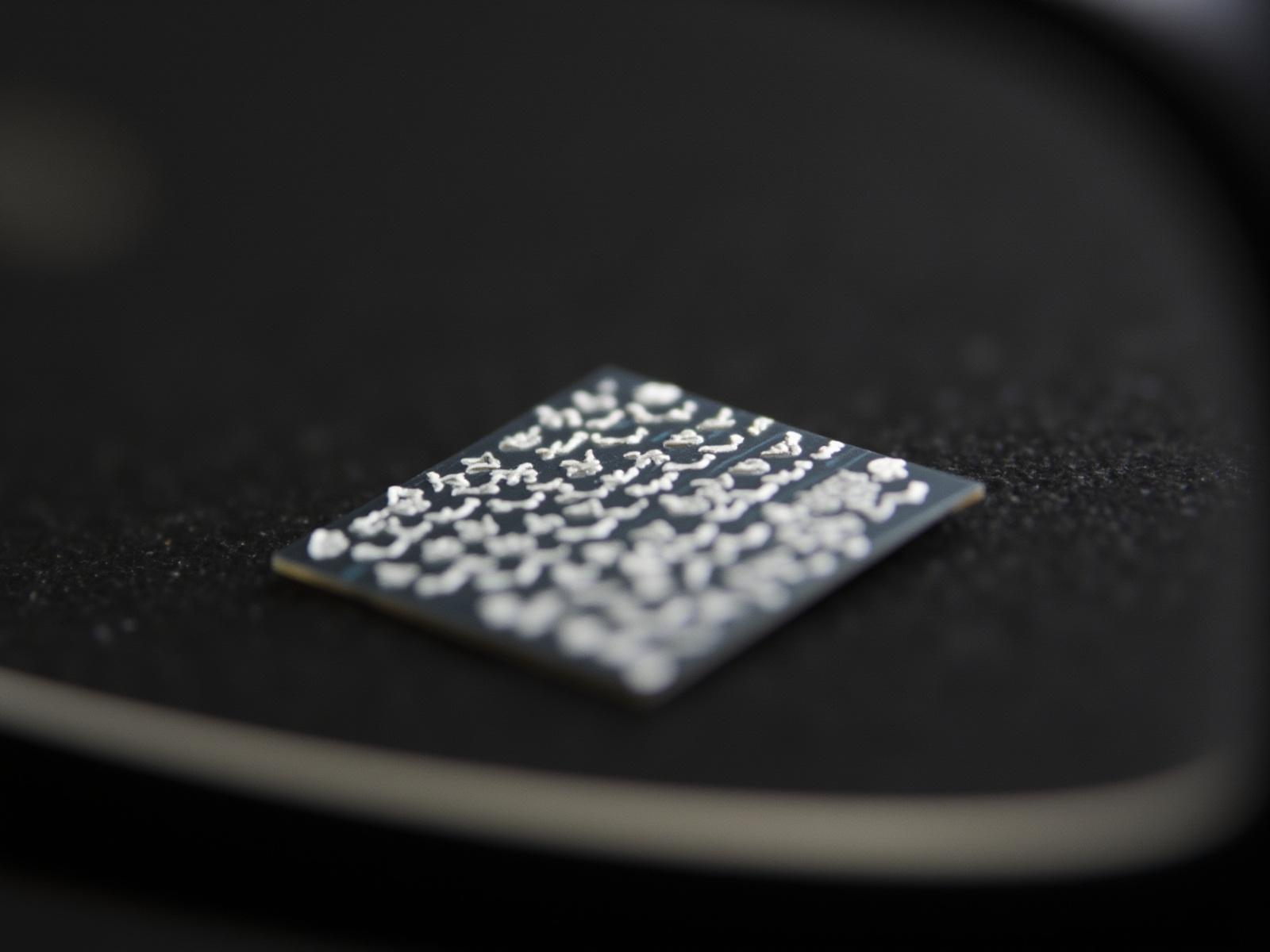
The eight fields a reusable battery study has to carry
Eight fields, in this order, because the first three are inputs that have to be fixed before anything is measured and the last three are outputs that have to be recorded when the measurement ends.
1. Unit and revision. Not the model name — the unit. Build revision, firmware version, cell batch if known, and whether the unit came from a production batch or from an engineering sample. Our catalogue states a runtime for twenty-eight models without stating a revision for any of them, which is precisely why two units of the same nominal model can behave differently.
2. Workload definition. The field most often missing, and the one that decides whether the study is worth anything. What stayed on during the test, and at what level? For our camera platforms, does "in use" mean the camera capturing continuously, or the device paired and idle? Those are different products, and the difference is roughly the difference between five hours and something else entirely. Write it as a procedure, not a phrase, because a phrase cannot be repeated by somebody else.
3. Ambient temperature. Cell behaviour is temperature dependent in both directions, and a study that omits it cannot be reproduced. State the range, not just the nominal, and record where the measurement was taken.
4. Start condition. Fully charged at the start is a reasonable default, and it is a decision rather than a fact. What matters is that it is recorded, along with whether the charging source was the wall, the case or a dock, and how long the unit rested before the test began.
5. End condition. At what point does the clock stop? When the device shuts down, or when it becomes unusable while still drawing power? The two can differ by a material margin in a product that fails gracefully, and a study that does not say which one it used cannot be compared with a study that did.
6. Observed runtime. The number you will defend to somebody who thinks it is too low. State it as observed, with the conditions above attached. Do not round it upward, and do not present it as a guarantee.
7. Sample size and repeats. How many units, how many runs each, and what the spread was. A single unit measured once is a data point; a figure with a stated sample size is a result, and the spread is what tells you whether a shortfall in the field is a defect or ordinary variation.
8. Who ran it and when. Repeatable, or not. If somebody ran it once on one unit, say so — that is honest, and it is still more useful than an unattributed number. Add the date, because a cell's behaviour moves with the calendar.
Using the template against a supplier
The template is not only a writing structure; it is also the request you send. Handed to a supplier before the sample order, it converts a vague request for runtime data into a specific one, and the response is worth reading for what it reveals about the supplier as much as for the numbers.
Ask for this in writing before you order, not after the sample arrives. The response you are expecting is not a perfect study — most suppliers in this category do not have one. You are expecting three things.
Do they know their workload assumption? A supplier who says "continuous playback at a stated level, room temperature, freshly charged" has thought about it, and the fact that they can state the assumption means they can change it when you describe a different workload.
Will they repeat it on a sample? That converts the figure from a claim into evidence, and it is the question that separates a supplier with a measurement habit from one who forwards a figure from a product brief.
Do they know which fields they cannot fill? A supplier who identifies their own blanks is more useful than one who fills them with plausible values, because a blank can be planned around and a plausible value cannot.
This is ordinary supplier due diligence rather than a technical task. A buyer who sends this template with a request for quotation learns something about the supplier's documentation practice before committing a sample budget, and that knowledge is what the rest of the evaluation rests on.
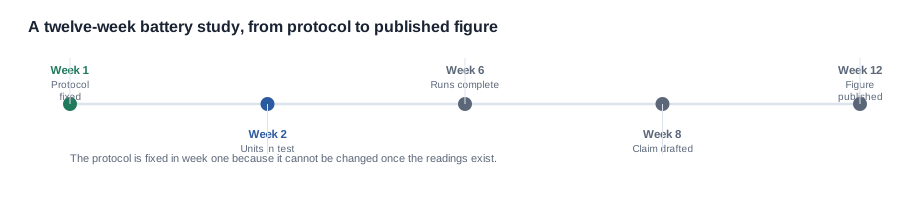
Filling the template for one hypothetical camera glasses programme
This is a hypothetical case rather than a client project, and the entries below show the shape of a completed field rather than a measurement. Every value is left as a requirement for the reader to satisfy, because a template filled with invented numbers would be worse than an empty template.
The scenario. A field-service brand is sourcing AI camera glasses for technicians who work in plant rooms and on scaffolding. The brand wants to publish a runtime figure on a product page. The brand's own tolerance is that a technician should not need to recharge during a typical shift, and it has not yet decided what a typical shift is.
Field 1, unit and revision. Two units from the first production batch, firmware build identifiers recorded at the point of the test. The reason for two is not statistical rigour; it is that a single unit cannot tell you whether the figure is a product property or a unit property.
Field 2, workload. Written as a procedure: paired to a phone throughout, capture triggered at a stated interval, audio playback at a stated level for a stated proportion of the run, and the ambient noise of the plant room recorded rather than characterised as typical. The brand's tolerance is then applied to that procedure rather than to a marketing phrase.
Field 3, temperature. The room temperature during the run, with the range across the run, and the point made that the plant room is not a constant.
Field 4, start condition. Fully charged from the wall, with a stated rest period before the test.
Field 5, end condition. The point at which capture no longer functions, distinguished from the point at which the unit shuts down, and the study reports the first because that is the one the technician experiences.
Field 6, observed runtime. The measured figure, carried with fields 1 through 5 in the same entry, not separated from them.
Fields 7 and 8. Two units, one run each, run by a named person on a stated date — which immediately tells a reader that the figure is a boundary rather than a result.

What this produces rather than a figure
The output of the step above is not a figure a buyer can publish. It is a decision about what to measure next, and that is the honest result of a first study. Two units with one run each across a range of temperatures establishes a boundary and a spread; it does not establish a typical value.
What it does establish is the requirement. The brand now knows that its plant-room procedure produced a result that it can state, that the procedure is repeatable by somebody else, and that the figure it eventually publishes will describe a named scenario rather than the product in general. Every subsequent study adds units and repeats, and the published figure follows the evidence instead of preceding it.
That sequence is the one that makes a study reusable. A study that begins with the figure and works backwards to justify it produces a document nobody can use twice.
Turning a filled template into a defensible listing claim
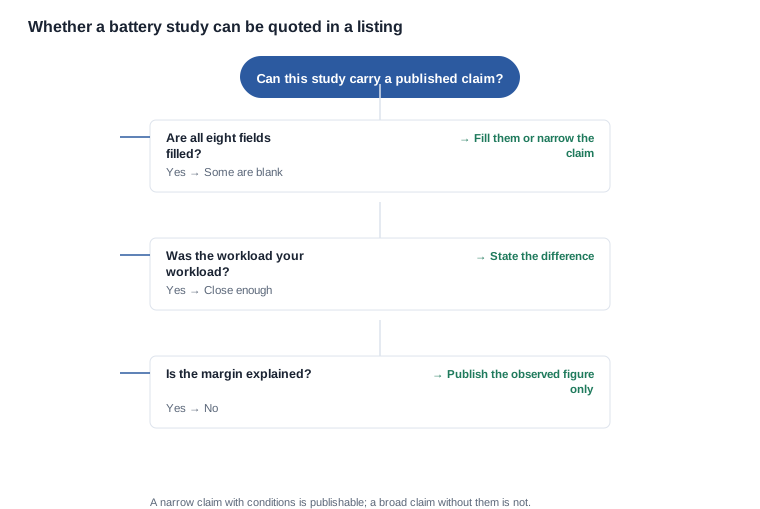
The template exists to serve a claim, and the claim is where most of the value is lost. A figure with all eight fields attached can be published. A figure with the fields removed cannot, and the fields are always removed in the same three places.
The condition is dropped and the number survives. This is the commonest failure, and it happens because a listing wants a number and the condition is a sentence. The defence is to write the condition inside the same field as the number, so that the two cannot be separated by a copy-and-paste.
The scope is widened. A figure measured in one scenario gets presented as the product's battery life. The defence is to name the scenario in the claim itself rather than in a footnote.
The margin is silently removed. A brand that measured a boundary and applied a margin to reach a publishable figure will sometimes publish the margin-adjusted number without the adjustment, because the margin-adjusted number reads better. The defence is to keep the observed figure and the margin separately, and to publish the observed figure with the scenario attached.
The three claims this template can support
A completed template supports three kinds of statement and no others. A comparative claim, which states the measured figure against a stated workload and states the workload. A suitability claim, which states the scenario in which the figure was measured and therefore the scenarios in which it may not hold. A specification claim, which states the requirement the product was measured against, for use in a technical file or a tender response.
It does not support an unqualified claim of the form "battery life: X hours" with no scenario, and it never supports a guarantee. A guarantee built on a measured figure is a commitment to a condition that the buyer controls and the supplier does not, and it is the kind of commitment that becomes a warranty claim.
The criteria a claim has to meet before it goes on a page
A completed template is not automatically publishable, and the criteria are simple enough to apply in a few minutes. Four of them, and they are the ones that decide whether a figure is a defensible claim or a number that has been copied too far.
Is the workload one a customer would recognise? The scenario has to be describable in a sentence that a person outside the business would recognise as their own situation. A workload described in internal terminology is technically a condition and practically unusable, because the reader cannot map it onto their day.
Is the sample size stated? A figure from one unit can be published as an observation with the unit count attached. A figure presented as typical while resting on one unit is a claim the study does not support, and if the number is later questioned the sample size is the first thing anybody will ask for.
Is the condition inside the same field as the number? This is a formatting rule rather than a content rule, and it is the one most often broken. If the condition can be separated from the number by a copy-and-paste operation, it will be, eventually, by somebody.
Does the claim match the decision it was made for? A figure measured to decide whether a configuration was acceptable for a technical file is not automatically the right figure for a consumer-facing product page, because the audiences tolerate different things. The criteria for each are different, and the honest approach is to write the claim for the audience it is aimed at rather than to reuse one claim everywhere.
Three cases the template cannot cover
A framework that claims to cover everything invites misuse, and there are three situations where it does not apply.
The multi-cell configuration. Where a product carries two cells, the question of which cell reaches what state during the run changes what the end condition means, and a single elapsed time hides it. The template still applies, but the end condition has to be specified per cell and the study has to state whether the figure describes the frame, the pair or the case-assisted configuration. The audio platforms in this range with 55 mAh × 2, 70 mAh × 2 and 90 mAh × 2 arrangements are the case in point.
The case-assisted configuration. A device that is recharged from its charging case during the day has a different discharge profile from one that is not, and a study of the frame alone says nothing about the day a customer actually has. The template applies to the frame; the day requires a second protocol, and the two protocols together are the study.
The age of the cell. A study on new units establishes a starting point and nothing about the fleet at month nine. Ageing is a different measurement over a different timescale, and no version of this template produces an ageing curve.
The limit of what our own catalogue can populate
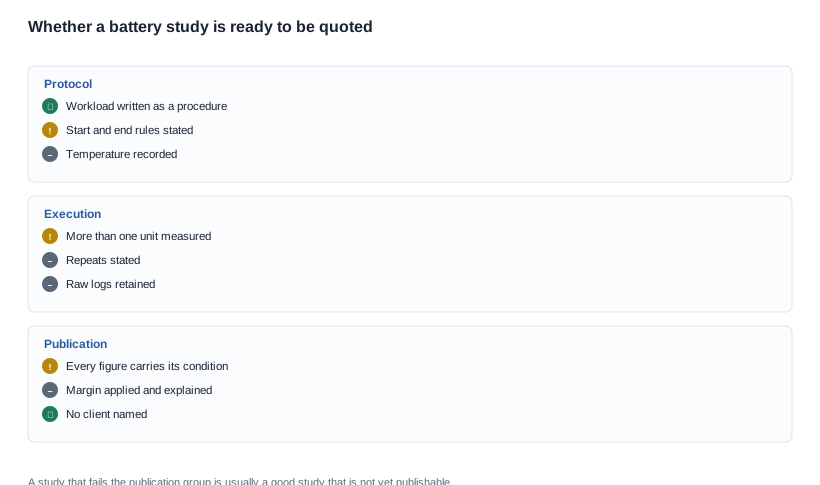
We are not going to publish a battery case study we cannot stand behind, which in practice means not publishing a runtime claim with invented test conditions. What we will do is tell you which fields of the template we can populate for a given configuration, and where the answer is that the condition was never recorded.
For our own rows, fields 1, 3, 4 and 5 can be answered for most configurations — the model, the cell configuration, the charging method, the interface and the case capacity are all published. Fields 2, 6 and 7 cannot: the workload behind each published runtime is not stated, no repeat measurements are published, and the spread across units is not published. Field 8 is the one we can be most precise about, because the catalogue carries a date.
That distribution matters for how a buyer uses us. Four fields are answerable from the catalogue and four are not, and the four that are not are precisely the four that decide whether a figure can be quoted. We would rather state that plainly than fill the gaps with a typical workload that nobody performed.
If you send us a study template filled in for one of our models, and the workload matches your product, we will tell you which parts of it are consistent with our published figures and which are not. That is a more useful exchange than a case study that says nothing.
The measurement methods behind these figures are set out under smart glasses battery life and power. For the platform-level detail across the range, the bluetooth audio glasses page covers the audio class, and the protocol that turns a published figure into evidence is in how to test smart glasses battery life yourself.
Related reading
- What a rated figure does not tell you — reading a battery spec sheet
- Mistakes this template prevents — battery life buying mistakes
- Where runtime sits against unit cost — battery cost vs performance
Send us your workload definition and we will tell you which rows of the template we can populate for it.


