

A Bluetooth version checklist for a procurement team looks like the smallest item on the file, and it is one of the ones where a wrong assumption propagates furthest. The version is the row a buyer uses to justify a configuration choice to a colleague, and it is the row that gets copied out of a catalogue into a specification without any of the conditions that came with it.
Our published data shows why the discipline matters, and the shape of it is worth stating before any clause is drafted. Half of the range carries a version: the K01 and the K02 on 5.3, and twelve entries on 5.4 — the D11, the LC-105-1, the D12, the LC-105-2, the YK12, the G07, the YKC02, the D17, the ZH12, the A07, the AR entry and the light-responsive entry. The other half carries nothing on that row. The eleven camera platforms, the A05, the A06 and the bone conduction entry publish no version at all, which is why a clause of the form "every model must state a Bluetooth version" fails on the first line of a range sheet, and why a supplier's answer to that clause is so often a quiet reword rather than a number. The version correlates with no other published row, and a clause has to be drafted against the blank cell rather than against the expectation of one.
So a checklist for this category is not a list of questions. It is a file with a lifecycle: a request annex that goes out with the request for quotation, an inspection annex that runs when the cartons are opened, and an escalation route that decides what happens when a line fails. Smart glasses bluetooth version smart glasses checklist for procurement teams is about building that file rather than about compiling a set of things to ask.
Smart glasses Bluetooth version: what the row does to a procurement file
A row on a specification sheet has three lives. It is written at the quotation stage, it is compared at the evaluation stage, and it is checked at the goods-in stage. Most checklists only cover the first, which is why the version so often ends up in the wrong place in the file.
The version is good at the traceability life. It is a durable, unambiguous, quotable fact, and it belongs in the technical file annex where a reviewer can see which radio generation the product was built with. It is useless at the comparison life, because in our published data it does not separate one product from another. Two models on different versions behave the same way in every published row we hold, and a shortlist ordered by version has been ordered by a procurement decision the factory made years ago.
It is actively dangerous at the goods-in life, and this is the part worth costing properly. A version on the purchase order is a requirement, and a requirement that fails at inspection is a lot that cannot be released. A version recorded in the traceability annex is a fact, and a fact that differs from the expected one is a conversation rather than a dispute. The same character, the same number, produces completely different outcomes depending on which of the two files it was written into.
Then there is the blank-cell case, which is where a checklist earns its keep. A rule that says "the product must state a Bluetooth version of 5.4" applied to a range that publishes no version for its camera platforms will fail on a compliant product, because the requirement was written against a cell that nobody fills in. The corrective is not to drop the row; it is to write the requirement as "the version, or a written statement of the supplier's position where the row is not published", so that the file records the gap rather than failing on it.
The last thing to cost is the propagation. A version requirement written into the specification travels into the purchase order, into the factory's bill of materials, into a possible radio module substitution, and into a new conformity route and a new trademark qualification. Every step of that chain is a work package. The cheapest place to stop it is the specification, and the most expensive place to stop it is after the first lot has been paid for.

The request annex: eight lines that belong in the first request for quotation
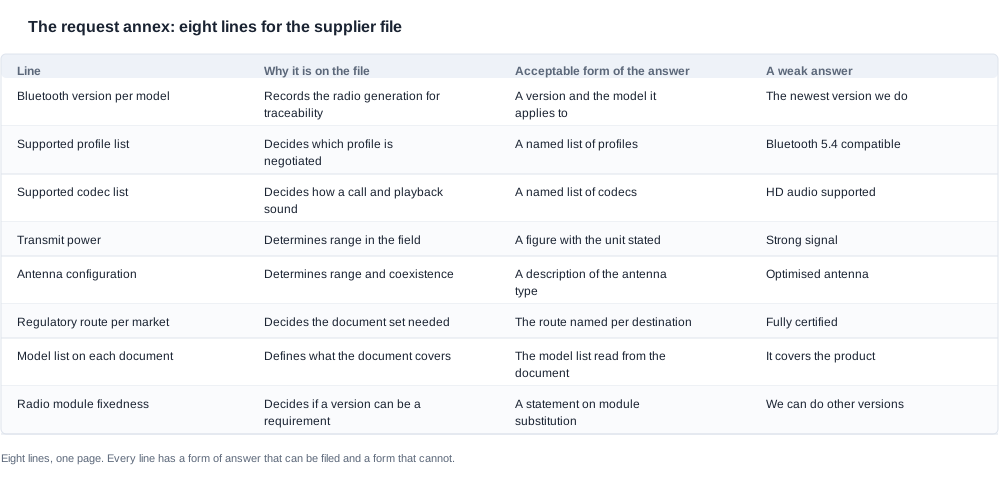
The request annex is the part of the file that goes out before a sample arrives, and its job is to convert what the supplier can answer into what the buyer can file. Eight lines do most of the work, and each one has a form of answer that survives a contract and a form that does not.
The version, per model, from the published data. On our range that means 5.3 on the K01 and the K02, 5.4 on the A07, the D11, the LC-105-1, the D12, the YK12, the LC-105-2, the G07, the YKC02, the D17, the ZH12, the AR entry and the light-responsive entry, and no published version for the eleven camera platforms, the A05, the A06 or the bone conduction entry. Record it as a fact about the platform, and record the absence for the models where it is absent, because a blank cell that nobody mentioned is a blank cell that gets filled in by an assumption later.
The supported profile list. This is the list that determines behaviour in practice, and it is the row that is on no datasheet. A buyer who needs a particular profile to be negotiated needs this list, not the version, and the useful form of the answer names the profiles and identifies which one the product takes by default.
The supported codec list. Same logic, and a separate document. A product can implement a radio generation perfectly and support no codec at all, and a codec list is the only way to know which is the case before a customer does.
The transmit power and the antenna configuration. These two determine the range, and they are the two numbers that answer the question a version cannot. A range figure without the antenna description is only half an answer, because the same power behaves differently in two different temple structures.
The regulatory position, per market. The radio equipment route for each destination, the EN 18031 cybersecurity category with its evidence, UKCA for the United Kingdom, FCC equipment authorisation for the United States, and the Bluetooth qualification for the implementation. The position comes from the route and from the model list printed on the document. It does not come from the version.
The model list on the qualification and on the conformity documents. A document that names a family does not cover a specific model, and this is the failure that the version's simplicity encourages, because a version looks like coverage and a model list is not the kind of row people remember to ask for.
The host device and the application position. What a customer actually gets is the intersection of the device, the phone and the application. If the fleet is a specific operating system version or a specific phone mix, that constrains the usable feature set regardless of the radio, and the constraint is invisible in every datasheet.
The change control position for the radio. A radio substitution changes the product's conformity position and its trademark qualification, and the procedure for it has to be written into the change control document rather than agreed in principle.
Two things belong alongside the eight lines, and both are about the form of the answer rather than its content. Ask for every answer in writing, because a verbal answer to a radio question is not a file and will be re-asked at the next quotation round. And ask which of the eight the supplier can answer per model, which it can answer per platform, and which it can answer only by running a test — because that third category is your sample plan, and it is better to know it on day one than in week six.
The three answers a supplier can give, and what each one obliges you to do
Every line in the request annex comes back in one of three forms, and treating them identically is the reason a procurement file fills up with answers that cannot be used.
The first form is a documented fact with a source attached — a number, a list, or a reference to a document. These can be written into the specification and the purchase order straight away, and they become acceptance criteria. This is the only category that produces contractual weight, and it is the smallest category in practice.
The second form is an assertion without a document. The supplier is probably telling the truth, but the answer cannot be checked by anybody else, cannot survive an audit, and cannot be cited when the product behaves differently in the field. The correct treatment is to accept the answer as the basis for the sample test rather than for the contract, and to write the test into the plan. A test that is defined by the answer it is checking is a weak test, so it has to be defined independently: the profile that is negotiated, the codec that is carried, the range that is measured.
The third form is a gap: the supplier does not hold the answer. This is more common than buyers expect, particularly on transmit power and antenna configuration, and it is not a reason to abandon the line. It is a reason to change the question, because a gap is usually a disclosure problem rather than a capability problem. The supplier may know the value without having documented it, or may hold it in a form that has to be re-derived for a specific model.
Recording which of the three forms each answer came in is the single most useful column in the annex, because it converts an email thread into a plan. Lines in the first column go into the order. Lines in the second column go into the sample plan. Lines in the third column go into a request for the missing document with a date against it. A file where all three categories are mixed together looks complete and is not.
The inspection annex: four checks at goods-in that catch a substitution
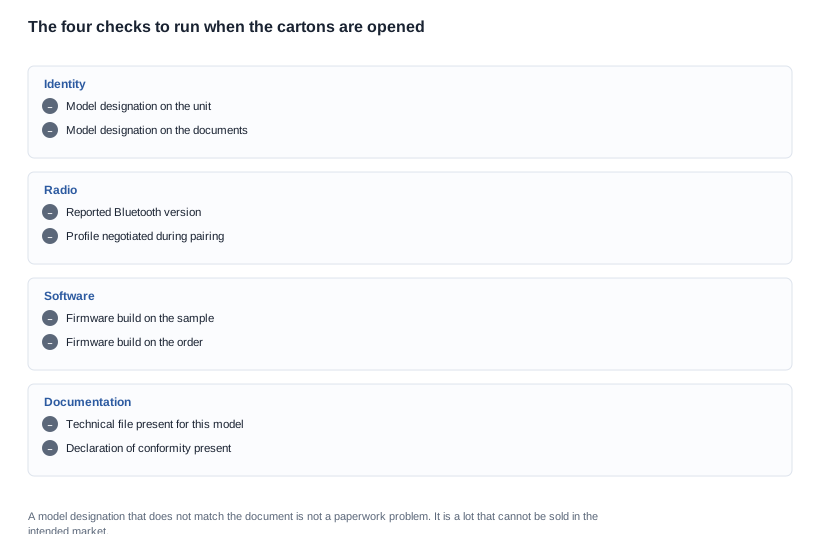
The inspection annex runs when the first production lot arrives, and it is the last chance to catch a mismatch at a price that is still negotiable. Four checks do most of the work, and each one produces a line in a table.
Identity: does the model designation on the unit match the designation on the documents? Start from the unit and read the label, then compare it against the model list you already hold. This is not a formality. Our own catalogue lists one entry as "L2 Utral", with a note that "Utral" appears to be a typographical rendering of "Ultra", and a further designation of "Utral Pro Max" whose meaning is not published to us. Where a document and a carton disagree by a letter, the product is the one that is wrong in the eyes of a customs check, and the buyer pays for that.
Radio: does the unit report the expected version, and which profile does it take? The version check is a simple read and it catches a substitution directly. The profile check is the more valuable one, because a product can report the right version and negotiate the wrong profile, and that difference is invisible on a spec sheet and audible on a call.
Software: is the firmware build the one the evaluation was run against? A radio version can be correct while the firmware is not, and the difference does not appear anywhere except in the build identifier. Record the build number on the sample and write the matching build into the order; then the inspection has something to compare against.
Documentation: is the technical file present for this model, and does the declaration match it? A lot that arrives with the right hardware and the wrong file is a lot that cannot be sold in the intended market, and the correction cycle for that is measured in weeks.

The escalation route is what makes the inspection annex a control rather than an observation. A failed line needs a named consequence: hold the lot, quarantine the affected units, or release under a written concession. Without a stated consequence, every failed check becomes a judgement call, and a judgement call on a first lot sets the precedent for every lot that follows. The three outcomes worth naming in advance are the ones that differ in cost by orders of magnitude — a unit swap, a documentation fix, and a re-test of the radio — and the difference between them is usually discoverable at goods-in and invisible afterwards.
Sampling for the inspection annex follows the same logic as sampling for the lot itself, and the two are worth designing together. The identity and documentation checks are cheap, so they can be run on every carton; the radio and firmware checks require power and a phone, so they are run on a smaller sample drawn from named positions. What matters is that the positions are written down, because a sample drawn from the top of the pallet is a sample of the top of the pallet. A substitution that arrived partway through a production run will not be found in the first cartons, and the sampling plan is the only mechanism that can find it. Put the positions in the purchase order, agree the sample size against the lot size before the first shipment, and record the result against the lot reference so that a later question about a specific unit has an answer attached to it.

Naming precision: the model list is a contractual term, not a detail
The single most consequential item on this checklist is the model list, and it is the one most often left as a verbal assurance. It is also the item with the most leverage, because it is a term that can be written into the purchase order and enforced against it.
The discipline has three parts. First, the designations used in the contract have to be the designations used on the unit, the carton, the product listing and the artwork. A contract that names a model the product does not carry is unenforceable in practice, because nobody can establish which product it was referring to. Second, the model list on each document has to be transcribed into the contract, or attached to it, so that coverage is a matter of record rather than of memory. Third, the scope of each document has to be stated — one model, a family with a boundary, or a platform — because the boundary is where a variant falls out of coverage without anybody noticing.
Two changes in a programme make naming precision harder rather than easier. A private-label programme adds the buyer's brand to the product, and the buyer's brand has to be reconciled with the designation on the qualification. A range extension adds a variant, and the variant has to be tested against the boundary of the existing coverage rather than assumed to sit inside it.
The practical output of this section is a single page: a table with one row per model designation, one column per destination market, and one cell per market holding either a document reference or a stated gap. It takes an afternoon to build and it is the document that gets reviewed when somebody asks whether the programme is covered.

Where the version belongs in the evaluation matrix, and where it does not
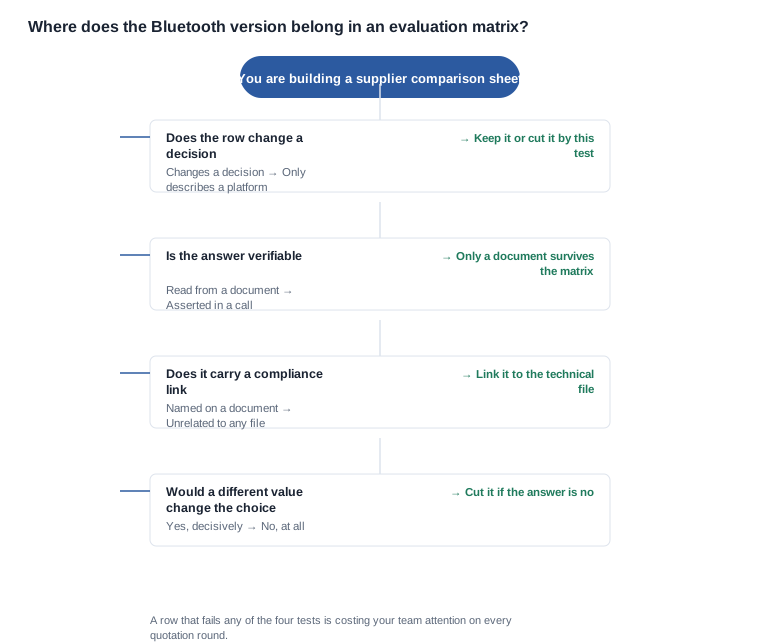
The evaluation matrix is where a row earns or loses its place, and the test is simple: a row that changes a decision belongs, and a row that only describes a platform does not. Applied to the version, the answer is that it does not belong, because in our published data it tracks no product difference at all.
The second test is verifiability. A row survives into a matrix only if the answer can be read from a document or measured on a unit. The version passes this test, which is precisely why it persists in matrices long after it has stopped being useful — it is one of the few radio rows a buyer can obtain, and buyers keep the rows they can get.
The third test is whether the row carries a compliance link. Here the version fails in the opposite direction: it looks like it carries one, because it sits next to certification information in most catalogues, and that adjacency is exactly what causes a buyer to infer that a 5.4 radio means a 5.4 product is approved. Moving the version out of the compliance section of the matrix and into a traceability annex is the whole of the correction.
The fourth test is the decisive one. Ask what would happen if the value changed. If a different answer would change which model wins the shortlist, the row belongs. If the answer could change without changing the outcome, cut it. For the version, the answer is that a model on 5.3 and a model on 5.4 would be selected identically on every published row we hold, so the row is cut from the evaluation matrix and kept in the annex.
A matrix rebuilt on that basis usually needs four more rows than it had, and every one of them is a row the supplier can produce: the profile list, the codec list, the transmit power, and the antenna configuration. Those four, plus the published electrical rows, are what a Bluetooth audio comparison should have been built on in the first place.
What we can answer from a catalogue and what has to be requested
Stated plainly: a procurement file needs the Bluetooth version to be accurate and does not need it to be decisive, and distinction decides where the row sits. The version we publish for each model is accurate, and it is not a quality indicator, because in our own data it tracks no product difference at all.
We publish the version, and we publish the cell capacity and the rated runtime for every model in the range, and the charging method for the twenty-four models whose catalogue row carries one, because those are the rows that a landed-cost comparison and a specification both need. We do not publish module part numbers, transmit power, antenna configurations, supported profile lists, supported codec lists or qualification references for any model, and we will not estimate any of them from a typical figure, because a typical figure cannot be checked and therefore cannot be written into an acceptance criterion.
We will also say plainly that a version number does not get a product into a market. Radio conformity is a function of the radio module, the antenna configuration, the transmit power and the declarations held for the product, and the version is the least decisive of those inputs. A row reading "Bluetooth 5.4" on a procurement checklist is not a market approval, and treating it as one is how a product ends up listed in a territory it was never assessed for. For the same reason we will not tell you a document covers your model unless we have seen the model list printed on it.
Where a procurement file needs the profile list, the transmit power, the antenna configuration or the model coverage on a document, ask us and we will tell you which of those we can answer from what we hold, which have to come from the engineering team, and which need a test on your own units. Send the model list, the quantities and the destination markets, and we will tell you which configurations exist and which do not.
Related reading
- Bluetooth connectivity and versions
- Bluetooth version common mistakes
- Bluetooth version for beginners
- Bluetooth SIG compliance
Ask for the profile list, the transmit power and the model coverage, and we will tell you which of those we can answer directly.


