

Bluetooth version is the one row in this category that a buyer is certain to be quoted and certain to over-read, so it is worth being precise about what it costs in a programme — because the cost is almost never in the radio.
Our published position across the range: Bluetooth 5.3 on the K01 and the K02 in the audio tier, and 5.4 on the YK12 and the G07, the D11 and the D12, the ZH12 and the D17, the LC-105-2 and the LC-105-1, and the YKC02 and the A07, the AR entry and the light-responsive entry. The eleven camera platforms, the A05, the A06 and the bone conduction entry publish none at all. Nothing else on the published sheet moves with the version, and in our own data the version tracks no product difference.
So smart glasses bluetooth version smart glasses cost factors is a question about where the radio-adjacent money actually sits, which is not where buyers expect it to sit. The short answer is that the generation is the cheapest thing in the file to change and one of the most expensive things in the file to change, depending on which level of the cost stack you are standing at.
Smart glasses Bluetooth version: the radio is rarely where the cost sits
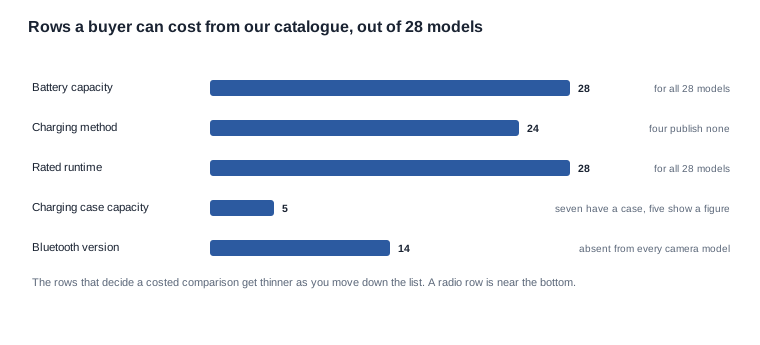
The chart above is a coverage map of our own catalogue rather than a cost model, and it is the closest thing to a cost map that published data supports. The rows that decide a costed comparison get thinner as you move down the list. Battery capacity is published for all twenty-eight models. A charging method is published for twenty-four of them; the four rows that carry a case capacity publish none. Rated runtime is published for all twenty-eight as well, though for the camera tier it arrives as a range on six platforms and a point figure on five, and none of the twenty-eight carries the test condition behind it. Charging case capacity is published for five of the seven models that have a case. The Bluetooth version is published for fourteen, and it is the row that gets quoted in every conversation about the radio.
The pattern to take from this is not that the version is unimportant. It is that the rows nearest the top of the list are the ones that move the money, and the version is nowhere near them. A buyer building a landed-cost comparison from our catalogue has the cell capacity and the runtime available for every model, the charging method for twenty-four of them and the case capacity for the rows that carry one. The version is available for half the range, correlates with nothing, and is the row most likely to be used as a proxy for something else.
There is a second reason the radio is not where the money sits, and it is structural rather than accidental. In this product form the radio is one of several competitors for a very small amount of space. The antenna has to sit in a temple that may also carry a cell, a main board, a speaker, a microphone and, in the camera platforms, an imaging module. A radio module is cheap relative to the rest of the bill of materials, and the antenna is the component most likely to be compromised by the space available and the hardest to diagnose when it is. Our published position contains no antenna configuration and no transmit power for any model, and that absence is not an editorial accident — it reflects how much of the radio story genuinely cannot be summarised in a table.
So the correct starting position for a cost conversation is this: the radio is a small share of the unit cost, and a version-driven price argument is an argument about the smallest line in the cost sheet while the largest lines go unexamined.
The five costs that do not move with the protocol generation
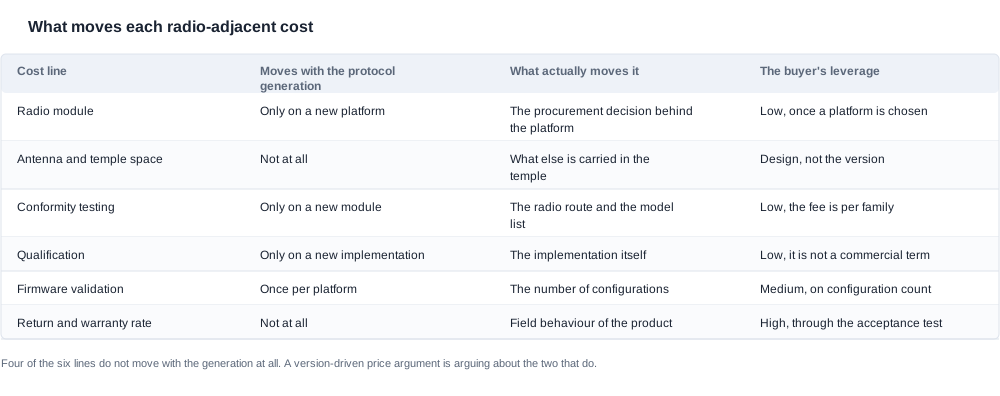
These five lines are the ones that actually shape a programme's cost, and not one of them responds to a change of generation. A buyer who negotiates hard on the version and leaves these five unexamined has negotiated the wrong line.
The antenna and the frame. The radio's performance depends on the antenna design and its position, and in a smart glasses product the antenna is inside a temple that also has to carry everything else. Every one of those is a competitor for the same space, and the antenna is the component that is easiest to compromise and hardest to diagnose. A compromised antenna shows up as a return rate in a particular environment rather than as a test failure, which means the cost appears in the field rather than in the factory.
The conformity route. The radio equipment route applies whatever version the radio is. In the European Union the Radio Equipment Directive (EU) 2014/53/EU applies with the EN 18031 harmonised standards cited into it, and the General Product Safety Regulation (EU) 2023/988 applies from 13 December 2024. In the United Kingdom UKCA applies with a framework that has diverged from the European one, and in the United States FCC equipment authorisation covers the radio. A version change inside a platform is a new radio module and therefore a new authorisation with a new test and a new fee; a version difference between two products in the same platform costs nothing at all.
The trademark qualification. The Bluetooth qualification is tied to a specific implementation, not to a version string. A supplier quoting a version has not shown you the qualification, and the qualification is the document that determines whether the mark may be used on the product at all. This is a fixed cost per implementation with an elapsed time set by the review queue, and neither the fee nor the schedule is a commercial lever.
The power budget. The radio is one contributor to the published runtime figures, and the radio's efficiency is a property of the module rather than of the version number. In our range the audio tier publishes roughly six to eight hours and the camera tier roughly five to eight, and the difference is the load rather than the radio. A buyer comparing two models on runtime is comparing something that is published, and a buyer comparing them on generation is comparing something that is not.
The certification category. A product with a microphone and an application falls into the personal-data category under EN 18031, and that follows from the product's function rather than from the version. The work to demonstrate that category — the technical file, the data-handling description, the application review — is the same work whichever radio the product carries, and it is usually larger than the radio itself.
The costs that do move with a generation change, and they are small
Five costs do respond, and it is worth listing them precisely so that the argument stays proportionate.
The module itself. A different generation usually means a different module, and the module is a procurement decision that was already made. Its contribution to the unit cost is real but small, and it is also the line most likely to be quoted as though it were the whole story.
The silicon area. In a platform where the radio shares a board with camera processing and, in some products, an on-device model, a larger radio package competes for area. Our published position is that which AI models are supported and where the processing runs is not published in our range, so the competition for silicon is not describable from published data and has to be raised with engineering.
The firmware work. A new generation usually means a new firmware baseline, and that is a one-off per platform rather than a per-version cost. It is also the cost most likely to be underestimated, because it arrives as engineering time on the factory's schedule rather than as a line on a quotation.
The profile and role behaviour. Which profile a product takes by default, and how it behaves when the host offers a different one, is a firmware matter and not a version matter. In practice, a generation change is a good moment to re-characterise this behaviour rather than to assume it carries across.
The host compatibility. This is bounded by the oldest device in the customer's fleet rather than by the radio, and it is the cost a buyer is most likely to underestimate because it appears as support contacts rather than as a purchase order line.
Against that, the four things a generation change actually costs are all paperwork and schedule: a new radio approval, a new trademark qualification, a new technical file revision and a re-test. None of them is a large number. All of them have an elapsed time that the factory does not control, and elapsed time is the cost that actually damages a programme.

Total landed cost: the rows the version column hides
A landed cost for this product form is built from more than the unit price, and the version column is not one of the rows in it. The rows that are, in the order they are usually forgotten, look like this.
The tooling and the fixtures. The charging interface is the biggest single tooling decision in the audio tier, because magnetic charging and Type C are different tooling, different test equipment and different production lines. Our published data separates the two cleanly: in the eight audio models, magnetic charging on the LC-105-2 and the LC-105-1, the K01 and the K02, and the YK12 and the G07, and Type C on the D11 and the D12; in the sport models, magnetic charging on the YKC02 and Type C on the D17 and the ZH12. Outside those two groups, the A07 and the AR entry are magnetic, and the V03 Pro, the L2 Utral and the bone conduction entry are on Type C. A range that spans both interfaces carries two sets of tooling, and a range that stays within one carries one.
The packaging. Packaging is tooling too, and it is where the model list, the destination market labels and the trademark usage conditions all meet. A range that adds a destination market adds a carton, and a carton is a mould.
The case, where there is one. Seven models in our range have a charging case, and five of them publish a capacity: 1400 mAh on the CY05 and the CY03, and the L1 Pro, 900 or 1400 mAh on the L2 Utral, and a 1200 mAh folding case on the MT6. The KY06 and the MT5 have a case whose capacity is not published to us. A case is a second product with its own tooling, its own certification scope and its own failure mode, and it should be in the landed cost as a separate line rather than folded into the unit price of the glasses.
The battery transport paperwork. Cells moving across a border carry their own requirements, and the UN38.3 test report is a document that has to exist per cell and per configuration. It is inexpensive and it is a hard gate, which is a combination that catches programmes by surprise.
The inspection and test cost. This is the line that most often surprises a buyer, because it is quoted as a percentage in a quality agreement rather than as a cost. It scales with the number of configurations, which is why configuration count is a better lever than unit price.
The running cost. Warranty and returns are recurring, and the rate is set by field behaviour rather than by anything visible at the factory gate. The published runtime and cell capacity are the best available predictors of it, which is another reason the version is the wrong row to argue about.
What a landed-cost comparison should be built on instead
It is worth setting out what the comparison table should contain, because the version column is usually the first row on the sheet and the sheet is then never revisited. A landed-cost comparison for this product form has five blocks, and the radio generation is not one of them.
The unit block. Cell configuration and capacity, the charging interface where the catalogue carries one, the case configuration where one exists, and the unit price at each quantity tier. These are the rows our published data supports across the range, and they are the rows that actually separate two supplier quotations from one another.
The one-off block. Tooling for the charging interface and for the packaging, the first-article and sample costs, and the certification and qualification fees. This block is where a programme's setup cost sits, and it is where the number of configurations has its effect. A range that adds a charging interface adds a set of tooling.
The compliance block. The conformity testing per model, the trademark qualification per implementation, the battery transport documentation per cell configuration, and the re-test cost that a module change would trigger. This block is the one where a version argument can have a real, if indirect, financial consequence — because a module change reopens it.
The recurring block. The inspection and test cost, the warranty provision, the firmware and application support window, and the model retirement terms including a last-time-buy window. This is the block that decides whether the product is worth having in three years, and it is the block that a volume-based negotiation works on most directly.
The risk block. The cost of a lot that fails incoming inspection, the cost of a model that cannot be sold in one of the intended markets, and the cost of a programme that has to be re-opened because a document did not cover the variant. These are the costs that the version column invites, because the version column is the one that looks like it answers a market question and does not.
A comparison sheet built on those five blocks, with the version moved to a traceability annex, will produce a different shortlist from one built on the version, and the difference will be the correct one. When you write those criteria into a request for quotation, the answers you get back are also the answers that can be written into an acceptance criterion, which is the test a procurement team should apply to every row before it goes on the sheet.

Where a buyer has leverage, and where the supplier does not
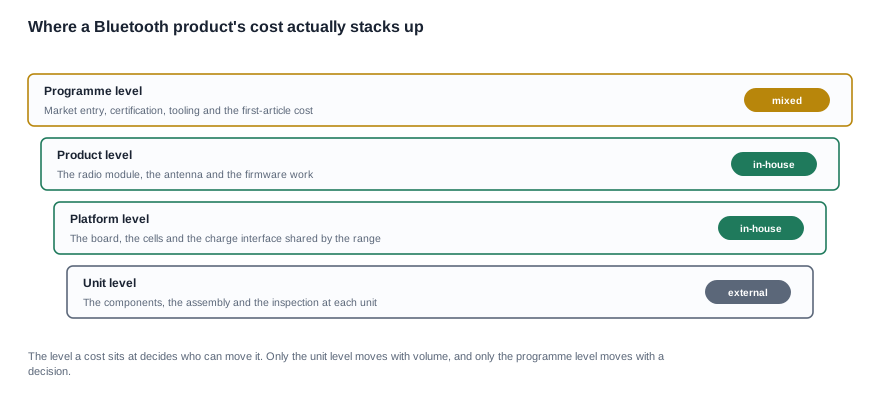
The level a cost sits at decides who can move it, and that is a more useful organising principle than the cost itself. At the unit level the cost moves with volume and with the quality agreement, and that is where a buyer has the most conventional leverage. At the platform level the cost was fixed when the platform was chosen, and a buyer joining an existing platform has almost no leverage over it. At the product level the cost is fixed by what the product has to carry, and a buyer can move it only by changing what the product is. At the programme level the cost moves with decisions, and this is the level at which the version turns out to matter.
That last point is the one worth sitting with. The generation is irrelevant at the unit level, largely settled at the platform level, and consequential at the programme level, because a change there is a new radio approval, a new qualification, a new technical file and a re-test with an elapsed time nobody controls. The buyer who wants to argue about the version should be arguing about the programme-level consequence of changing it, not about the module's contribution to the bill of materials.
Three programme-level items are negotiable and one is not, and the difference is worth stating precisely.
The number of distinct configurations is negotiable, and it is the most valuable thing to negotiate in this category. Every configuration carries its own minimum order quantity, its own packaging, its own firmware build and its own share of the inspection cost. Halving the configuration count is usually worth more than any unit-price argument available on the radio.
The packaging and the destination labels are negotiable, and they are cheap to negotiate and expensive to get wrong. The label set is decided by the markets, the model list and the trademark usage conditions, and it is a good moment to check the model designations against the model list on the documents.
The payment and delivery structure is negotiable in the usual way, and it belongs in the same conversation as the configuration count rather than in a separate one, because a staged delivery against a configuration count is a different commercial structure from a staged delivery against a unit count.
The certification cost and certification time are not negotiable, and neither is the nature of the qualification. The fee is per product family and the elapsed time is set by the test laboratory and the review queue. A buyer who has budgeted for one document and then receives two after a module change is not being overcharged; the second document is the price of the change.
The cost questions we can answer from published data
Stated plainly: we publish the Bluetooth version accurately for each model, that we will not present it as a quality indicator because in our published data it tracks no product difference, and we will not quote a transmit power, an antenna configuration, a profile list or a codec list for any model in this range because none is published to us.
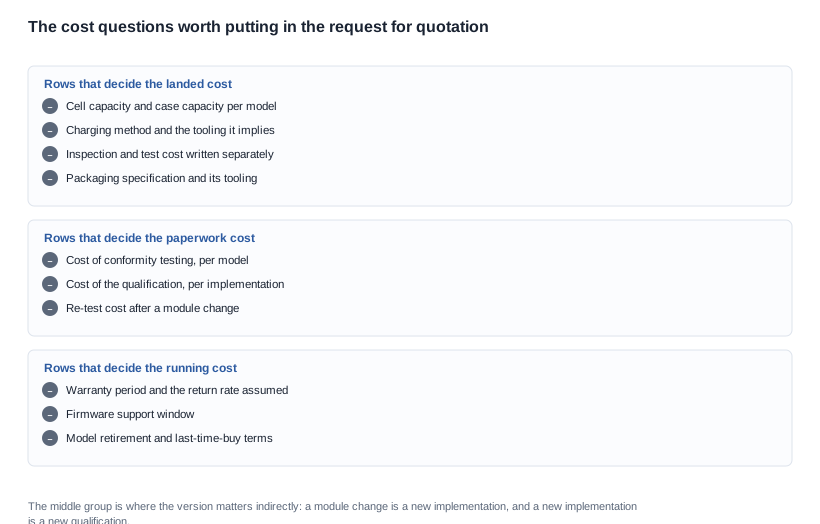
What we can do is hand over the rows that move the money. The cell capacity, the rated runtime, the charging method and the case capacity are published for the models where they apply, and they are what a landed-cost comparison should be built on. The four rows that are not published — transmit power, antenna configuration, profile list and codec list — we will mark as open rather than estimate, and we will tell you which of them have to come from the engineering team and which need a measurement on your own units.
One more thing we will do, because it is the question that gets asked most and is the most useful of the set. If you send the models, the destinations and the quantities, we will tell you which of these costs are real for you and which are not. A programme running a single model into a single market has a very different cost structure from a programme running four models into three markets, and the version is not the line that distinguishes them.
Related reading
- Bluetooth connectivity and versions
- Bluetooth version spec sheet explained
- Bluetooth version supplier verification
- Bluetooth SIG compliance
Tell us the host devices and the markets and we will say which costs are real for you.


