

Whether the Bluetooth version matters depends entirely on what the product is being asked to do, and the honest answer for most programmes is that it matters less than buyers expect. The useful variable is not the scenario but the load the radio carries — whether it is idle most of the time, working intermittently, or under sustained transfer. Load is what a generation actually changes, and load is a property of the channel rather than of the product category.
Smart glasses bluetooth version smart glasses for different use cases therefore resolves into seven procurement scenarios, and in only two of them is the generation number close to a decision criterion. In those two, our own catalogue cannot answer the question, which is the uncomfortable finding this article is organised around.
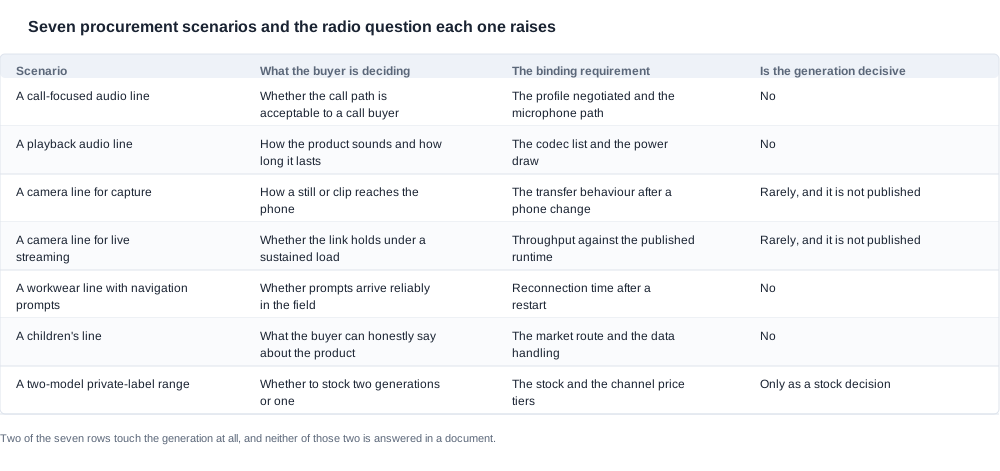
Smart glasses Bluetooth version: seven procurement scenarios, one radio question each
The table below is written from the buyer's side. Each row is a programme, not a product: who is buying, what the product has to do in the channel, what the binding constraint turns out to be, and whether the generation number is in the argument at all. Read across a row and the question the buyer should be asking becomes obvious, which is the point of writing them down in this form rather than as a list of features.
Two things stand out immediately. The first is that in five of the seven rows the generation number is not part of the decision. The second is that in the two rows where it is closest to mattering, the models involved are exactly the ones whose radio rows are blank in our published data.
That concentration is not a coincidence and it is worth naming early, because it changes what a buyer should do. The buyers for whom radio detail matters most are the buyers with the least of it available, from us and from much of this industry. The consequence is that the question a camera programme should be asking is not "which version" but "what would we need to know, and how do we get it", and the answer is a sample test with a written protocol rather than a catalogue comparison.
The two scenarios where the generation is closest to deciding
Only two of the seven rows have a radio under sustained load, and they are the two where a generation difference would show itself if a feature were attached to it. Both sit in the camera class, and both sit in the class whose radio rows are blank in our published data.
The reason the generation is relevant in these two, and irrelevant in the other five, is a property of the link rather than of the product. A radio that is idle most of the time spends its life negotiating and re-establishing, and both of those are firmware behaviours. A radio that is carrying something continuously is operating against the protocol's throughput limits, and those limits are where a generation difference becomes observable. That is the whole mechanism, and it is worth holding on to because it tells a buyer which scenarios to spend money on and which to leave alone.
The commercial reading of this is that a camera programme has an information problem rather than a selection problem. The models to choose between are probably already decided by the imaging tier, the runtime and the case configuration, all of which are published for most of the camera class. What is missing is the radio detail, and the missing detail is obtainable by asking a specific question and testing a specific behaviour. Spending the programme's effort on a version comparison between two models whose radio rows are both blank is the most expensive way to obtain nothing.
The second reading is about supply. The camera platforms are the models with the most demanding radio workload, and they are also the models where the published data is thinnest, which means a camera programme has more reason than an audio programme to make its radio requirements explicit in the request for quotation, its test protocol and its acceptance criteria. A requirement written down before the sample arrives can be met; a requirement assumed can only be discovered.
Calls: the profile and the microphone path decide
The binding requirement for a call-focused programme is the profile the product negotiates and the behaviour of the microphone path that follows from it. A radio generation number tells you almost nothing about either, because noise handling is implemented in the audio chain rather than in the protocol.
In our catalogue, the audio platforms that publish a version all carry either 5.3 or 5.4, and both generations handle calls. The published data is consistent across the tier: the K01 and the K02 on 5.3, and the G07 and the D12, the LC-105-2 and the LC-105-1, and the D11 and the YK12 on 5.4. The sport models publish 5.4 as well, on the YKC02, the D17 and the ZH12, and the A07 carries a 5.4 row of its own. If calling is the product's core function, the radio version is a poor selection criterion and the call profile and the microphone behaviour are the right ones.
Codec support and idle power draw are what matter next. A newer radio offers some headroom on power efficiency in theory; whether that reaches the product is a question for a sample rather than a catalogue.
The published electrical rows are what a buyer in this channel should be working from, and they separate the models far more than the radio does. Capacities run from 55 mAh × 2 on the G07 and the LC-105-2, and the YK12 and the LC-105-1, through 70 mAh × 2 on the YKC02 and 90 mAh × 2 on the K01 and the K02, to 100 mAh on the D11 and the D12 and 115 mAh on the D17, with rated runtimes from roughly six to roughly eight hours. Playback endurance is bounded by those published figures, not by the radio generation, and the cell configuration is the row that actually changes what a customer experiences at the end of a shift.
What actually separates the models in a two-model call range
Buyers in the call channel routinely narrow to two candidates, and the separation between them is worth walking through because it is the clearest illustration in the category of a version doing no work at all.
Take the LC-105-1 and the K01. Both are audio platforms in the same tier, both use magnetic charging, both publish a rated runtime, and they differ on the cell configuration — 55 mAh × 2 against 90 mAh × 2 — and on the radio generation, 5.4 against 5.3. A buyer who has to justify the second model to a channel partner has a choice of two arguments, and only one of them survives the question "what does the customer get". The cell configuration is a published fact with a customer-facing consequence; the radio generation is a protocol class with no published feature attached to it in either model.
That comparison generalises. The D11 and the D12 add a second axis of difference — a Type C interface against the magnetic charging of the LC-105 pair and the G07 and the YK12 — and a Type C interface has a tooling consequence, a packaging consequence and a customer-facing consequence in the same way the cell configuration does. The K02 carries the same 90 mAh × 2 configuration and the same 5.3 generation as the K01, which is a useful reminder that even within one generation the models are not interchangeable.
The rule that comes out of this is simple: when two candidates differ on a published row and on the version, the published row is the argument, and the version is the footnote. It applies to every selection in this category, and it costs nothing to apply.
Sustained media transfer: the workload decides, not the generation
This is one of the two cases where the radio genuinely is close to decisive, and it is worth being precise about why. A camera platform transfers media over the radio, which puts the link under sustained load rather than idle most of the time — and sustained throughput is where generation differences actually show. A link that carries a two-second clip every few minutes and a link that carries continuous video are not the same radio problem, and the second one is the one where the protocol matters.
It is also the case where our documentation is thinnest. Of the eleven camera platforms in our range, none publishes a Bluetooth version. So the scenario where the answer matters most is the scenario where we cannot give it.
Three requirements decide the product in this scenario, and none of them is a version number.
Transfer behaviour after a phone change or a restart. This is the real requirement, and it is a software behaviour rather than a radio property. It varies more between firmware implementations than between radio generations, and it is the requirement that produces the support contacts, because a customer who changes phone and finds the product no longer transfers anything will not describe the problem in radio terms.
Low-latency control. Whether a given radio meets a latency target is measurable on a sample, and the number of taps required matters as much as the latency itself, because a control that responds in a quarter of a second feels broken in a workflow that depends on it.
Idle power draw. Here the radio's wake behaviour dominates the budget, and a radio that wakes more often costs more than its generation would suggest. A product intended to be in service from the start of a shift to the end of one has an idle budget as well as a working budget, and the published runtime figures describe a product working, not a product waiting.
All three are testable on a sample in about two minutes each, which makes them a much better use of a buyer's time than comparing version numbers, and all three are testable against a written protocol that can be put into the acceptance criteria of the order.

Live capture and streaming: throughput against a published runtime
Live streaming is a sustained-load question with a thermal question attached, and it interacts directly with the published runtime figures in a way that catches programmes out.
The interaction is this: a camera platform publishing roughly five to eight hours is describing a camera working, not a stream running indefinitely. The published figure and the streaming requirement are not in conflict, but they are not the same measurement either, and a buyer who quotes the runtime figure as the streaming endurance has made a substitution that will not survive a customer's first hour of continuous use. In our range the camera platforms publish runtime bands of five to eight hours, six to eight hours or roughly seven hours, and those bands are all the runtime-versus-streaming question can be answered from, because none of the camera platforms publishes the test condition behind its own figure.
Two more requirements belong in this scenario, and both are commercial rather than technical. The first is the thermal behaviour of the product in the streaming state, which determines whether the unit needs a cooling path in the packaging and therefore whether the packaging is a custom item. The second is the point at which the product stops being compliant with the claim on the carton, which is a decision the buyer has to make before the artwork is printed rather than after the first complaint.
The camera class also carries a different radio workload from the audio class for a second reason: the presence of an application. A camera platform with a companion application is not a radio and a frame, it is a radio, a frame, an application and a server path, and the part of the chain that decides the transfer behaviour is the application rather than the radio. A programme that has tested the radio and not the application has tested the easy half.
The children's line, where the radio is the least of the constraints
The A05, the A06 and the A07 are the three models in our range designated as children's smart protection glasses, with 40 mAh on the A05 and the A06 and 70 mAh on the A07, magnetic charging and a rated runtime of roughly twenty hours on all three. The A07 publishes a version of 5.4; the A05 and the A06 publish none.
In this line the radio is the least of the constraints, and the binding requirements are elsewhere. The first is the market route and the documentation position, which for this class of product attracts more scrutiny than for an audio model and which our published position does not cover. The second is the EN 18031 category, because a product with a microphone and an application processes personal data, and the category follows the function rather than the generation. The third is the data path, and it is the one a buyer's compliance function will ask about first, because it is a question about a child's information rather than about a radio.
It is worth being explicit about the boundary here, because it is the boundary that matters in this category. Nothing in this article is a statement about what any of these products does for a child beyond its published electrical and connectivity rows, and no claim of any protective, medical or developmental effect is made or implied here. A buyer's position has to be one the supplier can evidence, and for this class of product that position is settled by the route, the documentation and the product's function — not by a radio generation and not by a marketing page.
The practical consequence for procurement is that the radio row on this line is a traceability entry, and the line's real work is in the market and data documentation. A programme that has done that work well and has left the version row blank is in a much better position than one that has a version and no file.
Selecting on workload instead of on a number

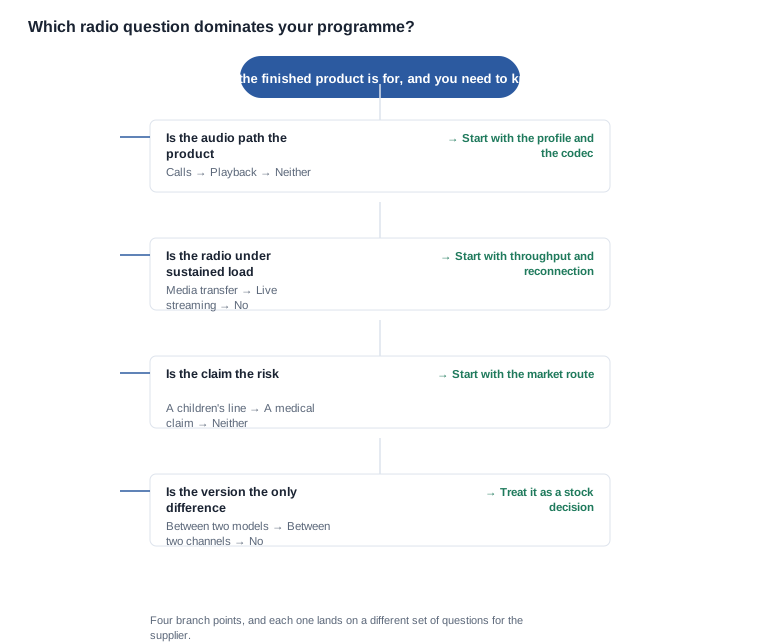
The method follows directly from what the radio actually controls. The generation is a factor only where the radio is carrying something continuously, and the question that follows from a load is always a throughput or a latency question rather than a version question.
Step one: write down what the finished product does, in one sentence. "Captures stills and transfers them to a phone" is a product statement. "Uses the latest Bluetooth" is not, and it is the kind of sentence that is written at the end of a programme because it is easier than the first one.
Step two: name the channel it is sold into and the volume in it. The same product in a promotional channel and in a serviced channel has different constraints, and the volume determines whether an interruption is a return or a complaint.
Step three: identify whether the radio is idle, intermittent, or under sustained load. This is the step that changes the outcome. Idle and sustained load fail in completely different ways, and a programme that has classified the load correctly knows which of the questions in the table above to ask.
Step four: choose the question that follows from the load, and send that one question to the supplier. For an idle radio it is the reconnection behaviour. For a sustained radio it is the transfer behaviour under load. For a call it is the profile and the microphone path. One question, asked in writing, is worth more than a version column.
Step five: test it on a sample before it enters the acceptance criteria. This applies to every channel, and it applies most strongly to the camera class, where our own catalogue can answer the least.
Step six: record the answer against the model, the firmware build and the environment. A test result without those three is an anecdote, and the environment is the one that gets left out.
What to ask, and in what order, for each load
The order of the request matters more than the wording, because a supplier will answer the first three questions fully and the rest briefly, and the first three should be the ones that decide the programme.
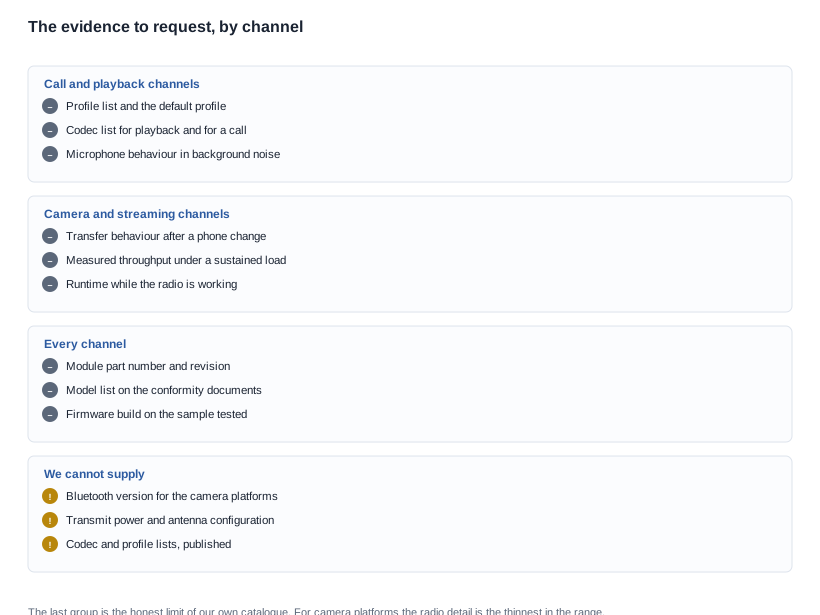
For an idle radio, ask three things. How long the product takes to re-establish the link after a restart. How long it takes after the host device changes. And what the product does when a second device is presented while a first is connected. All three are firmware behaviours, all three are cheap to answer, and all three are the requirements that generate support contacts. The version number is not on the list.
For an intermittent radio, ask two more. How the product behaves when the host offers a different role than the one the product takes by default, and what the fallback is. And whether the behaviour can be changed by the application, because that makes it a configuration rather than a fixed property, and a configuration can be written into a specification and tested.
For a sustained radio, ask for the measurements rather than the descriptions. The time to transfer a defined file size. Whether the transfer rate holds after a period of continuous use. The behaviour when the host is busy with something else. And the runtime while the radio is working, as distinct from the rated runtime in the catalogue, which describes a product in a mixed workload rather than one in continuous transfer. These four are the difference between a camera platform that works in a demo and one that works in a shift.
For every load, ask two closing questions. Which of the answers can be filed in writing, and which need a test on a sample. That single question converts a supplier conversation into a plan, and it is the question that a buyer should put at the end of the first call rather than the beginning.
The pattern worth noticing is that the radio generation is decisive in two scenarios, partially relevant in two, and largely irrelevant in three — and that the documentation gap is concentrated in the camera class, which contains both of the decisive scenarios. The practical answer to that is not to find a better catalogue. It is to buy the information: a written request for the two or three radio questions that the load implies, and a sample test with a protocol attached to the answer.
The technical background is under bluetooth connectivity, the terms are defined in the bluetooth version glossary, the platforms where we can describe the electrical rows fully are on the bluetooth audio glasses range page, and the camera platform detail gaps are covered in camera technology myths. Turning radio claims into evidence is the subject of sample evaluation.
Related reading
- Turning radio claims into evidence — sample evaluation
- Why camera platforms publish less — camera technology myths
- Asking a supplier about radio detail — bluetooth connectivity
Tell us what the product does, and we will tell you which of these seven scenarios we can support with published data.


