

The expensive Bluetooth claims in this category are rarely false statements. They are accurate statements attached to the wrong object — a version quoted from a chipset rather than from the model, a case treated as part of the product's radio, a family-level document read as model coverage. That is why argument rarely settles them and evidence does. Six patterns repeat across this category, every one of them observable without a laboratory, and every one of them traceable to a specific document, label or behaviour that you can check before an order is placed.
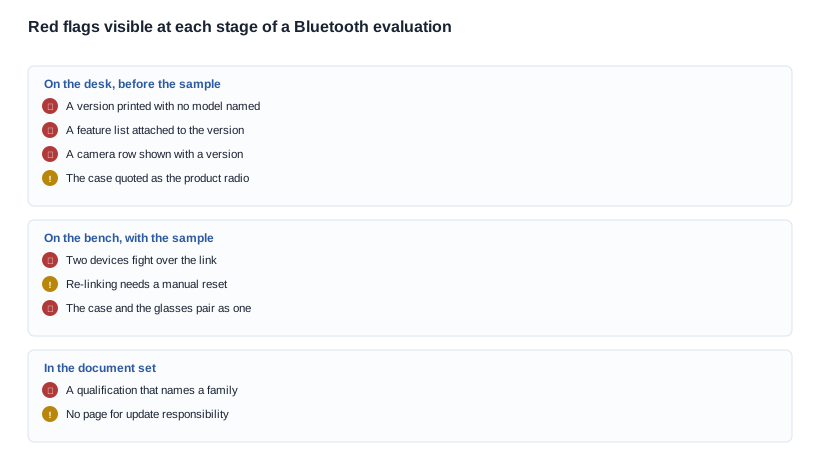
Smart glasses bluetooth version: six observable red flags you can confirm
The first red flag is a version printed without a model, and it has a sharp edge in this catalogue. Our own published position is that fourteen rows carry a Bluetooth version — V5.3 on the K01 and the K02, V5.4 on the D11, the D12, the LC-105-1, the LC-105-2, the G07, the YK12, the YKC02, the D17, the ZH12, the A07, the AR glasses entry and the AI electrochromic entry — and fourteen rows print nothing. The silent half is the eleven camera models, the two lens-format rows and the bone conduction entry. So when a camera row appears in a quotation, a listing or a comparison table with a version attached, it has come from somewhere other than the catalogue. That is not a rounding error; it is a number attached to a row that does not support it. Confirmation: read the version against the model code on the same page, and if the row is one of the silent ones, ask for the radio module part number instead.
The second red flag is a feature list hung off the version number. Multiptoint, LE Audio, broadcast audio and extended range are the usual passengers. A version identifies a radio controller family; it does not carry features, and the difference between the two is not academic because a feature on a listing page becomes a customer expectation. Confirmation: test the feature on the sample rather than reading it. Multipoint is settled by counting the connections that hold at once, which we do not publish for any row in the range, and broadcast audio is settled by whether a second device can hear the link.
The third red flag is the charging case counted into the product's radio. The cases in this catalogue are separate products with their own capacity — 1400 mAh on the L1 Pro, the CY05 and the CY03, 900 mAh or 1400 mAh on the L2 Utral, 1200 mAh on the folding case for the MT6, and cases on the KY06 and the MT5 whose capacity is not published. A case that pairs over a radio is a second radio with a second firmware, a second update path and a second product record. A supplier quoting the case's behaviour as the product's behaviour has merged two things that are sold, supported and documented separately. Confirmation: ask for the case firmware version separately, and check whether the case appears as its own line in the product documentation.
The fourth red flag is behavioural and shows up only when two devices meet. If the unit cannot hold a connection to a second device, or if it drops one of two connections without recovering, the radio claim has outrun the implementation. The catalogue publishes no multi-device limit for any row, so a limit claimed in a quotation is a claim that can be tested on a sample in ten minutes. Confirmation: connect two phones, then a third, and record which connections hold and which do not.
The fifth red flag is a document that names a family instead of a model. Test reports, declarations of conformity and Bluetooth SIG listings are all issued against named configurations, and a document that says "our smart glasses range" instead of listing model designations cannot be filed against a purchase order. This is the single most common documentation failure in the category, and it is invisible until somebody reads the model list on the page. Confirmation: find the model list on the document and check that the designation on your order appears on it.
The sixth red flag is the absence of a page about firmware updates. A product with no described update path has a radio behaviour that will not change for the better, and you will support it for its whole life. This one is observable rather than visible: ask for it in writing twice, and record what comes back. A supplier who can name the owner of updates and the channel they travel through has answered the question. A supplier who says that updates will be released has not.
Reduced to a working list, the six are:
- A version on a row that does not print one. Found by reading the version against the model code on the same page.
- A feature presented as delivered by the version. Found by testing the feature rather than reading the claim.
- The charging case counted as the product radio. Found by asking for the case firmware separately.
- A connection that cannot hold under load. Found by connecting a second and a third device.
- A document that names a family instead of models. Found by reading the model list printed on the page.
- No named owner for firmware updates. Found by asking in writing and recording the answer.
The ranking is worth having before you start. The first and the fifth are expensive because they corrupt the technical file, and a technical file that is wrong cannot be corrected after the first shipment without a re-run. The second is expensive because it becomes a customer expectation rather than an internal error. The third and the fourth are expensive because they turn into afters. The sixth is the cheapest to fix at the quotation stage and the most expensive to discover in the field, because a product with no update path is a product whose behaviour is fixed for its whole commercial life.
Turning an observation into a written objection
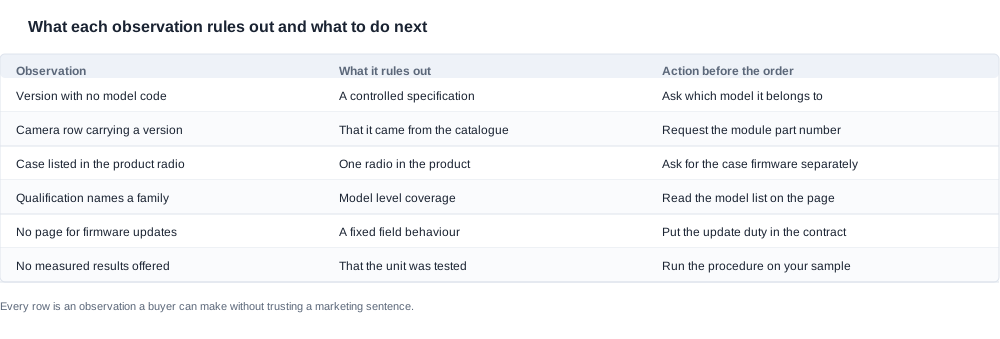
The value of an observation depends entirely on what you do with it, and most red flags are lost in the gap between noticing something and being able to act on it. The table above pairs each observation with what it rules out and with the action that closes it, and the combination matters more than the observation. A version with no model code does not by itself prove anything is wrong; what it proves is that the specification is uncontrolled, and the action is to ask which model the version belongs to rather than to reject the supplier.
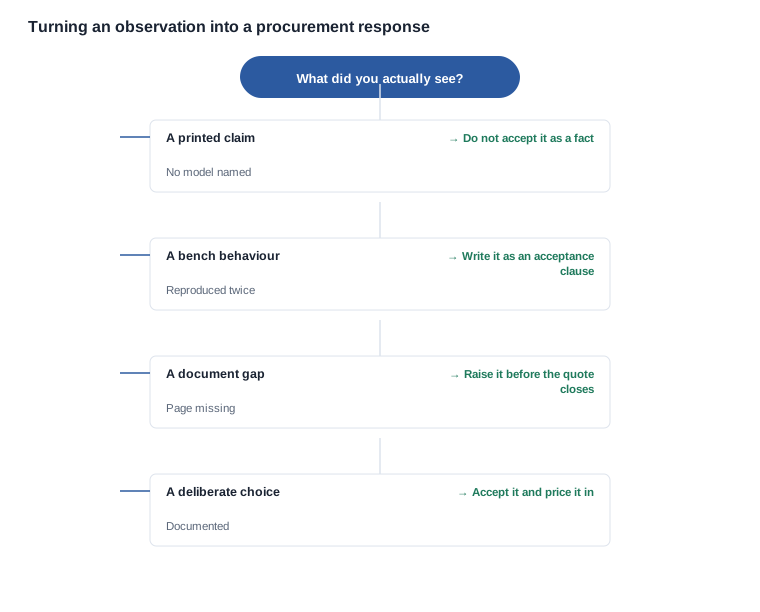
The decision chart is a useful discipline because it separates four outcomes that get confused. A printed claim with no model named is not a fact and cannot be filed, so it goes back as a request. A behaviour reproduced twice on the bench is a fact about the unit, so it becomes an acceptance clause attached to the order. A missing page in a document set is a gap, so it goes into the quotation as an open line with a deadline. And a documented design choice — a deliberate single-connection limit, for example, stated on the datasheet — is neither a defect nor a gap, so it gets priced into the product rather than argued about.
Writing the objection properly is a four-part method, and it is worth doing the same way every time. Describe the observation rather than the conclusion, so that the text can be checked: "the camera row on page four of the quotation shows V5.4" is checkable and "the Bluetooth information is wrong" is not. Name the document or the label the observation came from, so that the supplier knows exactly what is being referred to and cannot answer about a different thing. State what you need instead of what is wrong, because an objection without a requested form of answer produces a discussion rather than a document. And attach a date, because an open line with no date is an open line that survives to the end of the project.
One red flag does not justify ending a supplier relationship, and saying so plainly is part of a working method. If a row is silent in every catalogue in the category, including the ones belonging to manufacturers with better documentation, then the gap is a category condition rather than a supplier failure. The correct response to a category condition is a request with a deadline and an acceptance clause. The correct response to a supplier-specific failure — a version printed where the catalogue has none, a family name where a model list belongs — is a request for correction with a stated consequence.
What changes the commercial weight of a red flag is whether it is raised before or after the money moves. Raised before the first order, the cost of a red flag is a question and possibly a clause. Raised after the first production run, the cost is a technical file that has to be rebuilt, a conformity assessment that has to be re-scoped, and a shipment that either waits or ships with a risk nobody has written down. This is the practical reason to run a red-flag check against every quotation rather than only against the ones that feel cheap, since the cheap-looking ones are exactly the ones where the technical file is least likely to be reviewed.
There is also a category of red flag that is not about the supplier at all, and it is worth separating out because it is the most common one in a competitive evaluation. A catalogue that prints a version for every model is not more accurate than a catalogue that prints it for some; it is differently incomplete, because the versions it prints for rows where the manufacturer published nothing are necessarily estimates. A buyer who prefers the fuller sheet is choosing a sheet that has been completed by guesswork, and the guesswork will be discovered by whoever has to scope the conformity assessment.

The red flags that live in the document set
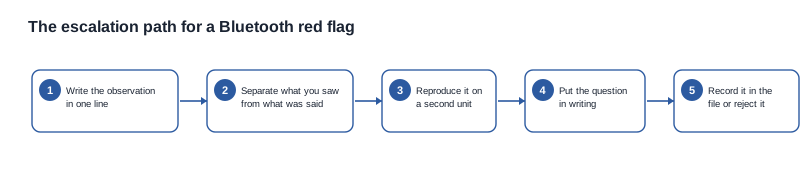
Paperwork is where the most consequential red flags hide, because paperwork is what a compliance reviewer reads and what a market-access authority relies on. Five documents make up the set a buying file should contain: the declaration of conformity for the product, the test reports behind it, the Bluetooth SIG qualification if the trademark and protocol are used, the marking and labelling page, and the technical file that ties them together.
The escalation path above is the order in which a red flag should be handled. Writing the observation in one line first, before any interpretation, prevents a conversation from starting from an accusation. Separating what you saw from what you were told prevents you from rejecting a product for a claim you never actually verified. Reproducing on a second unit removes the possibility that you are describing a defective sample. Putting the question in writing converts it from a relationship problem into a documentation problem, which is a much easier kind of problem to solve.
Three red flags appear in the document set often enough to name specifically. The first is a document issued against a configuration that differs from the one being ordered — a different antenna, a different module, a different case. The second is a model designation on a document that does not correspond to any catalogue row you are buying. The third, and the one buyers most often miss, is a company-level certification statement being read as per-model coverage. Our own catalogue carries an export certification statement at company level and no per-model certification row, which is the normal arrangement for a factory of this size and which is exactly why a document has to be requested for each model rather than inferred from the company statement.
Market destination is the other axis that catches people out. A document issued for one destination does not cover another, and the route differs between the European Union, where the Radio Equipment Directive (EU) 2014/53/EU applies with the EN 18031 series cited for the cybersecurity requirements that apply where personal data is processed, and the United States, where FCC equipment authorisation applies. A buyer collecting a file for two markets needs two files, and a document offered as covering "international" is a red flag rather than a convenience.
The Bluetooth SIG listing is the document most often handled loosely, because it sits outside the regulatory file and gets treated as a marketing formality. Two things about it matter commercially. The qualification is a statement about a specific product configuration and a specific Bluetooth version, so a listing that covers a family rather than a model designation has the same defect as any other family-level document. And the listing is the only part of the file that a retailer, a distributor or a marketplace will sometimes ask to see, which makes an incomplete listing visible in the channel even when the rest of the file is sound. A document naming a designation that does not correspond to any catalogue row you are buying is a related problem: it may be a genuine variant, an old designation or a different product entirely, and the only way to tell is to ask which configuration the document was issued against.
The distinction between a qualification and a regulatory approval is worth keeping in view while reading these documents, because they are answered by different organisations and priced separately. The Bluetooth SIG certification difference sets out the separation, and the common mistakes in Bluetooth SIG certification and marking and labelling guidance cover the two places where the two get confused in practice.

Where our catalogue's own gaps create red flags for buyers
The working rule we apply: we publish a Bluetooth version on fourteen rows and say nothing on the other fourteen, and a buyer is better served by knowing which half is which than by a catalogue with a number in every cell. We are aware that this creates a red flag of our own, because a buyer comparing our camera rows against a competitor's catalogue that prints a version for every model will reach the conclusion that our information is weaker. It is not; it is more complete about its own limits, and the difference shows up the first time a conformity assessment has to be scoped.
What we will not do is estimate a version for a silent row, publish a module part number we do not hold, attach a feature to a version we print, or treat the company-level export certification statement as per-model coverage. We will not describe a multi-device limit, a connection outcome or a range figure for any model, because none of them is published to us. Every one of those would be a fabricated figure, and a fabricated figure that reaches a technical file is a liability for the buyer who relies on it.
What we can do is read your document set against our catalogue rows and tell you where the coverage sits. Give us the declarations, the test reports, the qualification listing and the marking pages for the models you are considering, and we will mark each one: the model designations it names, the designations it covers only through a family statement, and the designations it does not cover at all. That marking is the part most suppliers will not do for you, because it requires holding the catalogue and the documents at the same time.
We also take red flags seriously when they are raised against us, and we would rather be told about one in writing than discover it in a buyer's comparison sheet. The most common one is a camera row carrying a version that we do not publish. The answer to that one is the module part number and the profile list, and if we cannot obtain them for a specific configuration we will say that too. A second common one is a family-level statement being read as model coverage in a market-access file; in that case the company-level export certification statement we publish is the relevant starting point, and the per-model documents have to be requested separately for each model that is actually being shipped.
One red flag we cannot resolve on your behalf is worth flagging in return. If a supplier quotes a Bluetooth version that contradicts the published catalogue for that model, and the supplier is the manufacturer rather than a trader, the contradiction has to be resolved in writing before anything else proceeds, because every downstream document in the file is scoped to a configuration that somebody has to confirm.
There is a boundary worth stating. We can tell you what a document says and which models it names. We cannot validate a test report, issue a certificate, or confirm a serial number's production history, and we will not imply that we can. Where the answer is not in the documents, the answer is that the document does not say it.
The wider treatment of radio behaviour sits under bluetooth connectivity, the audio platforms we can describe in full are on the bluetooth audio glasses range page, and the charging case options article separates the case radio from the product radio. For a worked example of what a connection test shows in a real environment, the calls use case covers the same ground from the product side.
Send the device list and the environment, and we will tell you which of the six red flags you can check yourself before you order. If you would rather start from the document side, send the conformity declarations and the qualification listing with the models you have shortlisted, and we will mark the coverage against the catalogue rows before you have spent a day on a sample.


