

AI camera glasses charging case options are decided by freight and packaging long before they are decided by taste. A case is a second lithium cell in every unit, a cavity in the retail box, a hinge on one model and a new set of failure modes on all of them. Two configurations that look identical on a product page can land in different freight classes and different packaging SKUs, and the difference between them is usually a line nobody asked for.
Our catalogue publishes eleven camera models — the L2 Utral and the CY05, the V03 and the MT6, the V06 and the L1 Pro, the KY06 and the CY03, the S7 and the MT5, and the V03 Pro — and for each of them the case position is either a published row or a row the catalogue does not print. This article sets those rows out, explains what a case actually changes commercially, and gives a decision method that works whichever channel you sell into. It does not quote prices, because our catalogue publishes none.
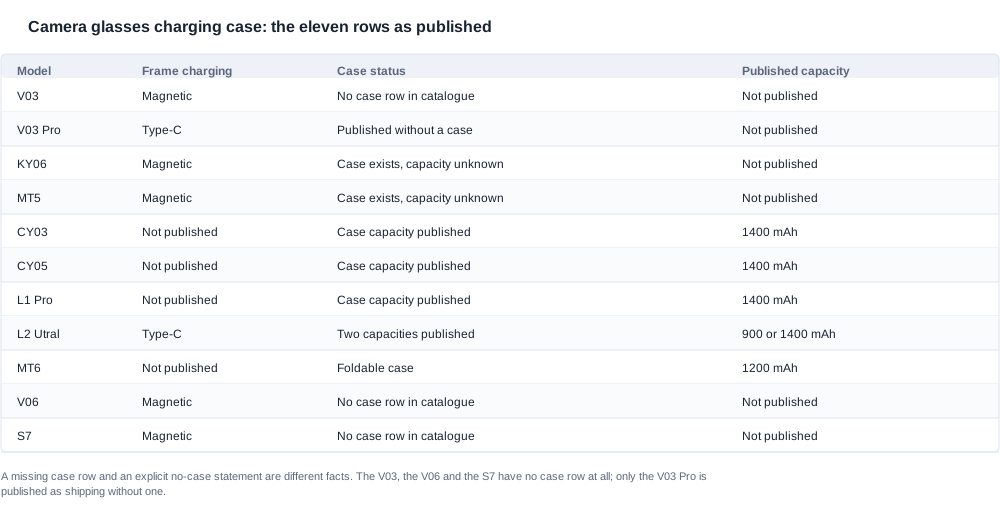
AI camera glasses charging case options: the eleven rows as published
The first thing a buyer should do with any published specification sheet is distinguish not published from none. In this range the distinction carries real weight, because the case status of the eleven camera models falls into three distinct groups rather than two.
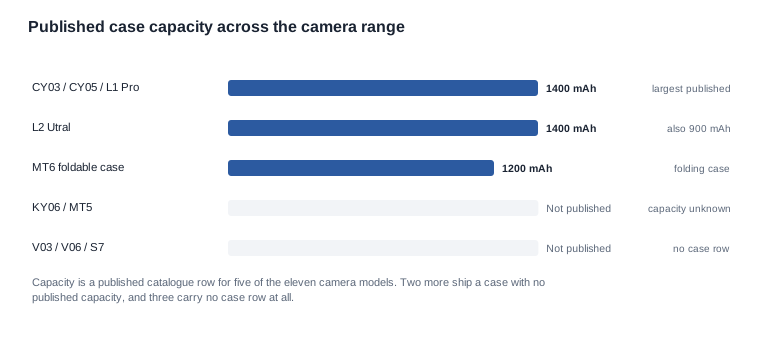
Five models publish a case capacity. The CY03 and the CY05, and the L1 Pro each publish a 1400 mAh case. The L2 Utral publishes two capacities, 900 mAh and 1400 mAh. The MT6 publishes a 1200 mAh foldable case. These are the models where the carton, the freight class and the listing proposition can be modelled today from a published number.
Two models ship a case with no published capacity. The KY06 and the MT5 are published with a charging case, and the capacity of that case is not published. This is a genuine gap rather than a small one, because the case capacity is the number that determines whether the unit can be recharged away from a socket, and it is also the larger of the two lithium items in the parcel when it is larger at all.
Four models carry no case row at all. The V06, the S7 and the V03, and the V03 Pro have no charging-case row in the catalogue. That is an absence of information, not a statement that no case exists. It is one of the most useful things a buyer can ask about, and one of the easiest to forget, because a sheet listing what is published will not list what is missing.
No model is published as having no case. The V03 Pro is one of the four that carry no charging-case row at all, alongside the S7 and the V06, and the V03, and the catalogue prints no row that would settle the question either way for any of them.
That is three states across eleven models, and a buyer who treats them as two — case or no case — will misread six of the eleven. The full breakdown is in the table above; the commercially important part is that only five of the eleven let you model the parcel from published data.
The other published row that travels with the case is the frame charging method, and it separates the range into three groups. Five camera models charge magnetically: the V06 and the S7, and the MT5 and the KY06, and the V03. Two charge over Type-C: the V03 Pro and the L2 Utral. Four do not publish a charging method at all: the L1 Pro, the CY05 and the CY03, and the MT6 — and all four of those publish a case capacity, which is worth noticing, because it means the four models whose charging method you cannot read are exactly the four whose case you can.

Four ways a charging case changes the delivered cost
A case is the highest-leverage accessory decision in this range, and it is worth being precise about why, because "it sells" is only one of the four reasons and it is the least measurable.
It changes the parcel. This is the reason the decision belongs in a procurement conversation rather than a merchandising one. A case adds a second lithium cell to every unit in the shipment, and the number of declared cells and their capacities are what the freight forwarder, the carrier and the destination authority work from. A parcel that goes by air with one cell and a parcel that goes by air with two are not the same shipment, and the second one is not only heavier and bulkier but also differently documented. At volume this is often the largest single line in the delivered cost, and it is entirely invisible on a product page.
It changes the packaging. A case needs a cavity in the retail box, protection in the master carton, and warehouse volume per unit. That is a tooling item and an artwork item, not a packing instruction, and both are incurred once per packaging configuration rather than once per unit. This is where the volume arithmetic bites: a retailer running two case sizes splits one packaging programme into two, and the fixed costs do not split.
It changes the returns profile. A case adds a charge indicator, a connector and, on the MT6, a hinge. Each of those is a failure mode that does not exist when the unit is a frame and a cable. A buyer running a high-volume channel should treat case faults as a separate return reason code from day one, because a case fault and a product fault have different causes, different suppliers and different remedies, and mixing them in one code makes the trend unreadable.
It changes the listing. A case is the object that makes a "charge once, use through the day" proposition credible on a product page, because it is the only way a customer can picture that claim being true. This is the strongest commercial argument for the case and it is real — but it is a reason to include a case, not a reason to choose a particular capacity.
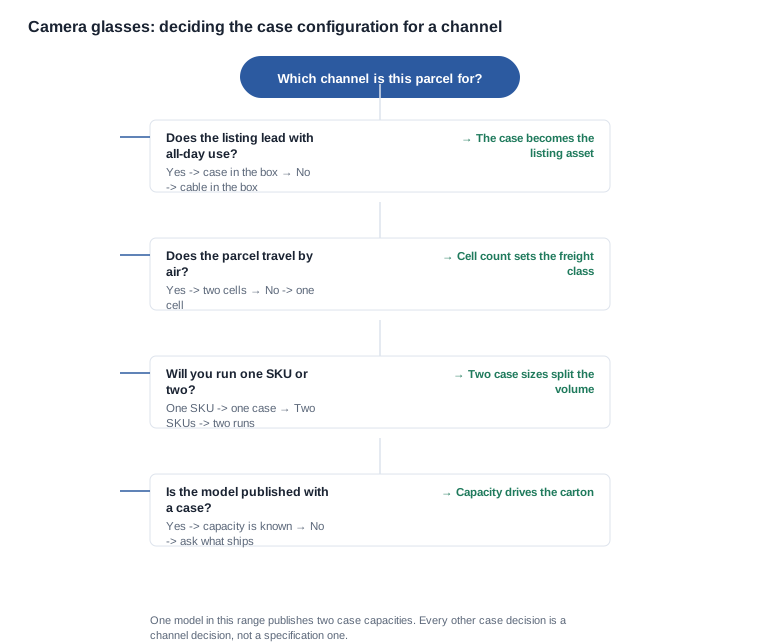
The fourth of these is the only one a buyer can see, and it is the one that tends to drive the decision. The first three are the ones that decide whether the programme is profitable. The failure pattern to avoid is the reverse order: a case chosen to support the listing, and the freight, packaging and returns consequences discovered after the artwork is approved and the first pallet has shipped.
Magnetic frames and Type-C frames as two shipping positions
The charging method published on the frame row is not only a technical detail; it splits this range into two positions that behave differently in a parcel, and a buyer who is comparing models should compare them on this axis before comparing them on anything else.
The magnetic group — the V03 and the MT5, the V06 and the S7, and the KY06 — needs a charging accessory in the box. A customer who receives the unit without one has a product that does not work on arrival, which is a returns driver and a one-star review driver, and it is the kind of defect that is invisible in the factory's own inspection because the accessory was in a different carton. The magnetic group also splits on the case: the KY06 and the MT5 ship a case whose capacity is not published, while the V03 and the S7, and the V06 have no case row at all. Three questions are therefore needed for this group — does a case exist, what is its capacity, and does it need to be in the box.
The Type-C group — the V03 Pro and the L2 Utral — needs a cable, and a cable is something the customer already owns. The parcel is smaller, the freight is lighter, and the unit works on the first day without an accessory. The L2 Utral is the more interesting of the two because it is the only model in the range that publishes two case capacities: it can be configured with a 900 mAh case or a 1400 mAh case, or run as a Type-C-only configuration with no case at all, subject to what the supplier confirms.
The four unpublished-method models — the L1 Pro and the CY03, and the MT6 and the CY05 — are the ones to press hardest on, because their case capacity is published and their charging interface is not. A model that ships a 1400 mAh case and charges over an interface nobody has named is a model where the in-box contents cannot be finalised. Ask for the interface before the packaging is drawn, and ask for it in writing, because the answer determines whether a cable is in the box as well as a case.
The commercial rule that falls out of this is simple enough to state: decide the in-box contents from the charging method row, and decide the parcel from the case row. When the two rows disagree — and for four models they do — the discrepancy is a question, not a decision.
The L2 Utral is the only place in this range where the case decision can be made inside a single model rather than between models, and it is worth treating that as a case study in how the decision should be argued. Two published capacities, 900 mAh and 1400 mAh, let one platform serve two propositions: a configuration where the unit goes through a full working day on one charge with no accessory in the box, and a configuration where the accessory is in the photograph and the parcel carries a larger second cell. The commercial cost of taking the second route is not the capacity difference; it is that a second packaging configuration is a second artwork route, a second stock line and a second set of packing instructions, and all of those are incurred once rather than per unit. The question to answer before choosing is therefore not "which capacity is better" but "does this channel support two packaging configurations at the volume I plan to buy". A channel with a single SKU and a single carton has no use for the second capacity, and a channel with two tiers and enough volume on each has a strong use for it. The AI camera glasses packaging options piece covers how that choice propagates through the artwork, the insert and the master carton.


Building a case comparison the way a buyer will be asked to defend it
The comparison a procurement team actually needs is not a league table of cases. It is a shortlist with three numbers per model and two conditions, and the conditions matter more than the numbers because they are the parts that are not published.
The three numbers. The frame cell capacity, which is published for all eleven models and drives the base weight. The case capacity where published, which is the number that tells you whether a second charge is possible away from a socket. And the packed unit weight, which is not published for any model in this range and has to be measured on a sample, because it is the only number that combines the unit, the case, the insert and the retail box.
The two conditions. The first is the charging interface, which is published for seven of the eleven camera models and not for four. The second is the case configuration itself: capacity published, capacity unknown, or no case row. These conditions are not a detail of the comparison; they decide which models can be compared at all, because a model whose in-box contents are unknown cannot be compared on parcel weight with a model whose in-box contents are known.
The measurement itself should be done once, in a fixed way, and recorded. Weigh a packed unit on a sample that represents the shipping configuration, including the case if one ships and the insert if one is used. Measure the retail box dimensions as packed, not as designed, because the difference between the two is often the difference between a dimensional-weight charge and a flat charge. Then compare the actual weight with the volumetric weight of the master carton you intend to use, and note which one governs. The shipping weight analysis covers that arithmetic in detail and the camera packaging options analysis covers how the case decision propagates into the box and the insert.
There is a trap in this comparison that is worth naming. Do not compare a model with a published case against a model with no case row and conclude that the second is lighter. It may well be lighter, but the comparison is invalid, because you do not yet know what is in the box for the second model. A model whose case row is absent might ship a case, and a case is heavier than the cable it replaces in every configuration we have seen. The honest comparison states that the second model is lighter than the first if and only if no case ships with it, which is a question with a written answer attached to it.
The second trap is the one the battery transport compliance buyer checklist is built around. A case is a second lithium item, and it changes the transport documentation even when nothing about the product changes. If the second cell is larger than the first — and on four models it is — then the declared capacity, the packing instruction and the freight mode are all decided by the accessory rather than by the product.
Where the case decision belongs in the quotation
A case decision that is made in a merchandising meeting and arrives at the factory as an instruction is a decision made too late, because the factory's quotation will already have been priced around a configuration that is no longer the one you want. The fix is to put the case question into the RFQ itself, so that each supplier's quotation answers it explicitly rather than by default.
Five items belong in the request. Whether a case exists for the exact model, and if so whether the capacity is published or not. The charging interface on the frame, since it decides whether a cable is needed in the box. The case's own charging interface, its charge time and whether it carries a state indicator, since a case with an indicator is a different accessory from one without. The case weight and dimensions, and therefore the packed unit weight, which is measured rather than estimated. And the freight class and the transport requirement that follow from the declared cell count. None of these is glamorous and all of them change the carton.
The items that follow from the answers are the ones that belong in the negotiation. The number of packaging configurations is negotiable and it is the number that carries the tooling and artwork cost, so it is usually worth more than a unit-price argument. Whether the case is ordered with the first lot or held for a later one is negotiable and it changes the working capital in the programme. The freight basis — by weight or by volume, and which of the two governs — is negotiable and it changes what the case decision costs. The cell count, by contrast, is not negotiable, because it is a property of the product rather than a commercial term, and no agreement changes what is in the box.
Two questions are worth raising during the negotiation rather than after it, because both are cheaper to settle early. The first is whether the case ships with the unit or is offered as a separate line. A case shipped with the unit changes the parcel for every unit; a case sold separately changes it only for the units that carry one, and it changes the freight documentation for the same reason. That single decision can move more money than a unit-price conversation, and it is usually presented as a packaging preference rather than as a commercial one. The second is how the supplier treats a configuration change after the first lot has shipped. A programme that reorders with a different case in year two is either a new packaging route with new artwork and new lead time, or it is a continued run on the original route — and the difference between those two answers decides whether a later variation is cheap or expensive.
The catalogue publishes no minimum order quantity, no lead time, no unit price, no case weight and no case dimensions for any camera model, and we will not estimate them. What we do publish is the case capacity where it exists, the foldable nature of the MT6 case, the single published unit weight in the whole range — 158 g for the MT6 glasses unit, which excludes the foldable case — and the charging method on seven of the eleven models. The AI camera glasses buying guide sets out the category-level decision and the CY05 charging options analysis works through the same choice for a single model.
Send us the channel, the volume, the destination country and the models you are weighing, and we will tell you which case configurations exist for them, which of the eleven publish a capacity, and which four questions will have to be answered before the packaging can be finalised. The range is at AI camera glasses and the electrical background is under charging solutions.
Related reading
- How the category is decided — AI camera glasses buying guide
- The parcel arithmetic — AI camera glasses shipping weight
- The documentation a second cell triggers — battery transport compliance buyer checklist
Send us the channel, the volume and the destination country, and we will tell you how the case configuration changes the delivered cost per unit.


