

If you are buying open-ear audio frames for calls, the three rows that decide the purchase — microphone pickup, leakage, and stability under movement — are precisely the three rows that are not published for any model in this category. This page is written for the buyer who has to make that purchase anyway. It gives you a method for evaluating the three unpublished rows, the published rows you can actually rely on, the questions to put in the request for quotation so the answer arrives before the order rather than after it, and the criteria to write into the purchase agreement so the result is agreed rather than argued.
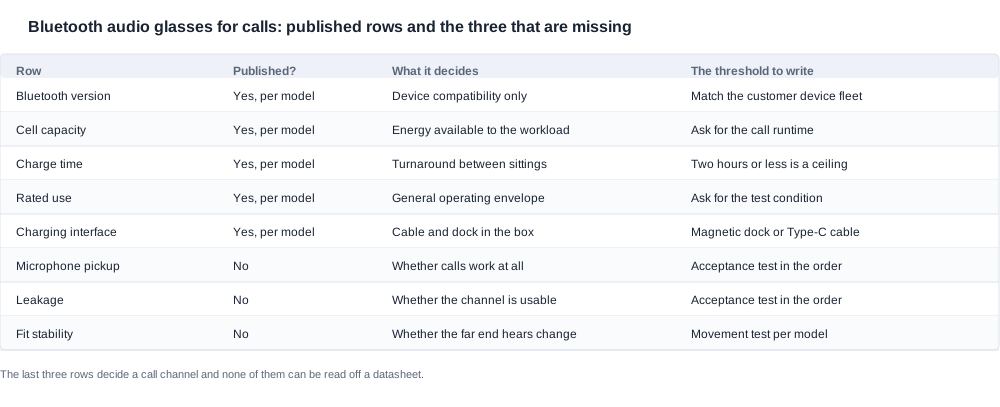
Bluetooth audio glasses for calls: three rows the sheet does not publish
An open-ear frame puts the speaker at the temple and leaves the ear uncovered. That single geometry is the whole appeal and the whole problem: the arrangement that lets a buyer hear traffic, a colleague and a warning also lets the room hear the buyer. Every other category in this range has a published row that narrows the decision. This one does not, for the rows that matter.
The three decisions behind a call channel
A brand owner building a call channel has to put a product in front of a customer who will be on calls all day, and the published rows will not decide it. They need to know in advance that the decision will be made on a sample rather than on a datasheet, because that changes the schedule, the sample budget and the claims the listing is allowed to make.
A procurement manager shortlisting open-ear frames against two or three supplier quotations needs to know which differences between the quoted models are real product differences and which are catalogue wording. This is a category where several models publish identical electrical rows under different names, so a difference that looks like a difference in a comparison table may be nothing at all.
A channel buyer placing a single order for a business customer is defending a decision that the customer will test within a week, in their own environment rather than yours. The customer will not accept a general claim, and the supplier cannot make one either, so the only defensible answer is a documented result.
Why calls break open-ear frames
Three failure modes show up in real use, and they are worth separating because each has a different test.
Wind noise at the caller's end. The noise is generated at the microphone, not at the speaker, and no open-ear geometry eliminates it. What differs between frames is microphone placement and whether the frame's own shape shelters it. Neither is published for any model in this range.
Leakage. The buyer's own voice is audible to the person standing next to them. This is the disqualifying failure for call use, because a channel built around calls fails wholesale when leakage is too high — the customer returns a quantity rather than a unit.
Instability under movement. A frame that shifts when the wearer turns their head or walks up stairs changes the microphone-to-mouth distance, and that changes what the far end hears. This failure is quiet, which is what makes it expensive: the call is still connected, and nobody can point at the moment it went wrong.
None of the three can be derived from a battery figure, and none is described anywhere in the published data for the eight audio models in this range.
What a call channel costs when the wrong model lands
A buyer who treats the call use case as a listing line rather than a selection criterion does not lose a single unit. The commercial loss arrives in a shape that is hard to see in the shortlist and obvious in the quarter.
The return rate moves before the margin does. A business customer who discovers that calls are unusable does not return one frame and stay. They return the whole deployment, because the product was bought as a productivity tool and the productivity case has failed. A retail channel with a 5% return rate on a discretionary product is having a normal month; a business channel with a 5% return rate on a productivity deployment has a procurement conversation with its own customer.
The cost of the failure is the sample budget, not the unit price. The unit price of the wrong model is recoverable. The sample budget spent discovering the problem late, the second sample order, the artwork revision and the launch delay are not. This is the argument for running the leakage test before the shortlist is scored rather than after the order is placed.
The cost of the failure is the support load. A call product that underperforms generates a support stream that a general-audio product does not: tickets that describe a call problem, a return authorisation, a replacement, and a second ticket from the same customer. A channel buyer should price that stream into the unit economics before the order, because a product with a published surround sound line invites exactly this expectation.
The cost of the failure is the claim. If the listing said the product was built for calls and it turned out not to be, the exposure is not a return but a claim. That is a different commercial conversation, and it is the reason the claims discipline below is not optional.
The published rows and the narrow job they can do
The category publishes five rows per audio model, and they are worth reading carefully because each does a smaller job than buyers expect.
The radio version is a compatibility row. The K01 and the K02 publish Bluetooth V5.3; the G07 and the LC-105-1, the D11 and the YK12, and the D12 and the LC-105-2 publish V5.4. The difference between the two generations is a platform decision, and it tells you nothing about how a call sounds. Treating it as a call-quality row is the single most common reading error in this category.
The cell configuration tells you the energy available to the workload, and the workload for a call is a specific one. The K01 and the K02 publish two 90 mAh cells; the LC-105-1 and the YK12, and the LC-105-2 and the G07 publish two 55 mAh cells; the D11 and the D12 publish a single 100 mAh cell. None of those is a call runtime.
The charge time for every audio model in the range is published as a ceiling of two hours or less, which is a turnaround figure for a business deployment rather than a call-quality figure. The charging interface is published per model: six models charge magnetically, and the D11 and the D12 charge over a Type-C port.
The rated use figures are published as about eight hours, about seven hours or about six hours depending on the model, and they carry no stated test condition. The K01, the K02 and the LC-105 pair publish roughly eight hours; the D11 and the D12 publish roughly seven; the G07 and the YK12 publish roughly six.
The same five rows, read against what a call deployment needs, produce the grid below. It is the grid a buyer should carry into the request for quotation, because every row marked "not published" becomes a question and every row marked "published" carries a caveat.
| Row | Published for this range | What it settles for a call channel | The caveat or the criterion to write |
|---|---|---|---|
| Bluetooth version | Yes, per model | Which devices in the customer's fleet can pair | A compatibility row, never a call-quality row |
| Cell configuration | Yes, per model | The energy available to a call workload | Not a call runtime; ask for the workload figure |
| Charge time | Yes, two hours or less | Turnaround between two sittings in a shift | A ceiling, not a measured result |
| Rated use | Yes, about 6 h to 8 h | The general operating envelope | No test condition is published |
| Charging interface | Yes, per model | Which accessory chain the business ships | Six magnetic, two over Type-C |
| Surround sound line | Two models only | A listening feature on the D11 and the YK12 | Says nothing about transmission |
| Microphone pickup | Not published | Whether calls work at all | An acceptance test in the purchase order |
| Leakage | Not published | Whether the channel is usable in an office | An acceptance test with a second judge |
| Stability in movement | Not published | Whether the far end hears a change | A movement test per temple configuration |
| Frame weight | Not published | The main driver of movement | Weigh a sample unit |
Two rows that exist and are often over-read
Two audio models publish a surround sound line: the D11, whose published feature line names surround sound together with long battery life, and the YK12, whose published feature line names surround sound together with a slim temple. That is a listening row. It says nothing about transmission, it carries no driver size and no response figure, and it must not be used in a call argument. A third audio model, the G07, publishes a slim build with a detachable temple, which is a mechanical and merchandising row.
It is also worth stating plainly what is absent, because the absence is the point of this page. No model in this range publishes a capacitive touch control row, no model publishes a microphone specification, no model publishes a leakage figure, and no model publishes a frame weight. The only weight published anywhere in our catalogue is 158 g for the MT6, which is a camera model with a different cell and a foldable case, and it cannot be used as a proxy for an audio frame.
How to build a comparison table when the rows are this thin
A procurement manager comparing three supplier quotations will reach for a spreadsheet, and the spreadsheet is where the mistake happens. A comparison grid filled from five published rows looks like a specification comparison and behaves like a marketing one: it produces a ranking, and the ranking is an artefact of which rows happened to be published.
The method that works is to split the grid in two. The first block holds the published rows, and it is used to eliminate rather than to rank — a model whose radio version does not match the customer's device fleet is out, whatever else it scores. The second block holds the unpublished rows, and it is used to build a test plan, with one row per test, one acceptance criterion per test, and a column for the result once the samples arrive. The output of that second block is not a ranking at all. It is a purchase order.
Two disciplines make the difference between a comparison that closes and a comparison that stalls. First, every published row in the grid must name the model it came from, because several models in this range publish identical rows and a value copied from one is easily attributed to another. Second, every cell that reads "not published" should be read as a question rather than a gap, and each one should be turned into a line in the request for quotation. A grid with eight empty cells and a request for quotation with eight numbered questions is a procurement tool. A grid with eight empty cells and nothing else is an argument waiting to happen.

Four sample tests that close the call gap
The correct conclusion from the previous section is that the published data lets you choose a platform. It does not let you choose a call product. These four tests are what convert an open question into a documented result, and each one has a completion standard so that the result can be presented to a supplier, a customer or a compliance team.
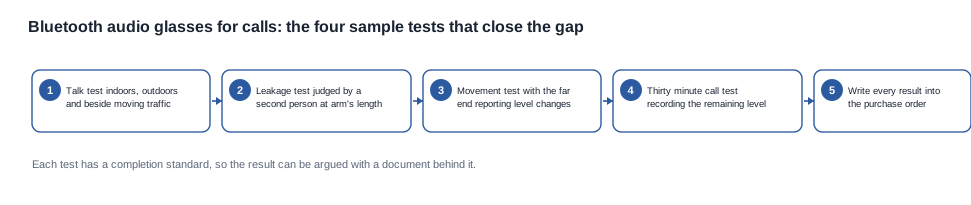
The two-metre talk test. Have the person at the far end rate intelligibility in three environments: indoors, outdoors in light wind, and outdoors beside moving traffic. A rating rather than a yes-or-no answer, because the yes-or-no answer is too coarse to distinguish two models. If the channel is a commute channel, the third environment is the one that decides the product.
The leakage test. Read a message aloud at normal speaking volume and have a second person at arm's length judge whether they can hear it. This takes two minutes, and it disqualifies more products for call use than any published specification does — which is precisely why skipping it is so expensive.
The movement test. Turn the head sharply, walk, and go up stairs, with the far end reporting whether the level changes. A frame that moves is a problem that can sometimes be addressed through temple choice, and two models in this range publish a temple configuration while six publish none.
The sustained call test. Make a thirty-minute call from a full charge and record the remaining level. The published rated use figures carry no test condition, and a call is a defined workload worth measuring yourself. Quote the result with its condition attached, which is the only way it can be defended later.
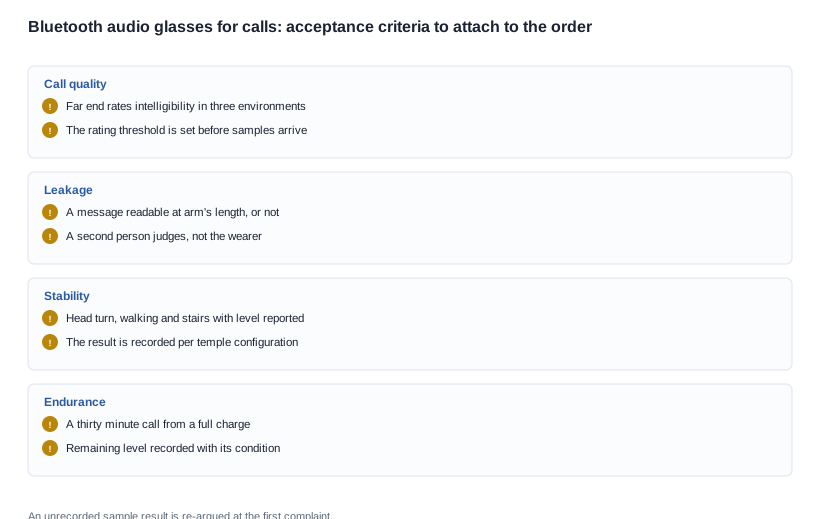
Write the results into the request for quotation and into the acceptance criteria before the samples arrive. A sample result that was never written down gets re-argued at the first complaint, and the buyer is the one who has to do the arguing.
Running the tests on a supplier sample rather than your own
There is a version of this that is cheaper and a version that is more honest, and the difference between them is worth understanding before the purchase order is signed.
The cheaper version runs the four tests on a unit the supplier supplies and accepts as representative. The risk is that the supplier's unit has been selected, configured or conditioned in a way that a production unit will not be, and the buyer's agreement is usually too vague to catch it. The more honest version has the buyer purchase the sample on the same commercial terms as the production order, so the sample travels the same route as the goods and is subject to the same inspection. It costs more and it is the only version where the result is defensible.
Where the buyer's own test team runs the protocol, two further points matter. The protocol should be written before the samples arrive, with the acceptance thresholds fixed in advance, because a criterion invented afterwards is a negotiation and the buyer starts it from the weaker position. And the protocol should be run on more than one unit of each model, because a single unit tells you about a single unit. The difference between one sample and three samples on the same model is the difference between a single anecdote and a rate, and in a category where the published rows are this thin the sample data is the only rate available.
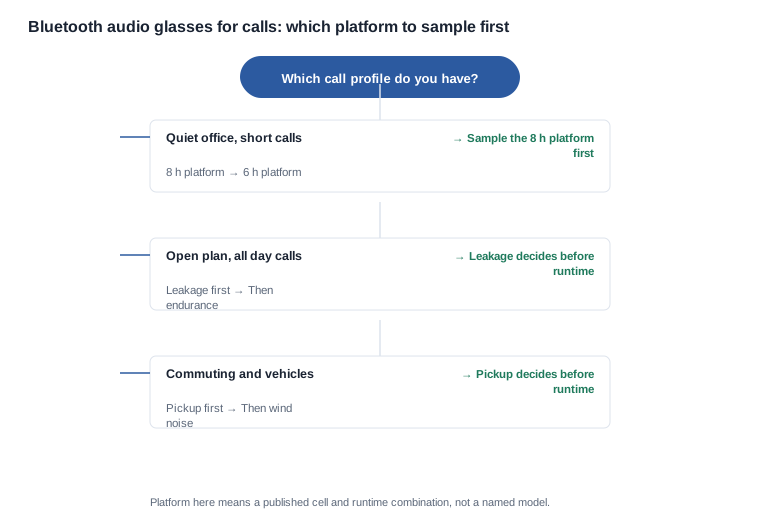
The decision chart above is about which tests to commission first, not which model to order. A buyer with a quiet-office call profile can defer the wind stage; a buyer with a commuting profile cannot. Prioritising the tests is what keeps the sample programme inside a sensible budget.
The commercial terms a call channel should fix
A call channel has different commercial exposure from a general-audio channel, and the purchase agreement should reflect that.
The sample order and its terms. A call programme needs more than one unit per model under test, and the sample cost, the shipping cost and the timeline for those samples are all negotiable lines that are rarely quoted. Ask for them separately from the production quotation so that the production price is not anchored to a sample-sized quantity.
The acceptance criteria as contractual text. The four results, with their conditions, belong in the purchase agreement as acceptance criteria rather than in an email. A lot that fails a stated criterion is a lot that can be refused or reworked; a lot that fails an unwritten expectation is a lot that has been accepted.
The return terms for a business channel. A business customer returns in quantity, so the terms need to reflect quantity rather than unit. Ask what the return window is, what quantity band triggers a different process, and who carries the freight on a return. Also ask for the warranty period with a stated response time, because a failure in a business deployment is a support commitment to the end customer and the buyer has to be able to pass one on.
Payment nodes against inspection. For a call channel the inspection point matters more than usual, because the three decisive rows are only visible in a sample test. A payment node released after the sample tests pass, rather than after the production run completes, moves the risk to the right side of the contract.
What should not be negotiated. The compliance cost and the compliance lead time follow the testing body and the laboratory queue, and pressing on either produces a longer schedule rather than a shorter one. The per-configuration re-validation cost compounds with every configuration change, which is the reason to freeze the configuration list before the artwork is approved. And the acoustic and microphone specification cannot be bought with a negotiation; it has to be measured or it has to be requested in writing and received.
Six ways a call channel ends up with the wrong product
The published rows were treated as a call-quality claim. Symptom: the product sells on its radio version or its surround sound line and the customer finds out within a week that calls are unusable. Root cause: a listening row or a compatibility row was read as a transmission row. Prevention: keep the call argument and the listening argument in separate paragraphs of the listing, and require a sample result for each.
The shortlist was scored on price before the leakage test was run. Symptom: the customer cannot use the product in an open office and the channel does not work. Root cause: the cheapest disqualifying test in the category was never run. Prevention: run the leakage test before the shortlist is scored, and treat a failure as a red flag against the product rather than a note in the file.
The frame was never tested in movement. Symptom: call quality changes whenever the user moves, and the user attributes it to the product. Root cause: only a static call was tested, on a desk, seated. Prevention: the movement test belongs in the sample stage, and the temple configuration is the variable to vary while you run it.
A sample result was treated as a specification. Symptom: a second batch behaves differently and the supplier's position is that the sample was not representative. Root cause: no acceptance criteria were written, so there is nothing to compare against. Prevention: attach the criteria to the sample order itself, not to the purchase order that follows it.
The endpoint was never specified. Symptom: the customer's own phones and network produce a problem that gets attributed to the frame. Root cause: the radio version was never checked against the environment the product will actually be used in. Prevention: ask for the customer's device platforms, quote the version against them, and state the pairing requirement in the listing.
The call workload was never measured. Symptom: a business customer runs out of charge in the middle of a call, in a meeting, in front of their client. Root cause: the published rated use figure was read as a call runtime. Prevention: run the thirty-minute test, record the remaining level with its condition, and quote that figure rather than the catalogue one.
The limits of what a call listing can honestly claim
We will not publish a microphone pickup distance, a driver size or a leakage figure for a model where the manufacturer has not provided one, and we will not describe a surround sound line as improving call quality. We will not quote a frame weight we have not been given, and we will not present a sample result as though it were a published specification.
What we will do is tell you which models publish which rows, be explicit that call performance in this category is a sample question rather than a specification question, and give you the acceptance criteria in writing so that the outcome is agreed between the parties rather than argued between the parties. The rows we publish are the rows we can defend; the rows we do not publish are the ones you should measure before you commit.
There is a commercial reason for that narrowness. A specification published without a measurement condition cannot be defended against a customer who measures it, and in a category where the customer is going to measure it — because the three decisive rows are invisible on a sheet — an undefendable published figure is a liability that reaches into the margin rather than into the documentation.
What to do next
- Send the four tests with the sample request, with the acceptance criteria attached to the same email.
- Ask which models publish a temple configuration, and plan the movement test per configuration.
- Ask the customer's platform, and quote the radio version against it before the shortlist is scored.
- Run the thirty-minute call test and record the remaining level with its condition.
- Buy the sample on the same terms as the production order, so the result is defensible.
- Put the acceptance criteria, the return terms and the warranty period into the purchase agreement.
Send the use case, the environment and the models you are shortlisting, and we will tell you what is documented for each. The Bluetooth audio glasses collection page is the range reference, which model to pick covers choosing a platform from the published rows, and private label options covers the range structure a call channel sits inside.
Related reading
- Choosing a platform from the published rows — which model to pick
- Selecting a platform for a branded range — private label options
- A second demanding environment — Bluetooth audio glasses for cycling
Send the use case, the environment and the models you are shortlisting and we will tell you what is documented for each.


