

Smart glasses Bluetooth version: the row it hides
The Bluetooth question is the one buyers in this category ask most often and answer least often, and the reason is that the answer they want is not the answer the row provides. A buyer asks which Bluetooth version a product carries, and the version is the least informative thing about the radio. Bluetooth V5.3 and Bluetooth V5.4 differ in features that a factory sells in a specification sheet and that a procurement decision almost never turns on. What the decision actually turns on is whether the device will pair with the phone the customer already owns, whether it will hold a call in a noisy environment, whether it will coexist with the warehouse scanner on the same shelf, and whether the radio documentation that has to travel with the product actually covers the product being shipped. None of those four questions is answered by a version number.
There is a second reason the version attracts attention it has not earned. In a catalogue where most rows are published for every model, a missing row stands out, and in ours the Bluetooth row is one of the emptiest. The catalogue states a Bluetooth generation for fourteen of the twenty-eight entries it lists. The fourteen that carry no generation are exactly the fourteen a buyer is most likely to be evaluating: the eleven camera models, the two children's protective entries, and the bone-conduction entry. That is not an editorial oversight and it is not a statement about the products. It means the row was not filled in for those products, and a buyer who reads a catalogue as a specification is reading a document with a hole in the middle of its most commercially important segment.
So the honest way to handle this category is to separate the question from the row. The question — will this product work reliably with the customer's phone, in the customer's environment, with the customer's other wireless equipment — is entirely legitimate and completely answerable. The row — the generation number — answers it only sometimes, and when it does, it answers a narrower question than the one being asked.
- Which device models must the product pair with? The oldest one still in the channel, named in the order rather than described in it.
- Which profiles and codecs are implemented? The generation number does not say, and the answer decides the call experience.
- What radio load will it work in? A warehouse band and a retail floor are not the same test.
- What happens after a dropout, and how long does recovery take? This is the behaviour that generates most of the support contacts.
- Which markets, and which conformity route for each? A decision that has to be made before the documentation is commissioned.
The mechanism behind connectivity in this range is covered on the Bluetooth connectivity technology page, and the certification side sits on the Bluetooth SIG compliance page. If you are new to the category, the Bluetooth version guide for beginners sets out the vocabulary, and the Bluetooth procurement checklist is the condensed version of what follows.
The fourteen entries where the catalogue states a generation
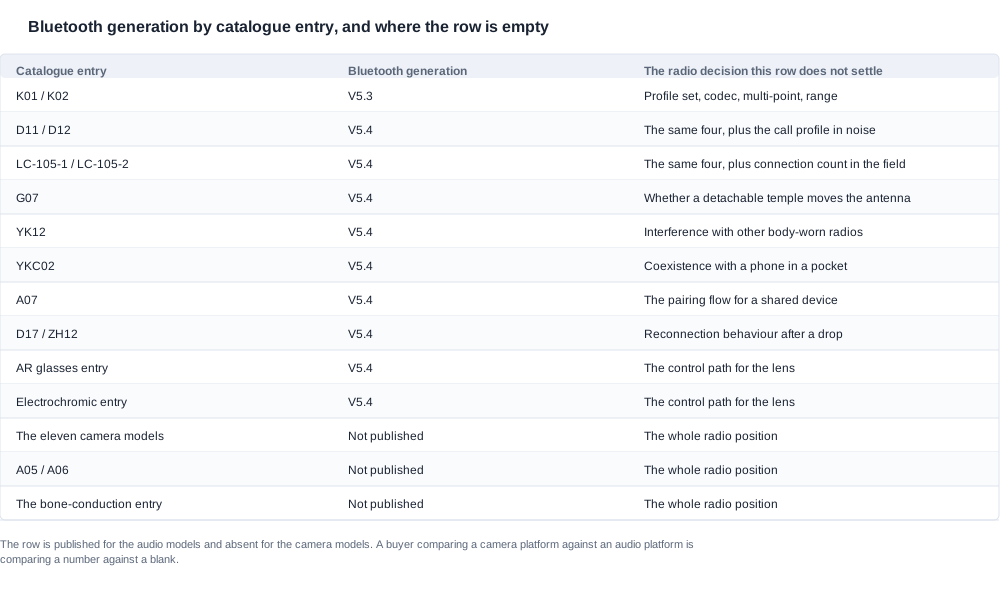
Here is the complete published Bluetooth position, with the entries where the row is empty attached to it. Read it as a map of where a buyer will have to ask, rather than as a comparison table.
| Catalogue entry | Bluetooth generation | The radio decision this row does not settle |
|---|---|---|
| K01 / K02 | V5.3 | Profile set, codec, multi-point behaviour, range |
| D11 / D12 | V5.4 | The same four, plus the call profile in noise |
| LC-105-1 / LC-105-2 | V5.4 | The same four, plus the connection count in the field |
| G07 | V5.4 | Whether a detachable temple changes the antenna position |
| YK12 | V5.4 | The same four, plus interference with other body-worn radios |
| YKC02 | V5.4 | The same four, plus coexistence with a phone in a pocket |
| A07 | V5.4 | The same four, plus the pairing flow for a shared device |
| D17 / ZH12 | V5.4 | The same four, plus the reconnection behaviour after a drop |
| AR glasses entry | V5.4 | The same four, plus the control path for the lens |
| Electrochromic glasses entry | V5.4 | The same four, plus the control path for the lens |
| The eleven camera models | Not published | The whole radio position, including the generation itself |
| A05 / A06 | Not published | The whole radio position, including the generation itself |
| The bone-conduction entry | Not published | The whole radio position, including the generation itself |
Two things fall out of this table. The first is that the audio models are well covered on the generation row, and the camera models are not covered at all — which means a buyer comparing a camera platform against an audio platform is comparing a published number against a blank. The second is that G07 is the entry where the published row is least informative, because its detachable temple is exactly the kind of mechanical change that moves an antenna, and the generation number says nothing about whether the radio still works when the temple comes off and goes back on.
The third thing is worth stating because it comes up in almost every radio discussion: a generation number is a version of a specification, not a statement about the product's radio implementation. Two products both marked V5.4 can have different antenna layouts, different transmit power settings, different default connection behaviour and different certification histories. The generation is the floor of the comparison, never the ceiling.
What a Bluetooth generation number actually settles
Used properly, the generation number settles one thing: that the product is built to a current generation of the specification rather than a legacy one. That has three commercial consequences, and they are worth separating from everything the number does not do.
The first consequence is the radio equipment compliance position. A product sold into the European Union with a radio has to satisfy the Radio Equipment Directive (EU) 2014/53/EU — the radio equipment directive, not the EMC directive, which is a separate instrument with a different number and a different scope. The generation of the specification is part of how the radio requirements are assessed, because the assessment is against the applicable harmonised standards for the technology in question, and those standards track the specification generation. A current generation makes that assessment straightforward; a legacy generation makes it a question for the compliance team rather than a formality.
The second consequence is the listing and qualification chain. A Bluetooth product that carries the Bluetooth mark has to be qualified and listed for the product, and the listing is tied to the product designation and the design. That chain has consequences at the level of change control: a mechanical change that alters the radio, a firmware change that alters the qualification, or a second model that reuses the same listing without covering it, each of which is a documentation event rather than a production event. Buyers who intend to add a colour, a region variant or a second model need to know early whether the listing travels with the first or has to be reissued for each.
The third consequence is the practical expectation about the phone. A current generation implies a current phone ecosystem, and in practice a buyer will be asked by a customer whether the product works with a recent handset, with an older handset, with a tablet, and with a laptop. The version number is the start of that answer and not the end of it.
The four questions the version number does not answer
What profiles and codecs are actually implemented. A device can be built to a current specification and still implement a narrow set of profiles. For a call-oriented product, the audio profile that carries the microphone, and the codec that carries the audio, are what decide the call experience; for a file-transfer or contact-sync product, the profile set is different again. The generation number says nothing about which of them are present. The question to ask is a list: which profiles are supported, which are enabled by default, and which are used in the product's own application.
How the device behaves when the phone is not the only radio around. A warehouse, a retail floor, a hospital ward and a vehicle all carry 2.4 GHz traffic, and the interesting failures are coexistence failures rather than range failures. What decides them is the radio's behaviour in a congested band and the antenna's performance with the product in its actual configuration. The version number is silent on all of it, and it is the question that produces the returns.
How the device behaves when it drops out. Reconnection behaviour, the time to recover, whether the audio resumes or has to be re-initiated, and what happens to a recording in progress are all product behaviours. They are also the behaviours that generate support contacts, because a customer experiences a dropout as a fault and a supplier experiences it as a normal network event. Any acceptance criterion for a radio-connected product has to name the reconnection expectation, and a buyer who has not written one will discover the supplier's default.
Whether the product can be sold into the markets the customer needs. A radio product needs a conformity route per market, and the route is not the same everywhere. The European position runs through the radio equipment directive and its supporting standards; the United States runs through FCC equipment authorisation; a large number of other markets accept one of those routes or run their own. The list of markets is a commercial decision that has to be made before the documentation is commissioned, because commissioning it late is how a launch slips.
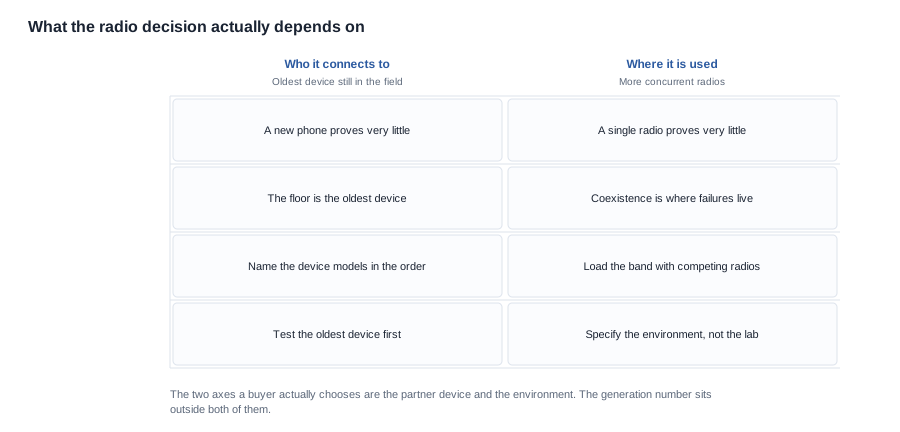

Qualifying a radio before the purchase order
Qualifying a radio does not require a laboratory. It requires a written procedure, a controlled environment and a decision about which failures matter. The sequence below is deliberately ordered so that each step eliminates a class of problems before the next one is worth running.

Step one: establish the compatibility floor, not the ceiling. Write down the handset models the customer will actually use, including the oldest one that is still in the field. The test is not whether the product connects to the newest phone; it is whether it connects to the oldest one, because that is the phone that produces the support ticket. A product that connects to everything new and fails on the oldest device in the channel is a product with a predictable return pattern.
Step two: run the coexistence test in the environment that will be sold into. Put a representative radio load around the device — a second unit, a warehouse scanner, a wifi access point, a phone hotspot — and exercise the connection while the load is running. The point is not to certify the radio; it is to find out whether the product drops the call or the file transfer in a condition that is common in the target environment.
Step three: run the dropout and reconnection test. Remove the device from range deliberately, at a stated distance and for a stated duration, and record what happens: how long before it reconnects, whether audio resumes, whether the session has to be restarted by the user. Write the result down, because this is the behaviour that will be quoted back to the supplier when a customer reports it.
Step four: check the physical configuration, not just the electronic one. For any product with a detachable or adjustable element, repeat the connection test in each configuration. For a product with a temple that can be removed, the radio has to work with the temple fitted, and if the product is sold with the temple removed, that is the configuration that has to be certified and tested. This is the step that catches the interaction between the mechanical and the electronic, and it is the step that the published row cannot help with.
Step five: get the documentation chain in writing, before the order. The qualification and listing references for the exact product, the conformity route per market, the date on which a change to the radio would require a re-listing, and the model designations the documentation covers. Ask for the reference numbers rather than the documents; a number can be checked later by a broker, a marketplace or the buyer's own compliance team, and a PDF attachment cannot.
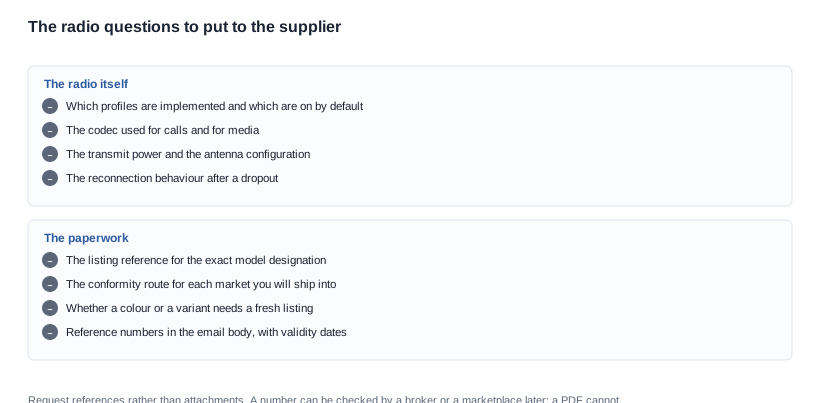
The declaration and listing steps nobody schedules
The most common schedule failure in a radio-enabled programme is not in the factory. It is the documentary chain, and it fails for a structural reason: each item waits on an identifier that has not been issued yet, and the identifier is usually requested last because it looks like an administrative step.
The order that avoids the failure is unglamorous. The model designation comes first, because the technical file, the packaging artwork, the customs description and the conformity documents all cite it. Then the market list is fixed, because the conformity route and the test scope follow from it. Then the radio documentation is commissioned, because it is the longest lead item and the one with a laboratory queue attached. Then the artwork is approved, because the label, the packaging and the manual all have to carry the same information as the file.
The listing step deserves a specific warning. A Bluetooth product that carries the mark has to be qualified and listed, and the listing is tied to the design rather than to the category. A brand that adds a colourway, a region variant, a different logo treatment or a second model to the same platform has to establish whether the existing listing covers it. A buyer who assumes that one listing covers a family of variants is the source of a documentation gap that surfaces at the border or at a marketplace review, and both are expensive and both are slow.
The compatibility failures that appear in the field, and what causes them

The compatibility failures that appear in the field
Four failures recur, and each one is a specification failure rather than a hardware fault.
The product pairs with the buyer's phone and not with the customer's. The symptom is a return cluster from one market with a description that mentions connection. The root cause is that the compatibility floor was set to the newest device rather than the oldest one still in the channel. The prevention is to write the floor into the order as a list of named device models, and to test the oldest of them.
The call drops in a busy environment and the supplier calls it normal. The symptom is that the product works in the buyer's own office and fails in the customer's warehouse. The root cause is that the coexistence test was never run in a loaded band. The prevention is to specify the environment and the competing radio load as part of the acceptance test.
The connection is fine until the temple comes off. The symptom is an intermittent fault on one product variant, with the pattern that it correlates with how the unit was assembled or adjusted. The root cause is that the radio was qualified in one mechanical configuration and the product is sold in another. The prevention is to make the shipped configuration part of the radio qualification request, and to test each configuration separately.
The product is documented, but the documentation names a different variant. The symptom is a customs query or a marketplace rejection rather than a technical failure. The root cause is that a family-level listing was treated as coverage for a branded configuration. The prevention is to make the exact model designation a condition of the purchase order and to check the string on the units on receipt.
A shortlist built on the radio, not on the version
The practical output of everything above is a way to shortlist, and it is worth writing it down because most shortlists in this category are built on the published row by default. A radio-led shortlist has three filters, and none of them is the version number.
The first filter is the partner device. Before any product is compared, the buyer writes down the handset models and operating systems the customer's fleet actually contains, with the oldest one flagged. Any candidate that cannot be tested against that floor is removed, and the removal is cheap because the floor is a list the buyer wrote, not a judgement about a supplier.
The second filter is the environment. The buyer names the physical radio load of the target application, and any candidate that has not been tested in a comparable load is removed for the same reason: the absence of a test is itself a decision, and it is an expensive one. A buyer who cannot test in the customer's environment can at least require a documented test in a comparable one.
The third filter is the documentation chain. A candidate whose listing reference, conformity route and change-control position have not been confirmed in writing is not eliminated, but it is moved behind every candidate that has, because an unconfirmed document is a schedule risk that no product advantage compensates for.
What remains after the three filters is a shortlist built on things the buyer can verify, and the version number appears in it only as a sanity check that the radio is current. That is the correct place for it: a floor check, applied last, on a list that was built for other reasons.
What we can answer on connectivity, and what we cannot
We publish the Bluetooth generation for fourteen of the twenty-eight entries in our catalogue, and the table in this article is the complete list. Where the row is published it is a floor rather than a ceiling: it says the product is built to a current generation of the specification, and it says nothing about the profile set, the codec, the antenna, the transmit power, the coexistence behaviour or the reconnection behaviour. We do not publish a range figure for any model, because we do not hold one that has been measured in a way we would stand behind.
We also do not publish the radio documentation references per model, and we would rather say that than publish a family-level reference that does not cover the variant a buyer is ordering. The productive route is to ask for the references for the exact model designation, with the issuing body and the validity dates, in the body of the email rather than as an attachment.
What we will do on request is confirm which configurations exist, walk through the published rows for the models under consideration, and tell you where the catalogue is silent so that you can ask the right question of the supplier. If the requirement is a compatibility floor, a coexistence condition or a market list, the right next step is to write each of them as a line in the order and ask a supplier to be measured against it. The Bluetooth connectivity technology page sets out the published position, the Bluetooth SIG compliance page is where the conformity route is documented, and the Bluetooth procurement checklist is the short form of the procedure above.


