

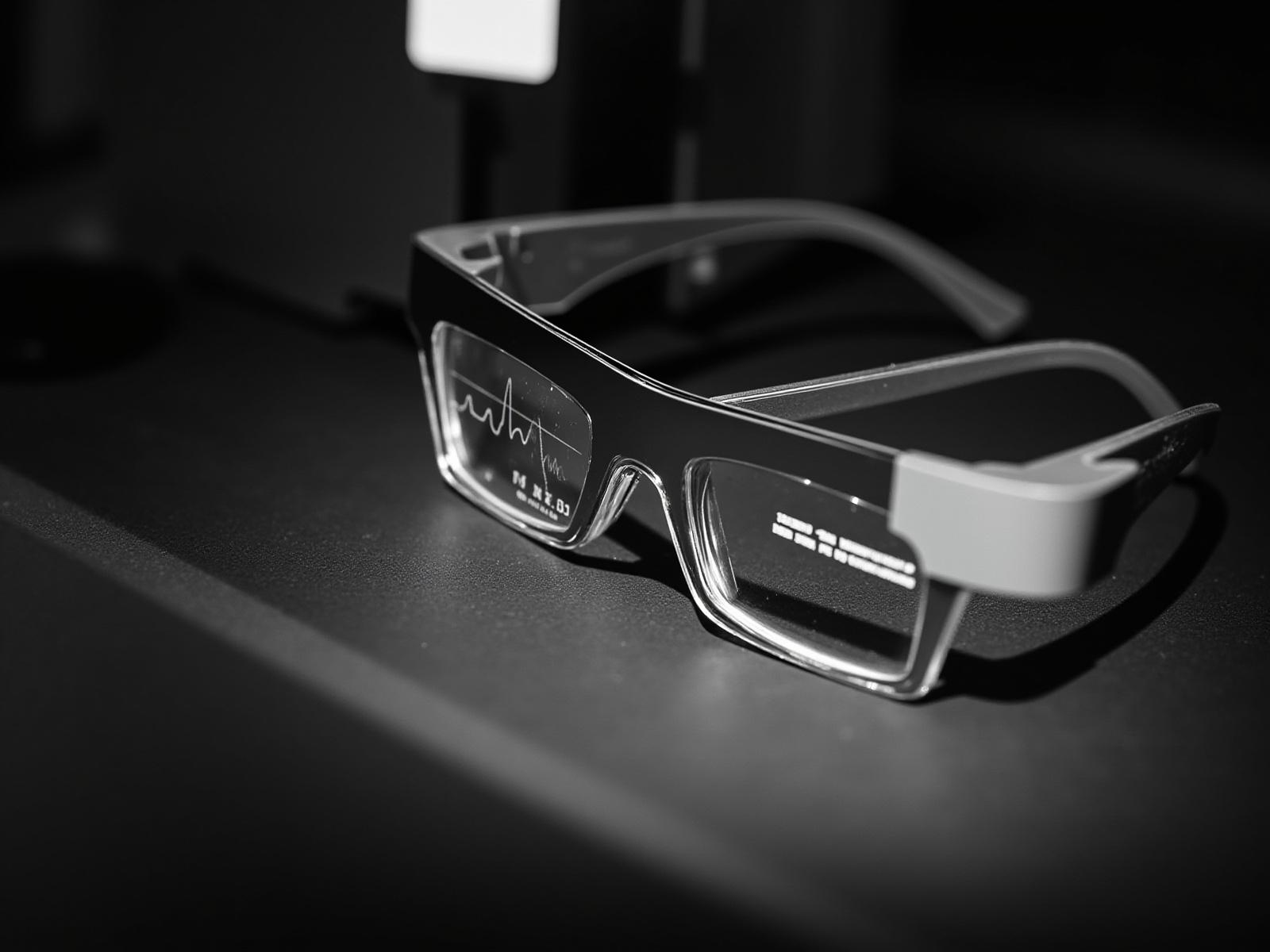
A Bluetooth spec sheet is short, and the shortness is misleading, because the rows it does contain are the ones that are easy to state and not the ones that determine whether the product works for a given buyer. The generation number is a fact about a radio module, and in our published catalogue it tracks no product difference at all. The rows that decide a purchase are the ones the sheet does not carry: the profile list, the codec list, the transmit power, the antenna configuration, the connected-device behaviour and the firmware release policy. There is a second gap that is easy to miss, and it is specific to this catalogue: the radio row is published for fourteen entries and left empty for fourteen, including all eleven camera models.
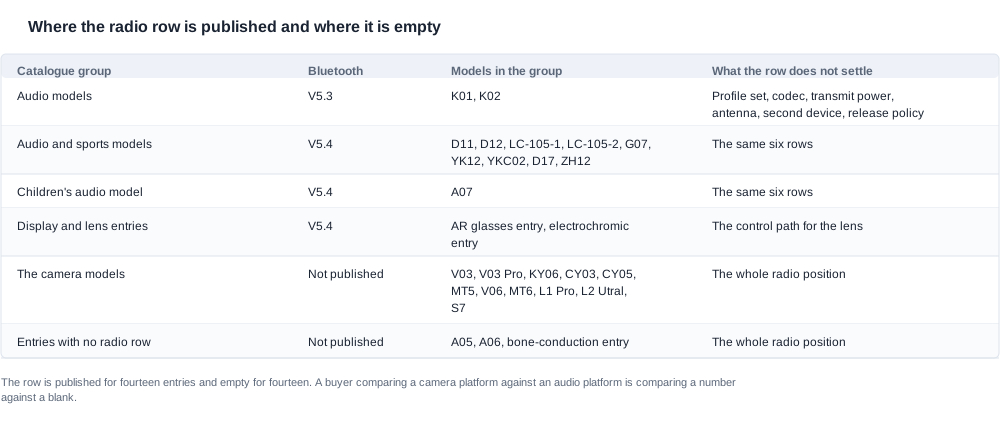
Smart glasses Bluetooth version: module, not a product
What the row tells a buyer, and what it does not
The published position in our range is Bluetooth 5.3 on the K01 and the K02, and 5.4 on the D11, the LC-105-1, the D12, the G07, the LC-105-2, the YK12, the YKC02, the D17, the ZH12, the A07, the display entry and the electrochromic entry. That is the whole Bluetooth content of a spec sheet for a smart glasses product, and it tells a buyer almost nothing about compatibility.
What it does settle is the protocol generation of the module. What it does not settle is whether the product will work in the environment it is sold into, and the reason is structural rather than an omission in the document: the radio is one component in an assembly where the antenna has to coexist with a cell, a board, a metal camera module in the camera tier, and a frame whose geometry the industrial design team chose for reasons of appearance.
A buyer who treats the generation as a compatibility signal is therefore reading a component specification as a system behaviour. The two are related, but the relationship runs through six rows that no consumer-facing sheet publishes.
The buying task behind the version question
The reader is usually a brand-side product owner or a channel buyer who has to answer a compatibility question for somebody else — a retailer's technical team, a marketplace's listing reviewer, a customer's IT department, or in a fleet case, an operations manager who has to know what happens when a device meets an old phone in a customer's pocket.
The fear is specific and it is rarely about the version. The first is a product that will not hold a call with the host device it is actually sold alongside. The second is a range that behaves differently after a firmware update, with no notice and no policy, discovered by the customer rather than by the brand. The third is a document that names a family rather than the model that shipped, which surfaces at a customs query or a marketplace rejection.
All three are cheap to prevent at the quotation stage, because they are questions rather than tests. The first is a question about the profile list. The second is a question about the release policy. The third is a question about the exact model designation on the conformity documents.
Where the radio row is published, and where it is empty
The camera tier, and what an empty row means
Eleven of the twenty-eight entries in our catalogue carry no published Bluetooth row at all, and they are the eleven camera models. This is not a quality judgement and it is not a gap in the product; it is an absence of information, and the practical consequence is that a buyer comparing a camera platform against an audio platform is comparing a number against a blank.
That matters more than it sounds, because the camera tier is where the radio has the least room. A camera module is a metal assembly close to the temple, and the antenna in that tier has to be designed around it. Two products with the same published generation can behave very differently at the edge of range for exactly that reason, and the buyer who cannot read the generation for the camera models cannot read anything.
The correct handling of an empty row is to treat it as unknown and to request the answer. Asking a supplier which radio is fitted to the model you intend to order is a normal question, it takes one email, and the answer is a row the buyer can use.
The designation rows, and the ambiguity in them
One row on a spec sheet is more valuable than it appears, and it is the row that carries the model designation the other documents refer to. Our own catalogue carries an entry listed as L2 Utral, with a note that "Utral" appears to be a typographical rendering of "Ultra", and a further designation of Utral Pro Max whose meaning is not published. That is exactly the kind of ambiguity that a document-level check catches and a product page never does, because a page has no place to record it.
Where a range holds several models with similar names, comparing the designation on the conformity document against the designation on the order, character by character, is the step that catches a substitution. A mismatch is a stop condition rather than a query.
What the regulatory position adds, and where it sits
The regulatory position is rarely stated on a Bluetooth spec sheet, and it is usually worth more than everything else on the page. In the European Union the Radio Equipment Directive (EU) 2014/53/EU applies with the EN 18031 harmonised standards cited into it, and a product with a microphone and an application falls into the personal-data category as well as the radio category. The United Kingdom applies UKCA with a framework that does not track the European one automatically. The United States applies FCC equipment authorisation, which is a different route with a different evidence set.
Bluetooth qualification is a third thing again, and it is the one most often assumed to be the same as either of the others. A product that has been qualified against the Bluetooth specification has not thereby been placed on a market, and a product that is lawful in one market has not thereby been qualified. The three routes have separate evidence, separate owners and separate renewal cycles.
The six radio rows a spec sheet never shows
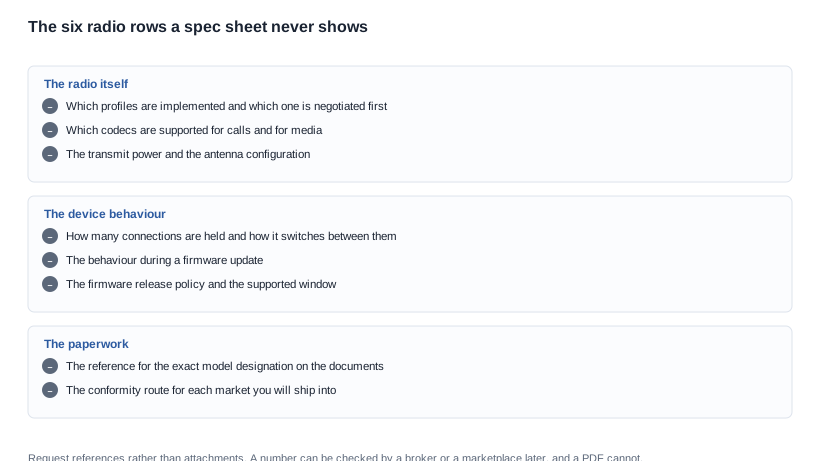
The profile list, and which profile is negotiated first. This is the row that decides the microphone path in a call, and therefore decides whether the product works for calls at all. A device that supports a stereo profile and a hands-free profile, and that negotiates the hands-free one by default, behaves very differently from one that negotiates stereo, because the hands-free profile is the one that carries a microphone.
The codec list. Codecs determine what happens to the audio in a lossy environment, and a product with no codec support presents as poor quality rather than as a failure to connect. The question that matters commercially is which codec is used for calls and which for media, because they are frequently not the same.
The transmit power. One of the two numbers that determine range, and the number a buyer is most likely to assume the generation provides. The generation is a protocol version, not a power setting.
The antenna configuration. The other half of the range equation, and the one that varies with the frame design, because an antenna in a temple has to coexist with a cell, a board and, in the camera tier, a metal module.
The connected-device behaviour. How many connections the product holds, how it switches between them, and whether the volume is stored per device or globally. A product with two connections and one volume register overwrites the first setting every time it switches, and a buyer who deploys one to a customer carrying a phone and a tablet will find this in week one.
The firmware release policy. The version a customer experiences is determined by the firmware, and a product with no stated policy is a product whose behaviour can change without notice. The policy row is also the one that tells a buyer whether an update is a scheduled event or an incident.
The questions to ask a supplier about the radio
- Which profiles are implemented, and which one is negotiated by default?
- Which codec is used for calls, and which one for media?
- What is the transmit power, and what is the antenna configuration in this frame?
- What is the minimum host version, and what does the product do at that version?
- How many connections are held, how does it switch, and is the volume stored per device?
- What is the firmware release policy, and what notice is given before a change?
- What is the behaviour during an update, and can the product be used while it runs?
- Which exact model designations appear on the conformity documents and on the qualification?
- How is the radio configuration reset when a device leaves a user?
The first three decide whether the product works in the environment, the next three decide what a customer experiences over a year, and the last three decide what a buyer can file and what a fleet can recover. Asking all nine in the first round is how a buyer finds out which quotation is complete, and it costs one email.

From a version string to a radio record you can file

The verification path is short, and each step assumes the one before it passed. A failure at any point tells you what the next point would have told you, which is why the order matters.
- Ask which exact model designations the documents name. A document that names a family does not cover a variant, and this is the failure that the simplicity of the spec sheet encourages, because a one-line version row looks like a complete radio answer.
- Resolve each reference in the issuing body's own register. Request the reference rather than the attachment. A number can be checked later by a broker, a marketplace or a compliance reviewer; a PDF cannot.
- Establish the minimum host version the product supports, and the behaviour at that version. A useful answer names the floor rather than the ceiling, because the floor is what a customer with an older phone will experience.
- Test the oldest device still in the channel, not the newest. A new host proves very little. The device that has been in a customer's pocket for three years is the one that decides whether returns come back.
- Test a second device and watch the connection and the volume. This is a five-minute test that closes two rows at once, and it is the one a buyer is most likely to skip because it is easy to postpone.
- File the references with the model, the body and the dates. The file is the asset; the version string is a label on it.
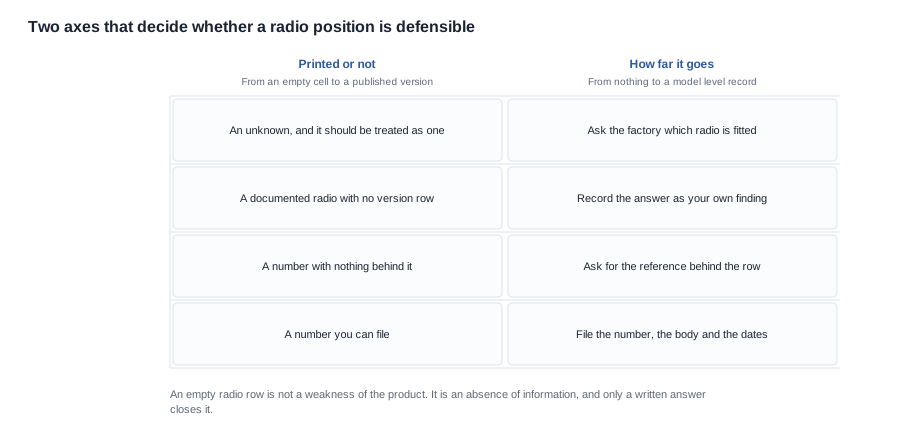
The matrix above is the shortest form of the whole argument. A radio position is defensible when the row is present and the evidence reaches model level. It is not defensible when the row is present and nothing sits behind it, and it is not a weak position when the row is absent and a written answer has been obtained: that is a row you closed yourself.
What a fleet deployment needs that the spec sheet does not carry
A single-unit sale and a fleet deployment have different radio questions, and the difference is not the hardware. A single-unit buyer asks whether the product will connect. A fleet buyer asks what happens when it does not, and what happens when the device is updated at three hundred sites without anybody watching.
Three rows matter more in a fleet than anywhere else. The connected-device behaviour, because field staff carry a work phone and sometimes a personal one, and the switch between them has to be predictable. The firmware release policy, because an update that a customer experiences as a change in behaviour is a support event, and a policy that gives notice turns it into a scheduled task. And the behaviour during an update itself, which decides whether a site can update a device while it is in use or has to be taken out of service.
There is a fourth row that is not a radio row at all and is often forgotten: how a device is recovered and reset when it leaves a user. In a fleet, a product that cannot be returned to a known state is a product that leaves your channel, and the radio configuration is part of that state.
The reason the radio file is worth building properly, rather than treating the version row as the whole answer, is that it is a procurement artefact with a shelf life. The generation number does not change while the file does: profiles, codecs and the release policy all move as the product is maintained, and a file assembled once at the quotation stage goes out of date without anybody noticing. A radio file that carries a date and an owner can be re-checked when the product changes, and one that does not is re-read at the point where it is already wrong.
A worked example: a brand deploying a connected product to a field team
The worked example here is a constructed scenario rather than a client project; it sets out the decision order rather than describing an outcome.
Assume a brand supplying a connected product to a logistics operator who will roll it out across three hundred depots. The binding constraint is that the operator's own devices are old, and the brand's marketing says the product works with any recent phone.
The floor is established before the ceiling. The brand asks for the minimum supported host version and the behaviour at that version, and then asks the operator which devices are actually in the depots. The oldest one is three years old, and it is at the floor but not below it. That is the answer that matters, and it is not the one the marketing page was written for.
The profile question is asked first. The product makes calls, and the operator's depots are loud. The brand asks which profile is negotiated by default and which codec is used for calls, and adds a test with a radio microphone at distance in the depot environment.
The two-device behaviour is tested with the operator's own configuration. Staff carry a work phone and a personal one. The test settles the switch behaviour and the volume behaviour, and the answer becomes a line in the operator's training material.
The update behaviour is written into the service agreement. A scheduled window, a notice period, and a statement of what the device does during an update. The operator can then plan maintenance rather than discovering incidents.
The reset path is specified. How a device is returned to a known state when it leaves a user, including the radio configuration, and what the operator's IT team does with it.
The result is a rollout that the operator can plan and the brand can support, with three rows that would otherwise have been discovered at three hundred sites. The decisive decision was the floor, and it took one question.
Our published position on the radio
Stated plainly: we publish the Bluetooth generation accurately for each model, and we will not present it as a quality indicator, because in our published data it tracks no product difference at all. The spec sheet is a summary of a radio, and a summary is what it is for.
It cannot tell you that the product is lawful in a destination market, because market position comes from the module, the antenna and the declarations behind the exact model rather than from the version string. Nor can it tell you that the documentation covers your unit, because a document that names a family does not name a variant. We would rather state plainly what a version row cannot settle than let it stand in for a file that does not exist.
The rows we do publish are the generation for the fourteen entries that carry it, and the model designation as the catalogue states it, including the entries where the designation itself is ambiguous. The rows we do not publish are the profile list, the codec list, the transmit power, the antenna configuration, the connected-device behaviour and the firmware release policy, for every model in the range. We will not estimate them, and we will not convert a generation into a compatibility claim.
The version number is the easy part of the radio file. The parts that are hard are the ones a spec sheet never shows: the profile list, the codec list, the transmit power, the antenna configuration and the release policy. Those are the rows that decide what the radio can actually do, and none of them appears on a consumer-facing sheet. If a file needs them, ask for them explicitly and ask whose document each answer comes from, because the source of each one tells you as much about the supplier as the value does. We will tell you plainly which we hold and which have to come from the engineering team.
If you are evaluating this category, send us the models, the host devices your channel uses and the deployment shape, and we will tell you which rows of the radio file are published, which are open, and which of the open rows a sample and a document request could close. The background is under Bluetooth connectivity and versions, the recurring questions are collected in Bluetooth version what buyers ask most, the shortlist method is in Bluetooth version procurement checklist, and the qualification route is under Bluetooth SIG compliance.
Related reading
- Bluetooth connectivity and versions
- Bluetooth version what buyers ask most
- Bluetooth version procurement checklist
- Bluetooth SIG compliance
Ask for the profile list, the codec list, the transmit power and the release policy, and we will tell you which we can answer directly.


