
Camera claims from manufacturers in this category are unusually easy to write and unusually hard to compare, and the reason sits in the published data rather than in the suppliers' honesty. The camera tier publishes two resolution tiers and almost nothing else about the imaging: eight megapixels on the CY05 and the V03 Pro, the MT5 and the KY06, and the V06 and the V03, and the CY03 and the MT6, and thirteen megapixels on the L1 Pro and the S7, and the L2 Utral. The sensor model, the field of view, the video resolution and frame rate, the stabilisation, the low-light behaviour and the storage format are Not published for every model, and no third-party measurement supports any of them.
That position makes this category's claims unusually load-bearing. Where a buyer has published figures to check against, a supplier's claim can be verified by comparison. Where the figures are absent, a claim can only be verified by asking, by measuring, or by not repeating it. So smart glasses camera technology smart glasses manufacturer claims is a question about which of the standard camera claims can be substantiated at all, which have to be earned with a sample, and which should never appear in a listing — plus the harder question of what a buyer inherits when it copies a manufacturer's wording.
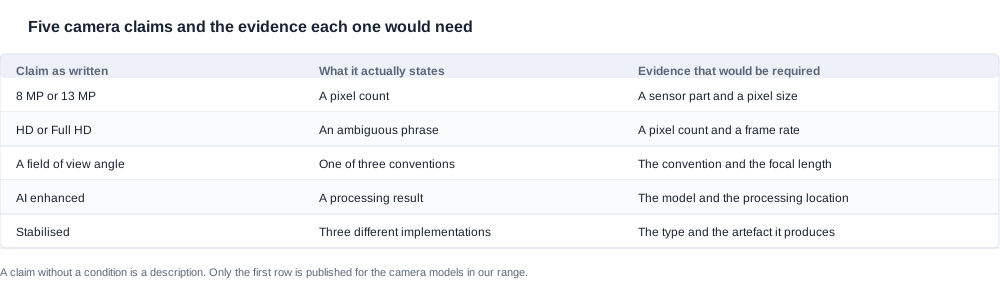
Smart glasses camera technology: five claims and the evidence each one needs
Claim one: the resolution, stated as a pixel count
This is the only camera claim in our range that is published, and it is worth exactly what it says: how many pixels the sensor can record. It does not state pixel size, light gathering or low-light behaviour, and a thirteen-megapixel sensor built from small pixels can be worse in poor light than an eight-megapixel sensor built from large ones. Used as a tier label on a price ladder it is sound. Used as a quality statement it is a claim with no measurement behind it, and it is the claim most often repeated by buyers who have taken it from a supplier's page without asking what it means.
The evidence that would upgrade it: the sensor part number and the pixel size. A supplier who will give those two has a measurement infrastructure behind the camera.
Claim two: HD or Full HD with no pixel count
The phrase is ambiguous in a way that serves the seller rather than the buyer, because it describes a category rather than a figure and the categories are not defined consistently between suppliers. It is not one of the published figures in our range, and it says nothing at all about whether the product records video or only stills. The evidence that would upgrade it: a pixel count with the video rows attached, so that the still path and the video path are separated rather than merged into one adjective.
Claim three: a field of view without a convention
Diagonal, horizontal and vertical are not interchangeable, and a horizontal 90 degrees is a diagonal of roughly 110 degrees. A claim that omits the convention cannot be compared with anything, including with the same manufacturer's other model. The evidence that would upgrade it: the convention, the focal length, and a statement of whether the figure describes the module or the assembled product, because the frame's own geometry occludes part of the scene.
Claim four: AI enhanced or AI image enhancement
This describes a processing result rather than a capture specification. The images do look different, and the raw capture is what the customer has. Our catalogue names an AI voice assistant as a key technology of the camera tier and publishes nothing about which models run, whether the processing is on the device or in a service, or whether a subscription is attached, so this claim cannot be evaluated from anything we hold. The evidence that would upgrade it: the model, where it runs, and what it does to the image.
Claim five: stabilised
Optical, electronic and software stabilisation are three different implementations with three different artefacts, and a camera carried on the head moves in ways a handheld phone camera does not. The word is three characters long and carries no information at all. The evidence that would upgrade it: the type, and the artefact it produces.
A sixth that belongs to the electrical block rather than the imaging block
A weight. Our catalogue publishes a unit weight for one model in the entire range, the MT6 at 158 g, and that is the glasses body including the battery and the camera and excluding the foldable charging case, whose capacity is published at 1200 mAh and whose weight is not published. Every other camera model needs its figure requested. A manufacturer claim about a light frame is therefore a claim a buyer can only accept for the model it was measured on, and the six words that carry the boundary of the figure are the part that matters most.
Separating a description from a measurement
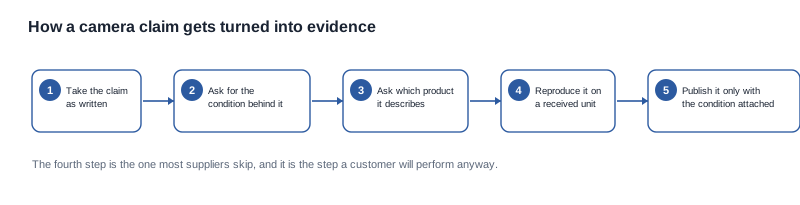
The single test that resolves most of these claims is whether the figure carries the condition it was produced under. A measurement has a scene, a method, a configuration and a boundary. A description has a word.
The four conditions a measurement must carry
The condition. A field of view measured on a bench has a distance and a target; a low-light figure has a lux level; a resolution has a crop and an output size; a runtime has a duty cycle. A number without its condition cannot be reproduced and therefore cannot be relied on.
The method. What was done, in what order, by whom. A method is what lets a second party repeat the measurement, and it is also what lets a buyer compare two suppliers' figures at all, because two numbers produced by different methods are not comparable even when they look alike.
The configuration. Which model, which lens, which firmware, which unit. A figure for one configuration is not a figure for the family, and a camera programme that changes configuration changes its figures.
The boundary. What the figure includes and what it excludes. The MT6's 158 g includes the battery and the camera and excludes the foldable case, and a reader who assumes otherwise will build a shipping carton for the wrong object.
The four answer shapes a supplier gives
A supplier's answer in this category arrives in one of four shapes, and they are easy to separate once you know what to look for.
A measurement, with the condition attached. This is the answer that can go into an agreement and be checked on an incoming unit.
A specification, which states what the product does without saying how it was established. This is usable for a configuration row, because a specification is a commitment rather than a measurement. It is not usable as evidence for a comparison.
A description, which uses an adjective where a number is required. It tells a buyer that the manufacturer considers the property important, and nothing else.
An assertion, which confirms that the claim holds. This is the shape that most often turns out to be a figure for a different configuration.
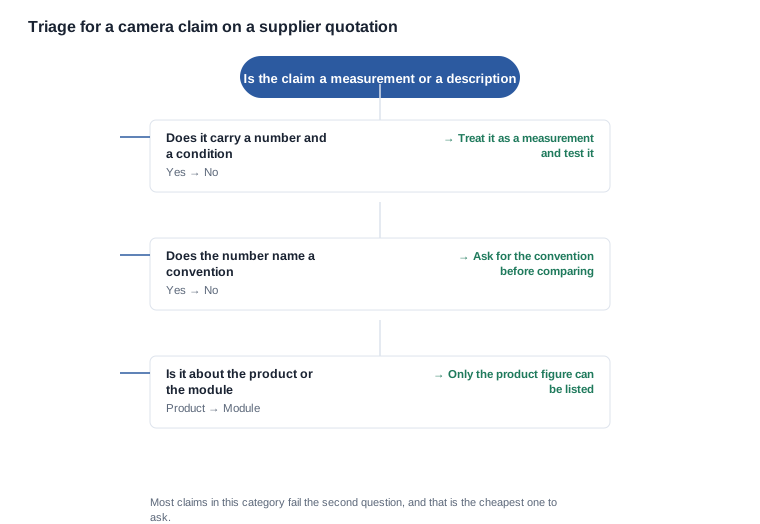
A hypothetical claim triage on two supplier quotations
This is a hypothetical case rather than a client project, and it shows the triage working on two documents that look superficially similar.
Two suppliers have quoted two camera-glasses platforms for the same requirement. Both quotations describe their camera as high resolution, and both include a field of view figure, and both mention image stabilisation. A third line in each quotation says AI enhanced, and one of them also states a battery figure and a unit weight.
The triage starts by separating the electrical rows from the imaging rows, because they behave differently. The battery figure and the unit weight in the second quotation are checkable against our own published rows, and one of them does not match: the weight quoted is described as the frame weight and the configuration quoted is not the MT6, so the figure belongs to a different model or a different definition. That single check removes the claim from the shortlist, and it takes two minutes.
The two high-resolution lines are then compared against the published tiers. One supplier's figure matches a published tier for the configuration quoted; the other does not, and the difference is that the second quotation is quoting the still-capture path while describing a video product. The tier can be used to place the model on the price ladder, and the gap between the tier and the video rows is now a specific question rather than a general doubt.
The two field-of-view figures are then read for their convention, and only one carries it. The figure without a convention goes back as a question rather than into the comparison table, and the comparison is rebuilt once it is answered.
The stabilisation line is the same in both quotations, and neither names a type, so it goes back twice. The AI line goes back as well, because nothing in either document says what the processing does.
What survives the triage is much thinner than what arrived: a resolution tier that can be used for pricing, a field of view with a convention, a cell configuration that can be checked against the published electrical rows, and a list of seven claims that remain unsubstantiated. That thinner list is the honest one, and it is the list the sample test has to work against.
The four questions that force a claim to be substantiated
- Which of these figures come from a measurement, and which are descriptive? The distinction is worth asking for explicitly, because the answer is frequently that the field of view is descriptive and the resolution is a specification.
- What is the measurement condition for the quoted figure? A claim without a condition is not a measurement, and this is the cheapest question in the category to ask.
- Is the claim about the product or about the component? A sensor's field of view and a product's usable field of view are different numbers, because the frame occludes part of the scene.
- Can the claim be reproduced on a received unit? This is the practical test of every claim in the list, and it is the test a customer will perform whether or not the buyer performs it first.
The two questions that go one level deeper
What is the boundary of the figure? For a weight, what is included and what is excluded. For a runtime, what duty cycle. For an angle, which convention. This is where the most expensive claims hide, because the boundary is the part that is dropped when a figure travels from a document into a listing.
What happens to the claim if the configuration changes? A claim tied to a configuration is a commitment; a claim tied to a family is an aspiration. In a camera programme the configuration is exactly what moves, so this question is worth more here than in most categories.
The checklist to run on any camera claim before it is accepted
- Does it carry a number rather than an adjective.
- Does the number carry a condition — a convention, a method, a scene, a configuration.
- Does it carry a boundary that says what is included and what is excluded.
- Is it about the shipped configuration rather than the module or the family.
- Is it in our own published rows, and if not, is it obtainable in writing before the order.
- Can it be reproduced on a received unit, and if not, is it a claim the listing should not carry.
Where a buyer's own copy inherits a liability
A buyer who repeats a manufacturer's wording inherits it. This is not a theoretical risk: the claim on the page becomes the claim the customer holds the brand to, and the brand is the party the customer will come back to. The supplier's wording is not a defence, and in most commercial relationships it is not even a term of the agreement.
The four places a camera claim usually leaks
Repeating a manufacturer's wording without knowing whether it is a measurement or a description. The description is inherited with the same apparent authority as a figure, and the customer cannot tell the difference either.
Quoting a resolution as though it described quality. It does not, and a customer who knows the hierarchy will notice, which is worse than the customer who does not.
Using a field of view figure taken from a component specification. The frame's occlusion is not in it, and the product will not reproduce it.
Publishing an AI-enhanced claim without saying what the enhancement is. It is a processing claim and it needs the same condition as any other, which means naming the model, the location and the effect.
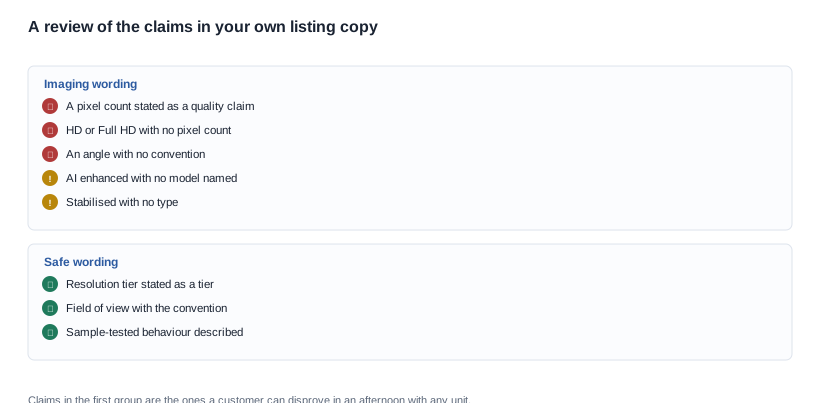
The wording that survives review
A claim that names its own limits is defensible even when it is modest. A resolution tier stated as a tier, an angle stated with its convention and its boundary, and a behaviour described as observed on a sample are all statements a buyer can hold. The risk in this category is not that the product is worse than the claim; it is that the claim is better than the product, and that the gap is discovered by a customer who bought on the wording rather than on the device.
The claim register, and why it is a procurement document
The most reliable way to stop a claim drifting is to write the claims down once and refer to that document everywhere else. A claim register is a small table with one row per claim: the exact wording, the source it came from, the condition that applies to it, the configuration it applies to, and where it has been published. It is a procurement document rather than a marketing one, because it decides which claims can go on a listing, which are conditional, and which are still open.
The register earns its keep in three places. At the configuration stage it becomes the basis of the sample test, because each open row needs a specific measurement rather than a general look. At the artwork stage it becomes the source of the copy, so the packaging cannot drift from the listing. At the review stage it becomes the evidence, because a claim with a recorded condition can be defended in a way that a sentence remembered from a supplier's email cannot.
The criteria for what enters the register are simple. It has to have a source, a condition, a configuration and a status. A claim without a source is an opinion, and an opinion that reaches a listing becomes a promise.
The review that happens before the artwork is approved
Artwork approval is the last practical moment to catch a drifted claim, and it is worth treating as a gate rather than as a formality. The check is short: take every imaging word on the artwork, find it in the register, and confirm that the register row is still valid for the configuration being produced. Three failures account for most of what turns up. A claim that was in the register as open has been written as if it were confirmed. A claim that was approved for the internal listing has been given a stronger word for the external packaging. And a claim that was written for one model has been applied to another because the artwork covers a family.
The register is also what makes a channel conversation tractable. When a distributor asks for substantiation of a claim, the answer is a row in a table with a condition attached, rather than an argument conducted from memory.
How the wording gets decided
The practical answer is that the claim list is written once, at the configuration stage, by the people who have the rows, and it is then reused verbatim across the listing, the packaging artwork, the channel brief and the support script. A claim that is re-written for each surface eventually acquires the strongest version of itself, because each rewrite is an opportunity to say more. The procurement-form checklist at the camera procurement checklist is the place to record the approved claim list, so that the constraint survives the marketing process rather than depending on it.
What we will not print on a camera listing
It is worth being precise: we publish the 8 MP and 13 MP resolution tiers and the electrical rows because they are figures taken from the catalogue, and we will not let a resolution figure turn into a quality claim on a listing, because the evidence that would separate the two is Not published to us. The number a manufacturer prints describes the part; the sentence a buyer remembers makes a promise; only one of the two belongs in a product description that a customer will hold us to.
We will also be direct that most of the camera claims in this category cannot be compared from published data at all, and that the only honest comparison is one the buyer runs on samples. The camera procurement checklist sets out the criteria to write before those samples arrive, the camera red flags to watch for page covers the claims that should stop a shortlist, the camera datasheet reading method page covers how to read a supplier sheet, and the what the spec sheet does not tell you page covers the rows that are missing from ours. The imaging rows are at AI camera glasses imaging.
If you tell us the model and the use case, we will tell you which of the five claims to chase, which one can be carried on a listing as it stands, and which one has to be closed on a sample before it goes anywhere near a customer.
Related reading


